

The list of Mozart’s compositions in his final year (he died aged thirty-six) is quite extraordinary. For major works there were two operas, including The Magic Flute; the Clarinet Concerto (K. 622); Piano Concerto 27 (K. 595); the String Quintet in E Flat major (K. 614); and a fragment of another string quintet. He also produced some thirty-seven dances, two organ works, two Masonic pieces, the Ave Verum Corpus, a Kyrie, the incomplete Requiem, the Horn Concerto in D major (K. 412, unfinished); and the Adagio for Glass Harmonica.
Despite the Turkish war that had depressed concert going in the late 1780s, Vienna in 1791 was seen by later generations as a musical paradise, when several of the wealthiest houses still had their own orchestras. Many private orchestras were disbanded over the next twenty years, thanks to inflation. Nobles with their own orchestras were important patrons of Haydn; a generation later, Beethoven’s patron had a quartet. So Mozart was living in a time of plenty.
Mozart had been made a court composer in 1787, but only so that he would not make his money abroad, and this patronage was more stifling than enabling. As H.C. Robbins Landon points out, there is a split between the very minor and very major works of Mozart’s last year. In the first three months of 1791, Mozart composed almost entirely minor pieces (plus the piano concerto): as Landon says, it was a criminal waste of his talent, a shocking negligence on the part of the court who employed him. Of a receipt for some songs and dances, Mozart himself said, “too much for what I did, too little for what I could do.”
Little could hold Mozart back, though. Mozart’s music wasn’t especially popular at court (Joseph II notoriously said it had “too many notes”) but that didn’t prevent it from being played, by Landon’s estimate, almost every day in the two week coronation celebrations. Most significantly, Mozart composed an opera for a coronation. Tito was said by an earlier biographer to have been written in eighteen days, partly during a coach journey. Modern estimates suggest six weeks. Landon thinks eighteen days is closer to the truth. Either way, Mozart’s compositional fluency is almost unimaginable.
In the second half of the year, Mozart was “chronically overworked”, making progress on The Magic Flute before Tito was done, then moving on to the clarinet concerto, starting the Requiem as soon as he finished. He almost never stopped thinking about music. One of his methods of composition was to play billiards. Mozart hummed while he played, then while others took their shots he made notes.
Mozart’s relative isolation at court led to his breakthrough with The Magic Flute. When his librettist partner was dismissed, he began a new collaboration. One account reports that Mozart worked so dizzyingly hard on that opera that “when genius gripped him, day and night were interchangeable.” He often fainted, remaining unconscious for several minutes. The Requiem was written in under a month, not especially fast work for Mozart, who wrote the “Linz” Symphony (K. 425) in five days in 1788, and all three of symphonies 39-41, some of his best work, in ten weeks.
We don’t know what killed Mozart. There is no evidence. That’s why well over a hundred theories have been put forward. Pushkin and Shaffer wrote plays about Salieri poisoning Mozart, but that is little more than nineteenth century gossip. These stories make good dramas, but they don’t help us to understand how Mozart composed as much, and as well, as he did.
H. C. Robbins Landon’s book 1791 Mozart’s Last Year shows that patronage was restrictive whereas the market for compositions (especially opera and concertos) gave Mozart creative freedom; it was beneficial to change collaborators; and that Mozart was not just gifted but obsessed, working so hard he blacked out.
When Mozart died another composer said, “Of course it’s too bad about such a great genius, but it’s good for us that he’s dead. Because if he had lived longer, really the world would not have given a single piece of bread for our compositions.”
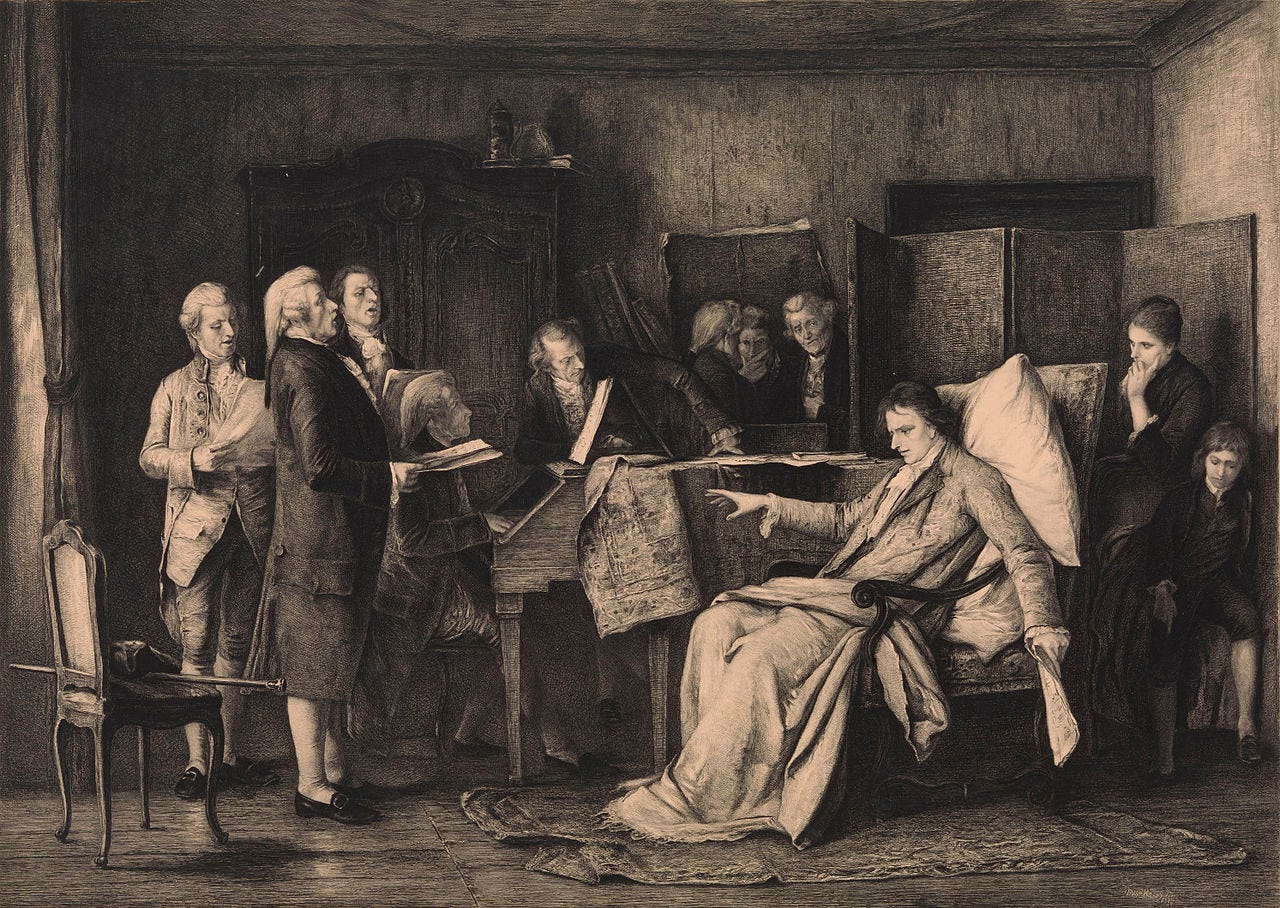
Why Mozart's health deteriorated ? There is one theory: Mozart travelled extensively and in his time travelling meant with horse carriage, the roads were in poor condtions. Hence the carriage was subjected to frequent shocks. Apparently it affected seriously his kidneys and that proved to be fatal.