

A.A. Milne was a buttoned-up old thing. In order not to be bored, he needed nothing more than a pencil and some paper, and he felt more at home with crosswords, puzzles, and maths games than with the holiness of the heart’s affections. That’s the impression one takes away from Ann Thwaite’s charming, absorbing, and thorough life of Milne—that he was, like many another writer, a little chillier than the idea we might form of him from loving his most famous book, the now centenarian Winnie-the-Pooh.
Milne’s ambitions were to write humour for adults—he was one of Punch’s leading humorists—as well as plays. He also produced a very good detective story. But reading Milne’s adult works now is more a chore than a pleasure, done from the interest of knowing more about the man who wrote Winnie-the-Pooh—done indeed in the expectation that such a writer must surely be as enchanting elsewhere as he was in the Hundred Acre Wood. Alas, Milne’s closeted heart only glowed deep in the forest of childhood. His other work now feels mannered, glib, and of period interest. It is the quest of the little bear and his boy that has lived on.
Those years were suffused with golden light for children’s literature. The Railway Children (1906), The Wind in the Willows (1908), The Secret Garden (1911), Peter and Wendy (1911). This world is still greatly alive in our imaginations. We can still step back into its charms, eccentricities, and Arcadian simplicities. Who does not know Ratty and Toad and the Mole? Who does not remember discovering the secret garden? Pooh belongs to this precious collection of stories, a little world away from the world, in which a stuffed bear who loves honey and a timid little pig can toddle off together into the sunset like Adam and Eve taking their solitary way.
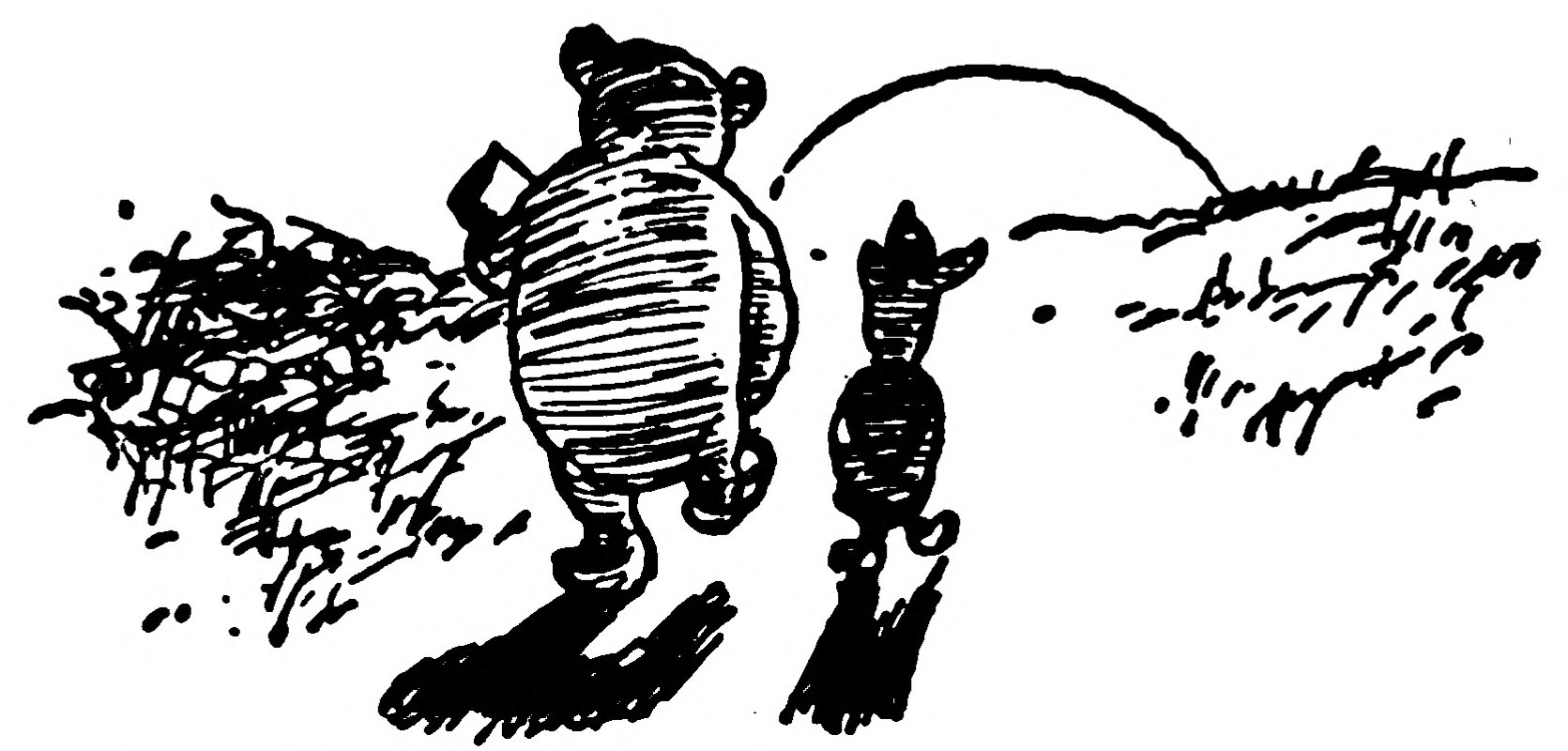
Pooh and Piglet now have the immediacy of all great popular art. To look at a drawing by E.H. Shepard, Milne’s Punch colleague and the original illustrator of Pooh, as well as the author of a delightful memoir about his own golden Victorian childhood, is to look through a mirror into the past. Like Edward Ardizzone a generation later, Shepard’s style is a world in-itself as well as an aesthetic of its times—we feel as if we might be able to step through the drawing and be there in the forest. The closed nature of these little worlds came directly from the closed nature of their creators’ lives: not just emotionally, but socially. Shepard was born five minutes away from Milne, though they never met until they both worked at Punch.
It is hard to think of these people as having the conflicted hearts of adults, such is their gift for depicting the timelessness of childhood, but Shepard once stood on E.V. Knox’s doorstep, angry and contorted about the fact that his daughter Mary was going to marry this much older man. Knox was another buttoned-up Englishman of placid demeanour, the editor of Punch and, incidentally, Penelope Fitzgerald’s father; Mary became the illustrator of Mary Poppins. She died the same year as Penelope.
All this was happening while the literary world was undergoing radical change. Milne had not read Henry James when he arrived as a Cambridge undergraduate in 1900. He knew members of the Bloomsbury group and became an acquaintance of Leonard Woolf’s. Thwaite points to their shared love of Hardy and Butler, a parallel puritanism in both men. Like Sydney-Turner, a marginal member of Bloomsbury, Milne became a champion crossword solver as the new puzzle was invented during his lifetime. Milne was a modern, in his own way, but without the intense seriousness of Bloomsbury.
Milne emerges then as a very particular sort of Englishman from a particular period of Englishness. He was hard to read: cagey and aloof are how contemporaries described him. As Thwaite writes, he was not an intellectual but “had a quiet passion for using his brain.” (Eeyore was saying to himself, “This writing business. Pencils and what-not. Over-rated, if you ask me. Silly stuff. Nothing in it.”) He accepted who he was after Westminster and Cambridge and worked to make the best of himself, knowing he could never be more than a minor writer. He was, in many senses, a captive of his class.
Milne’s first interview with his supervisor shows that he was not quite as much in charge of his own fate as he would have wished. The don was a Scot called Gilbert Walker, university lecturer in mathematics and a Fellow of Trinity. Milne was planning to play football every afternoon, and didn’t feel inclined to work immediately afterwards, so proposed to go to Walker in the morning at some hour when he didn’t have a lecture. ‘And will ye come in for the for-r-r-r-noon or the after-r-r-r-noon?’ Walker asked. Milne recorded, ‘My three-quarter English blood boiled at the idea of saying “for-r-r-r-noon”, politeness forbade me to say “morning”. So I went to him in the afternoon and never ceased to regret it.’
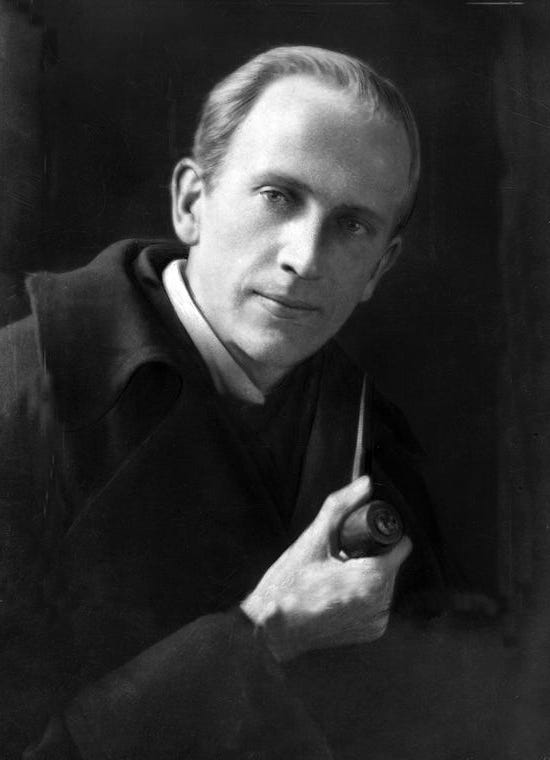
Milne then had a fairly conventional life, if a slightly idiosyncratic writing career: he joined Punch in 1906, married in 1913, became a Lieutenant in the First War, and produced a series of well-received plays and a detective novel. In this period he made heaps of money from his plays and lived richly—but safely: he invested his money too. The conventional looking man with a pipe between his teeth that you see in his photograph is indeed what he was. None of the glamour of Noel Coward or Somerset Maugham for Milne.
Then, in 1920, a son arrived. And in 1921 a bear was bought at Harrods. That, of course, is not the bear who became Winnie. It might have been the basis of the story, but the illustration was derived from Shepard’s son’s bear Growler. Milne was famous. He associated with H.G. Wells and met Charlie Chaplin. But it was on a family trip to Sussex that his lasting fame began, when his son fed a swan and called him Pooh. Seeing the cows nearby, Milne thought to himself, “moo rhymes with pooh, surely there is a bit of poetry to be got out of that.”
A bit of poetry is the telling phrase. Milne’s best verses are completely winning. What is the matter with Mary Jane? King John was not a good man. So wherever I am, there's always Pooh. Reading these aloud to children is tremendous fun: they are still as fresh as the day they arrived. But they are bits of poetry. So much of Milne’s work seems to be in bits, as if they formed pieces of a puzzle, needing to be slotted together into some greater arrangement. It was in Pooh that he managed this arranging.
Each of the stories is a bit of writing. Tigger needs to find his breakfast. Pooh gets caught in a flood. Eeyore and Piglet go out in the snow. And so on. But together, they form a succession of the sort of days we remember from childhood, where nothing very much happens but it is all quite momentous and worth the telling, and becomes a sort of formless saga of small events, the bits of our early life. Shepard understood this perfectly well. The two men were very different. Shepard felt one could never get past the facade of Milne. But they were able to work in unison. Neither would be so magnificent without the other. A line of Milne or a small extract of Shepard, and we are off down the path of the Hundred Acre Wood—it only takes a bit.
In the first eight weeks of publication, Milne’s first children’s poems, When We Were Young, sold forty-four thousand copies. Bitty it might be, but it is also a serious moment in the history of light verse. Geoffrey Grigson was surely right to see its influence upon John Betjeman. In a curious way, it is in his children’s poems that Milne achieved his ambition to write for adults. Many of them are more enthusiastic readers of the poems than children. But in that book were also some poems about a little boy and his bear. This is where Milne’s bit started to become a whole.
Grigson made a scathing assessment of the poems, noting that they were written for and about the upper-middle classes who had “lost their cultural nerve”. These poems take place in a world of Westminster school, two universities, and nursery maids. Freud is absent. Nothing nasty. Nothing like Hilaire Belloc.
Here mamas of the middle way, and fathers, and nannies, those distorting reflectors of the parental ethos, could be sure of finding Innocence Up to Date. Little Lord Fauntleroy – here he was, stripped of frills and velvet (as we can tell by the splendid insipidity of the accompanying drawings) for modern, sensible clothes; heir, after all, to no peerage, but still the Eternal Child.
Grigson has a point about the class—and intellectual—restrictions of Milne’s work. Milne’s world of tea and muffins, and little ditty rhymes, and pleasant social concourse is the world of the woods. “Nearly eleven o’clock,” said Pooh happily. “You’re just in time for a little smackerel of something,” and he put his head into the cupboard. “And then we’ll go out, Piglet, and sing my song to Eeyore.”
But so what? Winnie-the-Pooh makes a pastoral out of childhood, but also out of the slow and pensive moments that children experience irrespective of their class.
The sun was so delightfully warm, and the stone, which had been sitting in it for a long time, was so warm, too, that Pooh had almost decided to go on being Pooh in the middle of the stream for the rest of the morning, when he remembered Rabbit.
And Milne is perfectly capable of satirising himself and his milieu. When Piglet meets Eeyore in the forest, and sees the letter ‘A’ made of three sticks on the ground, he does not recognise it.
“Do you know what this is?”
“No,” said Piglet.
“It’s an A.”
“Oh,” said Piglet.
“Not O, A,” said Eeyore severely.
Eeyore reprimands Piglet for not knowing what an ‘A’ is and then gives a speech that ironises the educational assumptions of Milne’s class.
“I’m telling you. People come and go in this Forest, and they say, ‘It’s only Eeyore, so it doesn’t count.’ They walk to and fro saying ‘Ha ha!’ But do they know anything about A? They don’t. It’s just three sticks to them. But to the Educated— mark this, little Piglet—to the Educated, not meaning Poohs and Piglets, it’s a great and glorious A. Not,” he added, “just something that anybody can come and breathe on.”
There is plenty of this sort of thing, but it is more to the point that Milne is writing the Eternal Child, taking us to the forest where all quests originate or pass through, the timeless place of legend and innocence, out of which we must all, sooner or later, emerge, as Christopher Robin does at the end of The House at Pooh Corner, in order that he can go away to prep school. “Any by-and-by Christopher Robin came to an end of the things, and was silent, and he sat there looking out over the world, and wishing it wouldn’t stop.”
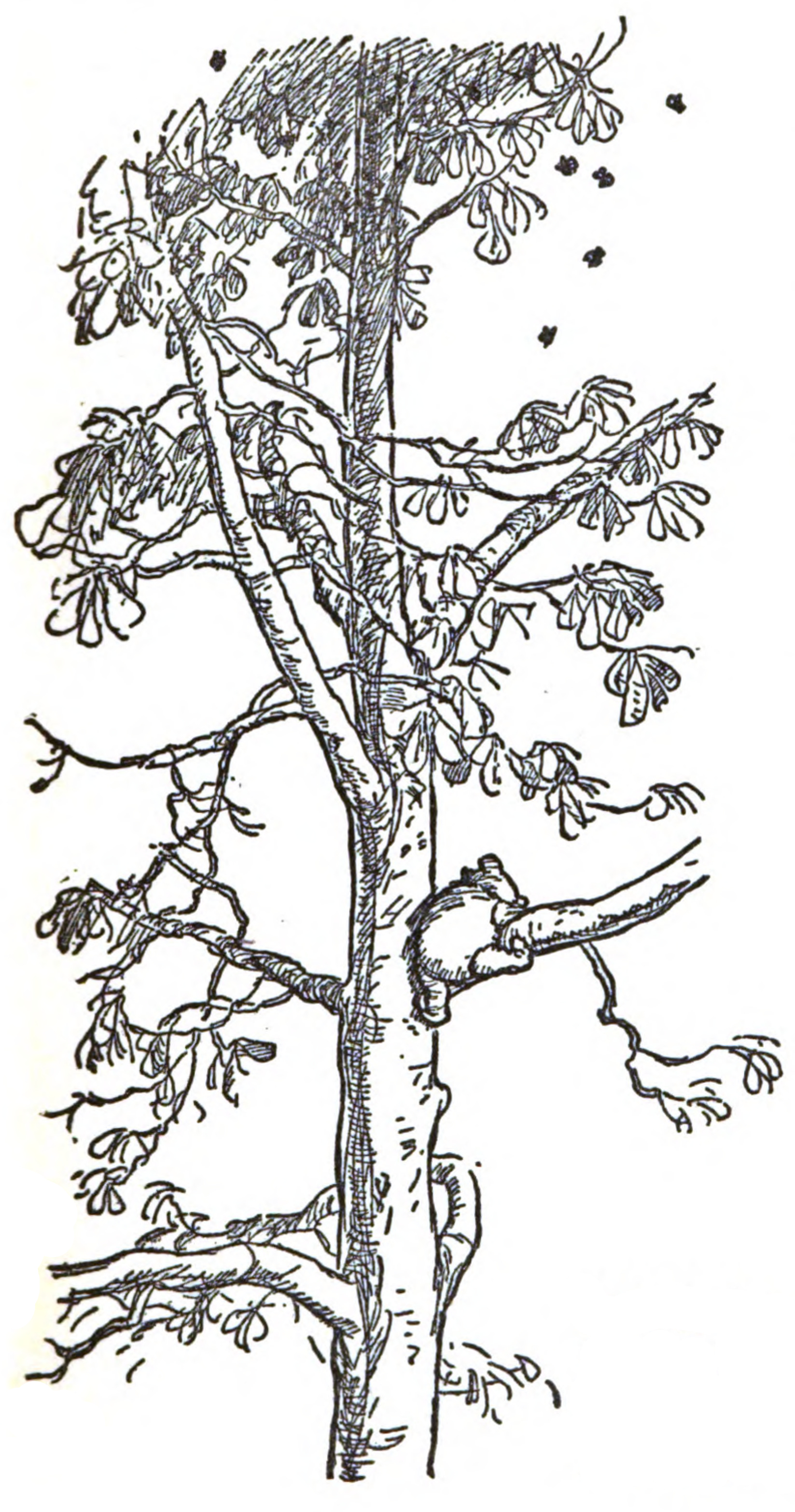
There is the sharp and sobering realisation. The little boy in When We Were Young who stands at the gates of Buckingham Palace, Pooh bear hanging down beside him, becomes, by the end of the stories, a boarding-school boy, on his way to Westminster, Cambridge, a job at Punch, and all the rest of it. Journeys abound in Pooh—when they hunt the Heffalump, when Pooh climbs the tree (“It’s like this,” he said. “When you go after honey with a balloon, the great thing is not to let the bees know you’re coming.”), when he floats down the river, when Tigger goes searching for breakfast (and somewhere to live), looking for the Woozle, finding Eeyore’s tail, the search for Small, Piglet going to fetch Christopher Robin in the wind, the journey down the river (“We might go in your umbrella,” said Pooh). All these are quests: journeys of play, pilgrimages of innocence. Preludes to leaving the forest. “Pooh, promise you won’t forget about me, ever. Even when I’m a hundred.”
The Eternal Child, as Grigson almost realised, is a particular boy in a particular place, a real bit of life. And he must therefore be fantasised not with fairies and magic, but with his own stuffed animals, the woods close to his house, and the sort of games a growing lad might discover.
Mr Milne treats his small companion as a sensible being who, indeed, wants to make up things, as is proper, but wants to make them up about real life and not about fairy doodleum. These two go about in the gayest and most whimsical of tempers, but the things that engage their attention are the soldiers at Buckingham Palace, the three little foxes who didn’t wear stockings and didn’t wear sockses, the gardener, the king who asked for no more than a little butter for the royal slice of bread . . . It is all great larks, but I wonder whether the Sterner Critics will realize that it also is a very wholesome contribution to serious literature.
Now that the Queen has visited the Harrods bear in the New York Public Library, a journey I recommend to you all, and the hundredth anniversary of the first book of stories approaches this October, we can restore Pooh bear to that special place in our imaginations reserved for wholesome contributions to literature. It is all over and gone now. Milne’s professional worries, his crossword-puzzle heart (Ask me a riddle and I reply: Cottleston, Cottleston, Cottleston Pie.), Mary’s marriage, Shepard’s dislike of his collaborator, Christopher Robin’s exclusiveness, the lack of engagement with “real” ideas… all that has passed. We are left with something more important: bits of poetry and books of tales that understand the great quest of childhood, the start of the journey of life, as something innocent, reserved, delightful, and worth remembering.
“In the first eight weeks of publication, Milne’s first children’s poems, When We Were Young, sold forty-four thousand copies. “
Finding sentences like this one is reason enough to keep coming around this neighborhood.
What a charming piece. Thank you for making my day.