

I know many of you hate AI. But hear me out.
Imagine you read, as I did this week, that the phrase “self-command” was not widely used in eighteenth century moral discourse outside the work of Adam Smith, and that you felt sceptical about this claim. You have three options. First, get out a lot primary texts and start making notes. Second, look for existing scholarship that is based on primary texts. Third, ask Claude or another LLM.
Whether or not you ask Claude depends partly on your moral views. Some of you simply won’t ask. Fair enough. But… after spending about 45 minutes asking Claude and GPT 6 Astra about this topic (with follow ups about other thinkers, clarifications, prompts to broaden or narrow the investigation, how this relates to Sense and Sensibility, and so on) I was a little depressed at the inevitability of LLM dominance in this area.
It will still be worthwhile to read (some of) those primary texts, but the work of historical scholarship is surely about to be undercut quite severely. Of course, this is old news. But in light of the mathematicians revolt against AI, it is newly relevant. Whether or not we approve of what is happening, the role of humanities scholars, critics, and practitioners of all kinds is going to change. Even if it changes because a new group of people find new ways of competing with existing practitioners.
The usual defence—that we wish to know what people think, not machines—seems inadequate here. I do, to some extent, wish to know what people think. But on the question of the use and import of the phrase (and concept) of self-command between 1750-1800 I also just want to know the truth. If we have to choose between knowing much less of the truth but knowing it from human work and knowing more of it from AI, for how long will we be able to choose not knowing?
Perhaps for a long time! This forces various questions, such as the distinction between scholarship and criticism, the place of the canon, the public role of criticism, and so on. The humanities will surely have more human involvement than mathematics, but still much less involvement in these sorts of factual questions. Not only can a vast amount of work be done in a sort amount of time, but everyone can work to their own knowledge frontier. I prefer to read things for myself, and I use Claude to find things to read rather than to “get answers” per se. (I end up looking at more scholarly papers when I ask Claude.) But there cannot be a viable future without the use of LLMs.
There are some people who already know enough about the usage of self-command. They don’t need to do any of the options I outlined above. But others have to choose which margin gets their time—the question they are already working on (for which this is a tangential or marginal issue) or this new question. Obviously, most of us, most of the time, will want to do enough research on side-topics to keep going with our original project. Everyone is in this position for a whole slew of questions of whatever size.
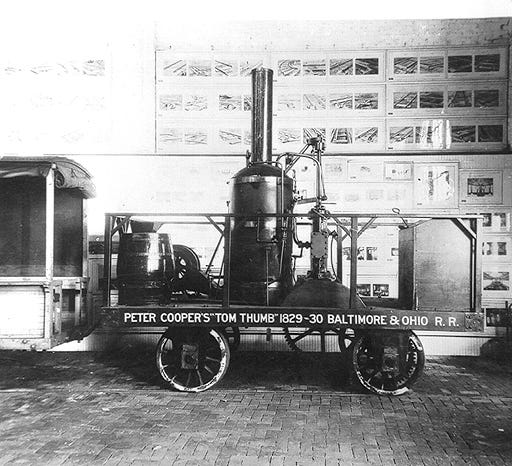
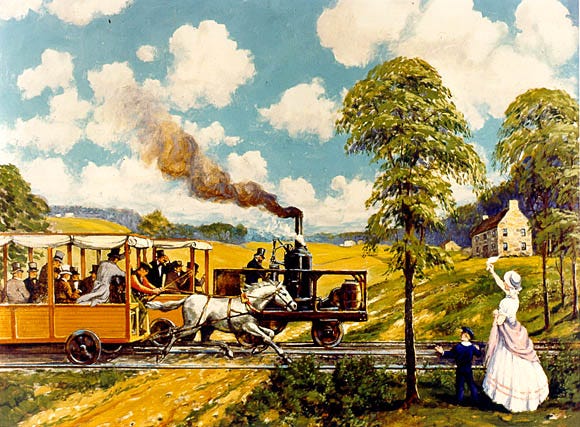
At which point AI use becomes imperative. Horses running against steam-trains won’t preserve very much. Horse riders still need oats that were brought into town on the rails, for one thing. Some concession to the new pace and order of things has to be made in order to preserve human work. If you create a loose collective of “human only” humanities people, but their work goes out of date much much faster, how viable will that be? Perhaps more people will leave humanities work and will preserve it as a hobby, but they will often be working with AI in whatever other occupation they move to. Concessions need only be minimal. In these examples, I am talking about AI as a sort of encyclopedia, index, concordance, dictionary, and guide.
One simple way to preserve humanities work for the humans is to keep the archives out of the training data. But under such a protectionist scheme, a new class of moral problems arise. I already find it hard to justify that the British Library hasn’t digitised some of its major collections. Why shouldn’t a scholar—or indeed an ambitious teenager in Newcastle—be able to read the Nelson papers online? Or the LSE Women’s Archive? It is currently too expensive to digitise all of this, but the new wave of AI philanthropy could surely be well-directed here. Either we believe that knowledge is for everyone or we don’t…
It is an inevitable step to make that knowledge available via an LLM. Yes, usage will be high variance, with some people getting smarter and some going the other way. But usage of current technology including books is already like that! I would not undo the superb work of the online George Eliot archive, or the online version of Samuel Johnson’s Dictionary, two websites upon which I am quite reliant, along with the online edition of John Stuart Mill, Project Gutenberg, and many others. Asking Claude to review them for me as part of my overall work pattern hardly seems immoral. I have read quite a lot of George Eliot’s papers. Am I morally obliged to re-read them, or to find my notes, every time I have a new stray thought? Do I have to use an index rather than Claude every time? Can I check how viable a line of research might be? Can I use it to test my hypothesis against existing scholarship and pursue those lines of enquiry? Am I only allowed to find new things to read in person in the library? (To be clear, that is what I miss most about the London Library and I expect that sort of activity to go up in value, but still.)
In the overall balance of humanities work, I therefore think that there will be less scholarship in the long run and more criticism. Finding out what was said will be less and less economically justifiable unless it is part of making some bigger assessment, being an enthusiast or a hater, or as part of a synthetic project. We will always want to read and discuss books with other humans. That will include humans who read obscure historical texts! But the “knowledge work” of organising, interpreting, and disseminating the contextual, archival, and other material will surely be unrecognisably different within a few years. If for no other reason than that the ambitious teenagers in Newcastle simply will be using AIs.
I should say, though many of you will hate it, that having asked Claude and GPT many questions of this sort, the new competition is going to be tough! And the new models are going to be better very soon. As Tyler Cowen said to me, “there are good reasons why people hate what you are saying about the AIs, and those reasons correlate with how good the AIs are.” Like I said, the AIs are depressingly good.
To end on an optimistic note, it is also probably the case that these developments leave a bigger overall role for humans in the humanities than in disciplines like mathematics. And so the relative status of humanities people will rise thanks to AI. It just may not be the status of the existing crop of people.
Funnily enough, I made no use of AI as I thought this piece through.
In some ways this is an extension of a problem that already exists in well-researched fields, e.g., Shakespeare studies. Although there are some who disagree, I think most of us in the field feel that there isn't any low-hanging fruit left in terms of basic scholarship. Yet coming to understand Shakespeare and his world remains the work of a lifetime, and no one can even begin to ask interesting critical questions without a deep grasp of the history broadly understood (including literary history and the historiography). You gain a feel for that world only by trying to put things together yourself--even if someone else has already done something broadly similar, or (realistically) far superior. You can't shortcut the process and it can't be relegated to AI or to the books of the past. I think we probably WILL see a shift from scholarship to criticism, but I'm not actually happy about that. What we probably do need is a shift from thinking about knowledge as something embedded in books to thinking about knowledge as embedded in people.
As a disclaimer, I've always (that is, since 2011; but privately, I think I had already quite grasped the possibility in my mind long before, when I was a kid with no Internet) been a believer in the (imminent) possibility of superhuman AI and the Singularity and thought a lot of the implications of humanity becoming extinct or irrelevant or anyway unrecognizable. I think this was good for me, as I went through some existential crises a bit before their time.
As an example, I am a mathematician and I had thought since 2018 of the possibility of computers routinely proving advanced math results while society otherwise marches on (I admit that, before 2018, I had only thought of a "hard take-off" where the period between no AI and superintelligent AI was of the order of several hours to a month). I think this makes me better prepared mentally than my colleagues who are in various states of denial.
In the past year, I have turned more and more to literature, thanks partly to your blog (I know it sounds a bit silly but your introductory post [1] brought me a lot of warmth). I have always enjoyed books, but now I realized that the act of reading a book, and then turning it around in my mind, is something that AI, no matter how intelligent or powerful, can never take from me (except by killing or torturing me, but humans could do that already anyway).
It is possible that we'll no longer get money or prestige or status from scholarship of any sort, but as long as we manage to find ways to stay alive and healthy in the coming times (and, if we can't, then our problems are bigger than the end of academia), we can still find ways to do the activities we like.
Anyway, I use this comment to thank you very much for writing this blog (whose archives I haven't yet read in full). It was and still is for me a light in dark times.
[1] https://www.commonreader.co.uk/p/how-to-get-started-reading-english