

On the stone bridge that crosses Bull Run, where the first shots of the first land battle of the Civil War were fired, a group of teenagers in sparkly gowns and fancy dresses whose sequins caught the sun were being photographed, presumably for their prom. In a family restaurant a few miles away in Manassas, we saw flesh that was mottled like a bloodless harlequin and purple-red like a fading burn. On the edge of the woods near the ridge where Stonewall Jackson organized his artillery, zebra-patterned butterflies, pale peppermint green between their stripes, swallow-tailed, and butterflies as dark as velvet, flew on top of the grass and into the trees. On a boardwalk through another part of the forest, a lizard with a tail that shone like sea-water slinked across the path.
There is something American about these landscapes but it is hard to say what. There are more pines than England, and the woods are deeper, with a greater sense that the trees are left to their own devices. There is a generic scene of sun-rise over a field, trees and hedge framing the picture, that begins so many historical documentaries, and even without the narrator’s accent or the music one knows it to be American.
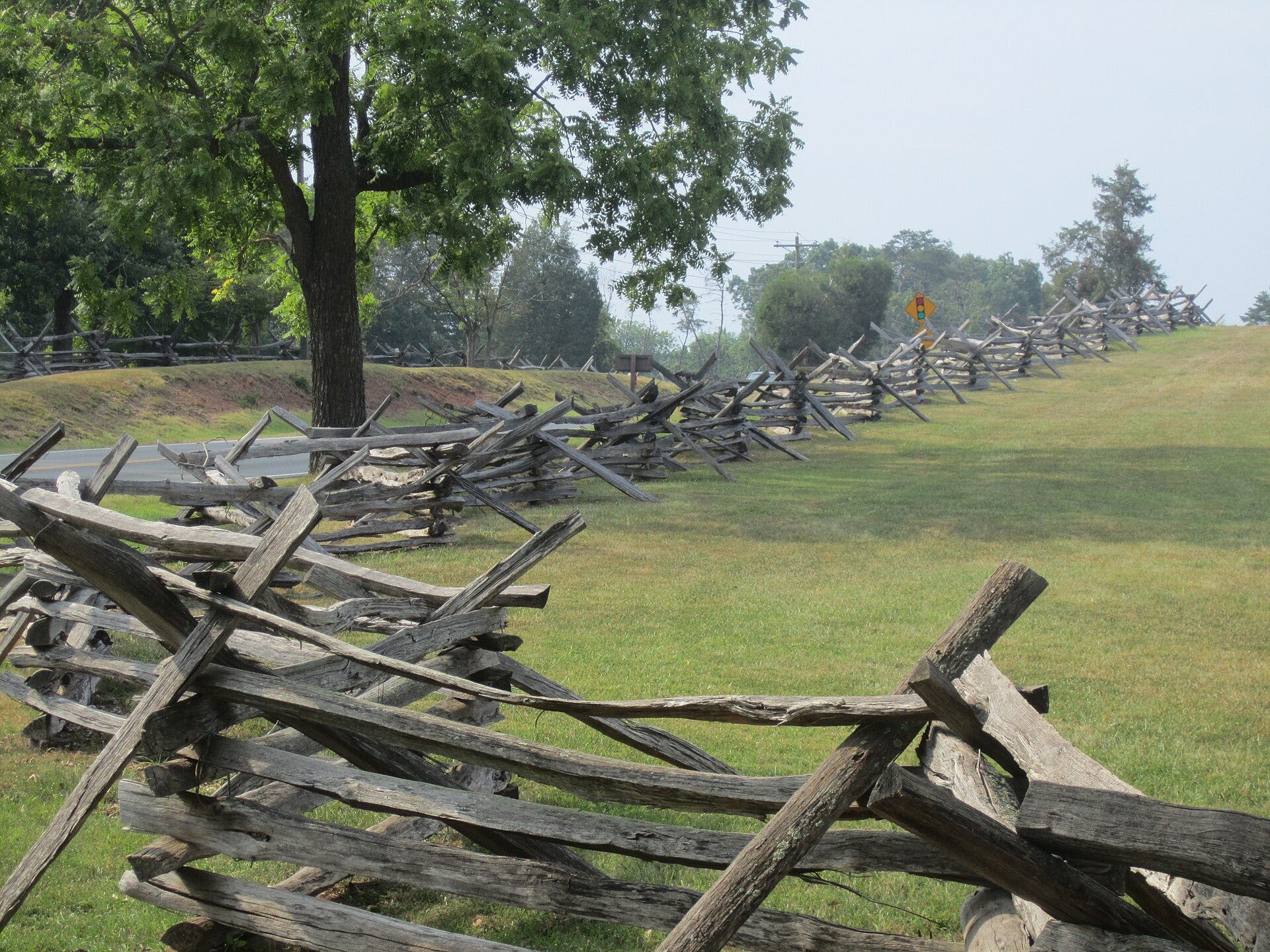
It is so peaceful, in this place where thousands of men were killed and injured out of sheer amateurism. The first day’s march from D.C. covered only five mile because of stragglers picking blackberries and filling water canisters. The army marched north to take the Confederacy by surprise and their bayonets glinted in the summer sunlight, giving them away. The gentle landscape is revealed as now a clever location to hide a brigade of men, now an opportune spot for artillery to have the advantage of height but not the problem of being seen from far away. At the intersection in the middle of the battlefield national park, there is a stone house, uninspiring in all but its history as the place where the wounded were treated, in both of the battles at Bull Run.
Now the traffic hardly ceases here. Six miles south, there are hotels, denser housing, the sort of restaurant where you cannot always get parking, and where the cowboy skillet of eggs, mince, and cheese comes with a side of pancakes. You always know you are coming into a town because of the gas stations—six or seven of them at once. There are over forty thousand people in Manassas, and over four hundred thousand in the wider county: a dozen gas stations within a mile of each other isn’t as unreasonable as it seems. We saw a truck on the Interstate with a sticker that read “WE VOTE PRO LIFE” and a Jeep with the licence plate “JEEP CAT”. The truck was twice the height of our saloon: the wing mirror was as high as the roof of our car. The Jeep simply could not keep in its lane. Usually this means the driver is looking down at their phone; sometimes it simply means they don’t care. Later on, two cars tried to pull into the same lane from opposite sides, in full view of each other.
None of this would happen in England—the prom photos, the JEEP CAT, the lax driving, and certainly not the pro-life sticker, which would be an invitation for abuse; but neither would the battle field be so well-kept: the ranger quizzed the children about history, gave them a badge, and had them take a pledge to take an interest in the past, and to help others do so as well. Some children wail and make demands in the museum—some sit quietly on the floor and make notes and drawing from the exhibits. In the last half-hour, people were still arriving there. It was just as difficult to get parking at the battle-field visitor center as it was at the restaurant, but in both places spaces kept opening up.
Henry, visit Gettysburg if you haven't already, and perhaps read Michael Shaara's Killer Angels before you go. And I'm sure I'm not the first person to recommend Shelby Foote's magisterial three-volume history of the Civil War.
Good article!
I lived in Manassas for a decade, and I loved the history walks.
History is a lot more than just geography. But…
If you pull out a present-day map of Bull Run and look to the east, you see Fairfax. Their economy was tightly tied to Washington, DC.
Look north and you see Leesburg, Waterford, and Harpers Ferry. Their economies were tied to Maryland, and DC.
Head west of DC and the first place with an economy not tied to DC, or another state is the Bull Run, Manassas area.