

Among the people who blame phones for the “reading crisis” and the associated decline in educational outcomes, the PISA results are, in my view, somewhat misunderstood. Here is a good explanation, from Alexander Thompson.
Second, PISA scores. OECD reading scores have fallen from around 2012 onwards. This coincides with the mass adoption of smartphones. Causation?
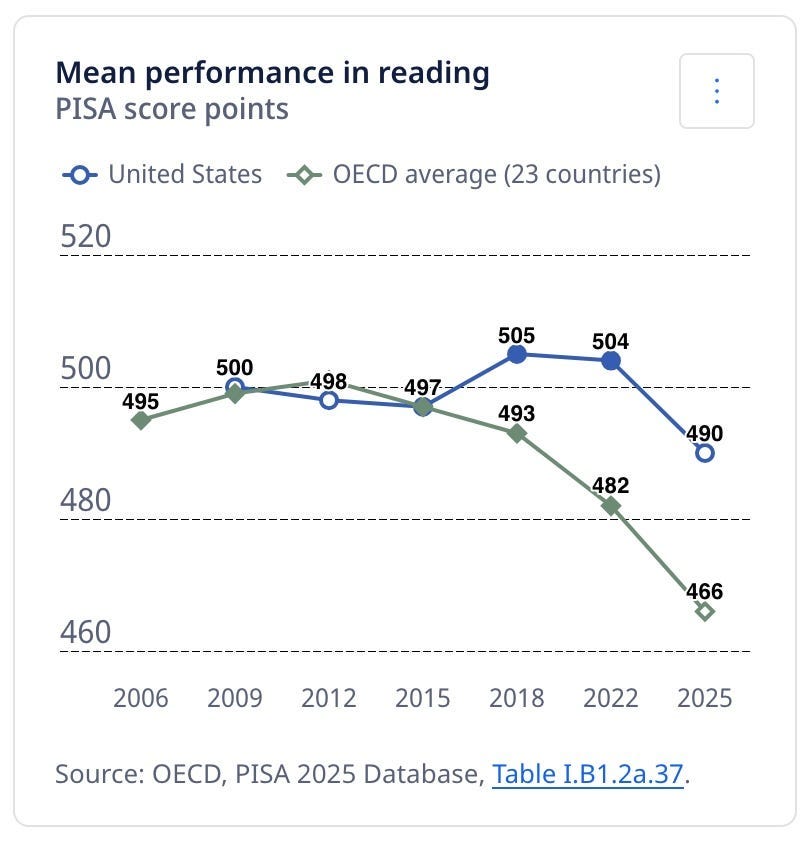
Unlikely. As you can see, US reading scores actually improved after 2012. Similarly, England’s reading scores showed a small increase in performance after 2012 which returned to 2006 levels in 2025:
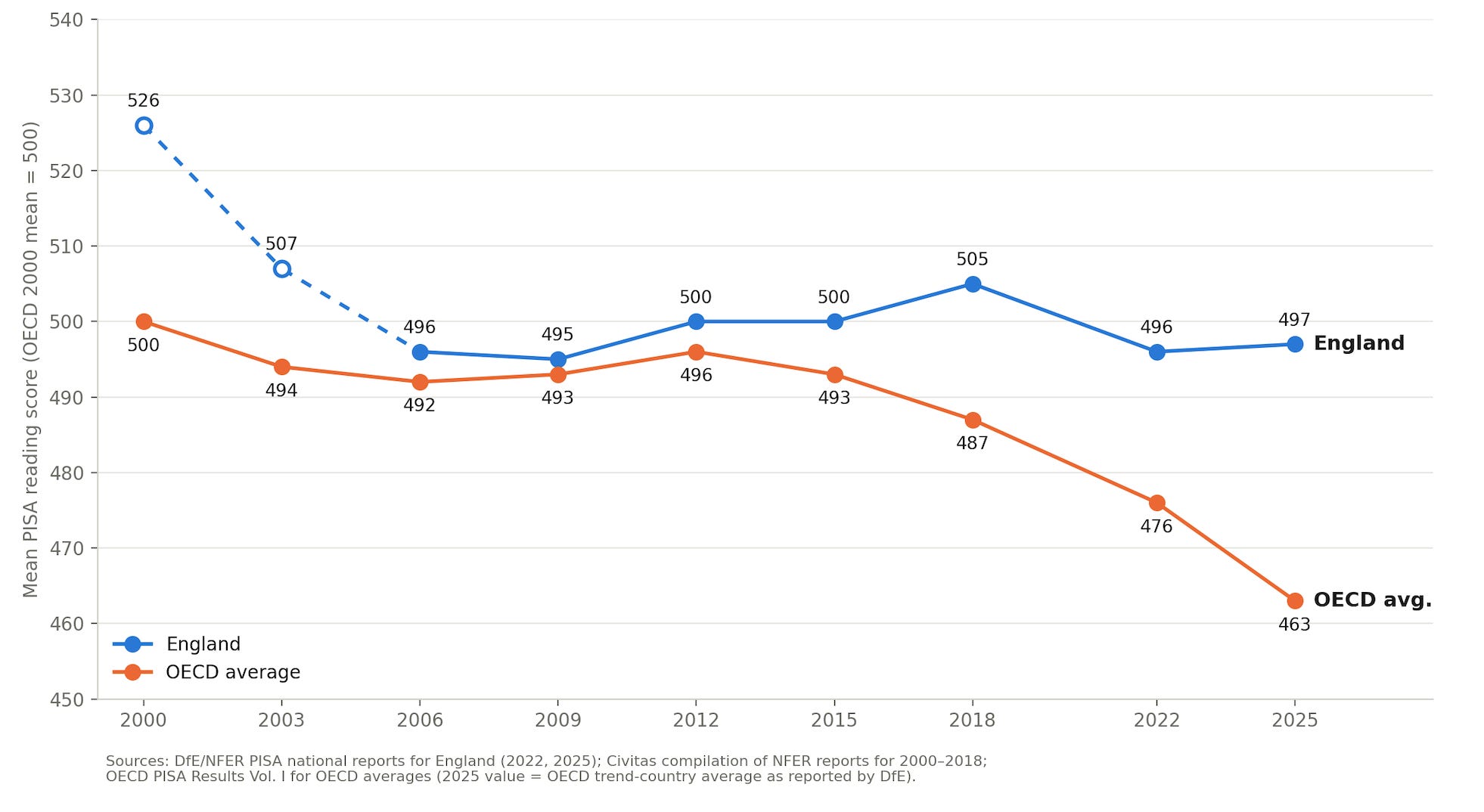
The Dark Ages implies television and phones are the main cause of cognitive decline. This fails to explain the patterns in PISA scores. Why did England and Scotland fall so precipitously from 2000 to 2005 whilst America improved? Why did England and Estonia hold steady after 2015 whilst most other OECD countries declined? How have Singapore, Taiwan, Japan avoided decline altogether?
A better explanation is that a country’s education system is more important than its television diffusion.1 East Asian PISA and IQ scores have probably remained constant, or even risen, because of their rigorous education systems and intensive tutoring cultures. The two European countries which avoid PISA-malaise – Estonia and England – have more rigorous education systems than their neighbours. They (more or less) use the knowledge-rich curricula, direct instruction, and systematic phonics - techniques which their more progressive neighbours abandoned between 1975-1990.
I worry identifying television and social media as the cause of PISA decline will, in effect, exculpate poor education policymaking. “It wasn’t the fault of the curricula we stripped of knowledge, it was the phones!”
And here is Carl Hendrick discussing the problems with modern “learning goals” as the cause of the growing trend of “hasty reading”, i.e. skimming not immersing.
The focus on skills sees reading as a generic transferable strategy where ‘finding the main idea’ is the goal. When generic skills are the dominant metric then the texts becomes a secondary consideration, merely the substrate in which the plants of ‘evaluation’, ‘comparing’ and ‘inference’ are seeded and grown.
Under this model, ‘Frankenstein’ and a four paragraph article about KPop Demon Hunters become interchangeable. Texts are chosen to create those generic skills and so we regrettably, we have shifted more and more towards a reading culture of extracts and compressed reading.
But reading comprehension is not predominantly a skill, it is the visible layer of a much deeper set of competencies based on domain knowledge, reading fluency and I would argue, a set of cultural and environmental norms which value sustained attention to particular texts.
Imagine two children, one who grows up in a house where reading is encouraged or enforced, and one who is not. It used to be the case that the second child was made to read books at school. Their teacher checked their reading record; someone sat with them and heard them read; a book was assigned as a class book; they were expected to show some knowledge of the whole book; and so on. Obviously, not everyone did this to the same degree of achievement. But that was the standard expectation. That is increasingly not the case, as children are taught from extracts and whole books are assigned less and less. (Talk to some homeschoolers: this is a big reason why parents feel the need to change their child’s schooling.) So now, whether that child goes home to a television or a phone is of far less significance than the loss of the standard that was once imposed and is now being lost. Everyone blames someone else: the teacher blame the administrators; the schools blame the parents; the parents blame the phones. They might all have a point. Who does it help? The starting point has to be the strict belief in the necessity of reading books, structured, enforced, and encouraged through schools. Whatever change is needed, it must be a change that will bring that vital idea back to dominance.
Discipline!!! Discipline!!! Discipline!!!
Where did our culture of discipline go? Who are its cultural ambassadors? And what, exactly, has created the laissez-faire ease that seems to embody so much of our educational experience?
I have some admittedly controversial thoughts about the rise of a tolerance-based culture—one increasingly oriented around “live and let live,” rather than firm boundaries, expectations, and meaningful consequences.
But alas, those ideas are rife with political entanglements, so I’ll leave it there—for now.
Just to note there is no “American education system.” K-12 education falls under the purview of individual states. Mine (Oregon, left coast so-called “progressive”) and another (Mississippi, rural south) have switched position in the last few years. Mississippi, with standards and PHONICS, rising from near bottom to #3 nationwide, and Oregon, continuing to refuse to implement phonics, plummeting from high ranking to 47 out of 50.
The American republic established states as the “laboratories of democracy,” so one can pick one’s lesson from this (if they can read).