

My children are still of an age that we can still sometimes sing as a family the songs we have enjoyed together. I have no sort of singing voice. Indeed, an old friend who has musical gifts once told me I am the only person he knows who can sing between the notes. But it is fun to sing. I remember the old days, when singing Lydia the Tattooed Lady was the best way to settle my daughter as a baby. (In my experience, children enjoy all sorts of unlikely things like the Great American Songbook and Noël Coward and My Fair Lady.) I thought of that song as we drove through the great state of Maryland this week after I hustled everyone into the car at 7.30 am to drive to the Atlantic coast. Ah this circus brings back memories, Groucho says before he starts singing—childhood days, lemonade, romance! Something about car journeys brings back memories, not explicitly perhaps, but in that Marx Brothers spirit, half nostalgic, half humorous, a state in which family life often exists.
Five minutes after we left the house, which a very kind benefactor gave us the use of for the week, the Chesapeake Bay Bridge appeared. I had a half-memory of reading about this bridge some years ago. It was quite startling, to see it rising up like a city skyline, curving mightily above the bay. I was not brave enough to walk across the Clifton Suspension Bridge, and had to go over it in a taxi (we did that several times, the view is extraordinary), but by the time you can see the bridge it is too late to pull over. So on we went. I should not be surprised to find such man-made wonders in America, but the very idea of a 4.5 mile long bridge is extraordinary to me. This is by no means the longest bridge in the USA, let alone the world. There’s a 23 mile bridge in Louisiana. Having now crossed the Chesapeake Bay Bridge, I find myself yearning to drive that 23 miles. I want to drive the San Mateo-Hayward and the Jubilee Parkway. What extraordinary views of the bay! What an extraordinary human achievement to build such a bridge!
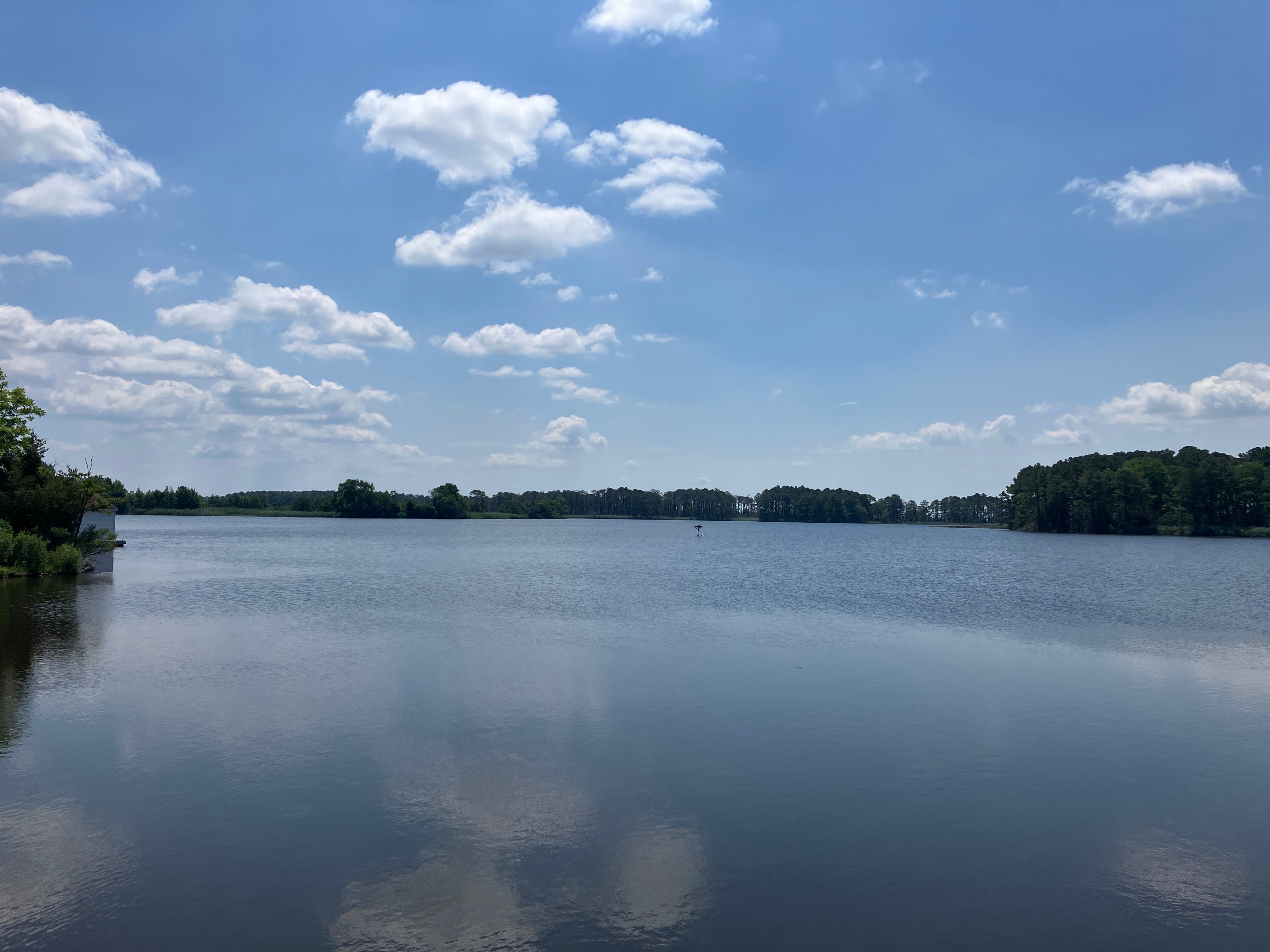
The day we crossed the Chesapeake Bay Bridge, we saw wild horses at Assateague, paddled the Atlantic, ate pancakes and a burger, and drove miles and miles through Maryland, where BBQ grills billow at the side of the road. We drove through the Blackwater Wildlife Preserve and saw giant egrets, red-winged blackbirds, an eagle nest, and leaping deer. We crossed the bridge again, which is stunning every time. We saw houses where the corn is growing up around them, visited small towns, bought an Amish cake. Went to the Unicorn Bookshop and picked up a pile of old mass market paperbacks for a dollar apiece. We passed through the picturesque St. Michaels, had lunch in diners and crab shacks, drifted around antique stores, one of which was next to a parking lot filled with dozens of tractors.
At Assateague the wild horses are sacred. The land was ours before it was theirs, but they have been there for four hundred years now, and the humans have ceded precedence to the horses. As such, when a horse drifts onto the beach, the lifeguard stands up and starts yelling: “Guys! I need you to be ready to get up and move your stuff. Move your food away from the horses.” A national park worker has a gentle water spray he uses to try and dissuade the horse from coming down to the sunbathers, but the horse doesn’t mind that. He just walks right on by. He knows he has right of way and plods along the beach, sniffing at deckchairs and coolers. Cars frequently have to come to a standstill while the horses occupy the road. Sometimes they cross leisurely. Sometimes, as on our way off the island, they walk right down the middle of the road, in full knowledge that the traffic will have to wait for them, as it did on both sides. On the beach, the waves were large and whooping, crashing up around our shorts, leaving a long sea mist along the edge where sand and water meet.
I was in Maryland to attend a week-long seminar at St. John’s College. This was a meeting of the Catherine Project, organized as a development session for some of their volunteers. I was accepted as an interloper. This allowed me to understand more about both the Catherine Project (which regular readers will know I believe in very deeply) and about St. John’s and their method of teaching the Great Books. The Project has grown out of the College, guided by its foundress Zena Hitz, whose wonderful book Lost in Thought was part of what contributed to my decision to quit my job and become a writer.
We read Theophrastus on plants, Goethe on botany and Nature, parts of Genesis, and Ecclesiastes. We met twice a day, for two hours, in small groups, led by two session leaders, one of who was a St. John’s tutor. I am unused to seminars. It was not a significant part of my university. Perhaps I have attended more seminars this week than I did in my three years as an undergraduate. I was frequently out of my depth, not only in terms of trying to understand the material (my last formal study of biology was aged eighteen and I am no Bible scholar), but as a seminar participant. Not only am I prone to day-dreaming (when something in Goethe seems relevant to J.S. Mill, or when someone says something that makes a new connection for me in Genesis), but sometimes people express themselves in philosophical terms (either formally or informally) which it takes me some time to apprehend.
But that confusion is a necessary part of the process. I was struck by the way that these seminars moved from confusion to clarity. After a few days, there was a real sense in the room of people working things out, together and individually, and a real sense that we were not only starting to come to terms with Goethe, but to understand plants themselves a little differently. As well as reading, we went outside to draw plants, brought leaves and flowers inside, and cut things open. I sliced open a magnolia bud and pulled a pine cone to pieces, laying it all out on the table. In this way, pulling things apart, comparing them, really trying to see, we began to find examples of what Goethe was talking about, and could not only see the plants differently, but could go back to the text with a better sense of where he was making sense, and where we felt confused about what the truth of the matter might be. The Great Books are not merely books. This is not about words on paper. Great Books call us to the things of this world—to the leaf and the stem and the petal.
The other thing I learnt is that the Catherine Project is becoming a social movement. People talk about “Johnnies”, the graduates of St. John’s who seem to share a certain culture—smoking in the boathouse, singing in rounds, struggling to read in Ancient Greek as a hobby, knowing (as I, alas, do not) the life-changing sensation of studying Euclid—and there is now emerging a set of Catherinites, those people (many from St. John’s, but by no means most of them) who are organizing and leading reading groups, online and in person, which work on the seminar model. I spoke to people from Oregon to Texas to Illinois to New York. I spoke to a software engineer, a therapist, a federal finance worker, several educators, a sexologist, a homeschooler, some graduate students, an artist, a carpenter—and they all share this Catherinite temperament. I felt like I was seeing the beginning of something—there is a shared purpose, a deep love not only of the books, but of this sort of life, this devotion to reading and to the practice of reading in seminars, in which, as Zena says in her statement on the Catherine Project website, “We read, speak, and listen, not to draw a boundary between ourselves and others, but to uncover bonds of human unity.”
Wherever I go, Americans tell me their country is in trouble. Everyone complains about politics. Some tell me this is an empire in decline. Of course, one sees this in the news. But I don’t share this pessimism. This is not what I experience as I drive around. Ah, I am new here, they tell me; you should have seen it before covid, or before 2008, or in the 1990s. Indeed, I had more than one conversation about this in Annapolis. (And then a viral tweet made the same point.) Perhaps I am too much an outsider enamored with the excitement of being here. It is easy for me to drive in wonder around Assateague and go to the National Cryptologic Museum (one of the best museums I have been to in the USA; my favourite is the Isabella Stewart Gardner Museum) and to get excited about road-side BBQ. It is easy for me to go to Chick and Ruth’s Delly on Main Street and say to my wife, “ah, it’s just like the diners we used to see in the movies.” I grew up in the golden age of American culture being exported all over the world. I come here and I think of childhood days, lemonade, romance!
And I see that while the Americans are worried about their country, there are still students singing in the boathouse at St. John’s (no, I did not offer my rendition of Lydia) and horses keeping their sacred status at Assateague. The deep woods still line the great roads. It is not too late for America to save itself, not too late at all. It may not even need saving. There has been so much brutality and cruelty in American history—this is not the end, and it may not even be the beginning of the end. Life keeps going apace here. America is still full of the energy that made it great. It is still debating itself and looking to its future. The spirit of childhood days, lemonade, romance! is not gone yet. Even today, as they do every day at 08.30, the customers in Chick and Ruth’s all stood and made the pledge of allegiance, just as you can see them doing in a photo on the wall from 1994.
The last thing I did before leaving Annapolis was to look around the statehouse. I had meant to go all week. This is where George Washington resigned his commission as commander-in-chief of the Continental Army. It moved me very deeply. It is one thing to read about this event, quite another to go and see the room where it happened. This was one of the great events of world history, a founding moment in the idea of America. The room is restored, not original, but it is laid out as it was at the original meeting. It is plain and simple. The members of Congress sat on dining chairs, loaned by local residents. Washington stood before them and delivered a short, emotional speech. That was all it took. Words, which stand for all our ideas and feelings and spirit—words, which have their own web and network of meanings and associations—words made the American Revolution possible, because they were spoken and written and heard and read by people who felt the power of being able to gain and lose power by the means of letters. Words called them to the things of this world. I shall never forget standing in that room.
You do a wonderful job of helping us see our own country with fresh eyes!
As a young girl, the book "Misty of Chincoteague" by Marguerite Henry introduced me to the wild ponies. Loved that book; think it's considered an American classic of children's literature.