

It took all my restraint, while everyone else was collecting their things and getting out of their chairs, not to start yelling out, “Play it again! Play It Again!” This was my first time seeing Citizen Kane (1941), and I was glad I saved it for the big screen. It is worthwhile to have some masterpieces to discover in middle-age, and this has been one of the most worthwhile of all. My youth as a film philistine repaid itself handsomely today. I have not been so affected by the ending of a movie since I saw Miracle Woman in London—another film where fire is devastatingly important.
Like Miracle Woman, Citizen Kane is a masterpiece of the Golden Age. Here is all the magnificence and munificence of the good old days of Hollywood. Here is the art of making real movies about real people and setting it all in a kind of fairyland. In everything, Citizen Kane is mighty: the scale, the scenery, the conceit, the careful arrangement of the pieces, the use of news-reels, flash-backs, real-time over-the-shoulder camera moves, the Alice in Wonderland quality of the distorted perspectives, the still moments that hang like paintings with a whole other story behind them.
My God, what a film.
For a long time, I assumed this was not a film I was very interested to see. It gets talked up as being about a newspaper magnate, as if it were a film of social importance, as if that were the criterion for art. Pah. Give me The Chimes of Midnight! Give me Sunset Boulevard, Notorious, Stagecoach! It was naïve of me to believe them, I know. And boy was I awoken in a mostly-empty movie theatre in Arlington when I experienced one of the great works of film that tells the story not only of a whole and complex and heart-breaking man, but of the way no-one around him—a newspaper magnate!—ever knew the real story.
From the first moment to the last Citizen Kane draws us down, down into its swirling world. This film is as expansive as Dickens. It has so much visual enchantment—the house, the great collection, the fireplaces! And so much sheer ingenuity. The way Welles keeps shape-shifting, the way the camera cuts so unmercifully onto Kane, the deep, deep shadows. The way the plot is put together with those little repetitions. The unexpected comic sequence that opens up into the whole second half of the story, the better part of the tragedy. The way it knows exactly where it’s going as a story while all the time doubting its own moral. The way it makes itself a Xanadu. The montages, the dancing girls, the failing marriages, the young bucks at the newspaper, the canny old men, the stifled women, the clothes. My God, what a film. Who could think of this as being primarily political when it is so human, so full of failure. So sad. So damn sad.
Welles’ fairyland carried me along perfectly. I had anticipated something of the ending, but not the exact details. The final shot! Oh my God, that final shot. Some art consoles; some devastates. Citizen Kane left me shattered. I wanted to holler. PLAY IT AGAIN. But I was too choked up even to whisper. I shuffled out into the lobby, the parking lot, the real world. What? Am I supposed to just go about my life now? I have to drive myself home? There is so much I wish to say, but that would give away the ending for any other lucky novices out there who might one day go and see this film on the big screen, unsuspecting, for the first time.
My God, what a film. Play it again. PLAY IT AGAIN.
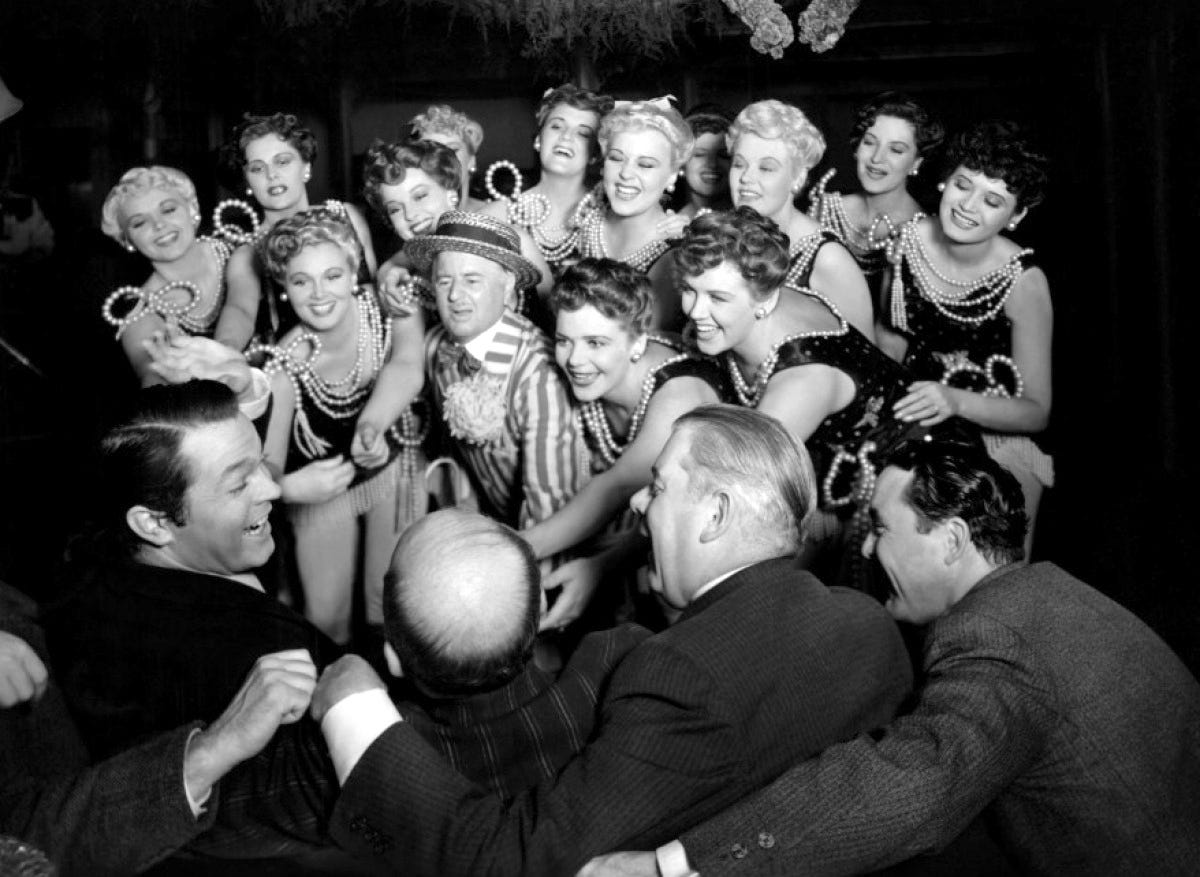
I had a similar feeling 20 or so years ago -- I assumed it must be overrated, and I thought -- "Give me Casablanca! Give me Some Like it Hot! Give me 2001! Give me all of Hitchcock!" Then I gave in and watched Citizen Kane (on TV, alas.) And I was awed. I think for me above all it was the ... I don't have the vocabulary: staging? framing? cinematography? -- the way some shots simply amaze, and also have real meaning.
(Mind you, I'll keep Casablanca, Some Like it Hot, and 2001 as well!)
Another movie that I ignored for years, and which was a revelation when I saw it (just a couple of years ago) is The Apartment. Not as technically innovative as Citizen Kane, but as emotionally powerful. (And, yes, I think among many great directors, Billy Wilder may be my favorite.)
Amazing to think of all the stars that aligned for a young man to create such a work of genius. All the influences within Welles that he was probably not even conscious of, they just flowed together in this story that seized his imagination. Its one of the creative wonders of the twentieth century and because cinema is a great art form, one of the great works of art.