

Emily Brontë is perhaps the most compelling character in Elizabeth Gaskell’s splendid Life of Charlotte Brontë. Though she appears incidentally—it is, after all, the story of her sister’s life—whenever she does appear, she steals the scene, at least for me. Oh Emily—so sullen, so scowling, so fashionless, so desperate for the freedom of solitude!
—that free, wild, untameable spirit, never happy nor well but on the sweeping moors that gathered round her home—that hater of strangers, doomed to live amongst them, and not merely to live but to slave in their service.
Yes, the lack of biographical information about Emily is one of the great losses of English Literature (as are the losses of her other writings, and the novel she had been working on before she died—alas!) Just think of the great life that could have been written—that could have been lived! Below, I have copied out many of the passages from Gaskell that give us glimpses of Emily, which all benefit from Gaskell’s wonderfully careful writing.
Gaskell has commonly been accused of doing Charlotte Brontë a disservice, but that is a contextless moral judgement more suited to modern priorities. Gaskell gives a great study of how a unique talent developed and repressed the sexual side of Brontë’s life in order to allow her a candid reception in a hostile world. It is not Gaskell we must blame for the fact that the author of Jane Eyre was widely assumed to be “a filthy minx” whose mind had “overthrown authority and violated every code human and divine”. To get the Brontë sisters a fair hearing for their work, she had to first subvert the Victorian culture wars. (You can read my views of Gaskell’s book in more detail here—now with no paywall!)
As you will see from the extracts below, Emily’s character was hardly “cleaned up” for the public. She may have read German while she made the bread, but she also beat her dog and shunned society. What emerges is not a demure, feminized picture but a proud singular woman whose immense talent can be seen emanating from her temperament.
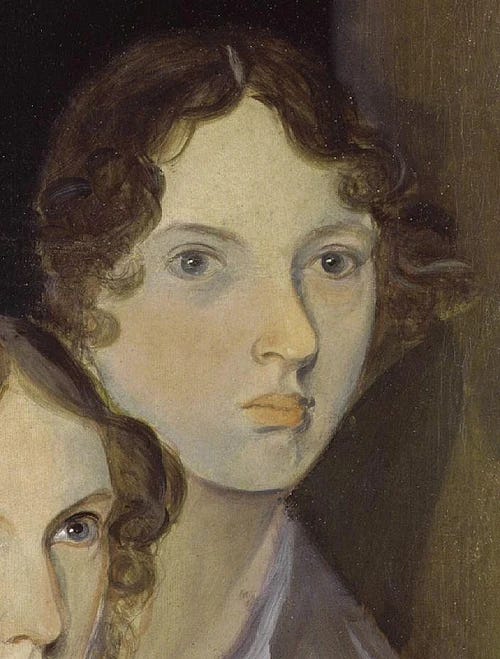
Raised as a reader
Mr. Brontë encouraged a taste for reading in his girls; and though Miss Branwell kept it in due bounds, by the variety of household occupations, in which she expected them not merely to take a part, but to become proficients, thereby occupying regularly a good portion of every day, they were allowed to get books from the circulating library at Keighley; and many a happy walk, up those long four miles, must they have had, burdened with some new book, into which they peeped as they hurried home.
Reserved, not shy
The first impression made on the visitor by the sisters of her school-friend was, that Emily was a tall, long-armed girl, more fully grown than her elder sister; extremely reserved in manner. I distinguish reserve from shyness, because I imagine shyness would please, if it knew how; whereas, reserve is indifferent whether it pleases or not. Anne, like her eldest sister, was shy; Emily was reserved.
Liberty was the breath of Emily’s nostrils
On the 29th of July, 1835, Charlotte, now a little more than nineteen years old, went as teacher to Miss W---’s. Emily accompanied her as a pupil; but she became literally ill from home-sickness, and could not settle to anything, and after passing only three months at Roe Head, returned to the parsonage and the beloved moors.
Miss Brontë gives the following reasons as those which prevented Emily’s remaining at school, and caused the substitution of her younger sister in her place at Miss W—’s:—
“My sister Emily loved the moors. Flowers brighter than the rose bloomed in the blackest of the heath for her;—out of a sullen hollow in a livid hill-side, her mind could make an Eden. She found in the bleak solitude many and dear delights; and not the least and best-loved was—liberty. Liberty was the breath of Emily’s nostrils; without it she perished. The change from her own home to a school, and from her own very noiseless, very secluded, but unrestricted and unartificial mode of life, to one of disciplined routine (though under the kindest auspices), was what she failed in enduring. Her nature proved here too strong for her fortitude. Every morning, when she woke, the vision of home and the moors rushed on her, and darkened and saddened the day that lay before her. Nobody knew what ailed her but me. I knew only too well. In this struggle her health was quickly broken: her white face, attenuated form, and failing strength, threatened rapid decline. I felt in my heart she would die, if she did not go home, and with this conviction obtained her recall. She had only been three months at school; and it was some years before the experiment of sending her from home was again ventured on.”
This physical suffering on Emily’s part when absent from Haworth, after recurring several times under similar circumstances, became at length so much an acknowledged fact, that whichever was obliged to leave home, the sisters decided that Emily must remain there, where alone she could enjoy anything like good health. She left it twice again in her life; once going as teacher to a school in Halifax for six months, and afterwards accompanying Charlotte to Brussels for ten. When at home, she took the principal part of the cooking upon herself, and did all the household ironing; and after Tabby grew old and infirm, it was Emily who made all the bread for the family; and any one passing by the kitchen-door, might have seen her studying German out of an open book, propped up before her, as she kneaded the dough; but no study, however interesting, interfered with the goodness of the bread, which was always light and excellent. Books were, indeed, a very common sight in that kitchen; the girls were taught by their father theoretically, and by their aunt, practically, that to take an active part in all household work was, in their position, woman’s simple duty; but in their careful employment of time, they found many an odd five minutes for reading while watching the cakes, and managed the union of two kinds of employment better than King Alfred.
Religious views
One time I mentioned that some one had asked me what religion I was of (with the view of getting me for a partizan), and that I had said that that was between God and me;—Emily (who was lying on the hearth-rug) exclaimed, ‘That’s right.’ This was all I ever heard Emily say on religious subjects.
Struggles as a teacher
Charlotte and Emily were trying teaching, and, as it seemed, without much success. The former, it is true, had the happiness of having a friend for her employer, and of being surrounded by those who knew her and loved her; but her salary was too small for her to save out of it; and her education did not entitle her to a larger. The sedentary and monotonous nature of the life, too, was preying upon her health and spirits, although, with necessity “as her mistress,” she might hardly like to acknowledge this even to herself. But Emily—that free, wild, untameable spirit, never happy nor well but on the sweeping moors that gathered round her home—that hater of strangers, doomed to live amongst them, and not merely to live but to slave in their service—what Charlotte could have borne patiently for herself, she could not bear for her sister. And yet what to do? She had once hoped that she herself might become an artist, and so earn her livelihood; but her eyes had failed her in the minute and useless labour which she had imposed upon herself with a view to this end.
Impervious to influence
Emily and Anne were bound up in their lives and interests like twins. The former from reserve, the latter from timidity, avoided all friendships and intimacies beyond their family. Emily was impervious to influence; she never came in contact with public opinion, and her own decision of what was right and fitting was a law for her conduct and appearance, with which she allowed no one to interfere. Her love was poured out on Anne, as Charlotte’s was on her. But the affection among all the three was stronger than either death or life.
Of her time studying in Brussels
“After the age of twenty, having meantime studied alone with diligence and perseverance, she went with me to an establishment on the continent. The same suffering and conflict ensued, heightened by the strong recoil of her upright heretic and English spirit from the gentle Jesuitry of the foreign and Romish system. Once more she seemed sinking, but this time she rallied through the mere force of resolution: with inward remorse and shame she looked back on her former failure, and resolved to conquer, but the victory cost her dear. She was never happy till she carried her hard-won knowledge back to the remote English village, the old parsonage-house, and desolate Yorkshire hills.”
Strange fashions and strong opinions
The two sisters clung together, and kept apart from the herd of happy, boisterous, well-befriended Belgian girls, who, in their turn, thought the new English pupils wild and scared-looking, with strange, odd, insular ideas about dress; for Emily had taken a fancy to the fashion, ugly and preposterous even during its reign, of gigot sleeves, and persisted in wearing them long after they were “gone out.” Her petticoats, too, had not a curve or a wave in them, but hung down straight and long, clinging to her lank figure. The sisters spoke to no one but from necessity. They were too full of earnest thought, and of the exile’s sick yearning, to be ready for careless conversation or merry game. M. Héger, who had done little but observe, during the few first weeks of their residence in the Rue d’Isabelle, perceived that with their unusual characters, and extraordinary talents, a different mode must be adopted from that in which he generally taught French to English girls. He seems to have rated Emily’s genius as something even higher than Charlotte’s; and her estimation of their relative powers was the same. Emily had a head for logic, and a capability of argument, unusual in a man, and rare indeed in a woman, according to M. Héger. Impairing the force of this gift, was a stubborn tenacity of will, which rendered her obtuse to all reasoning where her own wishes, or her own sense of right, was concerned. “She should have been a man—a great navigator,” said M. Héger in speaking of her. “Her powerful reason would have deduced new spheres of discovery from the knowledge of the old; and her strong imperious will would never have been daunted by opposition or difficulty; never have given way but with life.” And yet, moreover, her faculty of imagination was such that, if she had written a history, her view of scenes and characters would have been so vivid, and so powerfully expressed, and supported by such a show of argument, that it would have dominated over the reader, whatever might have been his previous opinions, or his cooler perceptions of its truth.
Insensible to any noise or movement
The first and second classes occupied a long room, divided by a wooden partition; in each division were four long ranges of desks; and at the end was the estrade, or platform, for the presiding instructor. On the last row, in the quietest corner, sat Charlotte and Emily, side by side, so deeply absorbed in their studies as to be insensible to any noise or movement around them.
Fierce, wild, intractability: her passion for animals
The helplessness of an animal was its passport to Charlotte’s heart; the fierce, wild, intractability of its nature was what often recommended it to Emily. Speaking of her dead sister, the former told me that from her many traits in Shirley’s character were taken; her way of sitting on the rug reading, with her arm round her rough bull-dog’s neck; her calling to a strange dog, running past, with hanging head and lolling tongue, to give it a merciful draught of water, its maddened snap at her, her nobly stern presence of mind, going right into the kitchen, and taking up one of Tabby’s red-hot Italian irons to sear the bitten place, and telling no one, till the danger was well-nigh over, for fear of the terrors that might beset their weaker minds. All this, looked upon as a well-invented fiction in “Shirley,” was written down by Charlotte with streaming eyes; it was the literal true account of what Emily had done. The same tawny bull-dog (with his “strangled whistle”), called “Tartar” in “Shirley,” was “Keeper” in Haworth parsonage; a gift to Emily. With the gift came a warning. Keeper was faithful to the depths of his nature as long as he was with friends; but he who struck him with a stick or whip, roused the relentless nature of the brute, who flew at his throat forthwith, and held him there till one or the other was at the point of death. Now Keeper’s household fault was this. He loved to steal upstairs, and stretch his square, tawny limbs, on the comfortable beds, covered over with delicate white counterpanes. But the cleanliness of the parsonage arrangements was perfect; and this habit of Keeper’s was so objectionable, that Emily, in reply to Tabby’s remonstrances, declared that, if he was found again transgressing, she herself, in defiance of warning and his well-known ferocity of nature, would beat him so severely that he would never offend again. In the gathering dusk of an autumn evening, Tabby came, half-triumphantly, half-tremblingly, but in great wrath, to tell Emily that Keeper was lying on the best bed, in drowsy voluptuousness. Charlotte saw Emily’s whitening face, and set mouth, but dared not speak to interfere; no one dared when Emily’s eyes glowed in that manner out of the paleness of her face, and when her lips were so compressed into stone. She went upstairs, and Tabby and Charlotte stood in the gloomy passage below, full of the dark shadows of coming night. Down-stairs came Emily, dragging after her the unwilling Keeper, his hind legs set in a heavy attitude of resistance, held by the “scuft of his neck,” but growling low and savagely all the time. The watchers would fain have spoken, but durst not, for fear of taking off Emily’s attention, and causing her to avert her head for a moment from the enraged brute. She let him go, planted in a dark corner at the bottom of the stairs; no time was there to fetch stick or rod, for fear of the strangling clutch at her throat—her bare clenched fist struck against his red fierce eyes, before he had time to make his spring, and, in the language of the turf, she “punished him” till his eyes were swelled up, and the half-blind, stupified beast was led to his accustomed lair, to have his swollen head fomented and cared for by the very Emily herself. The generous dog owed her no grudge; he loved her dearly ever after; he walked first among the mourners to her funeral; he slept moaning for nights at the door of her empty room, and never, so to speak, rejoiced, dog fashion, after her death. He, in his turn, was mourned over by the surviving sister.
Brilliant piece 👏🏼
Wonderful piece, very interesting, thank you