

In the life of a man about who more has been written than almost any other, it is the gaps that most intrigue. The contradictions, complications, and absences of a life that filled thirteen hundred pages (often with conversation) are what most compel our attention.
What is more strange? That there can still be so much we cannot know after thirteen-hundred pages, or that there seem to have been times when absence was all there was, when there is nothing to know? These vacuums are often what makes the writer who stands second only to Shakespeare in the English canon so interesting not just as a writer, but as a man, as a moral example.
He is famous for his moral essays, provocative conversation, and strict view of discipline and religion. He is interesting for all the ways in which he fails to conform to those ideals.
§
He rarely got out of bed in the morning. When he did, it was often to read a book about depression. He paid a great deal of attention to his belly, not just to keep himself well-fed so he could work without distraction—he concocted, out of his knowledge of medicine and food, his own syrups of figs and orange peel to keep digestion regular. He had no ear for music, and little appreciation of the visual arts, but few could claim to be better read in Latin or in English. He rolled, twitched, gesticulated, squinted, touched himself compulsively; he took religion so seriously he would admonish people fiercely in the middle of conversation; sometimes his political views came out in sulking fits. The woman he is thought to have loved, who said he would have been a hero to his own valet, once rated his personality traits out of twenty: for religion, morality, and general knowledge, he scored twenty; for person and voice, manner, and good humour she gave him zero.
A supporter of women’s education and accomplishments, in an age of patronising patriarchy, he gave Latin lessons to girls and women of his acquaintance, read and complimented (by quoting from memory) the novels of women writers, promoted their work, advised them and helped them get published; but he treated women with the same contempt he treated men, and when Catherine Macaulay published her radical History of England, which was republican, he not only refused to read it, but got into the habit of making toasts in her name, mockingly, when a toast to the King was called for. This was the same King, who he once said, if the people of England could be fairly polled, would be sent out of England, and his adherents hanged.
He so loved the hierarchical order of society, he thought the King—chosen by Parliament, a German Elector, and thus not the direct descendant of James II—was not the true King. It is not known what he was doing in 1745, the year in which a rebellion by James II’s descendants was launched against the throne. He wrote anonymous pamphlets which were sympathetic to the rebels’ cause. Scholars of his work argue bitterly in petty tones about where he might have been, and what he might have been doing. After recording the details of a rant about the recent history of England’s kings, his biographer declines to keep adding details of the expostulation, and instead merely notes, “He roared with prodigious violence against George the Second.”
This man who so loved hierarchy was an abolitionist before the abolitionist movement. He once shocked the company at a university dinner by making his toast to “the next insurrection of Negroes in the West Indies.” He took in a twelve year old boy, a freed slave, and trained him as a servant, eventually leaving him the majority of his estate. This servant, Francis Barber, had gatherings of other free Black Britons at his house.
Married once, widowed for much of his life, he was a lonely figure; tall; gangling; scarred on his face; lank and bony in youth; corporal and portly as he aged. His diary records his masturbations, sometimes three in a morning. He made several remarks about being whipped by women. He once picked up a woman almost starved to death in the streets, carrying her home upon his back, feeding her, housing her, imploring her not to work as a prostitute. He worried for her soul. Despite never being well-off, he frequently dropped change into the laps of the homeless, street beggars; thousands starved to death each year in London, he raged, and few cared enough to disperse pennies.
He was a great drinker, until he became teetotal and turned his addictive drinking onto tea, which he would take cups of all day, sometimes until the early hours of the morning. At Hester Thrale’s house, he sat in the garden, working, until the little girl interrupted him, who he would chat with, giving her sugar mice. They wrote to each other for years afterwards. He talked for victory: it was said that if he missed his shot he turned the pistol round and smacked the butt of it onto your head,—but not with the girl, who he adored. When children were made to perform in public, he moaned. He could talk about his ailments all night, halfway to the dawn. So many legitimate complaints had he, that his doctor once complained that listening to them made him almost suicidal.
He was torrentially productive: poems, reviews, histories, biographies, magazine articles on every subject, volumes of letters, a tragic play, hundreds and hundreds of essays spiritual moral and technical, a short novel, translations, literary criticism, sermons, legal opinions, travel writing, political pamphlets, scientific pamphlets, an edition of Shakespeare, a dictionary. He considered himself to be idle. He wrote for the market, not for patronage. He understood how commercial society worked many years before Adam Smith wrote The Wealth of Nations. Aged seventy-three, nineteen months before his death, he sat and talked on Good Friday morning about how hospitable one should be when rich (making calculations as he spoke), about why people in London collected bones from the street (boiled for wheel grease; used for knife handles; burned, ground, and sold to chemists to line the pots in which they heated compounds), about the collection of orange peel to make a fragrant oil, about the fixed and variable costs of building garden walls and the viability of such a product taking land cost and potential yield into account, about whether priests should admit to their training in oratory, about the process by which language first occurred.
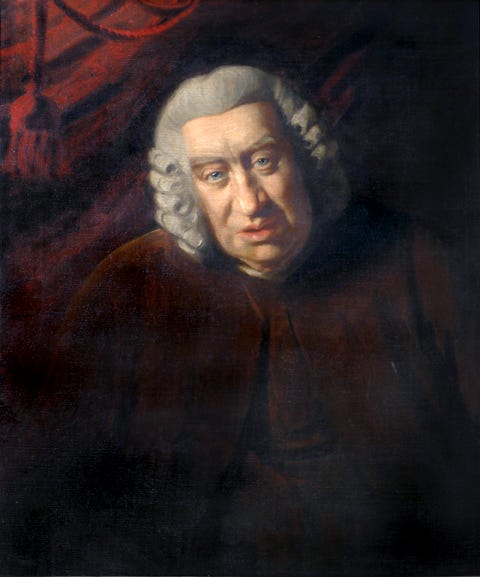
He was thought to be so great a man, so important to England’s literature, the government gave him a pension for life; before that he had been in jail for debt several times. Once the dictionary was written, his fame was secure: gossip columns, cartoons, salons, a nationwide nickname, an honorary doctorate, an audience with the king. Sir Joshua Reynolds, portraitist of the well to do, painted him looking scholarly. His definitions are still quoted today, often for their acerbic wit. He became known for his shabby, shambling, almost squalid appearance. Where once he had sat stimming and muttering in the corner, while people asked if he was a lunatic, his presence now was sought by all the great and good, and the rest. He is the towering, defining figure of his times. He has become a meme.
This vast, incomprehensible, complicated man was not famous for any one aspect of his life or work. The dictionary coincided with the moral essays and the novel; the poetry and journalism had first made his name in literary London; he was revolutionary in the field of biography. His work was gaspingly admired (and sometimes despised as teeth-breakingly difficult) across the country, across the generations. He was never the most famous, the most successful, but he was often recognised as the most significant.
Above all, this man was full of assertions and contradictions. He was so often an outsider who became an insider. About him, there are open questions of masochism and insurrection. He had no degree but became the foremost scholar of his times. He had no wife for much of his life, but wrote powerfully about marriage. He was so genuinely troubled by the thought that he might go insane, that he asked his friend Hester Thrale to lock him in his room all day (he performed mathematical calculations to keep himself occupied). He wrote his own prayers. He worried, more and more darkly as he aged, with an increasingly real terror, that he would go to hell.
He is the most famous and influential moralist in England’s history. He is Samuel Johnson.
§
Johnson is thought to be a man of order. In religion, politics, and literary criticism he is seen as prizing regularity, obedience, traditional form. He disliked the poet John Donne for yoking unrelated ideas violently together. When he left church, he complained loudly that the sermon praised liberty instead of rebuking licence. When Catherine Macaulay’s History of England was anti-monarchical, he embarrassed her by asking if she would invite her footmen to dine with her. He enjoyed the joke so much, he told the story to friends.
But Johnson is not a moralist of the monovocal and the orderly. He knew the power of exclusion, dissent, and failure. As a boy, he skipped church: people looked at him, at his uncontrollable movements. As an unhappily married man, he lay on the bed with another woman, cuddling and feeling her until he sent her away, appalled at himself. In middle-age, he battled depression, long delayed professional success, and his own idleness. His sexual impulses were strong, and somewhat mysterious. His fears of madness don’t seem to have been hypochondriac, but an extension of his dark depressions.
Moral advice is everywhere in Johnson’s work, not just the essays that expressly deal with ethical questions. In an age obsessed with taxonomy, the codification of knowledge, the scientific revolution, with understanding and categorising everything, Johnson was a voice of warning. Knowledge can be ordered. People cannot. He spent his whole life in the struggle for peace of mind. As a moralist, that was what he wrote about. Not the smooth and orderly outcome, but the struggle.
Much of Johnson’s insight captures the worser side of human nature, about which he is obdurately, provocatively truthful. He wants to expose all parts of the human mind to reason, to understanding. He knows about all the little vanities of man.
“Every man has a lurking wish to appear considerable in his native place.”
“No man is a hypocrite in his pleasures.”
“It is man’s own fault, it is from want of use, if his mind grows torpid in old age.”
“All censure of a man’s self is oblique praise. It is in order to shew how much he can spare.”
“I would rather be attacked than unnoticed. For the worst thing you can do to an author is to be silent as to his works.”
“There are people whom one should like very well to drop, but would not wish to be dropped by.”
“It is strange that there should be so little reading in the world, and so much writing. People in general do not willingly read, if they can have any thing else to amuse them.”
Johnson was able to specify any number of human frailties. Many of his sharpest lines come not from his essays, but were delivered to someone’s face. Johnson was not a lurker, a moralist who only let his thoughts out on the page; everywhere he went, Johnson preached. But he was generous, pragmatic, concerned not just to puncture hypocrisy, but to genuinely encourage better living. “I am a great friend to public amusements; for they keep people from vice.” Johnson combined strict ideals with a deep understanding of how hard it was to live up to them. He knew that most of all from personal experience.
§
Johnson contracted to start work on the Dictionary in 1746; he finished in 1755. He was forty-six. The Dictionary is an extraordinary accomplishment of scholarship, composition, and imagination to come from just one mind. But it was not all Johnson did in those years. In 1748 he published his most successful poem The Vanity of Human Wishes. Starting in 1750, he wrote the Rambler, a twice-weekly essay, with topics covering religion, morality, literature, social manners, psychology, marriage, and many other topics. The Rambler was published for over two years, more than two hundred essays in total. From 1758–1760, Johnson wrote the Idler, another set of essays, simpler and more direct than the Rambler. In 1759, he wrote Rasselas, a philosophical novella which has been described as having more wisdom than any other book by multiple writers and critics. All the while, he was often slowly working at his edition of Shakespeare. And there were minor works, too. In 1755, he wrote two pamphlets to promote Zachariah Williams’s theories of longitude.
But around 1760, Johnson came to a halt. After his enormously productive fifteen-year period, Johnson lost his energy. Working on the Dictionary involved reading an enormous number of books to select the one-hundred-and-ten-thousand quotations used to illustrate the meanings of words. This massive input had given Johnson the material to furnish all his other works. Rather than crowding out any other pursuits, the demands of the dictionary seemed to leave Johnson with so much extra material—left over quotations, spill over thoughts—that he had to use up, he produced far more around the time he was writing the Dictionary than in other periods. He had a hot-streak and it came to an abrupt end.
Two friends became large fixtures of the second half of his life—James Boswell who later wrote Johnson’s biography, and Hester Thrale, with who he was probably in love. But he didn’t meet them until 1763 and 1765 respectively. 1763 was also the year when the famous Club was formed, the society of learned men who met once a month and talked about their ideas, covering art, politics, economics, philosophy, music, literature, and affairs of the day. Boswell, Thrale, and The Club gave Johnson a new lease of life involving travel, socialisation, and discussion of ideas. Before them, though, there was a gap in Johnson’s life, the lost years of 1760–1763, perhaps longer.
Although he was famous and respected for his Dictionary, Johnson now lived a lonely, squalid life, with no routine, no work, and seemingly no purpose. When people visited him, they were astonished at the visible dirt in his rooms, the sparse furniture, the small ugly wig that hardly fitted on top of his head. One friend turned up hoping to write a letter and found that the great author had no paper, ink, or pen in his possession. He fasted, on one occasion, for two days.
As one old acquaintance had said of him before the Dictionary, when Johnson was an anonymous figure living in near poverty, Johnson now seemed quite lost to himself and to the world. The difference now was that his fame was secure, his great work was done. But to Johnson, it was a bleak period. So many of the pessimistic things he had written about human life in the last fifteen years seemed to be coming true. He didn’t believe that age would perform the promises of youth, or that the deficiencies of the present day would be supplied by the morrow, as he wrote in Rasselas, but now he had the melancholy indignity of living through his own projections. The wisdom of misery had caught up with him.
And instead of coming out and barking, Johnson sat at home: driven into a corner.
§
Throughout the Rambler, Johnson warns against letting short-term pleasures distract you from long-term happiness. This is a mistake he made a lot during his lost years. The most famous anecdote about his drinking, when he was woken up in the small hours by two young acquaintances and said, what you dogs I’ll go drinking with you, comes from this period. During his marriage, Johnson had become a teetotaller. Now he drank so much, he wrote ruefully about it in his diary. The young William Cowper—who went on to become a famous poet, translator of Homer, hymn writer, and member of the abolition movement—lived opposite Johnson at this time, but neither man had any idea. 1760 was such a slow year that as well as finding no published work, Boswell found no letter sent to any of Johnson’s friends. At Easter 1761, Johnson described himself as “dissipated and useless.”
For three years, the man who is so often quoted as advising friends when depressed to “be not solitary, be not idle” seems to have been just that.
This rises to near Johnsonian splendor of insight and prose. I can think of no figure better suited to counteract contemporary fluff, fashion and fads. Johnson’s moral seriousness and the vigor of his prose remain unmatched. His fears, his foibles, and his loneliness make him all the more approachable. I hope you have introduced him to a new generation.
Superb. Also, don’t forget Beryl Bainbridge’s lovely book - According to Queenie.