

For the last few weeks, when I have been able to arise and walk early enough, I have seen the rosy-fingered dawn, while the birdsong was filling the air, along with the thin translucent mists we get on cold mornings when your breath plumes as thick as an ostrich feather. Nothing is as beautiful as spring, and under the pink and orange light of April we can “See where the child with winged feet,/Runs down the slanted sunlight of the dawn.” This is the hour of “the dewdrop’s mystery.” The time of day when trees and houses and buses hold the charm of rising light. Ugliness is illuminated into beauty.
America is good at suburbs, especially the rich suburbs of D.C., where spies and bureaucrats and regulators live. There are roads so long you drive past houses with numbers like 10831. These roads keep running, round bends, over the bulge of a bridge, like a river on the edge of a wood. In many of the suburbs the cars roll along steady and quiet and persistent like sharks. One thinks of those scenes in the movies, Studebakers and station wagons inching along a perfectly boring road. Everything has enough space: the deer and the raccoon and the chipmunk as well as the family of four. The yellow school bus arrives as expectedly as the boy running through the courtyard so as not to be late. Soon the lawyers and lobbyists will be arriving at work.
The George Washington Parkway which runs around the Virginia border of D.C. is frequently beautiful and often semi-unusable, full of lumps, humps, cracks, and holes, but despite its flaws it is always full of minivans and SUVs, the modern equivalent of the station wagon. The Potomac shimmers in the sun, while people picnic by the water, which laps against rocks and driftwood, as children run in the grass and the adults chat lazily in fold-out chairs. Everyone gets a parking space at these nature spots and can bring as much furniture as they need—tremendous portable luxury. Over the river, even the splayed arches of the Woodrow Wilson Memorial Bridge look attractive in the sunlight.
Driving uptown, I missed the turn by the Lincoln Memorial, then took the wrong fork further along, and ended-up in Rock Creek Park, going up Cathedral Street, and saw the trees of the park taller than the roads that run above other roads. Here you find yourself going deadly slowly through streets so quiet you can begin to believe the people in the houses must be asleep or absent or making interrogations. Drive the other way, down to Fountainhead Regional Park, and you pass houses so big they could hold several families. In the strip mall, slow-moving locals stop off for frappuccinos. There is always construction. Zoning laws give the effect of provincialism arriving in an instant as you cross an invisible regulatory line.
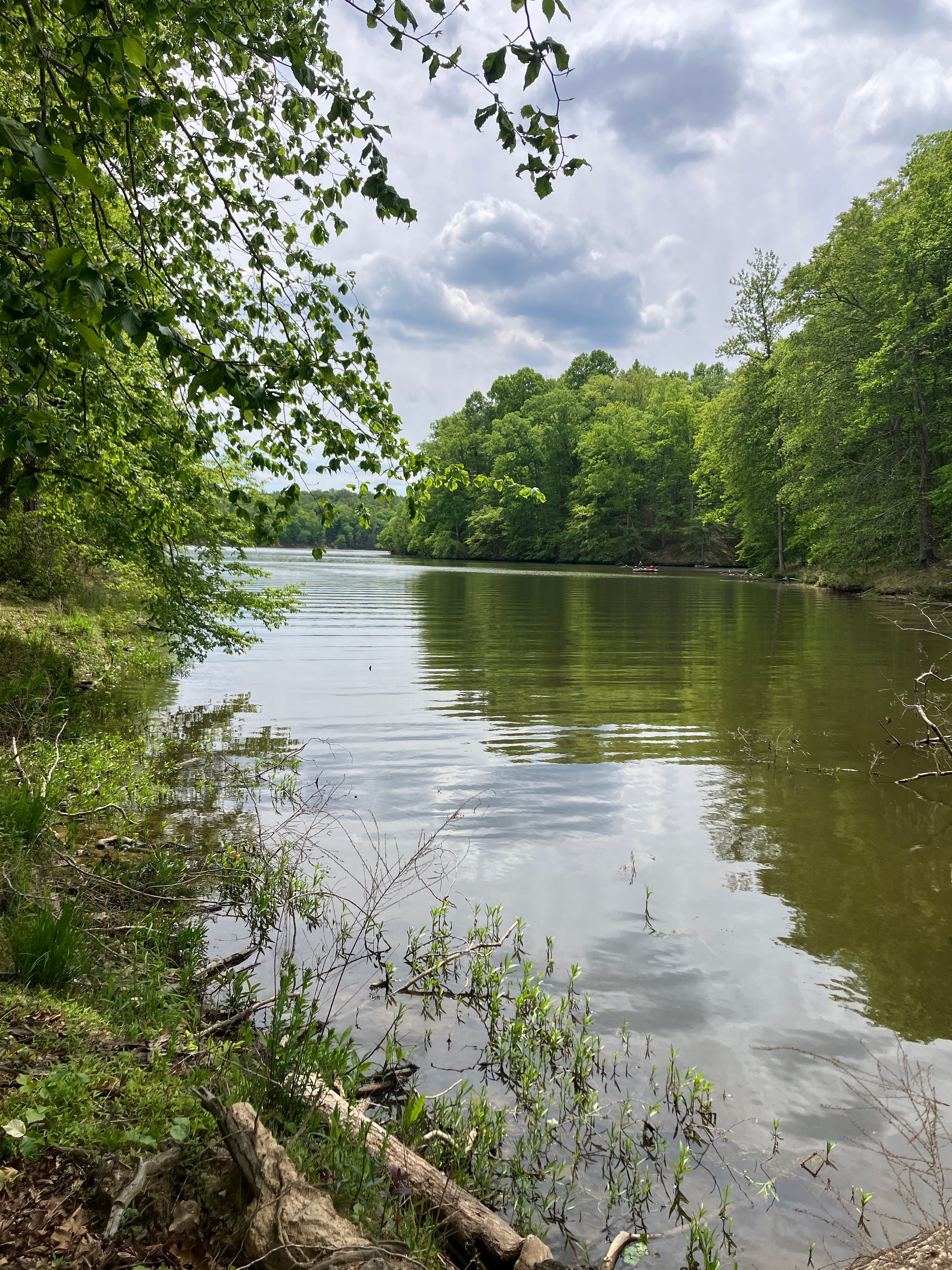
Fountainhead is a picture-book American forest—though, of course, it is not out of a picture book, but out of the movies. Long thin trees cluster together as in a hundred films and television shows we used to watch on slow afternoons. Here are the women who walk with poles and backpacks, the middle-aged married couple on a hike, the young man and his headphones, the lady and her dog. Mountain bikers fly up the bumps. Men sit quietly in fishing boats. A vulture circles higher and higher. In the distance, we hear the loud reverberations of a woodpecker. There are bouncy wooden bridges over small streams that become wide rivers. There are hollowed tree stumps, steeply rising paths with hunks of quartz, a crushed beer tin in a tree trunk, a can of corn by the shore.
Now is the time of spring’s coolness. The breeze and shade detain the heat. The trees look fresh and new. But the flowers are falling. The blossom is over and the rhododendrons and azaleas are nearly over. Far away in north D.C., the tulips at Hillwood House are peaking and about to wilt. Here the tiny blue flowers by the path will soon go to seed. As we walk back to the car, we hear an oven bird, whose loud clear song fills the forest from some hidden spot. So much of what we have seen are tropes from American films, and tropes of real American life. The oven bird is familiar from Robert Frost. “He says that leaves are old and that for flowers/Mid-summer is to spring as one to ten.”
The sun has begun its decline. One of the fishing boats is gone now. The young man in headphones is sloping back. Bikers are strapping their bikes onto car racks. As we leave the forest, we come back to aggressive American driving, the need to get things done before bed. The late sun sinks behind the trees and lights the undersides of the high-raised roads. Dogwood flowers gleam in the evening glow. We pass the filling stations and see the price of gas is rising, rising. A fire truck goes past. The 24-hour diner sign still shines. There were two dozen cars at the shore when we left—owners and boats were still launched on the Occoquan.
In Washington, there are secrets, heard and unheard, in Congress, the White House, and the Court—at Langley, Rosslyn, the Pentagon— and in all the agencies and institutions and non-profits that fill the grid. Somewhere back in the woods, the oven bird is still singing. “The question that he frames in all but words / Is what to make of a diminished thing.”
“Then comes that other fall we name the fall.”
Henry, you really need to go West! "The West is to the East as ten to ten." Both great parts of the country. Reading about the eastern part of the country as it is filtered through a mind that observes so carefully and writes so well makes me long for the same mind to travel the mountains and prairies and vast spaces of the Mountain West. Everyone would win, but you most of all.
"While here I stand, not only with the sense
Of present pleasure, but with pleasing thoughts
That in this moment there is life and food
For future years..."
WW had it right.