
Hermione Lee is the renowned biographer of Virginia Woolf, Edith Wharton, Penelope Fitzgerald, and, most recently, Tom Stoppard. Stoppard died at the end of last year, so Hermione and I talked about the influence of Shaw and Eliot and Coward on his work, the recent production of The Invention of Love, the role of ideas in Stoppard’s writing, his writing process, rehearsals, revivals, movies. We also talked about John Carey, Brian Moore, Virginia Woolf as a critic. Hermione is Emeritus Professor of English Literature at the University of Oxford. Her life of Anita Brookner will be released in September.
Transcript
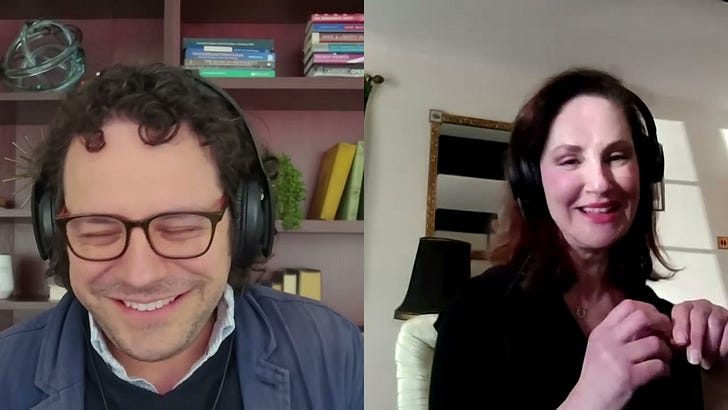
Henry Oliver: Today I have the great pleasure of talking to Professor Dame Hermione Lee. Hermione was the first woman to be appointed Goldsmiths’ Professor of English Literature at the University of Oxford, and she is the most renowned and admired living English biographer. She wrote a seminal life of Virginia Woolf. She’s written splendid books about people like Willa Cather, Edith Wharton, and my own favorite, Penelope Fitzgerald. And most recently she has been the biographer of Tom Stoppard, and I believe this year she has a new book coming out about Anita Brookner. Hermione, welcome.
Hermione Lee: Thank you very much.
Oliver: We’re mostly going to talk about Tom Stoppard because he, sadly, just died. But I might have a few questions about your broader career at the end. So tell me first how Shavian is Stoppard’s work?
Lee: He would reply “very close Shavian,” when asked that question. I think there are similarities. There are obviously similarities in the delighting forceful intellectual play, and you see that very much in Jumpers where after all the central character is a philosopher, a bit of a bonkers philosopher, but still a very rational one.
And you see it in someone like Henry, the playwright in The Real Thing, who always has an answer to every argument. He may be quite wrong, but he is full of the sort of zest of argument, the passion for argument. And I think that kind of delight in making things intellectually clear and the pleasure in argument is very Shavian.
Where I think they differ and where I think is really more like Chekov, or more like Beckett or more in his early work, the dialogues in T. S. Elliot, and less like Shaw is in a kind of underlying strangeness or melancholy or sense of fate or sense of mortality that rings through almost all the plays, even the very, very funny ones. And I don’t think I find that in Shaw. My prime reading time for Shaw was between 15 and 19, when I thought that Shaw was the most brilliant grownup that one could possibly be listening to, and I think now I feel less impressed by him and a bit more impatient with him.
And I also think that Shaw is much more in the business of resolving moral dilemmas. So in something like Arms and the Man or Man and Superman, you will get a kind of resolution, you will get a sort of sense of this is what we’re meant to be agreeing with.
Whereas I think quite often one of the fascinating things about Stoppard is the way that he will give all sides of the question; he will embody all sides of the question. And I think his alter ego there is not Shaw, but the character of Turgenev in The Coast of Utopia, who is constantly being nagged by his radical political friends to make his mind up and to have a point of view and come down on one side or the other. And Turgenev says, I take every point of view.
Oliver: I must confess, I find The Coast of Utopia a little dull compared to Stoppard’s other work.
Lee: It’s long. Yes. I don’t find it dull. But I think it may be a play to read possibly more than a play to see now. And you’re never going to get it put on again anyway because the cast is too big. And who’s going to put on a nine-hour free play, 50 people cast about 19th-century Russian revolutionaries? Nobody, I would think.
But I find it very absorbing actually. And partly because I’m so interested in Isaiah Berlin, who is a very strong presence in the anti-utopianism of those plays. But that’s a matter of opinion.
Oliver: No. I like Berlin. One thing about Stoppard that’s un-Shavian is that he says his plays begin as a noise or an image or a scene, and then we think of him as this very thinking writer. But is he really more of an intuitive writer?
Lee: I think it’s a terribly good question. I think it gets right at the heart of the matter, and I think it’s both. Sorry, I sound like Turgenev, not making my mind up. But yes, there is an image or there is an idea, or there are often two ideas, as it were, the birth of quantum physics and 18th-century landscape gardening. Who else but Stoppard would put those two things in one play, Arcadia, and have you think about both at once.
But the image and the play may well have been a dance between two periods of time together in one room. So I think he never knew what the next play was going to be until it would come at him, as it were. He often resisted the idea that if he chose a topic and then researched it, a play would come out of it. That wasn’t what happened. Something would come at him and then he would start doing a great deal of research usually for every play.
Oliver: What sort of influence did T. S. Elliot have on him? Did it change the dialogue or, was it something else?
Lee: When I was working with him on my biography, he gave me a number of things. I had extraordinary access, and we can perhaps come back to that interesting fact. And most of these things were loans he gave them to me to work on. Then I gave them back to him.
But he gave me as a present one thing, which was a black notebook that he had been keeping at the time he was writing Rosencrantz and Guildenstern, and also his first and only novel Lord Malquist and Mr. Moon, which is little known, which he thought was going to make his career. The book was published in the same week that Rosencrantz came up. He thought the novel was going to make his career and the play was going to sink without trace. Not so. In the notebook there are many quotations from T. S. Elliot, and particularly from Prufrock and the Wasteland, and you can see him working them into the novel and into the play.
“I am not Prince Hamlet nor was meant to be.” And that sense of being a disconsolate outsider. Ill at ease with and neurotic about the world that is charging along almost without you, and you are having to hang on to the edge of the world. The person who feels themself to be in internal exile, not at one with the universe. I think that point of view recurs over and over again, right through the work, but also a kind of epigrammatical, slightly mysterious crypticness that Elliot has, certainly in Prufrock and in the Wasteland and in the early poems. He loved that tone.
Oliver: Yes. When I read your paper about that I thought about Rosencrantz and Guildenstern quite differently. I’ve always disliked the idea that it’s a sort of Beckett imitation play. It seems very Elliotic having read what you described.
Lee: There is Beckett in there. You can’t get away from it.
Oliver: Surface level.
Lee: Beckett’s there, but I think the sense of people waiting around—Stoppard’s favorite description of Rosencrantz was: “It’s two journalists on a story that doesn’t add up, which is very clever and funny.”
Yes. And that sense of, Vladimir going, “What are we supposed to be doing and how are we going to pass the time?” That’s profoundly influential on Stoppard. So I don’t think it’s just a superficial resemblance myself, but I agree that Elliot just fills the tone of that play and other things too.
Oliver: In the article you wrote about Stoppard and Elliot, the title is about biographical questing, and you also described Arcadia as a quest. How important is the idea of the quest to the way you work and also to the way you read Stoppard?
Lee: I took as the epigraph for my biography of Stoppard a line from Arcadia: “It’s wanting to know that makes us matter, otherwise we’re going out the way we came in.” So I think that’s right at the heart of Stoppard’s work, and it’s right at the heart of any biographical work, whether or not it’s mine or someone else’s. If you can’t know, in the sense of knowing the person, knowing what the person is like, and also knowing as much as possible about them from different kinds of sources, then you might as well give up.
You can’t do it through impressions. You’ve got to do it through knowledge. Of course, a certain amount of intuition may also come into play, though I’m not the kind of biographer that feels you can make things up. Working on a living person, this is the only time I’ve done that.
It was, of course, a very different thing from working on a safely dead author. And I knew Penelope Fitzgerald a little bit, but I had no idea I was going to write her biography when I had conversations with her and she wouldn’t have told me anything anyway. She was so wicked and evasive. But it was a set up thing; he asked me to do it. And we had a proper contract and we worked together over several years, during which time he became a friend, which was a wonderful piece of luck for me.
I was doing four things, really. One was reading all the material that he produced, everything, and getting to know it as well as I could. And that’s obviously the basic task. One was talking to him and listening to him talk about his life. And he was very generous with those interviews. I’m sure there were things he didn’t tell me, but that’s fine. One was talking to other people about him, which is a very interesting process. And with someone like him who knew everyone in the literary, theatrical, cultural world, you have to draw a halt at some point. You can’t talk to a thousand people, or I’d have still been doing it, so you talk to particularly fellow playwrights, directors, actors who’ve worked with him often, as well as family and friends. And then you start pitting the versions against each other and seeing what stands up and what keeps being said.
Repetition’s very important in that process because when several people say the same thing to you, then you know that’s right. And that quest also involves some actual footsteps, as Richard Holmes would say. Footsteps. Traveling to places he’d lived in and going to Darjeeling where he had been to school before he came to England, that kind of travel.
And then the fourth, and to me, in a way, almost the most exciting, was the opportunity to watch him at work in rehearsal. So with the director’s permissions, I was allowed to sit in on two or three processes like that, the 50th anniversary production of Rosencrantz and Guildenstern at the Old Vic with David Lavoie. And Patrick Marber’s wonderful production of Leopoldstadt and Nick Hytner’s production of The Hard Problem at the National. So I was able to witness the very interesting negotiations going on between Tom and the director and the cast.
And also the extraordinary fact that even with a play like Rosencrantz, which is on every school syllabus and has been for 50—however many years—he was still changing things in rehearsal. I can’t get over that. And in his view, as he often said, theater is an event and not a text, and so one could see that actual process of things changing before one’s very eyes, and that for a biographer, it’s a pretty amazing privilege.
Oliver: How much of the plays were written during rehearsal do you think?
Lee: Oh, 99% of the plays were written with much labor, much precision, much correction alone at his desk. The text is there, the text is written, and everything changes when you go into the rehearsal room because you suddenly find that there isn’t enough time with that speech for the person to get from the bed to the door. It’s physics; you have to put another line in so that someone can make an entrance or an exit, that kind of thing.
Or the actors will say quite often, because they were a bit in awe—by the time he became well known—the actors initially would be a bit in awe of the braininess and the brilliance. And quite often the actors will be saying, “I’m sorry, I don’t understand. I don’t understand this.” You’d often get, “I don’t really understand.”
And then he would never be dismissive. He would either say, “No, I think you’ve got to make it work.” I’m putting words into his mouth here. Or he would say, “Okay, let’s put another sentence or something like that.”
Oliver: Between what he wrote at his desk and the book that’s available for purchase now, how much changed? Is it 10%, 50? You know what I mean?
Lee: Yes. You should be talking to his editor at Faber, Dinah Wood. So Faber would print a relatively small number for the first edition before the rehearsal process and the final production. And then they would do a second edition, which would have some changes in it. So 2%. Okay. But crucial sometimes.
Oliver: No, sure. Very important.
Lee: And also some plays like Jumpers went through different additions with different endings, different solutions to plot problems. Travesties, he had a lot of trouble with the Lenins in Travesties because it’s the play in which you’ve got Joyce and you’ve got Tristan Tzara and you’ve got the Lenins, and they’re all these real people and he makes him talk.
But he was a little bit nervous about the Lenin. So what he gave him to say were things that they had really said, that Lenin had really said. As opposed to the Tzara-Joyce stuff, which is all wonderfully made up. The bloody Lenins became a bit of a problem for him. And so that gets changed in later editions you’ll find.
Oliver: How closely do you think The Real Thing is based on Present Laughter by Noël Coward?
Lee: Oh, I think there’s a little bit of Coward in there. Yes, sure. I think he liked Coward, he liked Wilde, obviously. He likes brilliant, witty, playful entertainers. He wants to be an entertainer. But I think The Real Thing, he was proud of the fact that The Real Thing was one of the few examples of his plays at that time, which weren’t based on something else. They weren’t based on Hamlet. They weren’t based on The Importance of Being Earnest. It’s not based on a real person like Housman. I think The Real Thing came out of himself much more than out of literary models.
Oliver: You don’t think that Henry is a bit like the actor character in Present Laughter and it’s all set in his flat and the couples moving around and the slight element of farce?
The cricket bat speech is quite similar to when Gary Essendine—do you remember that very funny young man comes up on the train from Epping or somewhere and lectures him about the social value of art. And Gary Essendine says, “Get a job in a theater rep and write 20 plays. And if you can get one of them put on in a pub, you’ll be damn lucky.” It’s like a model for him, a loose model.
Lee: Yes. Henry, I think you should write an article comparing these two plays.
Oliver: Okay. Very good. What does Stoppardian mean?
Lee: It means witty. It means brilliant with words. It means fizzing with verbal energy. It means intellectually dazzling. The word dazzling is the one that tends to get used. My own version of Stoppardian is a little bit different from, as it were, those standard received and perfectly acceptable accounts of Stoppardian.
My own sense of Stoppardian has more to do with grief and mortality and a sense of not belonging and of puzzlement and bewilderment, within all that I said before, within the dazzling, playful astonishing zest and brio of language and the precision about language.
Oliver: Because it’s a funny word. It’s hard to include Leopoldstadt under the typical use of Stoppardian, because it’s an untypical Stoppard.
Lee: One of the things about Leopoldstadt that I think is—let’s get rid of that trope about Stoppardian—characteristic of him is the remarkable way it deals with time. Here’s a play like Arcadia, all set in the same place, all set in the same room, in the same house, and it goes from a big hustling room, late 19th-century family play, just like the beginning of The Coast of Utopia, where you begin with a big family in Russia and then it moves through the ’20s and then into the terrible appalling period of the Anschluss and the Holocaust.
And then it ends up after the war with an empty room. This room, is like a different kind of theater, an empty room. Three characters, none of whom you know very well, speaking in three different kinds of English, reaching across vast spaces of incomprehension, and you’ve had these jumps through time.
And then at the very end, the original family, all of whom have been destroyed, the original family reappears on the stage. I’m sorry to tell this for anyone who hasn’t seen Leopoldstadt. Because when it happens on the stage, it’s an absolutely astonishing moment. As if the time has gone round and as if the play, which I think it was for him, was an act of restitution to all those people.
Oliver: How often did he use his charm to get his way with actors?
Lee: A lot. And not just actors. People he worked with, film people, friends, companions. Charm is such an interesting thing, isn’t it? Because we shouldn’t deviate, but there’s always a slightly sinister aspect to the word charm as in, a magic charm. And one tends to be a bit suspicious of charm. And he knew he had charm and he was physically very magnetic and good looking and very funny and very attentive to people.
But I think the charm, in his case, he did use it to get the right results, and he did use it, as he would say, “to look after my plays.” He was always, “I want to look after my plays.” And that’s why he went back to rehearsal when there were revivals and so on. But he wasn’t always charming. Patrick Marber, who’s a friend of his and who directed Leopoldstadt, is very good on how irritable Stoppard could be sometimes in rehearsal. And I’ve heard that from other directors too—Jack O’Brien, who did the American productions of things like The Invention of Love.
If Stoppard felt it wasn’t right, he could get quite cross. So this wasn’t a sort of oleaginous character at all. It’s not smooth, it’s not a smooth charm at all. But yes, he knew his power and he used it, and I think in a good way. I think he was a benign character actually. And one of the things that was very fascinating to me, not only when he died and there was this great outpouring of tributes, very heartfelt tributes, I thought. But also when I was working on the biography, I was going around the world trying to find people to say bad things about him, because what I didn’t want to do was write a hagiography. You don’t want to do that; there would be no point. And it was genuinely quite hard.
And I don’t know the theater world; it’s not my world. I got to know it a little bit then. But I have never necessarily thought of the theater world as being utterly loving and generous about everybody else. I’m sure there are lots of rivalries and spitefulness, as there is in academic life, all the rest of it. But it was very hard to find anyone with a bad word to say about him, even people who’d come up against the steeliness that there is in him.
I had an interview with Steven Spielberg about him, with whom he worked a lot, and with whom he did Empire of the Sun. And I would ask my interviewees if they could come up with two or three adjectives or an adjective that would sum him up, that would sum Stoppard up to them. And when I asked Spielberg this question, he had a little think and then he said, intransigent. I thought, great. He must be the only person who ever stood up to him.
Oliver: What was his best film script? Did he write a really great film.
Lee: That one. I think partly the novel, I don’t know if you know the Ballard novel, the Empire of the Sun, it’s a marvelous novel. And Ballard was just a magical and amazing writer, a great hero of mine. But I think what Stoppard did with that was really clever and brilliant.
I know people like Brazil, the Terry Gilliam sort of surrealist way. And there’s some interesting early work. Most of his film work was not one script; it was little bits that he helped with. So there’s famously the Indiana Jones and the Last Crusade, he did most of the dialogue for Harrison Ford.
But there are others like the One Hundred and One Dalmatians, where I think there’s one line, anonymously Stoppardian in there. One of the things about the obituaries that slightly narked me was that there, I felt there was a bit too much about the films. Truly, I don’t think the film work was—he wanted it to be right and he wanted to get it right—but it wasn’t as close to his heart as the theater work. And indeed the work for radio, which I thought was generally underwritten about when he died. There was some terrific work there.
Oliver: Yes. And there aren’t that many canonical writers who’ve been great on the radio.
Lee: Absolutely. He did everything. He did film, he did radio. He wrote some opera librettos. He really did everything. And on top of that, there was the great work for the public good, which I think is a very important part of his legacy, his history.
Oliver: How much crossover influence is there between the different bits of his career? Does the screenwriting influence the theater writing and the radio and so on? Or is he just compartmentalized and able to do a lot of different things?
Lee: That’s such an interesting question. I don’t think I’ve thought about it enough. I think there are very cinematic aspects to some of the plays, like Night and Day, for instance, the play about journalism. That could easily have been a film.
And perhaps Hapgood as well, although it could be a kind of John le Carré type film thriller, though it’s such a set of complicated interlocking boxes that I don’t know that it would work as a film. It’s not one of my favorite players, I must say. I struggle a little bit with Hapgood. But, yes, I’m sure that they fed into each other. Because he was so busy, he was often doing several things at once. So he was keeping things in boxes and opening the lid of that box. But mentally things must have overlapped, I’m sure.
Oliver: He once joked that rather than having read Wittgenstein from cover to cover, he had only read the covers. How true is that? Because I know some people who would say he’s very clever in everything, but he’s not as clever as he looks. It’s obviously not true that he only read the covers.
Lee: I think there was a phase, wasn’t there, after the early plays when people felt that he was—it’s that English phrase, isn’t it—too clever by half. Which you would never hear anyone in France saying of someone that they were too clever by half. So he was this kind of jazzy intellectual who put all his ideas out there, and he was this sort of self-educated savant who hadn’t been to Oxford.
There was quite a lot of that about in the earlier years, I think. And a sense that he was getting away with it, to which I would countermand with the story of the writing of The Invention of Love. So what attracted him to the figure of Housman initially was not the painful, suppressed homosexual love story, but the fact that here was this person who was divided into a very pernickety, savagely critical classical editor of Latin and a romantic lyric poet. In order to work out how to turn this into a play, he probably spent about six years taking Latin lessons, reading everything he could read on the history of classical literature. Obviously reading about Housman, engaging in conversation with classical scholars about Housman’s, finer points of editorial precision about certain phrases. And what he used from that was the tip of the iceberg. But the iceberg was real.
He really did that work and he often used to say that it was his favorite play because he’d so much enjoyed the work that went into it. I think he took what he needed from someone like Wittgenstein. I know you don’t like The Coast of Utopia very much, but if you read his background to Coast of Utopia, what went into it, and if you compare what’s in the plays, those three plays, with what’s in the writing about those revolutionaries, he read everything. He may have magpied it, but he’s certainly knows what he’s talking about. So I defend him a bit against that, I think.
Oliver: Good, good. Did you see the recent production at the Hamstead Theatre of The Invention of Love?
Lee: I did, yes.
Oliver: What did you think?
Lee: I liked it. I thought it was rather beautifully done. I liked those boats rowing around that clicked together. I thought Simon Russell Beale was extremely good, particularly very moving. And very good in Housman’s vindictiveness as a critic. He is not a nice person in that sense. And his scornfulness about the women students in his class, that kind of thing. And so there was a wonderful vitriol and scorn in Russell Beale’s performance.
I think when you see it now, some of the Oxford context is a little bit clunky, those scenes with Jowett and Pater and so on, it’s like a bit of a caricature of the context of cultural life at the time, intellectual life at the time. But I think that the trope of the old and the young Housman meeting each other and talking to each other, which I still think is very moving. I thought it worked tremendously well.
Oliver: What are Tom Stoppard’s poems like?
Lee: You see them in Indian Ink where he invents a poet, Flora Crewe, who is a poet who was died young, turn of the century, bold feminist associated with Bloomsbury and gets picked up much later as a kind of Sylvia Plath-type, HD type heroine. And when you look at Stoppard’s manuscripts in the Harry Ransom Center in the University of Austin, in Texas, there is more ink spent on writing and rewriting those poems of Flora Crewe than anything else I saw in the manuscript. He wrote them and rewrote them.
Early on he wrote some Elliot—they’re very like Elliot—little poems for himself. I think there are probably quite a lot of love poems out there, which I never saw because they belong to the people for whom he wrote them. So I wouldn’t know about those.
Oliver: How consistently did Stoppard hold to a kind of liberal individualism in his politics?
Lee: He was accused of being very right wing in the 1980s really, 1970s, 1980s, when the preponderant tendency for British drama was radicalism, Royal Court, left wing, all of that. And Stoppard seemed an outlier then, because he approved of Thatcher. He was a friend of Thatcher. He didn’t like the print union. It was particularly about newspapers because he’d been a newspaper man in his youth. That was his alternative university education, working in Bristol on the newspapers. He had a romance heroic feeling about the value of the journalist to uphold democracy, and he hated the pressure of the print unions to what he thought at the time was stifling that.
He changed his mind. I think a lot about that. He had been very idealistic and in love with English liberal values. And I think towards the end of his life he felt that those were being eroded. He voted lots of different ways. He voted conservative, voted green. He voted lib dem. I don’t if he ever voted Labour.
Oliver: But even though his personal politics shifted and the way he voted shifted, there is something quite continuous from the early plays through to Rock ‘n’ Roll. Is there a sort of basic foundation that doesn’t change, even though the response to events and the idea about the times changes?
Lee: Yes, I think that’s right, and I think it can be summed up in what Henry says in The Real Thing about politics, which is a version of what’s often said in his plays, which is public postures have the configuration of private derangement. So that there’s a deep suspicion of political rhetoric, especially when it tends towards the final solution type, the utopian type, the sense that individual lives can be sacrificed in the interest of an ultimate rationalized greater good.
And then, he’s worked in the ’70s for the victims of Soviet communism. His work alongside in support of Havel and Charter 77. And he wrote on those themes such as Every Good Boy Deserves Favour and Professional Foul. Those are absolutely at the heart of what he felt. And they come back again when he’s very modest about this and kept it quiet. But he did an enormous amount of work for the Belarus exile, Belarus Free Theater collective, people in support of those trying to work against the regime in Belarus.
And then the profound, heartfelt, intense feeling of horror about what happened to people in Leopoldstadt. That’s all part of the same thing. I think he’s a believer in individual freedom and in democracy and has a suspicion of political rhetoric.
Oliver: How much were some of his great parts written for specific actors? Because I sometimes have a feeling when I watch one of his plays now, if I’d been here when Felicity Kendal was doing this, I would be getting the whole thing, but I’m getting most of it.
Lee: I’m sure that’s right. And he built up a team around him: Peter Wood, the director and John Wood who’s such an extraordinary Henry Carr in in in Travesties. And Michael Hordern as George the philosopher in Jumpers. And he wrote a lot for Kendal, in the process of becoming life companions.
But he’d obviously been writing and thinking of her very much, for instance, in Arcadia. And also I think very much, it’s very touching now to see the production of Indian Ink that’s running at Hampstead Theatre in which Felicity Kendal is playing the older woman, the surviving older sister of the poet Flora Crewe, where of course the part of Flora Crewe was written for her. And there’s something very touching about seeing that now. And, in fact, the first night of that production was the day of Stoppard’s funeral. And Kendal couldn’t be at the funeral, of course, because she was in the first night of his play. That’s a very touching thing.
Oliver: Why did he think the revivals came too soon?
Lee: I don’t really know the answer to that. I think he thought a play had to hook up a lot of oxygen and attract a lot of attention. If you were lucky while it was on, people would remember the casting and the direction of that version of it, and it would have a kind of memory. You had to be there.
But people who were there would remember it and talk about it. And if you had another production very soon after that, then maybe it would diminish or take away that effect. I think he had a sort of loyalty to first productions often. What do you think about that? I’m not quite sure of the answer to that.
Oliver: I don’t know. To me it seems to conflict a bit with his idea that it’s a living thing and he’s always rewriting it in the rehearsal room. But I think probably what you say is right, and he will have got it right in a certain way through all that rehearsing. You then need to wait for a new generation of people to make it fresh again, if you like.
Lee: Or not a generation even, but give it five years.
Oliver: Everyone new and this theater’s working differently now. We can rework it in our own way. Can we have a few questions about your broader career before we finish?
Lee: Depends what they are.
Oliver: Your former colleague John Carey died at a similar time to Stoppard. What do you think was his best work?
Lee: John Carey’s best work? Oh. I thought the biography of Golding was pretty good. And I thought he wrote a very good book on Thackery. And I thought his work on Milton was good. I wasn’t so keen on The Intellectuals and the Masses. He and I used to have vociferous arguments about that because he had cast Virginia Woolf with all the modernist fascists, as it were. He’d put her in a pile with Wyndham Lewis and Ezra Pound and so on. And actually, Virginia Woolf was a socialist feminist. And this didn’t seem to have struck him because he was so keen to expose her frightful snobbery, which is what people in England reading Woolf, especially middle class blokes, were horrified by.
And she is a snob, there’s no doubt about it. But she knew that and she lacerated herself for it too. And I think he ignored all the other aspects of her. So I was angry about that. But he was the kind of person you could have a really good argument with. That was one of the really great things about John.
Oliver: He seems to be someone else who was amenable and charming, but also very steely.
Lee: Yes, I think he probably was I think he probably was. You can see that in his memoir, I think.
Oliver: What was Carmen Callil like?
Lee: Oh. She was a very important person in my life. It was she who got me involved in writing pieces for Virago. And it was she who asked me to write the life of Virginia Woolf for Chatto. And she was an enormous, inspiring encourager as she was to very many people. And I loved her.
But I was also, as many people were, quite daunted by her. She was temperamental, she was angry. She was passionate. She was often quite difficult. Not a word I like to use about women because there’s that trope of difficult women, but she could be. And she lost her temper in a very un-English way, which was quite a sight to behold. But I think of her as one of the most creative and influential publishers of the 20th century.
Oliver: Will there be a biography of her?
Lee: I don’t know. Yes, it’s a really interesting question, and I’ve been asking her executors whether they have any thoughts about that. Somebody said to me, oh, who wants a biography of a publisher? But, actually, publishers are really important people often, so I hope there would be. Yes. And it would need to be someone who understood the politics of feminism and who understood about coming from Australia and who understood about the Catholic background and who understood about her passion for France. And there are a whole lot of aspects to that life. It’s a rich and complex life. Yes, I hope there will be someday.
Oliver: Her papers are sitting there in the British Library.
Lee: They are. And in fact—you kindly mentioned this to start with—I’ve just finished a biography of the art historian and novelist, Anita Brookner, who won the Booker prize in 1984 for a novel called Hotel du Lac.
And Carmen and Anita were great buddies, surprisingly actually, because they were very different kinds of characters. And the year before she died, Carmen, who knew I was working on Anita, showed me all her diary entries and all the letters she’d kept from Anita. And that’s the kind of generous person that she was.
That material is now sitting in the British Library, along with huge reams of correspondence between Carmen and many other people. And it’s an exciting archive.
Oliver: She seems to have had a capacity to be friends with almost anyone.
Lee: Yes, I think there were people she would not have wanted to be friends with. She was very disapproving of a lot of political figures and particularly right-wing figures, and there were people she would’ve simply spat at if she was in the room with them. But, yes, she an enormous range of friends, and she was, as I said, she was fantastically encouraging to younger women writers.
And, also, another aspect of Carmen’s life, which I greatly admired and was fascinated by: In Virago she would often be resuscitating the careers of elderly women writers who had been forgotten or neglected, including Antonia White and including Rosamund Lehmann. And part of Carmen’s job at Virago, as she felt, was not just to republish these people, some of whom hadn’t had a book published for decades, but also to look after them. And they were all quite elderly and often quite eccentric and often quite needy. And Carmen would be there, bringing them out and looking after them and going around to see them. And really marvelous, I think.
Oliver: Yes, it is. Tell me about Brian Moore.
Lee: Breean, as he called himself.
Oliver: Oh, I’m sorry.
Lee: No, it’s all right. I think Brian became a friend because in the 1980s I had a book program on Channel 4, which was called Book Four. It had a very small audience, but had a wonderful time over several years interviewing lots and lots of writers who had new books out. We didn’t have a budget; it was a table and two chairs and not the kind of book program you see on the television anymore. And I got to know Brian through that and through reviewing him a bit and doing interviews with him, and my husband and I would go out and visit him and his wife Jean.
And I loved the work. I thought the work was such a brilliant mixture of popular cultural forms, like the thriller and historical novel and so on. And fascinating ideas about authority and religion and how to be free, how to break free of the bonds of what he’d grown up with in Ireland, in Northern Ireland, the bombs of religious autocracy, as it were. And very surreal in some ways as well. And he was also a very charming, funny, gregarious person who could be quite wicked about other writers.
And, he was a wonderfully wicked and funny companion. What breaks my heart about Brian Moore is that while he was alive, he was writing a novel maybe every other year or every three years, and people would review them and they were talked about, and I don’t think they were on academic syllabuses but they were really popular. And when he died and there were no more books, it just went. You can think of other writers like that who were tremendously well known in their time. And then when there weren’t any more books, just went away. You ask people, now you go out and ask people, say, “What about The Temptation of Eileen Hughes or The Doctor’s Wife or Black Robe? And they’ll go, “Sorry?”
Oliver: If anyone listening to this wants to try one of his novels, where do you say they should start?
Lee: I think I would start with The Doctor’s Wife and The Temptation of Eileen Hughes. And then if one liked those, one would get a taste for him. But there’s plenty to choose from.
Oliver: What about Catholics?
Lee: Yes. Catholics is a wonderful book. Yes. Wonderful book. Bit like Muriel Spark’s The Abbess of Crewe, I think.
Oliver: How important is religion to Penelope Fitzgerald’s work?
Lee: She would say that she felt guilty about not having put her religious beliefs more explicitly into her fiction. I’m very glad that she didn’t because I think it is deeply important and she believes in miracles and saints and angels and manifestations and providence, but she doesn’t spell it out.
And so when at the end of The Gate of Angels, for instance, there is a kind of miracle on the last page but it’s much better not to have it spelt out as a miracle, in my view. And in The Blue Flower, which is not my favorite of her books, but it’s the book of the greatest genius possibly. And I think she was a genius. There is a deep interest in Novalis’s romantic philosophical ideas about a spiritual life, beyond the physical life, no more doctrinally than that. And she, of course, believes in that. I think she believed, in an almost Platonic way, that this life was a kind of cave of shadows and that there was something beyond that. And there are some very mysterious moments in her books, which, if they had been explained as religious experiences, I think would’ve been much less forceful and much less intense.
Oliver: What is your favorite of her books?
Lee: Oh, The Beginning of Spring. The Beginning of Spring is set in Moscow just before the revolution. And its concerns an Englishman who runs a print and publishing works. And it’s based quite a lot on some factual narratives about people in Moscow at the time. And it’s about the feeling of that place and that time, but it’s also about being in love with two people at the same time.
And, yes, and it’s about cultural clashes and cultural misunderstanding, and it is an astonishingly evocative book. And when asked about this book, interviewers would say to Penelope, oh, she must have lived in Moscow for ages to know so much about it. And sometimes she would say, “Yes, I lived there for years.” And sometimes she would say, “No, I’ve never been there in my life.” And the fact was she’d had a week’s book tour in Moscow with her daughter. And that was the only time she ever went to Russia, but she read. So it was a wonderful example of how she would be so wicked; she would lie.
Oliver: Yes.
Lee: Because she couldn’t be bothered to tell the truth.
Oliver: But wasn’t she poking fun at their silly questions?
Lee: Yes. It’s not such a silly question. I would’ve asked her that question. It is an astonishing evocation of a place.
Oliver: No, I would’ve asked it too, but I do feel like she had this sense of it’s silly to be asked questions at all. It’s silly to be interviewed.
Lee: I interviewed her about three times—and it was fascinating. And she would deflect. She would deflect, deflect. When you asked her about her own work, she would deflect onto someone else’s work or she would tell you a story. But she also got quite irritable.
So for instance, there’s a poltergeist in a novel called The Bookshop. And the poltergeist is a very frightening apparition and very strong chapter in the book. And I said to her in interview, “Look, lots of people think this is just superstition. There aren’t poltergeists.” And she looked at me very crossly and said they just haven’t been there. They don’t know what they’re talking about. Absolutely factual and matter of fact about the reality of a poltergeist.
Oliver: What makes Virginia Woolf’s literary criticism so good?
Lee: Oh, I think it’s a kind of empathy actually. That she has an extraordinary ability to try and inhabit the person that she’s writing about. So she doesn’t write from the point of view of, as it were, a dry, historical appreciation.
She’s got the facts and she’s read the books, but she’s trying to intimately evoke what it felt like to be that writer. I don’t mean by dressing it up with personal anecdotes, but just she has an extraordinary way of describing what that person’s writing is like, often in images by using images and metaphors, which makes you feel you are inside the story somehow.
And she loves anecdotes. She’s very good at telling anecdotes, I think. And also she’s not soft, but she’s not harshly judgmental. I think she will try and get the juice out of anything she’s writing about. Most of these literary criticism pieces were written for money and against the clock and whilst doing other things.
So if you read her on Dorothy Wordsworth or Mary Wollstonecraft or Henry James, there’s a wonderful sense of, you feel your knowledge has been expanded. Knowledge in the sense of knowing the person; I don’t mean in the sense of hard facts.
Oliver: Sure. You’ve finished your Anita Brookner biography and that’s coming this year.
Lee: September the 10th this year, here and in the States.
Oliver: What will you do next?
Lee: Yes. That’s a very good question, though a little soon, I feel.
Oliver: Is there someone whose life you always wanted to write, but didn’t?
Lee: No. No, there isn’t. Not at the moment. Who knows?
Oliver: You are open to it. You are open.
Lee: Who knows what will come up.
Oliver: Yes. Hermione Lee, this was a real pleasure. Thank you very much.
Lee: Thank you very much. It was a treat.