

According to my records, in one month during my first year of reading the Great Books, I read Madame Bovary, Emma, Pale Fire, Lolita, Paradise Lost, The Trial, Rousseau’s Confessions, and Marcus Aurelius’s Meditations. I was working a full-time job but had no social life, and I didn’t have much to do—sometimes I pasted entire books into word documents so I could read them on my laptop at work. This is how I read Voltaire, Edmund Burke, Sinclair Lewis, and Gabriel García Márquez.
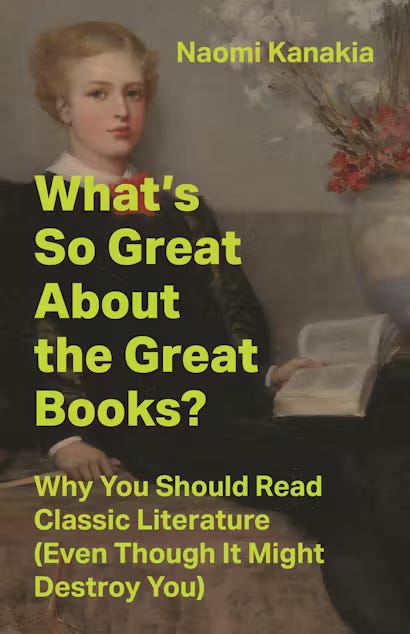
What’s So Great About the Great Books, written by Substack’s own Naomi Kanakia will be out in May. I was happy to write this blurb:
Naomi Kanakia’s deep love and knowledge of classic literature make her the perfect guide for readers who are just beginning the adventure of reading the Great Books or a charming companion for those who have been reading them all their lives. What’s So Great About the Great Books is practical, honest, straightforward, sensible, and amusing. It’s exactly what we need right now.
And here is a review from Isaac Kolding. I have been looking at Naomi’s book again today to prepare for an interview with her. She takes a more sociological and political approach than I usually do, but what I was struck by, as on my first reading, is how direct, personal, and honest she is—Naomi is the anti-snob. Her book is a splendid example of her main principle: anyone can read the Great Books.
As she says:
My aim in this book isn’t to tell you exactly what’ll happen if you read the Great Books, it’s just to convince you that there is a good chance something will happen. Because I think the real fear isn’t that the Great Books might destroy us—we long to be destroyed, long to be altered. The real fear is that we’d spend a lot of time slogging through these old tomes and experience nothing at all. And that, I think, is a fear that is usually without merit. If you spend enough time with the Great Books, I am positive that you will be altered by the experience.
Looking forward to the interview!
Thank you for your interesting observations on reading the classics.
I wonder why she thinks reading these books will "destroy" us? Nothing is further from that idea.
Usually, I argue with points that do not agree with my mindset, and resolve the question by either agreeing with the argument or I feel lucky enough to be in a different world.