

This is a subscribers’ only essay about Jane Eyre ahead of the Book Club on 9th July about Elizabeth Gaskell’s biography of Charlotte Bronte. My thanks to Hollis Robbins for prompting me to think a little more carefully about this novel.
Jane Eyre is the first example of a Bildungsroman in English that is about a woman. A Bildungsroman is a novel of coming of age, the novel of maturity. Central to Jane’s personal development is her feminist beliefs that women should enjoy more autonomy, their lives should be about more than darning socks and stirring puddings. But Jane Eyre is more than this, it is not just feminist but a Christian, feminist, Bildungsroman.
The essential element of this novel is contrast and balance. It is about the tension of duty and freedom, Christianity and feminism, self and other. Jane wants to be accommodated within the system, not to reject it. The Dictionary of National Biography says this:
By emphasizing the importance of a balance between reason and passion in Jane's journey towards social and spiritual maturity, Charlotte Brontë created a Bildungsroman focused not only on the individual's negotiation of the external world but on the well-being of one's interior life. The reader is apprised of Jane's internal world through the use of biblical, literary, and pictorial allusion, through fairy tale, dream, and myth.
Some critics have denied or downplayed the role of religion in this novel, no doubt influenced by the fact that Elizabeth Gaskell overplayed the meek obedience of Charlotte Brontë, disguising her sexual life. But in our quest to restore passion to Bronte and her novel, it is a mistake to exclude what one critic called
the way Brontë blends feminism and Christianity such that women of faith like Jane Eyre, and Charlotte herself at times, are not disempowered but find strength to obey God even if it means going against social and literary norms and conventional morality.
This struggle begins right at the start of the novel. Think of the scene when she spoke to the apothecary about how she was not prepared to leave a rich cruel house for a poor one, Jane reflects, “I was not heroic enough to purchase liberty at the price of caste.” When she tells her aunt the truth, that she is a nasty deceitful woman, Jane says, “my soul began to expand, to exult, with the strangest sense of freedom, of triumph.”
Throughout the novel, Jane is presented with examples of religious men—some clergy, some not—and has to choose which of them she respects as genuine Christians. What critics don’t take seriously enough is that it is St. John,—that cold, creepy, patriarch who gets the final line:
The last letter I received from him drew from my eyes human tears, and yet filled my heart with divine joy: he anticipated his sure reward, his incorruptible crown. I know that a stranger’s hand will write to me next, to say that the good and faithful servant has been called at length into the joy of his Lord. And why weep for this? No fear of death will darken St. John’s last hour: his mind will be unclouded, his heart will be undaunted, his hope will be sure, his faith steadfast. His own words are a pledge of this—
“My Master,” he says, “has forewarned me. Daily He announces more distinctly,—‘Surely I come quickly!’ and hourly I more eagerly respond,—‘Amen; even so come, Lord Jesus!’”
People have been discovering the secret repudiation of religion in Jane Eyre ever since it was published. This is a classic sort of too-clever-to-be-clever criticism. Brontë wrote this is a preface, addressing these claims
I would suggest to such doubters certain obvious distinctions; I would remind them of certain simple truths. Conventionality is not morality. Self-righteousness is not religion. To attack the first is not to assail the last. To pluck the mask from the face of the Pharisee, is not to lift an impious hand to the Crown of Thorns.
Brontë was from an evangelical, Anglican family; her father was a priest, and she and her sisters held a strong faith. Evangelical methodism was present in Charlotte’s home through her mother and then her aunt. Though inspired by evangelical theology, the Bronte family was liberal, reading was encouraged, as was political discussion, they were allowed to play cards and perform plays. This is not austere Calvinism or joyless puritanism.
The essence of evangelism is the direct knowledge of God, the revelation of God to the individual. Painted a few years after Jane Eyre was published, Holman Hunt’s Light of the World, depicts Christ based on a verse from Revelations: “Behold I stand at the door and knock; if any man hear my voice, and open the door, I will come in to him, and will sup with him, and he with me.” Here is Christ made flesh to man. Here is the basis of conversion, another core tenet of the evangelical.
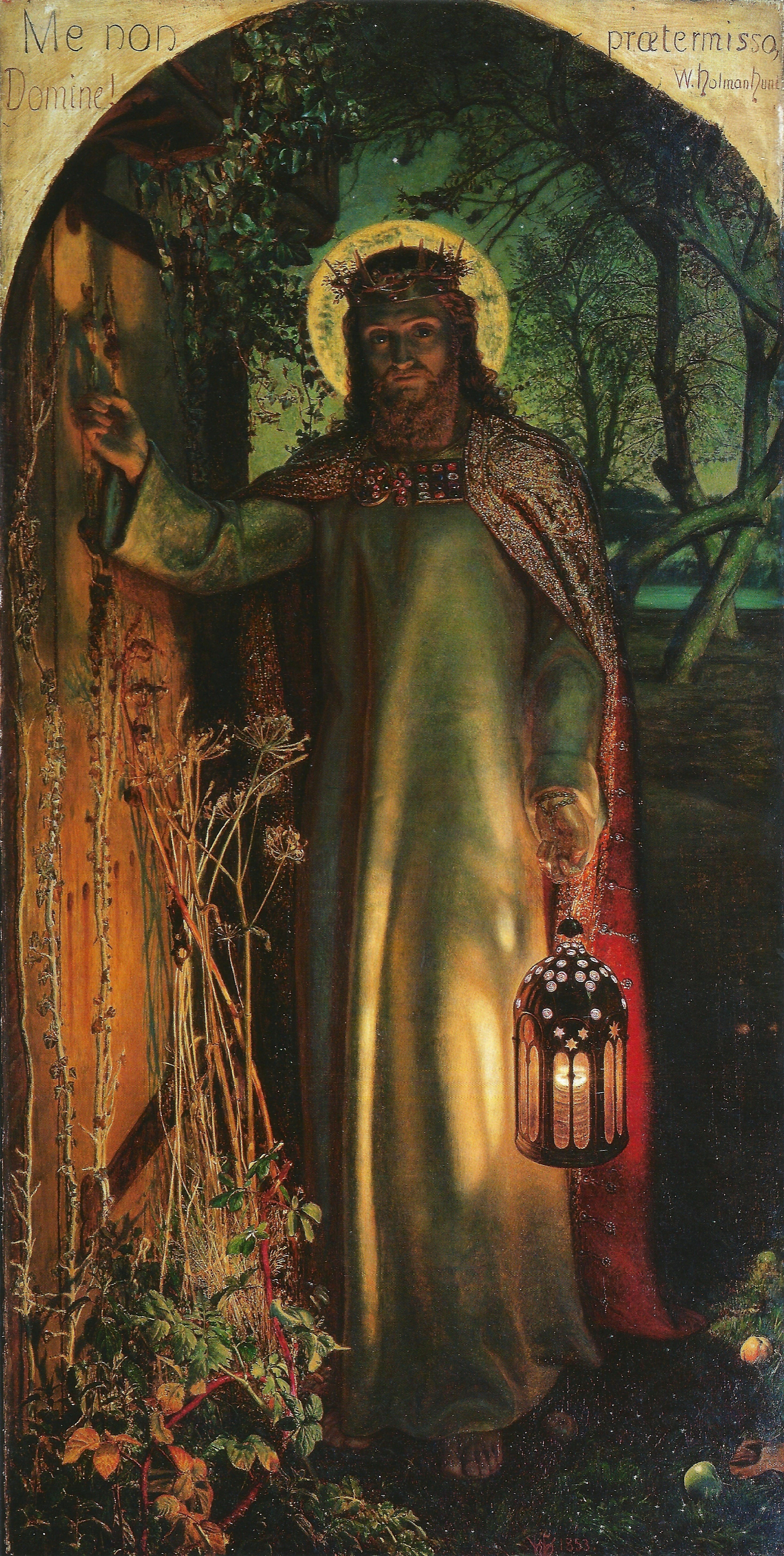
The importance of evangelism is that although women remain second class citizens, subject to the hierarchy of men, in their relationship with God they can step out of the hierarchy. They can hear the voice and open the door. Again and again Jane displays that, like Hamlet, she has that within which passeth show. The outer form of religion is shown to be false, in her aunt, and most damningly in Brocklehurst. These people have got got the tune of the time and outward habit of encounter. Jane, on the other hand, has genuine inner religion.
This contrast means Jane can challenge outward authority: she is unwilling to accept their social and moral control over her. As Emily Griesinger, whose paper I am relying on for this essay, writes:
The assurance of being saved and the experience of being intimately in touch with God became an important source of independence and power for Victorian women willing to challenge traditional religious authority and eventually social and political authority as well.
Jane’s conversion then is not in accordance with the adult who put on a show of religion, but with those who have undeniable inner faith and goodness, who are directly connected to God. The most important of them, as well as St. John, is Helen Burns, one of the great characters of English fiction. Although Brontë praises St. John at the end, he is Calvinist and she, and Jane Eyre, are not.
Helen is a martyr who preaches acceptance, codified in Johnson’s novella Rasselas, which she is reading. Jane does not entirely accept what Helen tells her, but she absorbs her lessons about God’s grace. Her story from now on is a religious one, in which she has to balance the need to confront injustice, as she did with her cousins, and remain true to her faith.
Hence, when she discovers Rochester is married she tells him she will not marry him. They can only be married as equals before God. Rochester tempts her away from her love for God. “My future husband was becoming to me my whole world; and, more than the world: almost my hope of heaven…I could not, in those days, see God for his creature: of whom I had made an idol.” Jane here is referencing the first commandment: “You shall not make for yourselves an idol.”
And so, inspired by her dream of the moon, the virgin goddess Diana, she leaves Thornfield, and takes her own path, eventually turning up at St. John’s door, in a manner reminiscent of the Holman Hunt picture above.
St. John is her final challenge—another idol, who would impose himself in front of her God. Sounding like Carlyle, Jane says of St. John
All men of talent, whether they be men of feeling or not; whether they be zealots, or aspirants, or despots — provided only they be sincere — have their sublime moments: when they subdue and rule. I felt veneration for St. John — veneration so strong that its impetus thrust me at once to the point I had so long shunned. I was tempted to cease struggling with him — to rush down the torrent of his will into the gulf of his existence, and there to lose my own.
This is explicitly Christian feminism: St. John, like Rochester, is threatening to control her access to God—and Jane cannot accept that. As Griesinger says,
If a “Christian feminist bildungsroman” traces the development of an autonomous spiritual “self “ against the social, psychological, and religious constraints of patriarchy, then in this section, Jane constructs an authentic, personal faith in direct opposition to the patriarchal authority of St. John Rivers, who seeks to impose what he believes is God’s will on her life. Jane’s response to St. John is radically feminist, Protestant, and biblical. She is willing to submit to Gods will, but she must determine that will for herself: “I sincerely, deeply, fervently longed to do what was right; and only that. ‘Shew me—she me the path!’ I entreated of Heaven.”
So Jane asserts her independence by appealing directly to Heaven. She becomes an autonomous women by becoming an autonomous Christian. Griesinger says this is
a remarkable (for Bronte’s day) assertion of women’s spiritual authority and an equally memorable rejection of the idea predominant among Victorians, and still dominant in many conservative evangelical churches, that women must always be “under” the spiritual authority of men.
This is why the woman who stood on the ramparts of Thornfield crying feminism can go back and marry Rochester. When she hears Rochester calling out, Jane interprets that as God’s doing. She marries him when she is able to maintain her independence before God. As she says, “God did not give me my life to throw away.”

