

Some writers make their novels out of beautiful, well-turned sentences, and some from flowing pages. In the popular jargon, some novelists work at the level of the sentence, crafting their worked-upon language, while others are immersive story-tellers. This second type of writer is more liable to be dismissed by highbrow, aesthete, or flat-out pretentious reviewers, while the first type is likely to be found wanting by a certain sort of practitioner-critic. If there is still such a thing as highbrows who hate middlebrows, this is the topic on which the highs will be roused to a bear-like defence of the narrow principles they hold to be dear and self-evident.
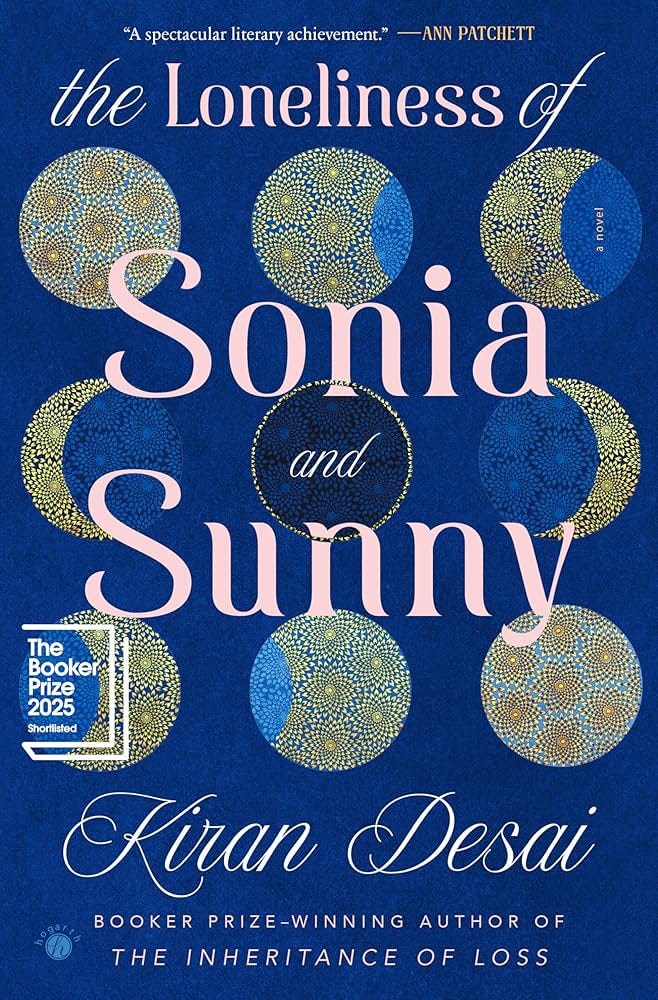
In The Loneliness of Sunny and Sonia, as in her previous two novels (The Inheritance of Loss and Hullaballoo in the Guava Orchard), Kiran Desai is squarely the second type of author. There is nothing wrong with her sentences: many are lovely, and some of them have an aphoristic turn: but she writes pages, not phrases: one often feels the sharp pull at the end of her chapters as the curtain falls, suddenly, and cuts us off from the immersion we had reached. One feels, too, the lack of craft in some of her sentences. But that is no matter: indeed, much of the time, it is part of how she makes her immersive pages.
Here is half a page from The Inheritance of Loss, which gives as good a demonstration of this effect as any.
This aqueous season would last three months, four, maybe five. In Cho Oyu, a leak dripping into the toilet played a honky-tonk, until it was interrupted by Sai, who held an umbrella over herself when she went inside the bathroom. Condensation fogged the glass of clocks, and clothes hanging to dry in the attic remained wet for a week. A white scurf sifted down from the beams, a fungus spun a shaggy age over everything. Bits of color, though, defined this muffled scene: insects flew in carnival gear; bread, in a day, turned green as grass; Sai, pulling open her underwear drawer, found a bright pink jelly scalloping the layers of dreary cotton; and the bound volumes of National Geographic fell open to pages bruised with flamboyant disease, purple-yellow molds rivaling the bower birds of Papua New Guinea, the residents of New Orleans, and the advertisements—“It’s better in the Bahamas!”—that it showcased.
Sai had always been calm and cheerful during these months, the only time when her life in Kalimpong was granted perfect sense and she could experience the peace of knowing that communication with anyone was near impossible. She sat on the veranda, riding the moods of the season, thinking how intelligent it was to succumb as all over Kalimpong modernity began to fail. Phones emitted a death rattle, televisions tuned into yet another view of the downpour. And in this wet diarrheal season floated the feeling, loose and light, of life being a moving, dissipating thing…
Perhaps you can nit-pick some of this, depending on your tastes and the extent to which your critical attitudes are based in the enforcement of persnickety “rules” of composition, but one can hardly deny that the passage as a whole works to establish “the peace of knowing that communication with anyone was near impossible”. Desai gives a full sense of the mood of the place she wishes you to inhabit. To achieve this, her narrative voice is not bounded by the character or what the character can observe. It acts like the camera in a film: the character is seen in and against the background of their surroundings, and we are narrated to with a fluid ease. Sometimes we are bounded by character perspective; sometimes the camera cuts, flips perspective, gives us the sense of looking at another corner of the room, while the action can be heard off-camera.
In the London Review of Books, Adam Mars Jones quoted this paragraph as an instance of this narrative scope.
She took the route by the Good Fortune Trading Company and the mysterious, deserted Buddhist monastery slung with barbed wire. The Farragut Projects were to the left; a low buzz from the Con Ed station emitted from the right. Rats competed with pigeons over stale discarded pitta in the dumpster outside the pitta factory, and a smell of bilge water rose from the Navy Yard, which was overrun by a band of feral cats that suffered from feline leukaemia. She passed by the empty lot where trucks were hosed down, the place that made industrial metal sinks, past Los Papi’s, past the oversize parking lot drenched with chemical waste owned by Jehovah’s Witnesses. She walked down towards the river away from a luxury high-rise, a middle finger to the poor.
Although he accepts a “hum and whiff of the real” in such passages, of another similar section he comments: “Divorce the character from the sensations that surround him, as this passage does, and the narrative conventions start to unravel.” But this assumes that a narrative must be tied to the character. Whereas, Desai’s immersive method, like Scott’s, aims at being bounded not by character, but by theme. Desai is a writer of custom and place and of the individual within the story; not in the traced, embedded, threaded sense of much fiction, but as a film-maker would see them. Scott’s recreation of a social order is akin to Desai’s: she, too, is trying to immerse us in a world-view. Whereas Scott’s was a world-view lost to history, Desai is trying to immerse us in a world-view that is across the street, in our train, next to us at the office, but out of which we remain, too often, locked. Her defence of fiction—because The Loneliness of Sunny and Sonia is an apology for the novel—is an apology for a whole way of seeing the world. And because that way of seeing is not the Western way, but the way of an Indian immigrant, it requires a different narrative mode. Desai is not exactly Scott-esque, but she is more Scott than traditionally English in the Austen-James mode as a narrator. Scott writes of history, Desai of culture.
In The Loneliness of Sunny and Sonia, Desai’s immersive method is presented as an almost-explicit alternative to the minimalism of auto-fiction. Early on, the narrator says:
After ramen, Sonia settled to writing stories for her senior thesis in literature and creative writing. Missing her family made her strongly conjure India. She began a childhood fable about a boy who climbed into a tree and lived like a monkey until he became one, a process complicated by his being mistaken for a holy hermit.
For those readers who are already admirers of Desai’s work, this short, dry paragraph is an amusing moment. It is not just that Sonia studies in Vermont, which is where Desai studied creative writing: Desai’s first novel, Hullaballoo in the Guava Orchard, is indeed about “a boy who climbed into a tree and lived like a monkey until he became one, a process complicated by his being mistaken for a holy hermit.” Unlike many modern authors who make such explicit allusions to themselves within the details of their characters, Desai does not write in a style so carefully minimal it becomes empty (Rachel Cusk) or in one so purple it almost outpaces Laurence Durrell (Deborah Levy) or with such an insistent usage of Twitter discourse that the narrator is simply a continuation of the new modish International Style (Lauren Oyler, Patricia Lockwood, and, very often, Erin Somers). Desai has that refreshing, novelistic, quality of writing like herself, not merely about herself. It is this quality that has typically distinguished the autobiographical realist novel from the modern auto-fiction novel. It ought to feel old-fashioned. Instead, it is a fresh reassertion of talent.
These are all reductive categories, of course, of course, but it can hardly be denied that there is a flatness, an idleness, to so much of the new International Style of Prose. One might assert that Ben Lerner or Sheila Heti write in this minimalism without having such a flat affect. But they cannot sustain it; their books soon sink. It is as if a generation of writers has self-trained themselves on the ability to write at the perfect length to make the new International Style polished and piquant for an edition of n+1 or the New Yorker, but lack the ability to make it work for the length of a book as a sustained and integrated part of the immersive story. One feels tired just imagining a Henry James-length book written in this manner.
Even an entertaining and talented writer like Sigrid Nunez doesn’t leave one longing for a book twice as long. The thought of Annie Ernaux at that length initiates a creeping sense of catatonia. This is not to deny the loveliness and sometimes beauty of some of the short works written in this mode, especially some of the popular Japanese novels of recent years.
One of the great benefits of Desai’s prose is her ability to set a scene.
One dawn hour, after the temperature had suddenly risen and Sonia could hear the snow outside Ilan’s house growing sudsy and retreating, the forest dripping, the drip percolating through the moss into the earth, she set out as if for an early morning walk. She left no incriminating footsteps.
There are some cliches here (percolating, incriminating footsteps) but the patchwork matters more than the details of every stitch: Desai is splendid at this sort of balance. The obvious comparison is V.S. Naipaul. From the opening of The Enigma of Arrival:
For the first four days it rained. I could hardly see where I was. Then it stopped raining and beyond the lawn and out-buildings in front of my cottage I saw fields with stripped trees on the boundaries of each field; and far away, depending on the light, glints of the little river, glints which sometimes appeared, oddly, to be above the level of the land.
We cannot quite say that Desai or Naipaul are novelists in the manner of Walter Scott, but there is a shared quality of place and atmosphere between the three of them. Compare to this passage from Ivanhoe:
The sun was setting upon one of the rich grassy glades of that forest, which we have mentioned in the beginning of the chapter. Hundreds of broad-headed, short-stemmed, wide-branched oaks, which had witnessed perhaps the stately march of the Roman soldiery, flung their gnarled arms over a thick carpet of the most delicious green sward; in some places they were intermingled with beeches, hollies, and copsewood of various descriptions, so closely as totally to intercept the level beams of the sinking sun; in others they receded from each other, forming those long sweeping vistas, in the intricacy of which the eye delights to lose itself, while imagination considers them as the paths to yet wilder scenes of silvan solitude. Here the red rays of the sun shot a broken and discoloured light, that partially hung upon the shattered boughs and mossy trunks of the trees, and there they illuminated in brilliant patches the portions of turf to which they made their way.
There is always more of Scott, but we can see in common an essential ability to turn little cliches or “dull phrases” to a more splendid whole. Nothing in the Naipaul paragraph is a cliche, exactly, but nor are any of the elements strikingly original. The aim of this writing is to use good, solid prose, with a clear voice, to establish an immersive sense of place. In contrast, Hemingway is the presiding figure of the International Style minimalists.
It stormed all that day. The wind drove down the rain and everywhere there was standing water and mud. The plaster of broken houses was gray and wet. Late in the afternoon the rain stopped and from our number two post I saw the bare wet autumn country with clouds over the tops of the hills and the straw screening over the roads wet and dripping.
This is not merely an argument about style, about which sorts of sentences are “better”. It is a question of suiting the action to the word. As Desai’s narrator says, the way you tell the story is cultural.
This was India, she thought. You might try and write a slender story, but it inevitably connected to a larger one. The sense could never be contained.
The International Style is not capable of writing a novel like Sunny and Sonia. It has reached a dead end, ideologically, stylistically, narratively. It is shrinking the novel at a time when the world is becoming weirder, more alarming, less predictable. The narrative mode of the isolated individual author who will not fictionalize has no answer to modernity, no ability to depict the decentralized kaleidoscope of the world today.
Desai, however, does. And a large part of Sunny and Sonia is about what fiction can say about the Indian diaspora, and how it can say it. A large part of the story is concerned with whether Sonia will be able to write her book. Eventually, her creative impulse has been deadened by too much literary criticism at college and she takes on very modern attitudes about fiction.
“Are you writing your stories at least?” Mama asked Sonia. Mama remembered the beautiful one about the boy who sat up in a tree with his beloved langur monkeys.
“It was oriental nonsense,” proclaimed Sonia. “And it feels childish and absurd to make things up. After a while you want to write the truth, plain and simple.”
Here Desai directly expresses the auto-fiction perspective. Rachel Cusk has said she found the “making things up” aspect of fiction “fake and embarrassing”. Sonia’s use of “oriental” here shows how she has subordinated her creative impulse to ideas of criticism, theory, and politics.
Later on, her mother tells her she gave up on her talent, and she replies: “It’s not so simple. You have to live enough life for a book.” Sunny and Sonia is indeed full of life, rather than being full of consciousness devoid of activity, the sole and often rather minor focus on the minimalists. Sunny and Sonia is expansive, like a quest. “Do you think you have one?” the mother asks—meaning, do you have a story?
“I catch a glimpse in the forest,” Sonia replies.
This is the essence of Sunny and Sonia’s quest. The two main characters wander the world like knights traversing through the forest (Naipaul makes a major allusion to the Arthurian legends in The Enigma of Arrival, also). They go to New York, India, Italy, always in search of a sense of home, the ability to live by their own lights, the capacity to be honest. They also go on journeys of the mind, in search of identity, meaning, creative potential. But wherever you go, you take the inheritance of your upbringing and your culture with you. The narrative camera is tethered to world, the theme, as much as the character to show us exactly this sense of place—they are not displaced, but rather that cannot not take India with them wherever they go. They carry the loneliness of being immigrants, of not being at home at home, to all their new locations. “Divorce the character from the sensations that surround him”, as Mars Jones has it, and you give the reader some sense of what that means.
Sunny’s girlfriend in New York is unable to see things from his point of view, and he is unable to see them from hers.
Sunny sipped his Basque wine. Secretly he was thinking that this woman had some nerve to go from her New York City apartment—no doubt equipped with a stove, microwave, toaster, fridge, blender, coffee maker, hair dryer, vacuum cleaner, television, computer, music system, heater, fan, air conditioner, boiler, furnace, if not also a bicycle or car—to tell women in India to cook their rice in a cardboard box covered with silver reflective paper so as to prevent deforestation and climate change.
At home Sunny said: “Ulla, why did you say I put curry in everything? I put spices in everything, not curry in everything. There’s no such thing as curry, in fact. It’s a fake word invented by the British.”
He distinctly heard his mother’s voice in his ear say, Who is this stupid person?
Desai is both wry and plangent when she describes their culture clash: “Why was it that in the Western world, snooping to uncover a crime was a worse crime than the actual crime? Ulla’s civilization was built upon not snooping and wandering about naked. Sunny’s civilization was based on donning your clothes and listening to every conversation.”
As the story moves on (I shall not spoil it for you, the only way to appreciate this splendid book is to read it; no summary can be sufficient), the title becomes more and more meaningful. There are so many ways for these two characters to be lonely. They can be lonely without meeting, after meeting, while they are together, when they are separated for good, when they meet again, expectedly or otherwise. When you travel with the essential loneliness of the immigrant, you cannot keep control of the narrative of your life. The camera will jump outside of you and your control. In this way, we do not perceive the world as the characters do. Instead, we see them as they are held and surrounded by the world.
Sonia went down to the ocean. After the ocean goes pink and orange, before it goes indigo and the dusk turns to dark, the ocean turns very pale and is still. Its movement becomes absorbed in this shade of milk: it levitates, otherworldly. Sonia floated on her back—it was like being rocked in a cradle. She wasn’t sure how long she stayed this way.
Sonia will write her book by managing to see what she cannot see. Her ability to imagine the world beyond her—just beyond her, the “hum and whiff of the real” that is not within her eye-line or earshot, that is the basis of writing fiction. Not the tightly controlled narrative mode of bounding the narrator to the character, which has become so narrow and minimal, but the grand, rolling style of Naipaul and Scott and Dickens, the novels that spill out and show their whole world.
All questers are caught midway on the path. All writers are questing to catch a glimpse in the forest. That is what Desai has achieved. The Loneliness of Sunny and Sonia is full of the life that the International Style and auto-fiction removed from fiction. The ending has everything you expect and a lot that you don’t. Strange, romantic, wild, ambitious.
I enjoy reading your take on this novel, Henry. I just finished it a week or two ago, and it's one of my favorite books I've read this year.
Regarding her style, I think the use of language in the initial two paragraphs you quoted is actually wonderful in ways that I can't entirely articulate except to say the use of vocabulary, the use of punctuation to create syntactic effect, and the details to give a sense of the place—I think they are fantastic. So coming into this novel with no sense of Kiran Desai as a writer, I would say she very much writes with a style that appeals to me at the sentence level, in addition to everything else (humor, misfortune, storytelling, pacing, sense of place, critiques/insights into American culture, etc.).
P.S. I also want to say that having walked and walked and walked all over New York City, her depiction of this city is spot on.
Terrific piece that explains why The Loneliness of Sonia and Sunny is so captivating and also why so many current novels feel so empty. This book was definitely not “work-shopped” by the “lapidarians” and it is better for it.