

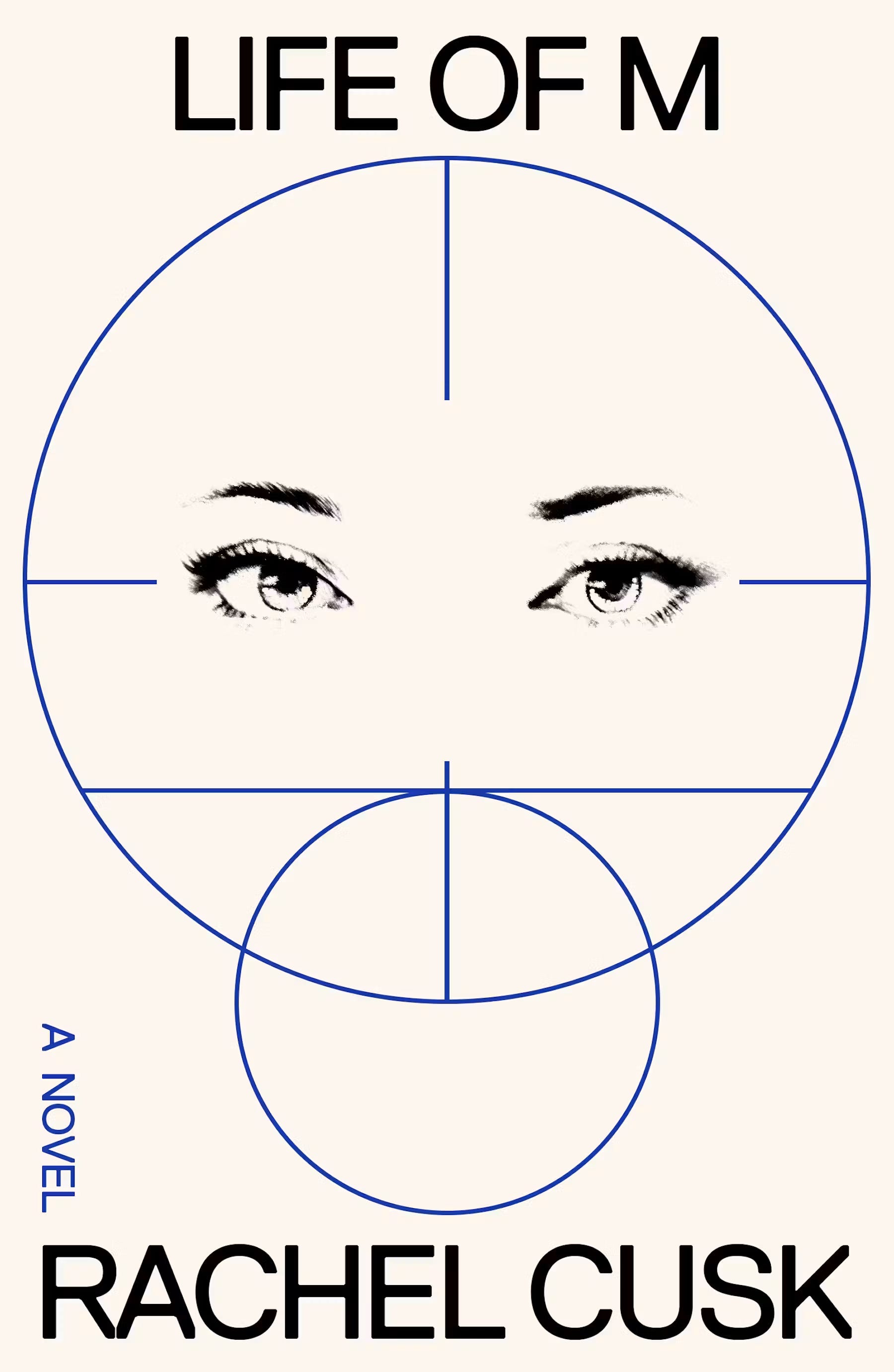
Perhaps I am the wrong reader of Life of M. Certainly I find Cusk’s books unsympathetic generally. (I hated Outline.) But I was absorbed enough to want to finish this novel, even though I don’t find it impressive. Cusk is undeniably interesting for her narrative experiments, but my persistent feeling is that those experiments are not leading to anything, and are concealing a deeper absence of ideas.
Life of M works on the conceit that the narrator is writing M’s autobiography, and making it all up. In the opening, M finds this amusing. At the end, she is hurt by all the falsities, but also by the way the book makes her seem like she “lacks humanity.” Lacking humanity, of course, is Cusk’s core theme, and her project as a novelist has been to deny or diminish the idea of character. So the book makes a neat loop around the idea that there is no-one there, whether the book was “real” or “made up”, about who the narrator could write. Whether she based it on “fact” or, as they claim in the final pages, invented it, all comes to the same thing.
M is presented as a hollow, almost fake, person, only ever acting her life. She is truly alive when acting and really acting in her personal life. Early on, she is presented as living in a doll’s house of fame, and this image is echoed many many times later on. Her house, enormous and empty. When people take pictures of her in public, it is like she is in a zoo. And so on. These images are also used of the narrator, who refers to themself as “we” (meaning they and their partner), apart from the opening and ending when they are “I”. The parallel is so thoroughly established it becomes dull. We are all trapped in the performances of our lives.
Life of M is part of a genre that sees biography, autobiography, and fiction as mergeable. This genre contains books like Orlando, The Real Life of Sebastian Knight, The Quest for Corvo, Biography of X, My Autobiography of Carson McCullers. Whereas those books generally take the view of their subjects as mysterious and multifaceted, Life of M takes the opposed view: mysterious because empty. This is not, however, a study of fame, per se, but of how anyone maintains individual identity and integrity.
At the end, the narrator says that when M finds out her friend’s painting sold for millions of dollars, she was astonished. She admired this friend’s integrity, a quality that she “experiences as a kind of absence within herself… like a vital organ that was removed early on.” Alas, she could have achieved her status and kept her integrity, she now realises, but “her life has not been her own.”
This is the refrain of the book. Cusk’s familiar complaints about parenthood are a core part of the theme, but so are many other complaints. The difference is that whereas most things are “a role like any other”, parenthood is a “sacrifice”, a word the narrator repeats. This is the great weakness of Life of M. The attempt to produce an experimental narrative about auto-fiction and the nature of the self fails because of the book’s philosophical incoherence. Who is being sacrificed, on this book’s terms? From who is the vital organ of integrity missing? Why is M able to feel so angry about her presentation, if there is no-one there and never was? It seems plausible that Cusk’s narrator thinks we are all subsumed into the system which could be broken free of, but that would take a lot more establishing than is achieved.
Cusk’s own narrator demonstrates this confusion:
Concentration is like a white field into which we levitate, leaving ourselves behind in time. One part rises while the other remains below. When our children were born they presented the greatest possible threat to our concentration. We could no longer access the white field because we could not forget them: our bodies wouldn’t allow it. To learn that this was not the case for men diminished men forever in our eyes. Yet it was we, at the time, who seemed to have been diminished.
Our children grow up, knowing or not knowing about our sacrifice. Some of them don’t care to know. Others are more willing, dimly perceiving that they may find themselves making the same sacrifice one day and wishing to remain informed. For a while we railed about the injustice of it all, as though our existence were a game in which someone had suddenly changed the rules halfway through. Then we stopped caring about it, about the rules. Perhaps, like so much of what we have seen in life, what looked like rules were not rules at all.
Who is “we” here? There is a modern idiom that implies a split self—I need to move my body—which has no basis in any philosophical or metaphysical claims. Cusk’s narrator uses this idiom several times: at the airport, people “will proceed in shameful stockinged feet to have their bodies scanned”; at the end, the narrator says “it was this abandonment of myself that helped me.” It is not clear what theory, if any, of the self the narrator has, proposes, or relies upon. This is pure idiomatic writing, without any deeper thought to sustain it. The narrator is similarly casual about philosophy when they say: “Her objectivity in the face of desire is the philosophical product of her fame.” God only knows what philosophical means in this sentence.
Cusk’s reliance on idiom is part of the general method of her narration. Like the recent novel The Ten Year Affair, her narrator doesn’t use the free indirect style to bring characters’ thoughts into the narrative, but to introduce external ideas. This is an inversion of free indirect style—ventriloquising discourse from outside the novel, which is relevant to the characters, rather than ventriloquising discourse from inside the characters that is relevant to the novel.
This is most apparent in Cusk’s use of idiom. The private school M’s children attend has “an air of commerce about it” and the parents, rather than picking children up in the car “attend on foot”. Here it is possible that Cusk is ironising people who do not appear directly in the novel—we don’t really see, hear, or know any of the parents directly—but they are satirised nonetheless by their idiom. But when the narrator writes that children grow up either knowing or not knowing about their parents’ “sacrifice” while the parents “railed about the injustice of it all” it seems more likely that these idioms are simply the way the narrator talks—a means of flattening the voice down to someone undistinguished, unindividualized, a cliche. It is a North London, soft-left, liberal literati vision of life. Just as M is a hollow person in a doll’s house life, so is the narrator. Thus when the narrator says M reads the newspapers as a way of “retaining contact with reality” the irony serves them both simultaneously.
This parallel is drawn most clearly in the way the scene is set: life is like a movie, as we are told more than once. The most frequent opening for a section is the phrase “It is…”. So: “It is a boat…”; “It is outside on the terrace…”; “It is a brasserie…”; “It is a meeting room…”. This is part of the “screenwriting” that is used to make life and movies become less and less distinguishable. “The elevator doors slide open and reveal M” reads like a screenplay direction. There are whole sections that are like this.
In the middle of the book, a section about death exposes the mismatch between “film reality” and “lived experience”. Echoes of Dante, the Book of Common Prayer, Exodus, and Philip Larkin are simple and obvious enough (intentionally so, presumably, as part of making the passage filmic while using the familiar idioms the rest of the narrative relies upon). But the real purpose of the passage, I think, is to contrast descriptions of the bin men as they might appear in a film (flourish, fan out, choreographed, wheeling, gilding, vigorous and graceful). This ekphrasis is a contrast to the falsity of modern art, discussed near the end of the book. There is something real about the bin men which the movies obscure, hence the anger one character expresses to M that we all live like we are in movies now, partly because of actors like her.
In the midst of our lives we sometimes wake in the darkness and hear the sound of our own heart thudding in our ears. There is a moment of blank emptiness before the memory of who we are and of all we have done and have yet to do slowly begins to fill us.
The waste collectors come early, before it is even light. In their big truck they rampage noisily through the dark streets, pausing at each building in turn. Two men drive while the others ride on the back. At each stop they hop off before the truck has fully come to a halt. They aren’t trying to save time: this flourish is something they are offering to themselves. They fan out over the street in the darkness and perform a choreographed routine, some wheeling the plastic municipal bins out into the road while others attach them to the truck’s rear forks. The forks lift and upend the bins over the belly of the truck then jerkily set them back down, empty. The street lamps rain their yellow haze over the truck and over the men and the municipal bins, gilding their movements; overhead the sky begins to lighten to a deep and jewel-like blue. The men return the bins to the foot of the building. They do this slightly carelessly, for the bins are now light. Ahead of them on each road the heavy waiting bins are neatly aligned while behind them the empty bins are all askew, like the discarded shells of things whose meat has been taken. The men wear high-visibility jackets. They are vigorous and graceful as they ride the truck through the dark dawn, their bodies erect, their faces lifted to the air. Their high spirits seem to derive from the prosaic honesty of their occupation. When they go on strike the city is rapidly crippled. It sits stewing in its own mess, helpless. The men obtain a certain dignity from this fact.
The noise of the truck fills our room as it passes in the darkness. It is a diabolical sound of shrieking metal and grinding gears, of shouts and the violent sounds of impact. There is nowhere in the city where this noise can be escaped. It comes to each place in turn like an angel of death. Sometimes it is comforting and sometimes it is maddening. The sound of our own heart thudding in the dark silence is neither of those things.
And you see at the end of the passage how the perspective shifts. No more filmic grace and choreography. As “We” listens to the bin collectors it is diabolical, violent, noise. The implicit image of death from the start of the passage is made clunkingly obvious. This move from image to sound, in order to effect a sense of contrast, is a classic technique of the movies, so the artifice of living as if we were in a film is even unavoidable in this novel.
Life of M may be trying to achieve a meta-joke, as Laura Miller suggested in Slate, about the nature of fame and personhood. If, as rumour suggests M is Natalie Portman, she is presumably in on the con. The whole point is that M is no-one, not even to herself.
The final sentence in Life of M is so bizarre and disorienting it throws even these revelations into chaos. As the writer departs, M stops her at the door, announcing there’s something she’s always wanted to ask her. Then M smiles “warmly and almost goofily,” and says, “This might sound stupid, but I’ve been wondering. Are you a guy or a girl?” Since Rachel Cusk is quite obviously the latter, what can this possibly mean? Only that Cusk is screwing with us and perhaps suggesting that not only is M not Natalie Portman, but the narrator isn’t even Cusk.
Life of M is a narrative hall of mirrors that only a fool would confuse with a thinly veiled roman à clef about a celebrity.
It may of course be the case that Cusk did base this book on Portman and has added a further layer to her joke. There is a very funny moment when one of the narrator’s friends thinks she may have depression, but she also read that so many people are taking anti-depressants these days that they are in the water. And thus the “integrity of her depression may have been compromised.” So it is with Life of M: there is so much of this sort of thing “in the water” that the integrity of knowing “who the book is about” may be compromised. Critics beware. The contortions of what is a movie and what is real life become irresolvable, as Cusk intends.
But that rather seems to be as much as the book is about. If you believe that the novel has run its course, that making people up is embarrassing, and all that jazz, then you will perhaps find this impressive. It is, however, not a very original joke to fill a whole novel. Perhaps inevitably, the broader intellectual discussion within Life of M is all rather lame. M’s freedom to pass through an airport is contrasted to the way ordinary people in the queue are “powerless”, “stripped of their goods”, moved forward in their “shameful stockinged feet.” Now, this is done to ironise M, who likens this to scenes of “displacement and persecution”. But the words are all the narrator’s. This is not free indirect style. And the narrator goes on to say that M has known others who renounce privilege and “seek the powerlessness of the ordinary.” Perhaps the aim is to reveal the trap of fame, but the doll’s house imagery has done that. Perhaps the aim is to ironise M, or the narrator, or both, but the language is, as elsewhere, more of the normal idiom that feels like it is being brought in from other discourse. That is the inevitable risk of writing two such characterless characters: like Outline, it means Life of M too often feels like a lecture or an op-ed about familiar themes in familiar language.
The narrator says things like, “We think again of the fact that nature has no nationality. Is that why it is doomed?” An unnamed character says, “Families are networks of social control, programmed to extinguish individuality.” Both come from a similar ideological background and are expressed in a recognizable idiom. Both make relatively little sense. Nations can die! Some of them are dying right now. Families are not programmed. Who or what does Cusk (or her narrator) think did the programming? That is another lazy idiom that skates over the real arguments.
Assume that this is all done as part of the presentation of the characters: the need for these sentences is still a problem. There is no individuality, nothing distinguishing (this is just how the characters talk in Life of M), nor are these issues especially pertinent to the plot. They are here only as part of the general ideology that all the characters seem to share. The book simply feels unable to get beyond this sort of editorialising. To actually overcome the idea of an authentic self, Cusk would have to go beyond the thinking of these idioms.
Life of M is so committed to its uncharacterful characters that everyone is simply an expression of a familiar perspective that belongs outside the novel. There is no narrative ambivalence: Cusk is dictating a worldview through a narrative. It is readable, and interesting enough to write a long review about—but even at 185 not-very-long pages, it is longer than it ought to be.
Cusk is an unavoidable novelist. She has a great capacity for technical control: Life of M is almost word-perfect at maintaining its style. The problem is that the style isn’t really about anything. The more philosophical the book sounds, the emptier the prose becomes. It is left feeling like a clever trick, not really up to the standards of the genre it hopes to join.
If a novelist believes that character doesn't matter why write novels? I like playful novels that are conscious of the form, but it seems very austere to think that the abolition of character in the novel is imperative because making up characters is fake and false and everything is bogus. Why carry on writing? Maybe I just miss the point of it all
I'm mature enough to think when I encounter a writer like a painter I just don't get despite the rapturous critical reactions to them the fault is with me. Middle age has changed me, when I was younger I'd declare it the artists fault. Cusk's novels fit into that condition with me. I'm sure they're as good as people say, but, I can't see it