

Marilyn and Her Books, Gail Crowther
I had higher expectations of this book than it was able to meet.
Transcendence for Beginners, Clare Carlisle
The new Claire Carlisle book is just excellent. It will get less attention than it deserves. But you should read it.
In chapter 2 I drew some conceptual lines, suggesting that the difference between singularity and generality mirrors the difference between biographical and philosophical enquiry—enterprises captured by two different questions: ‘Who am I?’ and ‘What am I?’ Yet for Spinoza, the highest, intuitive kind of knowing sees singular things, rather than identifying their generic properties. Knowing something in its singularity—as a ‘who’ rather than a ‘what’—means understanding both how it is causally related to other finite things and how it is dependent on God.
So the question ‘Who am I?’ is theological as well as biographical. It asks how some particular being shares in, and manifests, the divine nature. With Spinoza’s help, we can distinguish a biographical knowing that traces a life as ‘part of nature’—shaped by, and expressive of, its natural-cultural milieu—from a theological knowing that sees this life’s being-in-God.
My earlier interview with Clare about her biography of George Eliot is here.
The Bishop of Durham, Susanna Clarke
The essay at the end of this very short book is perhaps more interesting than the story itself, and we must hope for a collection of essays from Clarke one day. She talks about the importance of leaving things out of sight in fantasy and much though I enjoyed and admired this story, I wonder if giving us too much background about John Uskglass counts as bringing things into sight that ought not to be seen. Still, Clarke is a splendid writer and this is well-worth reading. It is just a shame it is not longer.
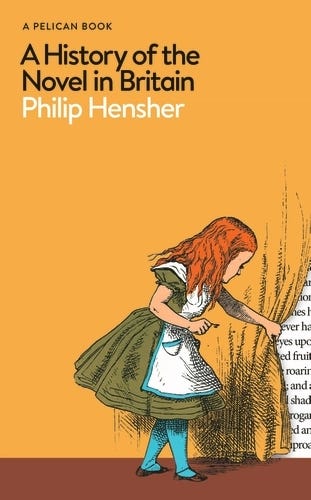
A History of the Novel in Britain, Philip Hensher
Six hundred pages that delivers exactly what it says. Anyone who knows Hensher’s Spectator reviews will know his style and the whole book is written that way: broad knowledge, close analysis where necessary, never shy of a judgement, highly developed idiosyncratic taste. I enjoyed the whole thing and could happily have read even more. It caused me to order some books. Good on patronage, libraries, and money as well as books and authors. I will write a full review closer to the release date in September. It also caused me to read The Northern Clemency.
John Foster Dulles Apostle of American Empire, Bevan Sewell
I was excited for this book, as I am interested to read more about Dulles (he is a minor character in the Norman Mailer novel I read half of during my week off), but this is full of cliches and written under the yoke of the Acceptable Doctrine. Great Man Theory of history is given the usual dismissal in the introduction, with the need for another approach claimed, as if this has not be de rigueur among historians for decades. Carlyle is not quoted, nor is the Theory explained. It is just a useful bogeyman. Then very specific claims, such as to do with the influence of Dulles’ grandfather, are made with no footnotes or sources. This carried on for sixty pages and then I stopped. Swapping out one acceptable doctrine for another is fine, but I biographers cannot just give judgements on faith, they must show whether they know something or are assuming it. Combined with all the cliched writing it creates a book that tells you very little relative to the page count. Perhaps I will try another fifty pages sometime but I doubt it. A shame as Dulles could do with a good biography.
Ending Up, Kingsley Amis
One of the books by the King that I hadn’t read. Hardly his best, and some of the jokes fall flat at this distance (the stink bomb…), but he always knows how to turn a sentence, and it is short enough that I finished it. Mostly I was aghast at how washed-up these seventy-year-olds were in the 1970s. (Amis, of course, ended up dying at this sort of age, and was as great a drinker as some of the characters he writes about here.) As always, I felt I recognised so much of what he described. In England, I so often felt, when I met snobbish or bizarre people, that it was like something out of a Kingsley Amis novel. There remains an general obsession with the idea that Martin Amis was a great writer, even though his admirers don’t seem to re-read his novels, and some of that appreciative energy ought to go to Kingsley, who was more original, and, frankly, a better prose writer. I think about his novels very often. He has the best chance of surviving only in a few works. Lucky Jim was over-rated for a long time. I especially like The Biographer’s Moustache, The Old Devils, The Green Man, and The Anti-Death League. Martin Amis’s memoir, Experience, has lots of very good material about Kingsley, and the Bookmark programme from 1991 has some interesting moments too.
How Proust Can Change Your Life, by Alain de Botton
I read this out of sheer curiosity to know why such a book would sell a million copies. I did not learn the answer, but it was much better than my prejudices might have expected.
Lost Lambs, by Madeline Cash
Lost Lambs, a novel which has been more attended to on Substack as an emblem of—take your choice—the corruptions of publicity or the conspiracy of capitalism, is, to my mind, and based on an incomplete reading, a remarkable instance of discourse fiction, which is, among a certain sort of writer, a prevalent genre of modern novels. In discourse fiction, there are strict limits set on how the fiction can be narrated, and those limits are set by the “discourse bubble” to which the writer belongs. There are, in short, no ideas in these novels which are not only pre-approved by the cultural-political echo-chamber to which the novelist belongs. The novel not only cannot escape the real-world echo-chamber, but is in fact largely written in the language of that chamber. It intends not to be a novel, but a novelization of a certain mood, vibe, or set of affiliations among a particular group of people, — in this case, the left-wing, Dimes Square adjacent generation.
Lost Lambs belongs with that group of novels which frequently contain passages that are not imitations of op-eds, but are merely repetitions of those editorials.
Late capitalism did its job of convincing Catherine that she was insufficient, an empty void, and thus needed to slowly fill that void with products that made her face smell like coconut or parsley.
There is no defamiliarization here: alas, it is all too routine. People write a version of this line every day on Twitter, in the Times, here on Substack. Lost Lambs is not interacting with this discourse: it exists in order to repeat it.
Bud was the accounts and systems manager at Alabaster Harbor™—not some backwater artery of commerce but the primary port for the entire western coastline, the premier gateway for domestic and international trade. It was a strange place to work, with questionable business practices, but Bud didn’t ask questions and was well compensated for it. Alabaster Harbor™ provided competitive wages to its employees and premium health insurance for Bud and his family. If Bud or his family were to, say, go down in a plane crash or if his girls were to fall victim to one of those ever-popular school shooting massacres or if a deranged killer were to come slaughter Bud or his family in the night, this would all be covered financially.
This passage fails to imagine Bud as an employee because it contains no knowledge of his work other than what is allowed in Lost Lambs’ political echo chamber. The use of™, the language of “premier gateway”, “questionable business practices”, “didn’t ask questions”, “competitive wages” might all serve as a parody of corporate speak, but that is not the effect of the passage, and the turn to “ever-popular school shooting massacres”, with the litotic “fall victim to” reveals an attempt to portray a certain pre-existing idea of American commerce using the pre-existing language, not to actually fictionalize that commerce or that idea. Bud is a useful trope through which Cash can channel her discourse. These are expected political opinions, not instances of imagined character.
The opening chapters set this up perfectly in which we meet a distracted priest with his “state-mandated therapist” who makes a Hannah Arendt joke (“the disobediance of banality”). In The Ten Year Affair, Erin Somers used an inversion of Free Indirect Style—ventriloquising discourse from outside the novel, which is relevant to the characters, rather than ventriloquising discourse from inside the characters that is relevant to the novel. In these examples, Cash is ventriloquising discourse from outside the novel without it needing to be relevant to the characters.
And so the characters become inevitable. We can have a depressed father who masturbates into a tea-towel, a mother who smokes weed and doesn’t want to be a housewife, and a twelve-year-old girl who sticks knives into van wheels, all presented according to the acceptable standards. You may well agree with all of this, and find Lost Lambs to be well-written and a reflection of something true in the world, but it doesn’t really achieve any of that as a novel. Cash repeats tribal cliches: “Every couple subsides off a narrative, a personal lore, and Bud and Catherine’s was that of young love and rebellion.” That would fit seamlessly into any modern Atlantic or New York Times article about divorce, adultery, and marriage.
Various aspects of Cash’s style reinforce this — not least the sentence fragments which are ubiquitous among non-fiction writers. Here is Cash writing as if she was in the New York Times opinion section five years ago.
The “arrangement” was better for everyone. A moral loophole. A creative outlet in the vastness of monogamy. Bud might even enjoy it too.
There’s also the minor-analeptic-recursive-comment technique that is a staple of this style.
Then came guilt—bad mother, bad wife—followed by resentment, and then a cigarette in the backyard. They had a backyard now.
This style sounds anonymous (Cash, as people would say, has no “voice”) because it is an acceptable house style. You read it every day in the media. They’re making cliche mainstream now. Including in novels. You probably enjoy it. It is no surprise to find that Cash has worked as a copywriter.
So adept is Cash at this sort of writing that she has excited her reviewers to do the same:
Lost Lambs is a stunning first novel, wondrously comic, propelled by absurdist wordplay and a deep knowledge of today’s over commercialized culture. It’s droll, sophisticated yet empathetic toward human flaws as it follows the Flynns, a dysfunctional nuclear family of five, and the sometimes wacky people around them. Add-on: it’s a crime caper involving each Flynn, one way or another.
Anyway, I stopped reading about a third of the way in.
The Clare Carlisle book does look very interesting. Never read anything by her--do you think this is the place to start?
I always find it hard to take seriously anyone who non-ironically uses the phrase "late capitalism" - a phrase coined literally 100 years ago, in order to convey the impression that capitalism was on its last legs ... and, well, here we are, and people are still claiming the same thing, and in the meantime capitalism continues, despite various ups and downs, to be going strong.