

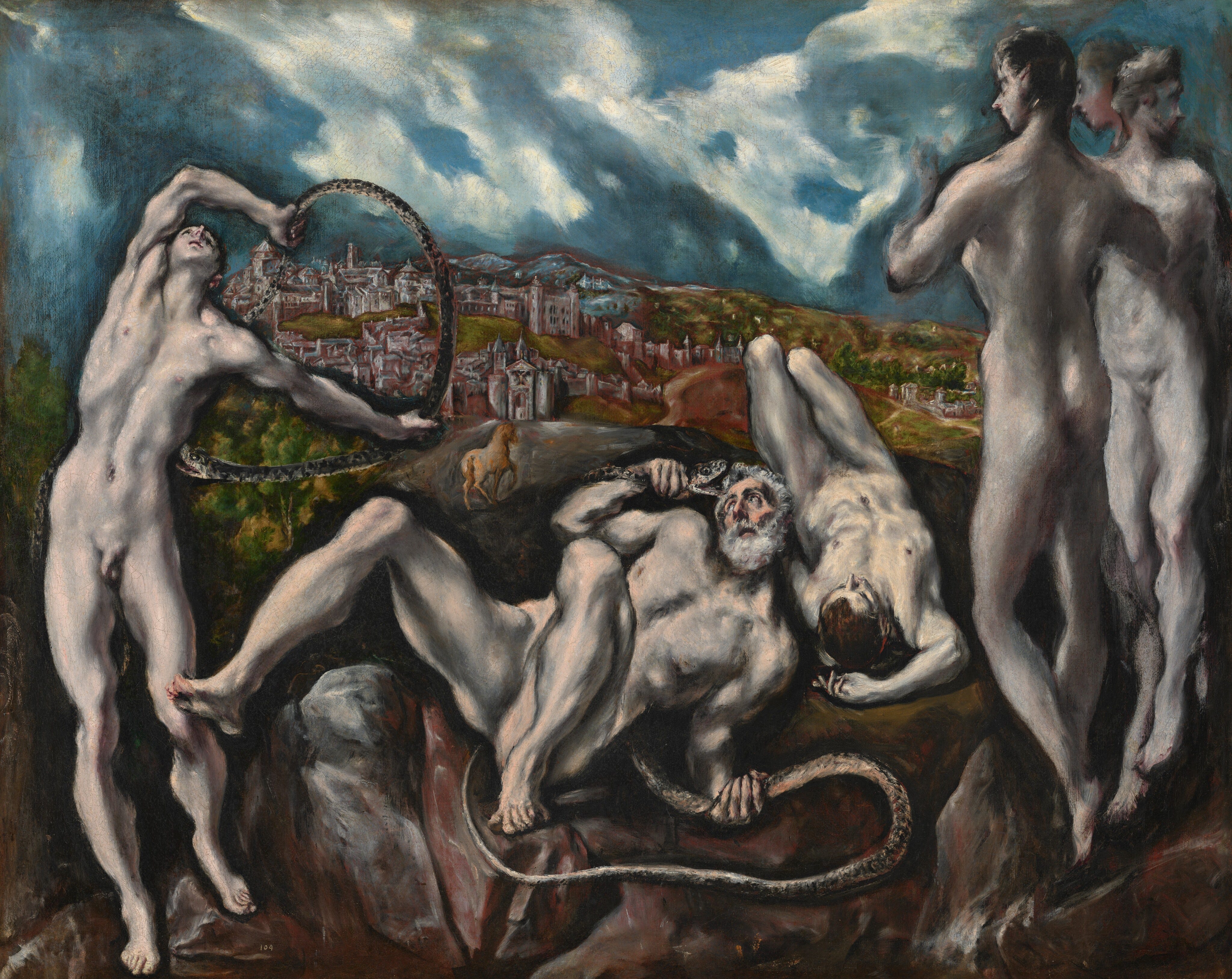
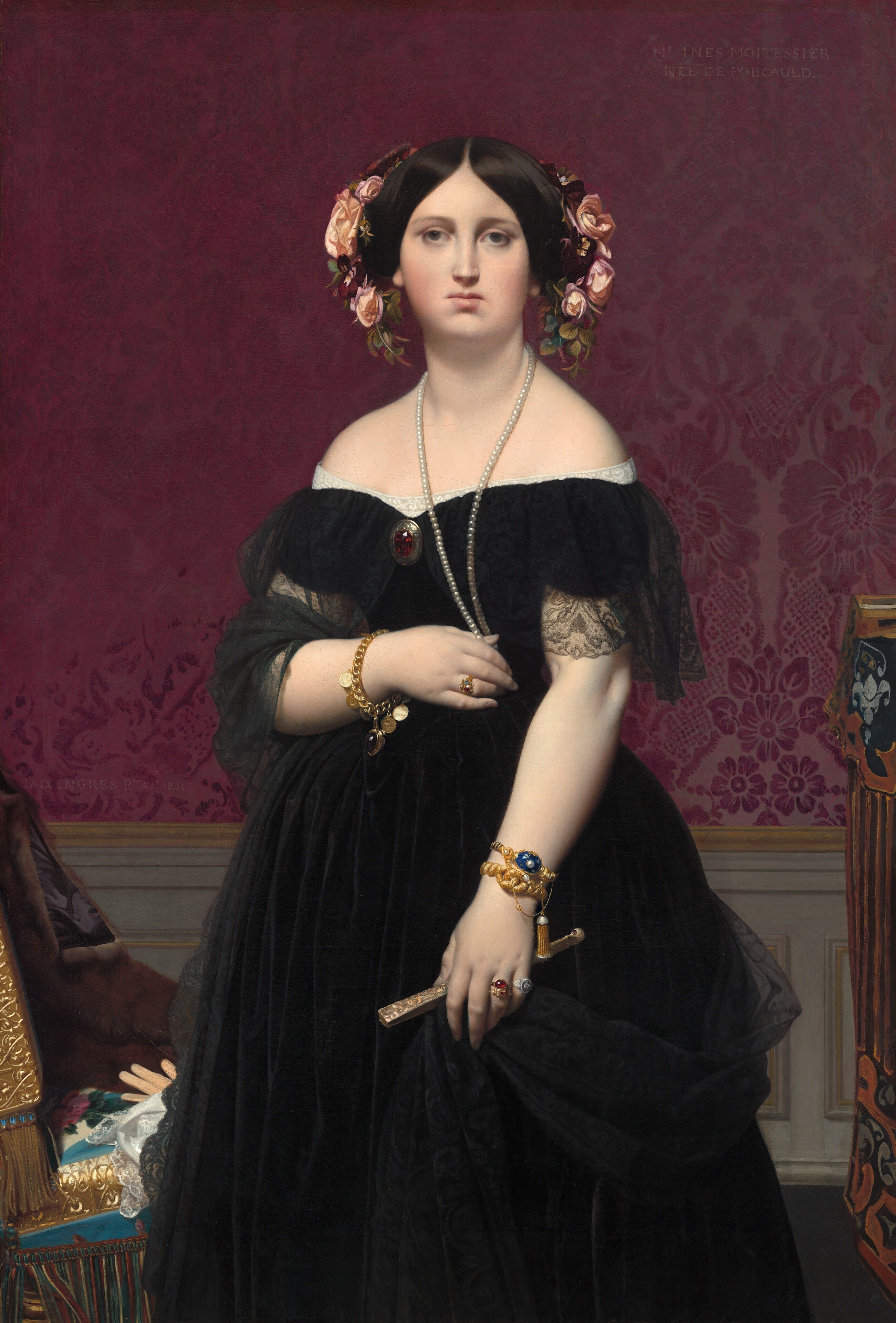
To the National Gallery, where I was shocked by El Greco’s Laocoön. The three figures on the right are like wraiths or spirits, perhaps shades visiting the dying men, for they cannot be the spirits of already-dead sons of Laocoön: there are only two of them. In this painting, one is lying dead and the other is arched at the point of the fatal bite. The whole picture is stretched, like the world is being sucked and pulled away from Laocoön and his sons as they lose consciousness. The only realistic part is Laocoön’s face, which is the same as the face on the repentant St. Peter. It is all the more terrible for its realism, stark and unusual, off center. To put a Christian face on a Greek myth is telling enough. As the perspective of the painting rushes towards the afterlife, a horse is trotting along the road to Toledo, a walled town in Spain—not Christ’s donkey. Various accounts of Laocoön exist—he was punished for letting in the Trojan horse or for having sex in a temple (he was a priest). The inherent uncertainty of why he was punished is quite to the point: great men, great cities, great civilizations—all fall. My thanks to the very splendid Alice Gribbin for giving me her guided tour and revealing to me the wonders of Tiepolo’s unbearably sad Madonnas (the mother’s sense of tragedy is so very hard to witness) and two very striking Ingres’ portraits.
At this year’s Emergent Ventures unconference (my third, such is my good luck), conversation ranged from death, art, and Mahler, to whether God wishes us to be happy, to the way Substack works (does anyone know?) to the nature of biography, and the future of the universities and the arts. These last two topics were the most unsettled. For some, the future is bound up with practical outcomes—which writers have the money, which universities achieve practical outcomes. For others, the questions are pure: where is our Keats, how will students come to a proper sense of what is good and true?
My thoughts are necessarily limited. I am no scholar and no philosopher. This I know. However many people it will involve, the serious reading of Shakespeare will continue. Yes indeed, students will talk to Claude, listen to podcasts, and so on: but the essential fact of reading remains. Knowing and loving the canon is irreducible. Perhaps it will be monastic, a minority activity. Perhaps the Oxford model will continue to prevail.
Whatever other considerations of signalling, status, and credentials there will be, the question of reading the canon will not die. The necessary innovations need to be made, of course, including the university. But while my respect for the scholars is deep (and my sympathy: they struggle under the yoke of the administrators) I have met English Literature lecturers who have read a mere twelve of Shakespeare’s plays. If the new world sweeps them away, I say Good Riddance. Old things are passed away; behold, all things are become new.
I walked around the Udvar-Hazy Center with Zena Hitz, one of my favourite internet people. Zena, of course, is not very online, but I know her work (including her splendid book Lost in Thought) from her Twitter feed. Soon there shall be a podcast available of Zena and me discussing Gulliver’s Travels, one of the very best books. One of my favourite scenes is when Gulliver meets the wizards who can summon anyone from the underworld. He chose Aristotle, Homer, and all of their commentators. There were so many commentators that “hundreds were forced to attend in the court, and outward rooms of the palace.”
I soon discovered that both of them were perfect strangers to the rest of the company, and had never seen or heard of them before; and I had a whisper from a ghost who shall be nameless, “that these commentators always kept in the most distant quarters from their principals, in the lower world, through a consciousness of shame and guilt, because they had so horribly misrepresented the meaning of those authors to posterity.”
It is a paradox of literature that having legions of commentators is part of what makes a writer an ancient, but that those commentators will almost all be so bad they would hide in shame from their author in the underworld.
It may be that middle-age is turning me sentimental, but reading Houellebecq recently has been quite an affecting experience. I have been thinking about Houellebecq because I recorded a podcast with Rasheed Griffith with whom it is always enjoyable to talk Houellebecq, Naipaul, Mahler, and many other topics. I do not find Houellebecq to be either a misogynist or a nihilist, although Serotonin is a boring blowjob fantasy. At his best, Houellebecq has a painful love of simple pleasures and yearns for the hedonism of ordinary life. He is no Bazarov, nor Updike. What seems like the voluntary death of the inner spirit is shown finally to be determined. Civilizations live and die like hedges rising and dipping when seen from a train. So much about his manner and mode is de trop, but he remains a figure of fascination. Will Lloyd recently called him Europe’s only novelist, which is excusable journalistic excess, but there is some quality in Houellebecq beyond misanthropy that justifies the spirit of the excess. Like Naipaul, he has edged the blade of his inexcusability with truth. One feels obliged to listen to his objections. The liberal society cannot shrug off its miserables too swiftly, because, as Houellebecq knows, the death of a civilization comes from within. Those moments in The Elementary Particles (called Atomised in England) and Submission in which some feeling of purity, innocence, genuine affection is achieved cannot be accounted for if Houellebecq is merely unacceptable. He sees what there is to regret in the passing of the old order, which has been passing for hundreds of years. So much of Submission has been prescient. Unlike other dystopias (Atwood, Orwell), the horror comes from the conversion of the protagonist to the idea of submission. P.D. James wrote about a society that loses its own power of regeneration in The Children of Men, but that was a physical failure, and a mystery. Houellebecq believes that anhedonia can be suicidal for a society, but that it can also be inevitable for men to give up in the face of inevitable decline. Some hope is saved from the misery of The Elementary Particles, but the optimism of the ending of Submission is the most chilling thing about it. François’ inner emptiness becomes his submission. The scope of the novel moves from his consciousness to the reestablishment of the Roman empire under the new regime. If the West falls, it will not be overtaken. It will give up from within. We might put the book down feeling reassured that the same contradictions that drive the plot will, in reality, have a centrifugal effect, allowing the society to grow and change, rather than the centripetal depression of Submission, which leads to the collapse and reformation of France, like a dying star, with a new religion, new norms, new moral foundation. In the real liberal society, poly-centric contradictions can be self-sustaining. But the dark core remains. The future of the West relies on the right sort of attention being paid to thinkers like Houellebecq. Houellebecq himself has written about art as an imperfect map of the world, but those are the only maps we have.
Ah, but it is good to have you back, Henry; very good indeed.
Re: Submission—The guy saw the alignment of the Left and Islamists years before it actually happened (in the US anyway). For that alone he deserves big plaudits.