

The Work of Philosophy, Jared Henderson
If you want to regain your attention span, revive the intellectual life you had when you were younger, or begin to think more deeply about the role of contemplation in a happy life, this book is for you. Jared takes up themes from Aristotle and C.S. Lewis and the Great Books movement and others and develops his own simple but rigorous ideas about the value of contemplation. This subject is so often consumed by anxiety and politics. The Work of Philosophy is a more serious starting point.
Paul Celan: A Life, by Anna Arno
What a splendid, splendid book. Adorno said that “To write poetry after Auschwitz is barbaric.” Celan proved him wrong. Naturally, this is a difficult subject matter to read about: not the sort of book you ought to read if you are sitting up alone at night. Arno has everything a biographer ought to have: mastery of the details, sensitive feeling for the poetry, and a calm controlled narrative style, so that the horrors and traumas can be dealt with properly, as can the ordinary aspects of life. This will be (one of) the best work(s) of literary non-fiction published this year. I don’t find Celan easy to apprehend in translation and I learned a lot from this book.
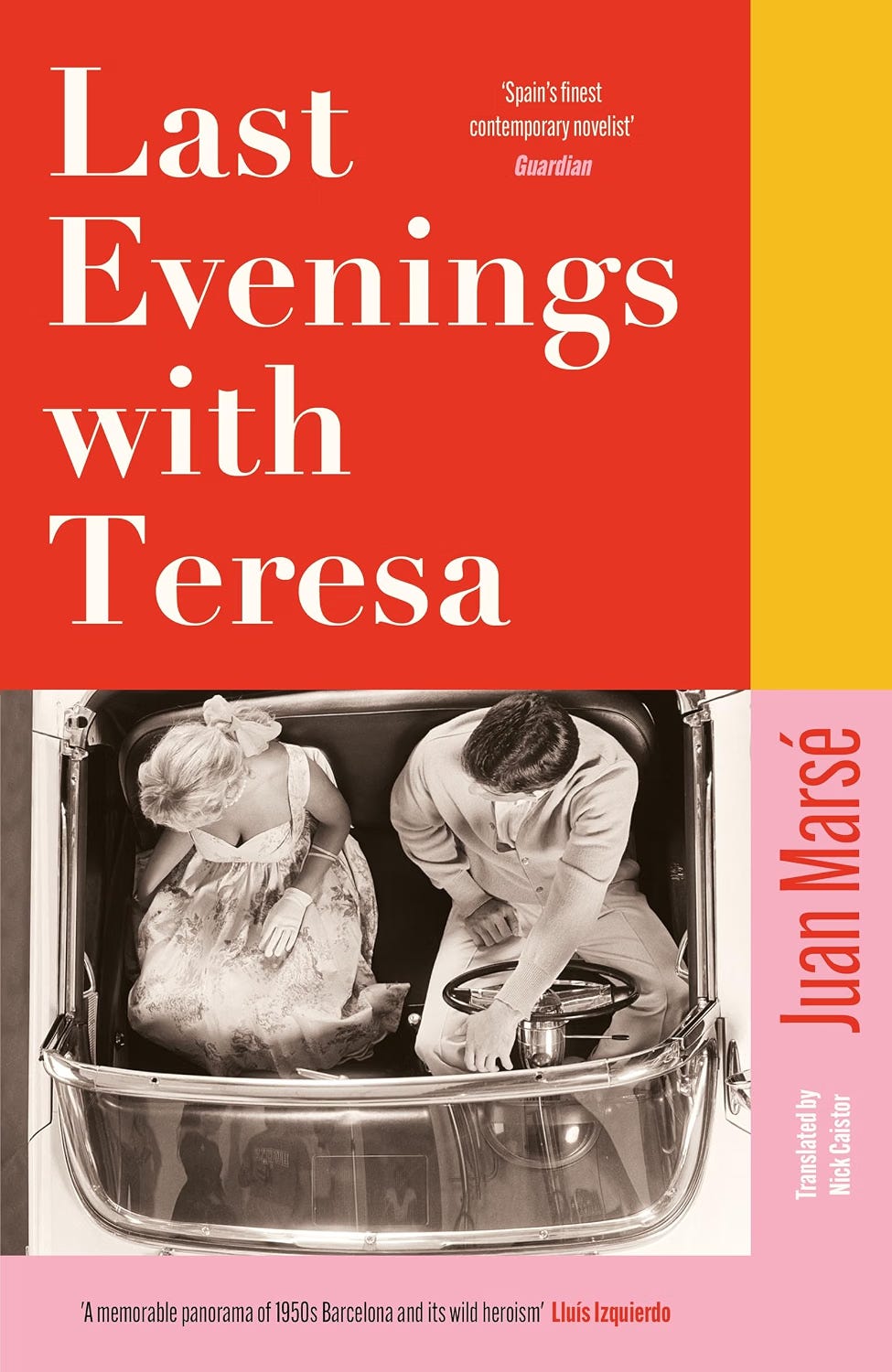
Last Evenings with Teresa, by Juan Marsé
This book is a delight. A love story from 1950s Barcelona, full of the class politics and youth culture of that era. It is like stepping into a lost world. The translation is very nice; the style is lyrical but also direct and simple and vivid. It is full of mesmerising passages: parties, secrets, adventures, sexual encounters, class conflicts, young people arguing about politics and literature, the rich misapprehending the poor. It is serious and amusing and tragic and compelling. I would like to quote so many passages. I am ill and reading this slowly and every day I just love this book. I prefer to make it last. You should all read it. Recently translated into English for the first time, it is a modern Spanish classic. I will be giving away copies at Christmas.
James Joyce: A Political Life, Frank Callanan
I have only so far read about one third of this and do not know when I will have time to go back but it is surely a major challenge to the view that Joyce’s work is non-political. I was not quite persuaded, but the work is very careful and thorough and this book ought to be essential reading for anyone interested in Joyce. I hope to write about this book again. It is clearly a remarkable work.
The Frenchmen: Or, My Life in Theory by Emily Eakin
I found this too anecdotal, personal, and not enough about the ideas as it ought to have been. I dropped out. Just read Sartre or whoever else!
Ghost Stories: A Memoir of Love & Grief, Siri Hustvedt
I didn’t love this as much as some other people did. Too many passages that just don’t have much significance. But, when it is good, it is very good. The sections when Hustvedt talks about Auster going back to his wife or when she is asking “where are you?” of the dead Auster—more, more! The bit when she reveals that Auster didn’t give a hoot about Barthes or Lacan? Splendid! But the emails Auster wrote his grandchild are not really book-worthy. There is a conscious artificiality to too much of this book, like when Hustvedt reproduces a letter she sent to friends about Auster being hospitalized, in which she compared their son-in-law to Virgil because he took Auster to the inferno of the hospital, or the notes she made during that time, titled in In medias res, in which she writes things like “Holding vigil. That’s the work now.” A lot of this material is quite touching, but they don’t feel like letters worth publishing. At one point Hustvedt writes: “All through Paul’s treatment I have been thinking of the US general who said during the Vietnam War: ‘We had to destroy the village in order to save it.’” I lost interest half-way.
Morel’s Invention, by Bioy Casares
A very good new translation by Margaret Jull Costa, recently out from NYRB. I had not read this classic before, but I shall be reading it again. A remarkable work of the fantastique.
American Hagwon, by Min Jin Lee
I read a little of this and it’s no Pachinko. I don’t know how far I will get.
The Language of Fiction, by Robert Alter
Coming in the new year, this is a succinct and cogent primer (giving an introduction to the way novelists use metaphor, syntax, rhythm, and so on), which also has many of Alter’s own opinions: for instance, Alter says Jameson was wrong about the penultimate episode of Ulysses: it is not “reification under late capitalism”, but instead is visionary. I did not need to read this book but I found it sympathetic. One small point: Alter says that no-one thinks, when hearing the cliché “throw in the towel” of a boxing coach throwing a towel into the ring, or, when hearing “going off the rails”, of a train leaving the tracks. I in fact do think of these things and have often found such phrases rather difficult to parse throughout my life. Generally, this is a sane, common-sense, learned book, without some of the usual political distractions, and not burdened by an attempt to be grand or lyrical.
Thomas Mann: New Selected Stories, trans. Damion Searls
To my chagrin, I had never read Mann before this year, not even Death in Venice, so I picked this 2023 translation up after I fell in love with Buddenbrooks. Next I will read the new translation of Doctor Faustus and, finally, The Magic Mountain. I like having masterpieces to discover in middle-age.
The End of Everything, by M. John Harrison
I read half of this and really have nothing to say. I don’t understand why the Booker ceremony had to be so political. Just be literary! I would like to try some of Harrison’s other novels.
The Magician’s Book, Laura Miller
Not a new book, but I have been reading a lot of C.S. Lewis recently and was captivated by Laura’s approach. I read this slowly, usually in the evenings, and it was a delight. Laura really loves Narnia. I would gladly give this book as a gift to a lot of people. I much preferred this to the other books about Lewis which I tried, and failed, to read. Laura is not fawning, nor does she have religious views that would make her partial. You can get both a good overview of Lewis and Narnia and enjoy Laura’s love of the books.
Pride and Prejudice
Sometimes you just have to read Pride and Prejudice, you know? It’s no wonder Pride and Prejudice is the most loved English novel. As well as being witty and pretty and bright, it is also morally serious, full of sound common sense, and has no truck with either snobbery or flippancy. It represents an outlook that most ordinary people hold: affection in marriage, contentment at home, a respect for good manners. It is the perfect romance novel.
I am really looking forward to your writing about Faustus and the Magic Mountain: your piece on Buddenbrooks was superb.
You might consider reading The Magic Mountain before Doktor Faustus. That’s WW I before WW II. I also found his Faustus more difficult, maybe the climax of reading Mann.