

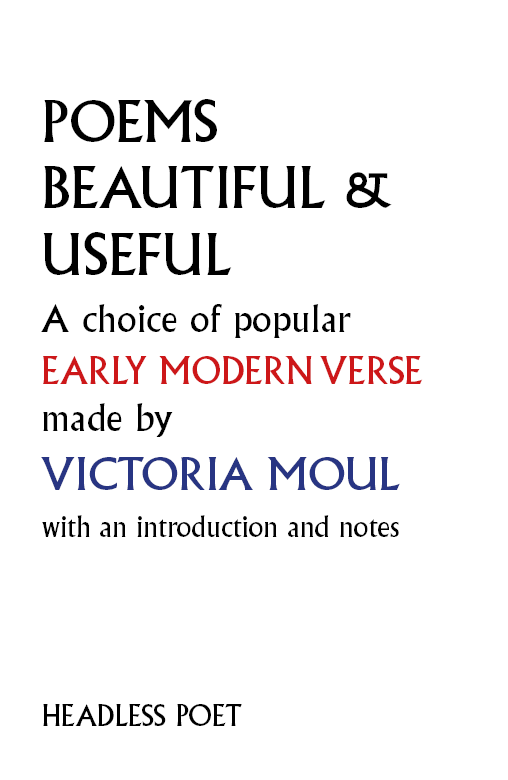
I was very pleased to receive my copy of this poetry pamphlet, published by Jem and selected (with an introduction) by Victoria. (Why do these poets have no surnames? Is this the new “initials and surname”?) I have left behind me in England all my books of Elizabethan poetry. Bullen’s Shorter Elizabethan Lyrics, collections of madrigals, that sort of thing. I do have Gardner’s Oxford Book here, and now a Golden Treasury, and Fowler arrived recently, but not my Ben Jonson, my Cavalier poets. No Donne! One manages, of course. First world problems and all that. Still, this was a very welcome addition to my stocks.
Naturally, Victoria Moul has made a very fine selection, and with some unfamiliar poems. The idea is that some of these poems are rarely anthologised. At least two of them, Like to the falling of a star by Henry King and Dazzled thus with height of place by Henry Wotton, are in Gardner, but not in Ricks. (Why Ricks excluded them is a mystery to me, though it’s not his period and it was Gardner’s.) Some of them are in Fowler too. But there are several poems not always available elsewhere and the overall selection has a good balance of the familiar and the unexpected.
Victoria says in her introduction that it was taken for granted in the seventeenth century that a poem “teaches or expresses something that it is helpful to remember as one tries to conduct a decent life.” This is the theme of the pamphlet. Here, in that spirit, is the Henry King.
Like to the falling of a star,
Or as the flights of eagles are,
Or like the fresh spring’s gaudy hue,
Or silver drops of morning dew,
Or like a wind that chafes the flood,
Or bubbles which on water stood:
Even such is man, whose borrowed light
Is straight called in, and paid to night.
The wind blows out, the bubble dies;
The spring entombed in autumn lies;
The dew dries up, the star is shot;
The flight is past, and man forgot.
Hot stuff, and really quite modern. Clive James was writing things like that final couplet in his early days. One can mistake this for mere verse, too simple, too gross to be “great literature.” Well, read it again with a real sense of your own mortality. The wind blows out, the bubble dies; The spring entombed in autumn lies—this is the good stuff. People like to say “this too shall pass” as if that were reassuring. It puts me in mind of verses like this. The bubble dies could almost be the title of an Agatha Christie novel. The idea of borrowed light, as opposed to borrowed time, is much more affecting. The spring entombed makes one think of the roots and bulbs all gone to dark. Shall they come up blind? In its relentless simplicity, the poem refuses the reassurance one inevitably seeks. We are apt to think this sort of thing sentimental but it is immensely moving given the right openness of attitude. One of my favourite poems in this vein (not included in the pamphlet) is Elizabeth Tanfield’s epitaph for her husband.
HERE shadow lie:
Whilst life is sad,
Still hopes to die
To him she had.
In bliss is he
Whom I loved best:
Thrice happy she
With him to rest.
So shall I be
With him I loved,
And he with me
And both us blessed.
Love made me poet,
And this I writ;
My heart did do it,
And not my wit.
I do not know how anyone could read those final lines and not feel them strongly.
My beloved Herrick is included, with his ‘In this world, this isle of dreams’, which shows all his deftness. ‘I sing (and ever shall)’, as he wrote elsewhere, ‘Of heaven and hope to have it after all.’ Campion is included too, with his wonderful lyric, ‘The man of life upright’. O what splendid mellifluous simplicity he can create!
Thus, scorning all the cares
That fate, or fortune brings,
He makes the heaven his book,
His wisdom heavenly things.Good thoughts his only friends,
His wealth a well-spent age,
The earth his sober inne,
And quiet pilgrimage.
James Shirley is represented with a very period poem (also included in Gardner), that gets those wonderful effects of a formal structure snapping shut.
The glories of our blood and state
Are shadows, not substantial things;
There is no armour against Fate;
Death lays his icy hand on kings
There’s plenty more and I have spent time in the last two evenings leafing through these twenty poems, enjoying the familiar authors and the new. The poems I did not know at all have been the least affecting, but also the ones I have spent most time with. I shall be going back to them. And it keeps getting me to open Fowler, visit Poetry Foundation, and so on. Above all, it reinforces the fact that this was a great, great period of English poetry. There is so much good writing, so much that can sustain many many readings. It is not just learned, crafted writing, but full of strong feeling, honed to a fine and sharp simplicity.
The field is large, the barn at hand,
The reapers quick and wise.
The stubble flames and sinful souls
Lie down and never rise.
The pamphlet is very nicely made and has some useful notes at the back. It would make a good gift. Headless Poet press will be publishing more such pamphlets and I look forward to those too.
If you want to know more about what makes this period the golden age of English poetry, Victoria discussed that in our interview a few months ago.
Victoria Moul. Poetry for life.

Although I am recovering, my violent and fatiguing cold has lingered, so, with many regrets, I have to cancel the Shakespeare book club this weekend. You can discuss the play in this chat, where I will answer questions etc. I’ll try and rearrange the meeting soon.
This pamphlet is a must like all of VM!
It really is extraordinary. I received my copy last Wednesday and I've already read through it three times. Needless to say, it is wonderful in both form and content. I'm very pleased to have subscribed to Headless Poet for the full year, and also hopeful that at least a few of the upcoming pamphlets will follow the model Victoria has set here. It is rare to find an anthology that lives up to its name and gathers a small and dazzling selection of beauties to be read and re-read rather than an overwhelming bushelful of dross to thump on a schoolroom table. And the anthology's piercing focus on what Victoria calls "useful" poetry from that great period in English verse shows how deeply emotional the didactic mode can be, while also highlighting its painful absence in contemporary verse. As a collection, it is a beautiful little triumph, and I look forward to re-reading it again.