

One day there will have to be a biography of Harold Bloom. It is inevitable. And rightly so. No other critic was so forceful and passionate a presence in the minds of so many readers. Even today, while I was reading the new book of letters written between Bloom and a series of poets, my neighbour came and chatted with me on the decking, and immediately upon seeing The Man Read Everything she said, ‘Oh I love Harold Bloom.” Until readers get the biography, these letters shall have to suffice. I could only wish for the book to be several times longer.
Inevitably, whatever else is said about these letters, the usual debates will recur, about whether Bloom was a fraud, a nonsense monger, so crazy that one imagines him, as John Carey once said, convinced that there are death rays coming from the television. Many others have more muted and reasonable objections to Bloom’s avowedly anti-rationalist style. It is for each reader to decide such things—a principle Bloom would have insisted upon throughout his career. Lest you think that subjectivity is inconsistent with Bloom’s insistence upon canonical values, remember that he by no means believed (or ever said, to my current memory) that a true understanding of the best poetry was available to everyone.
Bloom is not available to everyone. Serious readers will continue to disagree about his value. Frank Kermode, for example, in a letter that Rhodri Lewis found in the archives, excoriated Bloom. But there are letters in this book from A.R. Ammons praising Bloom in the highest terms. Northrop Frye admired Bloom until his Anxiety of Influence and Map of Misreading.
That he was a serious reader cannot be doubted, but beyond that it becomes hard to see what Bloom actually was. The debates about his worth stem precisely from this darkness. Writing to A.R. Ammons in 1972, Bloom said, “I’m not an artist or a critic, or a hybrid of the two, but something older and less, a reader.” This became a theme of his public self-professions later on, as did the idea that he was “merely” a teacher. But it is disingenuous.
Through these letters, Bloom is weary. He is often tired of academia, not merely in the way that teachers often become tired as their terms drag on, but tired of being in the shadow world of criticism, not the bright light of poetry itself. In these letters, none of the exhaustion and animosities of academia that characterised Bloom in the culture wars predominate. Instead, we see him turning towards the light. To A. R. Ammons in 1969—
An odd note, this—I came home just now from an exhausting Grad. Seminar in Poetic Influence—exhausting because a waste of spirit somehow—and I sat down—with cigar and scotch and soda—in my deep armchair in the living room—Daniel playing outside—David in the kitchen fingerpainting, Jeanne there too cooking chicken pilaf—and I turned to my downstairs copy of Ammons’ Selected Poems (I’ve got an upstairs copy for reading in my study—every house should have 2 Ammonses) and I read “Bridge”—because the book fell open to it—a poem I hadn’t been open to before—and Arch, it opened to me and found me—immensely beautiful, healing, Archie, as only Wordsworth and Stevens and Ammons can heal. I am very moved, very, very moved. It is a great poem, Archie, and if I had written it—rather than wasting my spirit (such as it is) in tiring seminars and exegeses we don’t need—I would feel blessed, Archie, as you must sometimes feel in spite of yourself.
This tiredness with not being a poet is perhaps essential to understanding Bloom’s own work. The most essential critical dictum is that you must let the poem explain itself, but that merely means recognising the need for some explanation. A poem is never so little as it appears. It is because the poem refuses to be an explanation that we must allow it to explain itself in its own manner. One reason why there is so little genuinely great criticism is that to go beyond the poem is to lose sight of this essential principle. We must enter the dream of the poem. Bloom writes in a similar manner, refusing to explain himself, as Ammons well understood.
Of course you are the greatest critic in the country. Mostly because your work comes from emotional reserve so that you cannot finally put your faith in clarity and definition. You are a meaning man, too. But precisely because you will not spend lengthy pages defining your words, I am seldom to fully know what you are saying. Your words—darkness, for example—are really gigantic, multidisciplinary metaphors and possess just the fuzziness and clarity, inexhaustibility, emotional range, of metaphor. I read you chiefly as I read any other poet, as a poet.
You can take this or leave it, find Bloom to be insufficient to his task, or condemn the whole enterprise of such a mode of criticism, but it is hard to dismiss him, as so many do. Ammons is not the only one to make this point in the book. John Ashbery called one of Bloom’s articles about one of his poems a poem itself.
Bloom belongs to the Longinian mode of criticism, cut with a Johnsonian influence, and mediated by the Emersonian tradition he was trying to discover in American poetry. (See his letters to Ammons in May 1970.) That is hardly the mainstream today, nor was it in his own time. But in his belief that “poetry must help a reader live his life”, Bloom remains constant to the concerns of us all. (I would have used this as the title, but “the man who read everything” is no doubt more provocative to sales.)1 He called that a Stevensian adage, but it is Johnsonian too, and Horatian. In this, Bloom is concerned with the essence of poetry—not, as Johnson rightly says, invention, which the essence of how poetry is made—but the essence of poetry’s effect and quintessential quality: sanctuary, as Ammons writes at the end of ‘Triphammer Bridge’, the poem about which Bloom wrote to him above.
sanctuary, sanctuary, I say it over and over and the
word’s sound is the one place to dwell: that’s it, just
the sound, and the imagination of the sound—a place.
I am one of those who finds some sanctuary in Bloom, and having read this book in two great gulps last night and today, shall be going to the library. I left behind so many volumes of American verse that I collected back in England. Now I shall be returning to them here, reading Bloom alongside. Bloom said he was not certain of his judgement but only of the overwhelming sensation of reading poetry—like Keats, who wrote: “I have never yet been able to perceive how any thing can be known for truth by consequitive reasoning… O for a Life of Sensations rather than of Thoughts!” It is those sensations which were the preoccupation, style, and subject of his own criticism, as these letters marvellously demonstrate.
Let there be more of them, and soon.
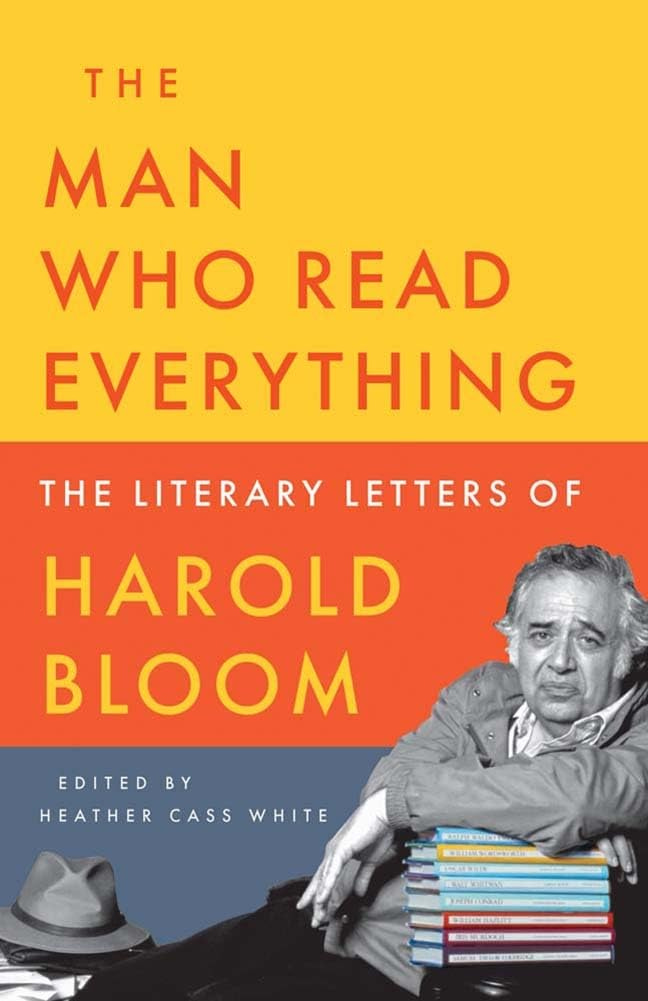
There are plenty of stories, though, that make it a plausible title, a little hyberole being always allowed.
He had read everything worth reading, or claimed to have. When he could still walk, he would allow bystanders on Yale quads to quote random lines of Milton to him, and he would pick up the line and keep reciting until he reached the other end of the quad.
The book sounds great! I think of Bloom as an essentially Talmudic scholar — the memorisation, the total spiritual commitment, the lifelong dialogue with the corpus — albeit of literature. I’m sure he’s said something similar about himself…
When Bloom praised a poet he was almost always right — or at least brilliantly illuminating. Often wrong about poets he didn’t love.
And once we were walking with him and we mentioned Saki. He proceeded to quote, verbatim, his ten favorite first paragraphs.