

Housekeeping
The next bookclub is on 26th November, 19.00 UK time. We are reading Darwin. Selected Letters and The Origin of Species. For letters, any edition will do, and it’s less essential than Origin.
On November 9th, I am running my final salon in the ‘How to Read a Poem’ series.
Go infinite or go home (or go to jail…)
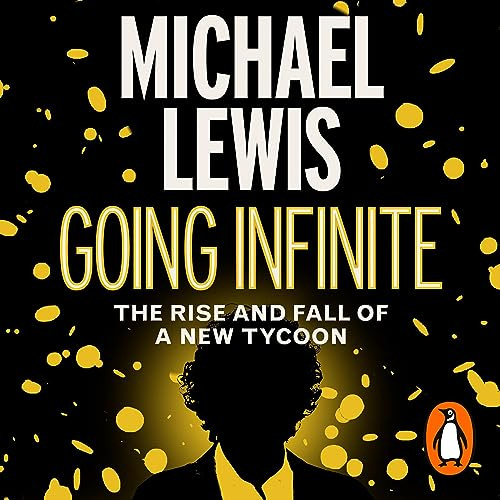
The new Michael Lewis book Going Infinite is an account of what happened to Sam Bankman-Fried who stands accused of fraud over his running of FTX, a crypto-currency exchange. Despite its failings, which are well documented elsewhere, this book is interesting for the way it exposits Sam Bankman-Fried’s deeply religious nature. In some ways, admitting that Bankman-Fried did many things that were deeply wrong, this is a tragic story.
FTX was run by a group of Effective Altruists. Effective Altruism is a form of utilitarianism that believes many people can do the most good with their lives by earning a lot of money to give away to improve the lives of the most impoverished people around the world. Organisations like GiveDirectly, for example, get your money directly to the people who can make best use of it in Africa, with low overheads. This movement have saved and improved millions of lives globally.
Sam Bankman-Fried became a zealous convert to this cause, so much so that it narrowed his view of the world. As with all religions, acting too consistently on very strict beliefs can distort your mind. In Bankman-Fried’s case, the distortions were extreme. Two hundred years ago, Going Infinite would have been a book about a religious fanatic.
Joining Effective Altruism was like joining a sect of dissenters. As a child, Bankman-Fried discovered utilitarianism and it increasingly explained to him that other people didn’t make sense. The things he didn’t like or understand about school and college could be rationalised with utilitarian explanations. Then, the Oxford philosopher Will MacAskill converted Bankman-Fried in a meeting where thought experiments played the role of gospel stories and the tenets of Effective Altruism were like the revelations of a new doctrine unavailable to ordinary minds.
Bankman-Fried was then inducted into the trading firm Jane Street, which, with all its rituals and games, was the psychological equivalent of joining a new church. Forget smells and bells, this religion has mysterious coin-toss games and gambling challenges. Jane Street doesn’t seem to be an especially cultish place, but to Bankman-Fried is was one more step on the road to fanaticism. Human beings can make a religion of anything, especially hyper-rationalists it seems.
And, as is so often the case with religious sects, divisions occurred. Lewis describes the way the old Wall Street culture and the new utilitarian cultures clashed inside Jane Street. Bankman-Fried left to set up his own firm, taking other EAs with him. (Zvi has more good detail on this episode.) And then, after a crisis, his firm spilt and he was left with a small core of dedicated believers. Lewis writes:
They were no longer a random assortment of effective altruists. They were a small team who had endured an alarming drama and now trusted Sam. He’d been right all along!
This event, when half of Bankman-Fried’s firm walked out, was referred to as “The Schism”—a reference to church history. His diary entries have the ascetic, admonishing tone of a deeply religious person.
“I did damage to the EA community,” he wrote. “I made people hate each other a little more and trust each other a little less … and I severely curtailed my own future ability to do good. I’m pretty sure my net impact on the world has, so far, been negative and that is why.”
Tweak the language just a little, and this becomes the sort of diary entry believers have been writing for thousands of years. This unhappiness pervades the book. Lewis writes,
His unhappiness was not a simple matter; he was unhappy in so many ways that it would have helped him to create new words for the emotion, the way the Inuit supposedly create all sorts of words for ice.
As this point, as at so many others, I wished Bankman-Fried had taken John Stuart Mill more seriously.
Think of the similarities. Bankman-Fried and Mill were both intense, isolated, children who became utilitarians at a young age, and were obsessed with working for the public good. Both neglected their own happiness and entered a period of depression in their early twenties. But then the stories differ.
Mill realised that living entirely for outside purposes was miserable, and so nurtured his inner life. In doing so, he improved himself as a philosopher and ended up doing more good for the world. That second part is hugely important. Mill wasn’t just enjoying himself. He was gaining a broader understanding of the world’s intangible, messy reality. He adjusted his principles to fit with the world. Bankman-Fried’s intransigence meant he tried to do the opposite.
When Bankman-Fried left Jane Street to set up his own firm, his mistake was to think that a different job would make him happy. Maybe he was already corrupted at that point, maybe not. Somewhere around this time seems to have been the time when his once genuine altruism and utilitarianism began to get corrupted into what became his fraud. This was driven by his unhappiness and his misguided belief that massive accomplishment to prove himself would make him happy. What he really lacked was inner resources.
One of his college exams asked what the distinction was between art and entertainment. Sam said it was bullshit. This is sub-Benthamism of the sort Mill left behind. Mill’s escape meant he could understand other sides to the world, including his opponent’s beliefs. Bankman-Fried was so devoted to Benthamism he became Calvinist in his disdain with those who didn’t see things his way. He thought the rest of the world was full of intolerable boredom. To manage his despair, he turned to video games. He needed this escapism so much, he played them during staff meetings, interviews, and during television appearances.
Lewis is remarkably sympathetic about such self-evidently poor behaviour. But, this does speak to the tragic side of Bankman-Fried, the way his uncompromising beliefs trapped him into a corner. If only he had read Ecclesiastes! Or Shelley! None of this is new. Shelley warned about people who go looking for The Truth and end up disappointed.
Through the unheeding many he did move,
A splendour among shadows, a bright blot
Upon this gloomy scene, a Spirit that strove
For truth, and like the Preacher found it not.
Sam Bankman-Fried thought he had found the truth. Alas. He had only made a religion of a narrow form of utilitarianism, which he would have known not to do if he’d read John Stuart Mill. He was so obsessed with the idea that his work would lead to some great change in the world, he forgot to enjoy himself. And that corrupted him. What started out as a lonely child finding his place became a fanatic’s obsession to win a game at any cost. Utilitarianism went from being a way of understanding things he didn’t like to a mechanism which helped Bankman-Fried take revenge on the world. Like so many others, he started out thinking he was doing God’s work and ended up thinking he was God.
It is part of the sadness of this story that, to begin with at least, Bankman-Fried obviously hoped his rationalism would make him somehow immune to all of this. In a funny way, despite the fact that he seems to have committed many terrible wrongs, Bankman-Fried sacrificed himself to his religion.
You're the first person who's said SBF should have read more Shelley and you are right!
Did I miss somewhere which letters we are reading?