

The Stranger, an adaptation of Camus’ L’Étranger, is one of those films you have seen before. It is shot in black and white, so that it almost looks like a film from the time of the novella (1942). Classic film techniques are used (like pointing the camera down onto the actors at dramatic moments), but the whole effect is more like the recent Ripley adaptation. Camus works better as a thriller than a conte and this film knows it. Obviously, Camus raises philosophical questions, about the nature of the self, moral obligations to people we do not really know, and the absurdity of life, but they are better answered with drama than existential speeches. To that extent, the film was worthwhile, but if you want beautifully made black-and-white films that deal with these themes, Hollywood has done that a hundred times before and better. If you want Camus, well, read Camus.
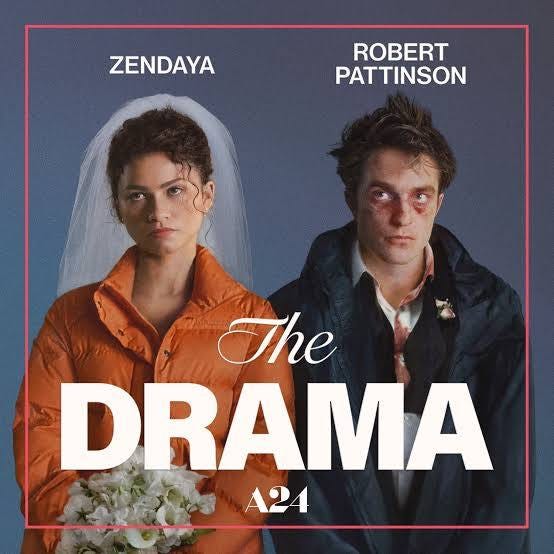
I went into The Drama pretty cold, having seen the trailer but none of the associated discussion. I knew none of the plot beforehand. (I learned afterwards who Zendaya is.) And I thought the film was splendid. It is a romantic-comedy-thriller, with exactly the ending I wanted, though giving no quarter to sentimentality. It is laugh-out-loud funny, and more interestingly shot than The Stranger, more originally so, with excellent use of flash-back-and-forward, without becoming intolerably confusing. The question that is asked throughout is “what is the worst thing you have ever done?” But the question the film is actually about is: “how much should our past define us to other people”? This overlaps with the same themes as The Stranger, but treats them entirely differently, and more successfully. I don’t want to give spoilers, but you should see this film.
When I came out of seeing The Drama, I read Nate West’s review of Transcription (a novel about which I have nothing to say).
Pitched higher are odd lyrical speculations that are irreducibly ambiguous, sublime from one side and silly from another, but attractive in the manner of Sudoku or a Rubik’s cube, as when he addresses the reader directly: “Say that it was standing there that I decided to replace the book I’d proposed with the book you’re reading now . . .”
For each of these fragile exercises, there are many more passages of what philosopher G. A. Cohen has called “unclarifiable unclarity”:
Unclarifiable unclarity is exactly the phrase. The bien pensant attitude of the unclassifiable is at the heart of Lerner and The Stranger. In contrast, The Drama struggles with this attitude. Toleration of ambiguity is one of the central modes of art, and the critical response to such ambiguity is often hostile when it impinges upon cherished beliefs. The Drama is about a school-shooting, a difficult subject for many people, as one of the characters demonstrates. There is a modern critical temptation in literature to praise literature for the sake of its ambiguity. Nate West challenges this directly. (As Henry Begler said, “let a thousand neo-Hazlitt’s bloom”.)
The Stranger is happy to merely have unclarifiable ravings at the end, while The Drama relies on something closer to cliche. But The Drama has worked through a complex narrative and found a real solution to a real problem. The Stranger just pronounces life unpronounceable. Art does not have to clarify to the extent of being a neat solution to a puzzle, God forbid, but what separates The Stranger and The Drama is their respective ability to work with unclarity, not just to comment on its existence. The crisis faced by the couple in The Drama is full of unclarity, and pushes them into unbearable uncertainty—the source of all their anxiety is that clarity might never be reached, that the unspeakable might have to be expressed. At the end of The Stranger an existential soliloquy is delivered, both boring and banal. At the end of The Drama there is an attempt to move ahead with life out of the ruins of a messy dénouement.
The Stranger is a small exposition of a philosophical problem; The Drama is a real story that reworks genre stereotypes to think about how we can live with the unclarity of the people we love. It may be that we can never be fully clarified as individuals, but that does not make an aesthetic of “unclarifiable unclarity” a suitable means of dealing with life, nor does it suggest a philosophy of absurdist nihilism. I prefer The Drama to The Stranger morally as well as aesthetically—The Stranger tells us many things we already know; The Drama is an ironic achievement: the bien pensant ideas of the middle class, to do with shootings, identity, personal morality, Freudianism and therapy, are satirised, (though Freud is found to have some essential truth), and in the end resolution is met through crisis.
These are two modes of art, both difficult to succeed in. The Stranger is exactly what you expect, both of an adaptation of this book, as a film of this type, and as a representation of a certain set of ideas; The Drama is not what you expect. My guess is that of Lerner, The Stranger and The Drama it is only the last that will survive, even though it will keep, for now at least, to a smaller set of admirers than it deserves.
I love it when someone tells me the truth: "If you want Camus, well, read Camus." I cannot think of a time in my life, however dismal, however ebullient, that I have not wanted Camus.
I liked Lerner’s 10:04 quite a bit, and parts of The Topeka School were great. (I wonder if it’s partially because Lerner and I are close contemporaries in age and background.)