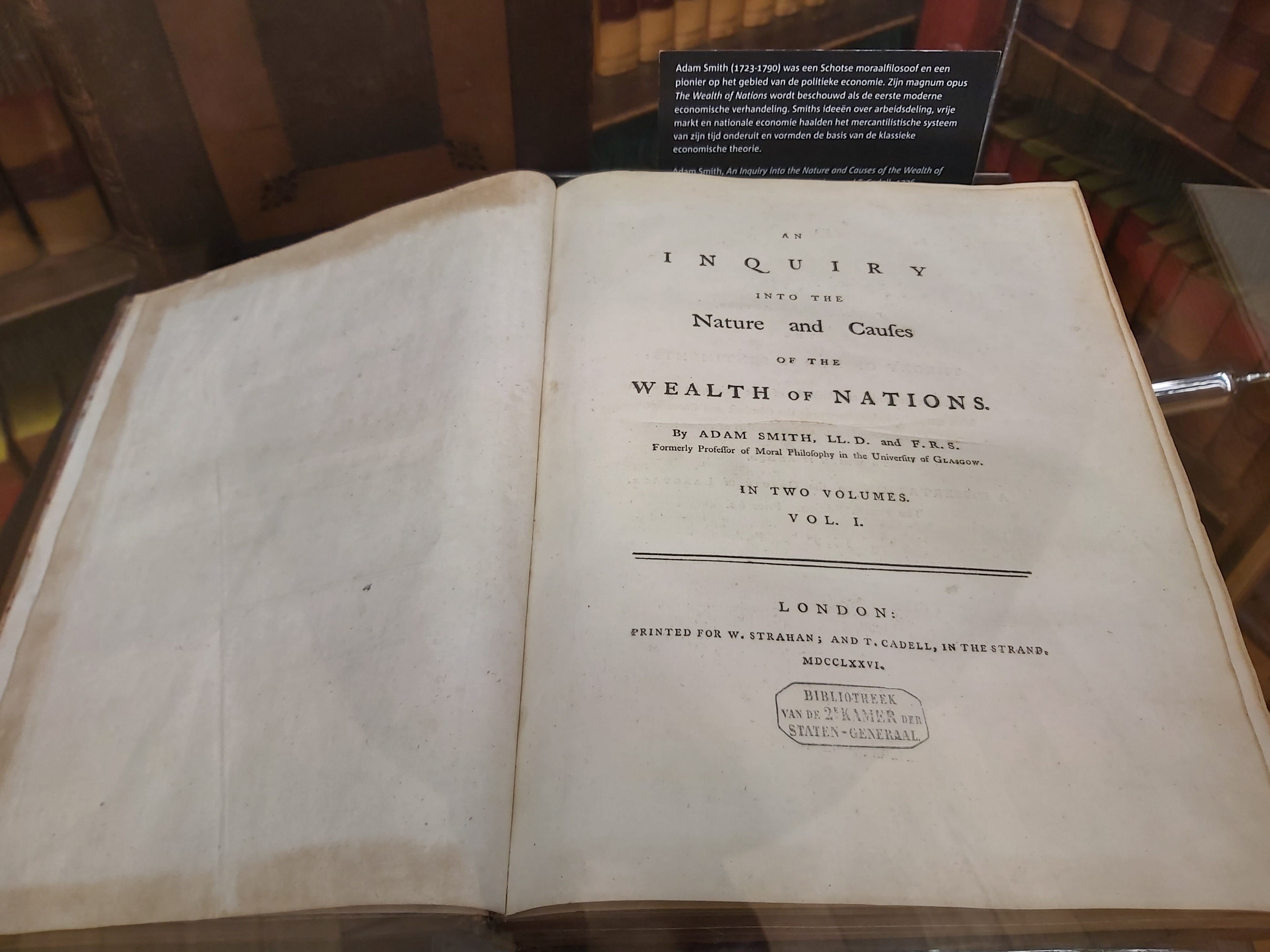
I wrote for Liberty Fund about The Wealth of Nations as a classic of English Literature. Smith was “a truly rounded humanist, a man who knew enough of life and books to write not just a great treatise but a work of significant pleasure.” Smith was a great reader of literary writers and the influence of Swift is everywhere apparent. There is some evident influence of Addison and Johnson, of course. (One of Smith’s first pieces of published writing was a review of Johnson’s Dictionary.)
Here is an extract.
Unlike so many social scientists, he writes about life in a way that retains the pulse of feeling while describing with a detached eye: “The contempt of risk, and the presumptuous hope of success, are in no period of life more active than at the age at which young people choose their professions.” (WN I.x.b.29) In his explanation of the lottery of fortune for navy men, he writes: “The distant prospect of hazards, from which we can hope to extricate ourselves by courage and address, is not disagreeable to us, and does not raise the wages of labour in any employment.” (WN I.x.b.32)
And despite his work being a descriptive account of economic science, so many of his observations are full of moral feeling: “The most decisive mark of the prosperity of any country is the increase of the number of its inhabitants.” (WN I.viii.23) He condemns the “cobweb science of Ontology” (WN V.i.f.29) being taught in universities. He wants education to be able to “improve the understanding [and] to mend the heart.” (WN V.i.f.32)
Here is the whole piece, which has some details about the early reception of WON.
Amusingly, when WON was published the publisher was impressed with the sales, which were said “more than I could have expected from a work that requires much thought and reflection (qualities that do not abound among modern readers).” Ah those modern readers, eh? Never quite what we want them to be!