

The most read pages in the First Folio at the Bodleian library in Oxford are the ones with the lovers’ first meeting in Romeo and Juliet.
In another copy of the First Folio, a reader has left extensive markings against R&J, notably against the lyrical passages and lovers’ dialogue. That was John Milton’s copy.
Taylor Swift’s 2008 song ‘Love Story’ is based around an R&J style fantasy with a happy ending.
Many theatres were closed between 1592-94, due to plague, and Shakespeare wrote lyric poetry in that time. In 1595, R&J shows the marks of a newly lyrical mode of expression in his play writing.
When Romeo compared Juliet to the sun, the original audience would have looked up at Juliet on the stage balcony and had to shade their eyes from the afternoon sun.
Six roles dominate the play—Romeo, Juliet, the Friar, the Nurse, Mercutio, Capulet. This is not true of any other 1590s tragedy. R&J is an ensemble play.
R&J was probably performed at the Theatre, which was in the suburbs outside the north eastern boundary of the City, the Curtain which was on the main road into the City, and the Globe, on the south bank. Unlike the polygonic Globe, the Curtain was a large rectangular theatre.
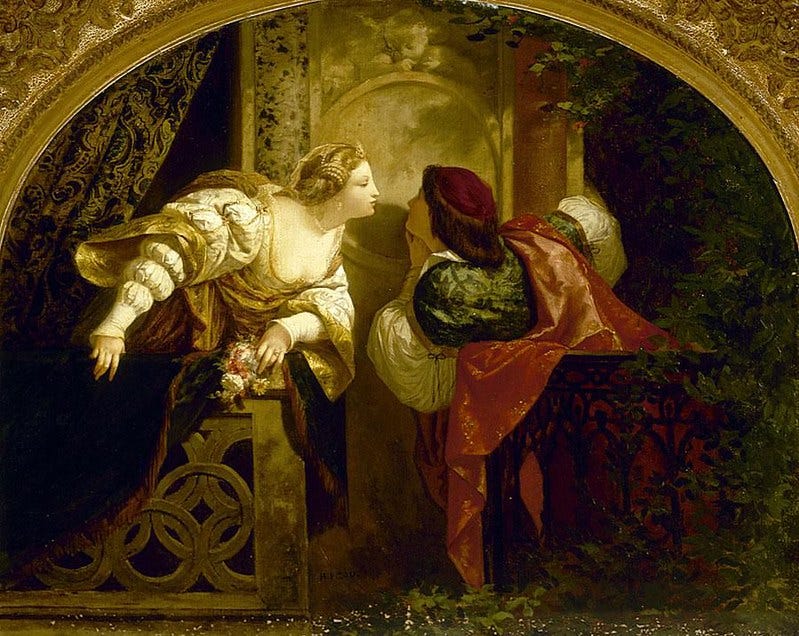
It is unlikely that Romeo climbed up the balcony at the Curtain, as he often does in modern productions.
There are feuding Montecchi and Cappalletti in Dante’s Inferno, from 1320. Shakespeare’s source is a narrative poem from 1562. The author of that poem, Arthur Brooke, drowned in 1563.
Shakespeare probably read Hero and Leander by Christopher Marlowe in manuscript, and was influenced by it. Marlowe wrote: “Where both deliberate, the love is sight/ Whoever loved, that loved not at first sight?” And Shakespeare: “Did my heart love till now? Forswear it sight!/ For I ne’er saw true beauty till this night!”
What takes days in Brooke—Romeo hanging out under Juliet’s window day after day; three months between the marriage and the killing of Tybult—happens in a few hours in Shakespeare. Shakespeare made R&J into a fast and furious story.
Shakespeare changed the fight with Tybult, too. In his version, Romeo is more involved, makes the decisive move that gets Mercutio killed, and then kills Tybult. In Brooke, Romeo is merely involved in a general gang fight and kills Tybult. This intervention is crucial, it shows us the change from a romantic to tragic story, and it makes it at least ambiguous about how much we should blame Romeo for that shift.
Shakespeare delays Juliet hearing the news of the fight, adding her soliloquy and the Nurse’s dialogue. He also delays the news of Romeo’s banishment. This increases the tension but also focusses in on the question of blame. Allowing the confusion to occupy the stage for longer forces us to reflect on what just happened: Romeo chose to kill Tybult. Romeo chose violence.
The 1590s were a time of sonnet writing and the influence of sonnets is everywhere in R&J. The famous kissing scene, where the lovers speak in a sonnet, was influenced by Philip Sidney’s sequence of sonnets Astrophil and Stella, which includes four kissing sonnets.
Shakespeare frequently self-plagiarised, re-worked ideas and dynamics from older plays in newer work. The Queen in Richard II clearly echoes R&J:
Richard
One kiss shall stop our mouths, and dumbly part.
Thus give I mine, and thus take I thy heart.
Queen
Give me mine own again. ’Twere no good part
To take on me to keep and kill thy heart.
So, now I have mine own again, begone,
That I may strive to kill it with a groan.
Richard
We make woe wanton with this fond delay.
Once more, adieu! The rest let sorrow say.It is likely that same actors played both roles.
Although it was normal to marry in your late twenties, or not at all, the average age of marriage in London seems to have been about 23.
Men outnumbered women and the marriage market was competitive. Romeo’s failure with Rosaline is a genuine problem: to remain single was to remain socially inferior, like a boy.
Shakespeare was married at 18, probably because Anne was pregnant. Young marriages weren’t unknown, but were less common. (Juliet is 13, and thus too young for marriage by most contemporary standards.)
Marriages conducted in the present tense were binding; those conducted in the future tense (I will take you) were binding after consummation. The consummation in R&J is therefore not legally important, but morally so. Sex was viewed positively in Protestant liturgy and theology.
The audience would likely have disapproved of the secrecy of the marriage, as well as the fact that the lovers are under age. It was a legal marriage of social equals, but also an act of disobedience.
Being a wife means Juliet must be loyal to Romeo, not Tybult, after the killing, which puts her on the path to death.
When Romeo and Juliet join hands they do not dance: it is decorous to join hands in dancing but scandalous to do so otherwise. Moving away from the dancing to their own space reinforces the transgression.
The parallel between duelling and dancing would have been obvious to contemporaries. R&J has more fencing terms than any other Shakespeare play. The new style of fencing was called “dance like”.
Street fighting was common among all social groups. Government policy had been trying to control it for decades.
Tybult fences in Spanish style, Mercutio in Italian—clear signs to the audience that Tybult was the villain.
Rapiers were the most deadly weapon. Carrying one gave members of the upper class further domination of public space. People of lower status stood aside—took the wall, in Benvolio’s words—on the street.
The phallic opening of R&J and the vulgar masculine jokes reflect the fact that there are estimated to have been up to 139 men for every 100 women at the time and that theatres were very male places. Sampson and Gregory, who make rape jokes, would have been played by the same actors as those who, in Titus Andronicus, played Chiron and Demetrius, who rape Lavinia.
Romeo has so many friends to make him a more sympathetic character and to tell the audience he is not just a mopey, self-absorbed young man. (Though he is.)
One consequence of the play’s speed and compressed action is the Romeo never gets the chance to tell his friends about Juliet. This only reinforces the gap between the courtly love and chivalric honour aspects of the drama.
Samuel Pepys saw Romeo and Juliet when the theatres reopened in 1662 and though it “the worst that ever I heard in my life.” He didn’t see Shakespeare’s version though, but a much edited one by William Davenant. As well as making the play too comic, many of the actors seemed to have forgotten their lines.
Much of this is taken from the New Cambridge Shakespeare edition, which has plenty more material, especially about performance history, in the introduction.
Why were there so many more men than women?
Obviously first thing kids ask when I teach it is ‘why is Romeo dating a 13 year old’. Generally just hand-wave it away with ‘different time’ etc. but obviously no, an Elizabethan audience would also have found that age gap inappropriate (or would they have cared in the same way we would now?) Is the age gap a Brooke thing, and if so why is it so pronounced?