

For a long time, I did not read Proust. I never imagined what it would be like to read Proust, the way one imagines, in that strange almost premonitory way, oneself enjoying a certain book based on the title or something in the style of its presentation or a passing remark from a friend or in an essay. No-one I knew spoke about Proust, or, if they did, it was a name without connotations, and I didn’t pay attention; I did not internalise Proust nor associate him with anything. Whenever I read about Proust, it likewise passed me by. Still, I gradually acquired the impression of Proust as one of the greats and by the time I was aware enough to want to read him, I was forever putting it off. Something else always needed to be read. I never got that premonitory feeling.
Then one day, I was reading Helen DeWitt’s blog, and she was commenting on a new translation of Proust. I was not reading her blog for this commentary, merely because I wanted to read her whole blog, which I more or less managed. The post that made me read Proust was a response to someone commenting on some new translations of À la recherche du temps perdu. DeWitt argued that these new translations may or may not be good, but that was hardly the point when readers could be encouraged to read the original French for themselves. Whatever you decide about translations, DeWitt wrote, order a copy of the original French and try it. Look up whatever words you do not know and make progress slowly. At the very least, you will have some sense of the original. As she says, the difference between the French and English is the difference between musical instruments.
By then, I was in my thirties, thought DeWitt a genius, and had been meaning to read Proust for a long time. So I did exactly what she said; I went to amazon.fr and ordered a copy of Du côté de chez Swann, paying the postage for it to be sent to me in London. When it arrived a week or two later, I began, with a notebook I had bought specially for the task, looking up every word and noting down its meaning and grammar. For half an hour every evening I sat at my desk and pieced things together. Slowly, the first few pages came into view. Every phrase and sentence I understood gave me the sensation of a light flooding my mind. I still recall the sensation of understanding the first paragraph well enough to be able to read it unaided, though that understanding is sadly lost to me now, and I especially remember the thrill of the image of the train in the second paragraph.
I would ask myself what o’clock it could be; I could hear the whistling of trains, which, now nearer and now farther off, punctuating the distance like the note of a bird in a forest, shewed me in perspective the deserted countryside through which a traveller would be hurrying towards the nearest station: the path that he followed being fixed for ever in his memory by the general excitement due to being in a strange place, to doing unusual things, to the last words of conversation, to farewells exchanged beneath an unfamiliar lamp which echoed still in his ears amid the silence of the night; and to the delightful prospect of being once again at home.
It is often said that the first sentence, Longtemps, je me suis couché de bonne heure, encapsulates the novel: it is synecdochic: in the opening sentence the whole theme of the novel is encapsulated, and the encapsulation is itself representative of the compressions of memory and recollection. The train develops this idea, beginning the constant unfolding of the theme, and creating the parallel track for the narrative: time, like the train, runs one way, but as we progress we remember life non-linearly “now nearer and now farther off”, and as we age and recall our lives “punctuating the distance” and we live like the traveller “hurrying towards the nearest station: the path that he followed being fixed for ever in his memory.” We are caught between living and memory.
Alas, like Samuel Johnson I have never been able to stick to a plan, and something—some illness, a trip somewhere, something to do with a child, or something, perhaps, innate to myself, some idleness, forgetfulness, entropy, (this last is the most likely)—meant that one day I put Proust back in the drawer of my desk, where it lived with its dedicated notebook, and never took it out again. I knew that I had failed, but, as DeWitt had written, “It's not, of course, compulsory to read the whole thing, but it seems a shame not to see what this extraordinary prose is like.”
Failure, however, left me with an appetite, the feeling that I should simply read the English and then I would be able to go back to the French, and so one day, caught by one of those sudden fits of mood one cannot account for—why this book, why just now?—just as I was packing up to leave the London Library for the day, I hurried to the second floor of the main building where the fiction is kept, to get the new Lydia Davis translation. But it was not there. So I put it on hold. And for a long time, I waited. Several people were ahead of me in the list. And so, after a few months of waiting, gripped by another of those moods, I walked from my house to the pale blue bookshop on the corner of the parade in Blackheath, which is still stocked and run in a traditional manner, with an ailing owner, a talkative woman who works there during the week, and paper signs hung in the doorway when she goes out for coffee, where I had seen an incomplete set of the beautiful old Chatto and Windus editions of the C.K. Scott Moncrieff translation (which I had read many people disliked) and paid more than I wanted to for the first two volumes, which made up, together, Swann’s Way. I was simply going to start.
My god what a revelation those books were to me. It was little surprise to discover that Proust was obsessed with The Mill on the Floss and Ruskin (“I do not speak English, I speak Ruskin”). I had to read as slowly as I have ever read, as with James. I stopped to take many notes, transcribing passages onto the yellow A4 paper I now used instead of notebooks, having gone half-mad when I was writing my own book not knowing which of the half-dozen identical notebooks I needed to open for that one page reference, and a new pile of notes began to form. When I finished those volumes, I walked back to Blackheath, knowing that the next two had not been among the ones they had in stock, but hoping they might have acquired them, which, alas, they had not. So the next day, I went to the London Library and checked them out. Again I read slowly, lying on my bed, almost inert with the immersion. But before I could finish the second volume, we had to leave England, the book had to be returned to the library, where my membership has now expired, and the original Moncrieff translation, which I had loved so much, was no longer available to me. Everything now is in the updated Moncrieff, which, perhaps irrationally, gives me the feeling of accepting the NRSV instead of the King James Version.
I have a tablet I use for Kindle reading, a Daylight, but for a long time I could not connect it to the internet in the USA (I forgot I changed the WiFi password), so I was unable to download Proust. And anyway, I had a new job, we had moved to a new country, reading Proust was nothing to do with anything I needed to do. And those moods kept gripping me to read other things like Adam Smith and Walter Scott’s poetry—books that demand all your attention, as much as Proust does. Once I figured out that I had been putting in the wrong WiFi password, however, I downloaded Proust. And then, that afternoon, before I started re-reading, I was browsing in Capitol Hill Books and I found old Modern Library editions of the Moncrieff translation. Déjà vu.
Another strange undefinable sense one gets that now is the time to read this book had gripped me and taken me away from Proust. For years, I disliked Henry James. The Portrait of a Lady, which starts so enchantingly, became unreadable to me within a hundred pages. James’s narrow, fussy, insular critical opinions were all explained by his fastidious fiction. This is the sort of book a man writes when he does not love George Eliot the way Proust loved George Eliot. I knew I had to take James more seriously. A great many other critics find James to be the pinnacle of a certain sort of art, The Master, the great theorist of the English language novel. Not for me. Before I read The Golden Bowl, James largely left me cold. This is an exaggeration, of course: some of the short fiction was irresistible, but I had failed to read The Portrait of a Lady, supposed to be his best, and even once I had read it, I could never love it. Books like The Europeans, The American were totally unreadable. The Bostonians took a great deal of work. Reading James made me feel simultaneously impressed and bored.
There had been a moment when everyone was talking about The Golden Bowl because it had been mentioned in the Sally Rooney novel Beautiful World, Where Are You. That moment had passed me by. But then, browsing the library shelves, I chanced upon an old copy of The Golden Bowl. It had large dull-green covers and the beautiful sort of thick, creamy paper that is no longer used to make books, upon which the firm’s fine old-fashioned typeface seemed to live with great authority and security. I picked it up with the sense that I would have to begin reading it right then.
I was immediately entranced. It is almost impossible to say anything about The Golden Bowl. If you have read it and you are one of the readers who loves the book (and indeed a great many of them do not, including Edith Walton who hated it terribly, thinking it the ruin of a great talent) we would be able to find some common ground, a shared sense of what the book is like and about. But if I merely tried to describe, summarize, explain, or explicate The Golden Bowl I think I would fail. It is notable that a lot of the most interesting criticism of this book, although it does make some efforts to explain the story, largely proceeds on the basis that you would only be reading criticism of The Golden Bowl if you had read the novel. James deliberately made his book into a labyrinth, and your choices are either to descend into the darkness or to entirely decline the adventure.
Although some of my efforts to read James had been successful—I liked The Spoils of Poynton and Washington Square, though that last one is a minor masterpiece, like Daisy Miller, not the pinnacle some people believe—this was an entirely new sensation, and I no longer read in that plodding, linear manner I had become accustomed to with James’s other books. Now I read like an enthusiastic spaniel, who, when let off the lead on a walk keeps running ahead and coming back, making loops, working over a piece of ground, moving on, coming back, making comparisons of obscurely doggy matters, so that in the end, the dog has not only had a walk of three or four times the length of the amused humans, but has experienced everything in a wild, rotating reality, quite different from the pleasant linear walk that takes place beside him. The same was true of the other late masterpiece I read by James, The Wings of the Dove, of which I never managed more than a few pages or paragraphs before turning back and re-covering the ground, sometimes pausing to re-read multiple times, sometimes to copy out page-long passages. There is no reading these books, one simply moves around in them, backwards and forwards, over and over, reviewing and reviewing, letting the picture become clearer and clearer. James is so dilatory and expansionary and moves so freely between the past and the present and the future, telling you what realization a character has in the future about a moment being narrated in the present, which clarifies something in the past, that one simply cannot breeze through the novel. We have entered the labyrinth and our torch will only show us one corner or one passageway at a time and we must keep moving it round and round the way James moves his narrative round until we develop a full sense of where we are and where we are going. The aim is not to solve the novel like a puzzle but to come to terms with its vastness. So little actually happens in the plot, but the novel contains so much.
This sort of reading is pure luxury. Sometimes, I read a hundred pages of The Golden Bowl, lying on the sofa in a sort of immersive trance—reading the way children read—but more often, it was the first thing I did in the morning, simply to read one chapter, and it took as long as it took, since I was prepared to give this book whatever it needed.
Many readers, though, find it impossible to enjoy The Golden Bowl, including accomplished critics and lovers of James’s early novels. After I recommended The Golden Bowl on Substack, someone emailed me asking if the book gets easier to read as you go. I had to tell them:
erm.... no.... Sorry!
He’s trying to depict the difficulty of knowing the world, the convolutions are his technique for showing you how hard it is to be certain about anything as an individual, or about an individual, and thus to tell the story through the vagaries of individual consciousness, rather than with the confidence of an external narrator.
I sent a paragraph from a Colin Burrow essay, published in the London Review of Books, which I thought got to the heart of the matter.
…we occupy a delicate weave of emotions and beliefs that half beguiles us into thinking of ourselves as its centre, until something is seen or something happens which tells us, irrefutably, that we are not. We live in a state of bewilderment, even though we do not want to acknowledge it, and indeed may not always know it.
James’s late style evolved along with this multiplex vision of human reality, and it is not so much a vehicle for that vision as its enabling condition.
When the modern novel was invented, it was, as Northrop Frye said, almost a parody of Romance. From tales of knights and dragons, through the direct parody of those things, the novel arrived at a reformulation of the Romance: wandering knights became gallant gentlemen, and while the characters didn’t go on marvellous journeys, they still adventured, albeit in a domestic, realistic manner. Elizabeth Bennet in her carriage is a modern image of Sir Lancelot in the forest. The quest took its characters into states of bewilderment—the state which Burrow identifies in James.
James’s characters are often called “pilgrims” who he describes as being on “adventures”—a word that once titled many early novels. His plots are so often about the arrival of a naïve American in the hostile land of England. The old quests had been in pursuit of something grand: Helen of Troy, the Holy Grail, God. Bewilderment led to victory and wisdom. But James wrote in disillusioned times. There was not just Moby Dick, but Bartleby The Scrivener, about a man who refused to do anything at all. As Borges says, in the past, every enterprise was fortunate. The golden apples were stolen. One of the knights, at least, deserved the Grail. Captain Ahab caught Moby Dick. Now, all our adventures fail: “the heroes of James or Kafka can only hope for defeat. We are so poor in courage and faith that the happy ending is nothing more than an industrial flattery. We cannot believe in heaven, but we can in hell.”
James’s characters are often stifled, bored, and disillusioned. They quest in search of experiences of life. So many of James’s characters make this appeal, and so much of the yearning and pathos that animate the late novels is an expression of this desire for life, for some real meaningful experience. The canonical expression of this mood is given by Strether in The Ambassadors.
… don’t forget that you’re young—blessedly young; be glad of it on the contrary and live up to it. Live all you can; it’s a mistake not to. It doesn’t so much matter what you do in particular, so long as you have your life. If you haven’t had that what have you had? This place and these impressions—mild as you may find them to wind a man up so; all my impressions of Chad and of people I’ve seen at his place—well, have had their abundant message for me, have just dropped that into my mind. I see it now. I haven’t done so enough before—and now I’m old; too old at any rate for what I see. Oh I do see, at least; and more than you’d believe or I can express. It’s too late. And it’s as if the train had fairly waited at the station for me without my having had the gumption to know it was there. Now I hear its faint receding whistle miles and miles down the line. What one loses one loses; make no mistake about that. The affair—I mean the affair of life—couldn’t, no doubt, have been different for me; for it’s at the best a tin mould, either fluted and embossed, with ornamental excrescences, or else smooth and dreadfully plain, into which, a helpless jelly, one’s consciousness is poured—so that one ‘takes’ the form as the great cook says, and is more or less compactly held by it: one lives in fine as one can. Still, one has the illusion of freedom; therefore don’t be, like me, without the memory of that illusion.
See the Proustian image, right in the middle of the paragraph, when Strether compares himself to a passenger who doesn’t know his train is waiting: “it’s as if the train had fairly waited at the station for me without my having had the gumption to know it was there.” Recall the description from Swann’s Way:
I could hear the whistling of trains, which, now nearer and now farther off, punctuating the distance like the note of a bird in a forest, shewed me in perspective the deserted countryside through which a traveller would be hurrying towards the nearest station: the path that he followed being fixed for ever in his memory
Strether never got on the train and his path was not fixed in his memory, instead, he was the epitome of the Borgesian failure: he never even began his journey. What was fixed in his memory was reluctance, denial, and yet, he chose to leave Paris, to go home to morality, to once more live without the gumption to know the train was there. In the late novels, James’s characters are on a quest for morality. The Golden Bowl is that rare thing: the triumph of Good over Evil in the figures of Maggie and Charlotte; The Wings of the Dove is the triumph of Good over Evil within the breast of the hero Merton Densher. And so, worried about the immorality of the adventure he finds himself longing for, Strether goes home.
But before he went home, he saw life—though that is all he was offered, it was, perhaps, enough. In his preface to The Ambassadors, discussing the passage I quoted, James wrote,
He has accordingly missed too much, though perhaps after all constitutionally qualified for a better part, and he wakes up to it in conditions that press the spring of a terrible question. WOULD there yet perhaps be time for reparation?—reparation, that is, for the injury done his character; for the affront, he is quite ready to say, so stupidly put upon it and in which he has even himself had so clumsy a hand? The answer to which is that he now at all events SEES
It is that seeing—that great awareness of what is happening, that the train is waiting, travelling, whistling, punctuating the distance—that defines Proust’s methods. As John Bayley says, “The secret of Proust’s success is to have seen how to make use of what we all experience, to explore with all the majesty of art the joyful mental possibilities that attend the most ignoble and commonplace and everyday consciousness.”
Any association I find between James and Proust perhaps owes more to my reading of Moncrieff’s translation than the original French. Adam Gopnik explains, in a review of a biography of Moncrieff.
One other, I think significant, aspect of the translation that the biography illuminates is the intertwining, in Moncrieff’s imagination, between the materials of Proust and the related—slightly different, but related—rhythms of Henry James. James’s direct influence on Proust is debated; certainly James disliked what he read of the French writer. But in Moncrieff’s mind Proust and James always seem to come up together, to get twinned
Are we to dismiss this as an invention of Moncrieff’s? What he saw in Proust, which relates to James, is the reversion of the quest inside the mind—the final conquering of the Romance by the novel: not only was the inner reality of Sir Launcelot of little matter to Thomas Malory, but the scenery was barely present, as Eric Auerbach explained in Mimesis. The quest was all—the journey of moral redemption was a tale—then the tale became domesticated—and then it went into the interior. The interior quest is exemplified by Proust, but it was perfected, too, by Henry James. In reading Henry James, I had been learning to read Proust.
Reading Proust in spurts and intervals is like having a recurring dream in which the dream-world is familiar, many of the people and aspects are recognizable, but where the action is perpetually unfolding at the pace and on the terms of the dreamscape, so that there is not only no rush to finish, but no sense of an ending, no compulsion to advance: one simply enters the dream of the book and continues.
Proust imagines the past as a realm of Romance, like a charm that can be cast over us, entered into with its enticements like the glowing lights above the street. This distant world is glimpsed in memory and with a Proustian dedication it can be made into an art, a parallel reality, as in tales of courtly love and chivalry, which exist within a heightened alternative to our lives, but which are clearly about us and contain us.
By reason of the muffling of all sound in the carpets, and of the remoteness of her cosy retreat, the lady of the house, not being apprised of your entry as she is to-day, would continue to read almost until you were standing before her chair, which enhanced still further that sense of the romantic, that charm of a sort of secret discovery, which we find to-day in the memory of those gowns, already out of fashion even then, which Mme. Swann was perhaps alone in not having discarded, and which give us the feeling that the woman who wore them must have been the heroine of a novel because most of us have scarcely set eyes on them outside the pages of certain of Henry Gréville's tales.
Proust finds the entry to this charm and secret most famously in a madeleine, although this is one of those reports from literature that proves to have been inadequate, because the madeleine itself is not the entryway to memory, but rather a spoonful of tea in which there is a crumb of the cake.
She sent out for one of those short, plump little cakes called ‘petites madeleines,’ which look as though they had been moulded in the fluted scallop of a pilgrim’s shell. And soon, mechanically, weary after a dull day with the prospect of a depressing morrow, I raised to my lips a spoonful of the tea in which I had soaked a morsel of the cake. No sooner had the warm liquid, and the crumbs with it, touched my palate than a shudder ran through my whole body, and I stopped, intent upon the extraordinary changes that were taking place.
Proust’s entrance to the realm of memory, the dream world of Romance, is, in Moncrieff’s translation at least, remarkably Shakespearean. Sonnet 27 begins,
Weary with toil, I haste me to my bed,
The dear repose for limbs with travel tired;
But then begins a journey in my head,
To work my mind, when body’s work’s expired
Here we find Proust’s “pilgrim” (with travel tired), his weariness (in one from a dull day, in the other from toil), and the transposition from the present reality of the body to the journey of the mind—Proust’s quest to the interior. He continues.
I drink a second mouthful, in which I find nothing more than in the first, a third, which gives me rather less than the second. It is time to stop; the potion is losing its magic. It is plain that the object of my quest, the truth, lies not in the cup but in myself. The tea has called up in me, but does not itself understand, and can only repeat indefinitely with a gradual loss of strength, the same testimony; which I, too, cannot interpret, though I hope at least to be able to call upon the tea for it again and to find it there presently, intact and at my disposal, for my final enlightenment. I put down my cup and examine my own mind. It is for it to discover the truth.
The traditional purpose of the quest is the moral reformation of the hero, who undertakes their journey in order to reorient themselves to their society, to atone for some indiscretion or sin, or to learn a greater awareness of themselves and their relation to the world. There is not only a common sense among questers that they must learn to navigate the world according to their own lights, but that some suffering must be endured in order for the quest to be transfigurative. There are moments when Proust’s narration is close to Dante’s, when he sees other people caught in the dilemma of improvement. Compare this, from Swann’s Way,
And yet this Odette, from whom all this evil sprang, was no less dear to him, was, on the contrary, more precious, as if, in proportion as his sufferings increased, there increased at the same time the price of the sedative, of the antidote which this woman alone possessed.
to this, from Canto VI of the Inferno,
So did we pass across that squalid mixture
of shadows and of rain, our steps slowed down,
talking awhile about the life to come.At which I said: “And after the great sentence-
o master—will these torments grow, or else
be less, or will they be just as intense?”And he to me: “Remember now your science,
which says that when a thing has more perfection,
so much the greater is its pain or pleasure.Though these accursed sinners never shall
attain the true perfection, yet they can
expect to be more perfect then than now.”
The accursed sinners of Proust shall never attain the true perfection either, but the vision of love is held before them, a vision requiring that they pass through suffering. Dante’s dark realms are real—Hell and Purgatory are external to us, places we must spend eternal life if we are unfortunate—whereas Proust’s dark realms are all within. He says, after drinking the second spoonful of tea, ready to examine his own mind,
What an abyss of uncertainty whenever the mind feels that some part of it has strayed beyond its own borders; when it, the seeker, is at once the dark region through which it must go seeking, where all its equipment will avail it nothing. Seek? More than that: create. It is face to face with something which does not so far exist, to which it alone can give reality and substance, which it alone can bring into the light of day.
Dante’s quest took him into the underworld; Proust’s into the inner world; but Proust echoes Dante, because the sensation of being called by a Beatrice, of passing through the realms of darkness, are all part of the experience of life, whether conveyed through Christian belief or personal experience.
At such moments Gilberte’s plaits used to brush my cheek. They seemed to me, in the fineness of their grain, at once natural and supernatural, and in the strength of their constructed tracery, a matchless work of art, in the composition of which had been used the very grass of Paradise.
Likewise, when he goes to Albertine’s room one evening in the hotel at Balbec, he describes his ascent in Dantean terms,
I rang for the lift-boy to take me up to the room which Albertine had engaged, a room that looked over the valley. The slightest movements, such as that of sitting down on the bench in the lift, were satisfying, because they were in direct relation to my heart; I saw in the ropes that drew the cage upwards, in the few steps that I had still to climb, only a materialisation of the machinery, the stages of my joy.
Proust continually turns from the physical world to the imaginative, which is reality-enhancing: “to strip our pleasures of imagination is to reduce them to their own dimensions, that is to say to nothing.” Like James, he makes this idea the keynote of his themes: it is in the gap between how we imagine ourselves and our futures and how we actually live that Proust and James find their subject.
We must have imagination, awakened by the uncertainty of being able to attain our object, to create a goal which hides our other goal from us, and by substituting for sensual pleasures the idea of penetrating into a life prevents us from recognising that pleasure, from tasting its true savour, from restricting it to its own range.
By the time of James and Proust, Romance was incredible; we had left Dante’s cosmos, and all the attendant certainties it allowed a poet, even so inventive and radical a poet as Dante, and had entered a new forest, the realm of memory. Proust says the past projects itself before us as a “shadow of itself which we call our future”. This is why James’s characters in the late novels are forever being described as reconsidering current events in the future. Describing the party where Kate meets Densher, James begins: “The beginning—to which she often went back—had been a scene, for our young woman, of supreme brilliancy.” The beginning—to which she often went back… So Proustian, so Dantean. The longer we read, the more resonant such phrases become, as we cannot but be aware that the circles Dante descended have become psychological circles, concentric memories, forever reviewed and revised in light of their outcomes. In The Wings of the Dove, James is not writing about the present, but about the past and the shadow it casts forward onto his characters’ futures.
The day after I found those Modern Library copies in Capitol Hill Books, I opened my Kindle app to finish reading In a Budding Grove. It was raining, so I could not read outside, but the office where I work has a single corridor running around its outer edge, and so I paced, round and round, reading as I walked, with the sudden feeling—despite the new surroundings, the difference of reading on a screen, not in beautiful old books—of having a dream I remembered from months before. Here it all was, just as I now remembered it, as I made my own little daily journey back into Proust. I was re-reading the last quarter of the book, so some of it was familiar, some of it was new. But having read James in the meantime, and having read James as part of a broader project—now abandoned—to write a book about the history of quests in literature, I was reading Proust afresh. I saw it all again in different terms.
Now, Proust was more obviously part of the history of the quest in literature, of the idea that if we want any meaning, any sense, we shall have to find it, create it, for ourselves, just as James wrote about in the Preface to The Ambassadors, and just as I had developed the idea from reading Dante, Shakespeare, Eliot, and many others. Authors have expressed this idea in so many ways that merely to list the relevant quotations could fill a book. But in Within a Budding Grove, the final section at the sea-side, I found a perfect expression of the idea I had been chasing through the Arthurian myths and The Pilgrim’s Progress and the novels of Jane Austen.
We are not provided with wisdom, we must discover it for ourselves, after a journey through the wilderness which no one else can take for us, an effort which no one can spare us, for our wisdom is the point of view from which we come at last to regard the world. The lives that you admire, the attitudes that seem noble to you are not the result of training at home, by a father, or by masters at school, they have sprung from beginnings of a very different order, by reaction from the influence of everything evil or commonplace that prevailed round about them. They represent a struggle and a victory.
So much is contained here. The word wilderness stands out to me, reminiscent of the opening of Bunyan—As I walked through the wilderness of this world—whose prose rhythms surely, consciously or unconsciously, informed Moncrieff’s translation, just as they influenced Ruskin, who Proust translated into French. Alack for my own paltry efforts: why write criticism about an idea that has not only been implicit and explicit in thousands of years of literature, but which received perfect concise expression in a masterwork? But the ambition to write a book dies easily in the face of the small creeping feeling that one is starting to get a sense of the whole, a view, however incomplete, of some essential part of literature.
George Eliot had said something similar to this in Middlemarch: “We are all of us born in moral stupidity.” Dorothea has to learn her way into wisdom. Even though she has begun to emerge from her stupidity early, when she married Casaubon she thought only of herself: “it had been easier to her to imagine how she would devote herself to Mr. Casaubon, and become wise and strong in his strength and wisdom, than to conceive … that he had an equivalent centre of self, whence the lights and shadows must always fall with a certain difference.” We are not provided with wisdom, we must discover it for ourselves.
Reading is part of that discovery, or it can be; certainly, that is part of what authors intend their books to do for us, if we will let them. The easy strictures that we see offered every day—that reading is improving, develops empathy, makes us into better people—all lack the simple idea required to bring out the real truth of the matter: reading is part of moral formation: it is not easy to be good, to develop the virtues, to become a wise person. Turning pages is insufficient. Discovering wisdom is not a question of reading novels. A letter that Samuel Johnson wrote to his servant Frank Barber comes to mind, written when Frank was sent away to boarding school as a child.
DEAR FRANCIS,
I am at last sat down to write to you, and should very much blame myself for having neglected you so long, if I did not impute that and many other failings to want of health. I hope not to be so long silent again. I am very well satisfied with your progress, if you can really perform the exercises which you are set; and I hope Mr. Ellis does not suffer you to impose on him, or on yourself.
Make my compliments to Mr. Ellis, and to Mrs. Clapp, and Mr. Smith.
Let me know what English books you read for your entertainment. You can never be wise unless you love reading.
Do not imagine that I shall forget or forsake you; for if, when I examine you, I find that you have not lost your time, you shall want no encouragement from
Yours affectionately,
SAM. JOHNSON.
Ah that wonderful line: You can never be wise unless you love reading. Taken alone, it is encouraging, the sort of thing we put on a card, or share online, and that we casually misread as meaning that if we love reading then we shall become wise, whereas all it really says is that in order to be wise we must learn to love reading: these are the conditions for wisdom to become possible, not the tricks to become a wise person. Look at all the things Johnson says around that little phrase: perform the exercises you are set, Frank is told, Johnson will be encouraging if he has not lost his time. But isn’t Proust all about lost time—not merely lost in the sense that it has gone, but in the sense that it was lost to inner speculation—how would Johnson, the great moralist of reading, feel about such a book: does Proust encourage us to undertake a quest for wisdom, or is his book an indulgence? After all, reading a novel, even Proust, is hardly a journey through the wilderness which no one else can take for us… Still, Johnson asks Frank, Let me know what English books you read for your entertainment. Reading can be part of moral formation, if that is the goal we have in mind. But also, Johnson says, if we learn to love reading.
When we moved to America, we had only eight suitcases, plus carry-on cases; half of my carry-on was filled with hundreds of sheets of yellow paper. These were the notes I had spent over a year making in the London Library. In my hurry to try and write a book about quests in literature, I had made hundreds of pages of notes: some of them were nothing more than copied out quotations and references, some were my own thoughts. These notes became a point of anxiety, for without them, not only would I not be able to write my book, but I would have lost all of that time, having to rely only upon what I could remember.
The notes were only half arranged, and when I got to my new office, one of the things I had to do was sort them into somewhat thematic piles, although that was only possible for some of the notes, because I had followed many references (and my own inclinations) to try and cover as broad an amount of material as possible, which inevitably only made the project longer and more ambitious, leaving me with a greater and greater sense that I was not trying to write a particular book, but was trying to learn as much of the history of literature as I could, a doomed and egotistical task.
The day before I began reading Proust again, I started writing this essay. I had been thinking about it all the time when I was not reading Proust, and sometimes when I was walking around, putting plates in the dishwasher, or staring out of the window, I thought of the first line, which had come into my head a long time ago. Once I had drafted about five thousand words, and read another hundred and fifty pages, I realized I needed my notes. I was making more notes now, highlighting passages on my Kindle, a much less satisfactory experience, and I needed to start keeping everything together, even if it was just with a paperclip. But in all the notes I went through, every thick-plastic London Library bag in which they had been transported to keep them safe from leaks (I am especially cautious after waking up on an aeroplane to find that the person sitting in front of me had leaked their water all over my leather satchel, and that my laptop had escaped damage by the sheerest luck), I could only find two or three pages about Proust. I knew this was wrong. I could see them. I could see the blue and green ink, and the turquoise colour that had been made between cartridges, and the desk that abutted the bed where I lay to read, and I could see the fact that there had been many more notes.
And then a passage from towards the end of Within a Budding Grove gave me one of those memory shocks that recalled to me so much of what I had loved about Swann’s Way. I was lying on the sofa in the middle of the office, in the communal space, reading on the Kindle app, a place where I liked to read at eight in the morning until my colleagues all start to arrive: it was a splendidly quiet time, like those moments in the symphony when the orchestra dips the volume much lower than you expect, and the whole tempo of the experience seems to change, even though the pacing proceeds as before, and when I read this passage it all came back to me.
But at other times, instead of going to a farm, we would climb to the highest point of the cliff, and, when we had reached it and were seated on the grass, would undo our parcel of sandwiches and cakes. My friends preferred the sandwiches, and were surprised to see me eat only a single chocolate cake, sugared with gothic tracery, or an apricot tart. This was because, with the sandwiches of cheese or of green-stuff, a form of food that was novel to me and knew nothing of the past, I had nothing in common. But the cakes understood, the tarts were gossips. There were in the former an insipid taste of cream, in the latter a fresh taste of fruit which knew all about Combray, and about Gilberte, not only the Gilberte of Combray but her too of Paris, at whose tea-parties I had found them again. They reminded me of those cake-plates of the Arabian Nights pattern, the subjects on which were such a distraction to my aunt Léonie when Françoise brought her up, one day, Aladdin or the Wonderful Lamp, another day Ali-Baba, or the Sleeper Awakes, or Sinbad the Sailor embarking at Bassorah with all his treasure. I should dearly have liked to see them again, but my grandmother did not know what had become of them, and thought moreover that they were just common plates that had been bought in the village. No matter, in that grey, midland Combray scene they and their pictures were set like many-coloured jewels, as in the dark church were the windows with their shifting radiance, as in the dusk of my bedroom were the projections cast by the magic-lantern, as in the foreground of the view of the railway-station and the little local line the buttercups from the Indies and the Persian lilacs, as were my great-aunt’s shelves of old porcelain in the sombre dwelling of an elderly lady in a country town.
Proust remembers the beginning of the novel here—the railway station—and his mention of the cakes being sugared with gothic tracery had a madeleine-and-tea effect on me, and, as so often happens when I have been reading for ninety minutes, I realized I was ready to write, and everything I had to say for the morning was already known to me, darkly, like the feeling that I was ready to lay an egg, or like I knew whatever it is that a seed knows. I put the coffee machine on while I went to the restroom and found the various extension cables, plugs, noise-cancelling headphones, made sure I had various copies of the novels available to me on Project Gutenberg, and began to type, trusting that I would remember more explicitly things that I had only taken in implicitly before, such as that mention of the train-station.
It was through architecture that Proust’s narrator of Remembrance of Things Past learned to love beauty, architecture and nature together, such as in the two passages from Swann’s Way when he recalls the beauty of the two “ways” of nearby families full of flowers that he remembers so intensely that no real flowers he has seen since ever compare to them in their realness, and in the description of the church at Balbec.
Whether it be that the faith which creates has ceased to exist in me, or that reality will take shape in the memory alone, the flowers that people shew me nowadays for the first time never seem to me to be true flowers. The 'Méséglise way' with its lilacs, its hawthorns, its cornflowers, its poppies, its apple-trees, the 'Guermantes way' with its river full of tadpoles, its water-lilies, and its buttercups have constituted for me for all time the picture of the land in which I fain would pass my life, in which my only requirements are that I may go out fishing, drift idly in a boat, see the ruins of a gothic fortress in the grass, and find hidden among the cornfields—as Saint-André-des-Champs lay hidden—an old church, monumental, rustic, and yellow like a mill-stone; and the cornflowers, the hawthorns, the apple-trees which I may happen, when I go walking, to encounter in the fields, because they are situated at the same depth, on the level of my past life, at once establish contact with my heart.
I remembered the feeling of reading this passage more than I remembered the passage itself, which had stayed in my memory, and been invoked by the phrase sugared with gothic tracery, but as soon as I re-found it I knew this was what I had been thinking of—more than anything else about Swann’s Way, I loved the writing about nature and architecture: I have memories of fields and river banks like this, and of gothic ruins and old churches monumental, rustic, and yellow like a mill-stone, and yet Proust writes with such immersive detail that when I read this passage, although I do think of my own memories, I also see something new, something that has not come from my memory, but which I imagine to be similar to what Proust describes. I do not know if the church in the next quoted passage is real, or an imaginative composite, but it seemed to me to be like any number of churches I have visited, in which the architecture is like a jumble of history, with stray parts of different centuries caught together and left behind as time otherwise moved on, an effect which Proust in this passage calls “stored consciousness.”
One day when, at Combray, I had spoken of this coast, this Balbec, before M. Swann, hoping to learn from him whether it was the best point to select for seeing the most violent storms, he had replied: "I should think I did know Balbec! The church at Balbec, built in the twelfth and thirteenth centuries, and still half romanesque, is perhaps the most curious example to be found of our Norman gothic, and so exceptional that one is tempted to describe it as Persian in its inspiration." And that region, which, until then, had seemed to me to be nothing else than a part of immemorial nature, that had remained contemporaneous with the great phenomena of geology—and as remote from human history as the Ocean itself, or the Great Bear, with its wild race of fishermen for whom, no more than for their whales, had there been any Middle Ages—it had been a great joy to me to see it suddenly take its place in the order of the centuries, with a stored consciousness of the romanesque epoch, and to know that the gothic trefoil had come to diversify those wild rocks also, at the appointed hour, like those frail but hardy plants which, in the Polar regions, when the spring returns, scatter their stars about the eternal snows. And if gothic art brought to those places and people a classification which, otherwise, they lacked, they too conferred one upon it in return. I tried to form a picture in my mind of how those fishermen had lived, the timid and unsuspected essay towards social intercourse which they had attempted there, clustered upon a promontory of the shores of Hell, at the foot of the cliffs of death; and gothic art seemed to me a more living thing now that, detaching it from the towns in which, until then, I had always imagined it, I could see how, in a particular instance, upon a reef of savage rocks, it had taken root and grown until it flowered in a tapering spire. I was taken to see reproductions of the most famous of the statues at Balbec,—shaggy, blunt-faced Apostles, the Virgin from the porch,—and I could scarcely breathe for joy at the thought that I might myself, one day, see them take a solid form against their eternal background of salt fog. Thereafter, on dear, tempestuous February nights, the wind—breathing into my heart, which it shook no less violently than the chimney of my bedroom, the project of a visit to Balbec—blended in me the desire for gothic architecture with that for a storm upon the sea.
Somewhere, perhaps overlooked on the shelves behind me as I type, or in a cupboard in my house, or left behind inadvertently in a box in England, there are pages of yellow paper with these passages written out upon them, and the collation of notes, alongside this essay, is my own sort of stored consciousness, just as Remembrance of Things Past is Proust’s, which is perhaps why he is such an appealing writer for critics and other writers, and for those readers who accumulated associations between their lives and their reading, and who can recall, as I can with my desk and my notes, places and times of their lives according to what they were reading, and the impressions that reading left, so strongly and deeply, upon them that a little phrase about sugar on a cake can recall it all.
At the end of Within a Budding Grove, I decided to read some Ruskin. Normally, Ruskin would be a pleasure. His beliefs are frequently incredible to me, but his prose is splendid. When young writers asked Evelyn Waugh for advice, he told them to read a page of Ruskin a day. A good many writers today could benefit from such advice, myself not the least. I turned to Ruskin after the mention of clouds in this passage,
To be quite accurate I ought to give a different name to each of the 'me's' who were to think about Albertine in time to come; I ought still more to give a different name to each of the Albertines who appeared before me, never the same, like—called by me simply and for the sake of convenience 'the sea'—those seas that succeeded one another on the beach, in front of which, a nymph likewise, she stood apart. But above all, in the same way as, in telling a story (though to far greater purpose here), one mentions what the weather was like on such and such a day, I ought always to give its name to the belief that, on any given day on which I saw Albertine, was reigning in my soul, creating its atmosphere, the appearance of people like that of seas being dependent on those clouds, themselves barely visible, which change the colour of everything by their concentration, their mobility, their dissemination, their flight—like that cloud which Elstir had rent one evening by not introducing me to these girls, with whom he had stopped to talk, whereupon their forms, as they moved away, had suddenly increased in beauty—a cloud that had formed again a few days later when I did get to know the girls, veiling their brightness, interposing itself frequently between my eyes and them, opaque and soft, like Virgil's Leucothea.
Reading this brought a line from Ruskin’s Edinburgh lectures to mind. I misremembered the wording. I thought of the line as being, “God makes the clouds new for you every day so you may as well look at them.” Obviously, this was my own bastardisation of Ruskin, who would never write in this hopelessly modern idiom. The original line, I find, reads: “does not God vary His clouds for you every morning and every night?” These are the cadences of a certain sort of English prose that is now, more or less, unheard, apart from on occasion. I think of that line often as I watch the clouds when I travel home in the evening. Ruskin said it as part of an argument that architecture had become dull and stale and needed to become a true art once more.
How many Corinthian and Doric columns do you think there are in your banks, and post-offices, institutions, and I know not what else, one exactly like another?—and yet you expect to be interested! Nay, but, you will answer me again, we see sunrises and sunsets, and violets and roses, over and over again, and we do not tire of them. What! did you ever see one sunrise like another? does not God vary His clouds for you every morning and every night? though, indeed, there is enough in the disappearing and appearing of the great orb above the rolling of the world, to interest all of us, one would think, for as many times as we shall see it; and yet the aspect of it is changed for us daily.
Proust’s narrator longs for storms and fog over the sea, just as he yearns for the church at Combray, and this combination of Nature and Architecture is a Ruskinian correspondence; it was what he hoped to see in Balbec, before he was distracted by the girls. The poor narrator was not given storms: instead, “the weather had been so dazzling and so unchanging” that when the curtains were opened “I could always, without once being wrong, expect to see the same patch of sunlight folded in the corner of the outer wall, of an unalterable colour.”
So I went to the Ruskin Proust translated, The Bible of Amiens, written for children to teach them about Christianity, which, although it is much more boring than Within a Budding Grove, has a great fascination because it is so startlingly Proustian. Once you have passed through the dark Preface, written with so much Victorian stiffness one begins to feel, despite its brevity, as if the words themselves are closing in, trapping you, there comes an opening sentence that cannot be read without thinking of the opening of Swann’s Way.
THE intelligent English traveller, in this fortunate age for him, is aware that, half-way between Boulogne and Paris, there is a complex railway-station, into which his train, in its relaxing speed, rolls him with many more than the average number of bangs and bumps prepared, in the access of every important French gare, to startle the drowsy or distrait passenger into a sense of his situation.
So Ruskin, too, structures his book as a quest, and, like Proust, a quest into the past, for which the image of the train makes a convenient opening symbol, representing travel, the opening of a narrative, but also life, which only goes one way, and is, as Philip Larkin wrote in his own poem about a train journey, a frail travelling coincidence. After a few paragraphs of scene-setting, Ruskin invites intelligent Eton boys, or perhaps a thoughtful English girl, to accompany him to consider a “building, and its unshadowed minaret.”
Minaret I have called it, for want of a better English word. Flèche—arrow—is its proper name; vanishing into the air you know not where, by the mere fineness of it.
This is Larkinian too. ‘The Whitsun Weddings’ ends with famous lines,
We slowed again,
And as the tightened brakes took hold, there swelled
A sense of falling, like an arrow-shower
Sent out of sight, somewhere becoming rain.
It is often said, because Larkin said it, that these lines were inspired by a scene in the wartime film of Henry V, with Laurence Olivier, in which the arrows of the archers at Agincourt are sent flying, but I cannot help but hear the echo of Ruskin’s vanishing into the air you know not where, by the mere fineness of it. Proust picks this up more than once, describing, in Swann’s Way, the church of Combray: “the apse, drawn muscularly together and heightened in perspective, seemed to spring upwards with the effort which the steeple made to hurl its spire-point into the heart of heaven.” In the French, Proust uses the word flèche.
l’abside musculeusement ramassée et remontée par la perspective semblât jaillir de l’effort que le clocher faisait pour lancer sa flèche au cœur du ciel
Moncrieff’s “spire-point” began as Ruskin’s “Flèche—arrow—is its proper name; vanishing into the air you know not where, by the mere fineness of it.” Slightly earlier, Proust describes his memories of seeing the spire rising up in the sky
And in the evening, as I came in from my walk and thought of the approaching moment when I must say good night to my mother and see her no more, the steeple was by contrast so kindly, there at the close of day, that I would imagine it as being laid, like a brown velvet cushion, against—as being thrust into the pallid sky which had yielded beneath its pressure, had sunk slightly so as to make room for it, and had correspondingly risen on either side; while the cries of the birds wheeling to and fro about it seemed to intensify its silence, to elongate its spire still further, and to invest it with some quality beyond the power of words.
Strange to hear the echoes of Larkin, Ruskin, and Proust together, but here they are, invested with some quality beyond the power of words.
Proust was trying to write about life, about what it is like to live. I am merely trying to write about reading, about what it is like to read. But can I write about more than reading Proust? This morning I picked up The Guermantes Way as I left early to go to the doctor, and thus all my plans were lost. I arrived at the office shortly after eight, settled my boy with his books and games (he comes with me sometimes, and we end up lying on the sofa reading together), and the next thing I knew, having done my laps of the office and read on the sofa, it had been some two and a half hours, and the comings and goings of my colleagues, their morning conversations, even a few direct interruptions, had all been subsumed by Proust’s narrator describing Françoise’s egotism, her essential servantness, his own secret attempts to catch a glimpse of the Guermantes Duchess, his interpolated essay about cotton-wool in the ears and the effects of silence. To read Proust is to be suspended, to step outside of time, or the awareness of time, and as I rise from the sofa, out of sheer physical necessity, and realise that rather than it being nine a.m. it is long after ten, I remember something Ryan Ruby once wrote about reading Proust,
a frequent experience while reading In Search of Lost Time is to look up half-way through a sentence and stare into the middle distance in a kind of mnemonic reverie or “epiphanic swoon” (as the scholar and translator Christopher Prendergast puts it in his recent study Living and Dying with Marcel Proust), only to find, catching sight of a clock out of the corner of one’s eye, that whole hours have passed.
Oh but I would gladly give up those hours again. I shall never forget the section where Proust explains that “every historic house, in town or country, has its lady or its fairy, as every forest has its spirit.” He has moved, or his family have moved, to the town, away from Combray, and he understands that the magical feeling of suspense which exists in the country, and which we have seen Proust describe in the fields, the spires, the railway, also inheres in the city, which is just as much a place of fantasy and the imagination.
Sometimes, hidden in the heart of its name, the fairy is transformed to suit the life of our imagination by which she lives; thus it was that the atmosphere in which Mme. de Guermantes existed in me, after having been for years no more than the shadow cast by a magic lantern slide or the light falling through a painted window, began to let its colours fade when quite other dreams impregnated it with the bubbling coolness of her flowing streams.
And yet the fairy must perish if we come in contact with the real person to whom her name corresponds, for that person the name then begins to reflect, and she has in her nothing of the fairy…
To touch reality is to break the veil of imagination. I was once sitting outside a London restaurant, the sort of place that allowed only members (and I was waiting for my friend, who was a member) when I looked up from my book and saw, stepping out of a black car of the sort that are used for official purposes, and which one gets used to seeing in London, the Princess Beatrice, who strode right inside the restaurant. I am something of a royalist, and there was, just for a second, a sense of having seen a fairy, one of those strange, proud creatures we are never afforded more than a passing sight of, unless we are unlucky—the idea of the Princess did not perish, for she passed by so swiftly. The same thing happened when I saw the Queen, the great Elizabeth II, shortly afterwards, when I worked in Parliament, and we gathered to wave to her as she left Westminster Hall; she looked over and waved to us before getting into her car, and it was, again, as if the spirit of the hall had come back, briefly, and brought a new life to the history of the place—as if, for a second, one had stepped out of time, as if suspended. It is this sense of being suspended that most characterises what it is like to read Proust.
Some of my favourite lines in Chaucer appear in ‘The Book of the Duchess’.
My windows were shut each one
And through the glass shone the sun
Upon my bed with bright beams,
With many glad gilded streams;
And the heavens too were so fair;
Blue, bright, clear was the air,
And full temperate, forsooth, it was;
For neither too cold nor hot it was,
Nor in all the heavens was a cloud. (A. S. Kline trans.)
Chaucer captures in these lines something slightly magical—the sensation of being in a gilded stream of light. There is something religious about that image, of course, but also something fantastical. One cannot sit in a stream of light. But when I read these lines, I am left with the head-spinning sensation of the narrator almost levitating in the glad gilded streams. Here is a poem called ‘Bath’ by Amy Lowell, which I take to be a response to Chaucer, intentional or not.
The day is fresh-washed and fair, and there is a smell of tulips and narcissus in the air.
The sunshine pours in at the bath-room window and bores through the water in the bath-tub in lathes and planes of greenish-white. It cleaves the water into flaws like a jewel, and cracks it to bright light.
Little spots of sunshine lie on the surface of the water and dance, dance, and their reflections wobble deliciously over the ceiling; a stir of my finger sets them whirring, reeling. I move a foot and the planes of light in the water jar. I lie back and laugh, and let the green-white water, the sun-flawed beryl water, flow over me. The day is almost too bright to bear, the green water covers me from the too bright day. I will lie here awhile and play with the water and the sun spots. The sky is blue and high. A crow flaps by the window, and there is a whiff of tulips and narcissus in the air.
Although these two descriptions are getting at something very similar, (the experience of lying either in bed or the bath while the sunlight comes in through the window, which changes your experience of the bed and the bath significantly), it is flattening, reductive, and weak-minded to try and summarize or explicate these poems. Poetry, as I am describing it, is not a means of saying something, but a means by which we can become aware of the way that we know the world in more ways than we realise. This is why, as John Carey said, “to reword is to destroy.”
I was reminded of these poems thinking about Proust and the scene in Combray when Proust was drifting idly in a boat, among the flowers, suspended almost, in the manner of Chaucer and Lowell. My friend Klara Feenstra has just published a blog that gets at the same idea. She writes of Kiran Desai, a novelist I love, “Her books create these insane auras that you enter and can’t exit from until you finish the book in its entirety.” Yes, Proust creates an aura you cannot exit from, that is why, despite having to return my copy of Within a Budding Grove to the library, the book was present in my mind all the time, like a door I knew I had left open, and could always see in my peripheral vision. I am living with the same feeling about Sir Charles Grandison, another book I cannot find here, and which I am avoiding putting on my Kindle for the same reason I delayed coming back to Proust.
I have work to do! An essay about Shakespeare and pragmatism is half-written. Another about David Copperfield is waiting for its edits. Soon I will have to start reading books that need reviewing. Work is due in the autumn about Mill and Locke and my notes are untouched on top of books left open, with pages marked. But Proust! Proust! How can I leave Proust!? Describing a scene at the theatre, when the Duchess acknowledges him, Proust’s narrator combines the Dantean mode with a description of suspense that reminds me of Chaucer.
…the Duchess had indeed seen me once with her husband, but could surely have kept no memory of that, and it gave me no pain that she found herself, owing to the place that she occupied in the box, in a position to gaze down upon the nameless, collective madrepores of the public in the stalls, for I had the happy sense that my own personality had been dissolved in theirs, when, at the moment in which, by the force of certain optical laws, there must, I suppose, have come to paint itself on the impassive current of those blue eyes the blurred outline of the protozoon, devoid of any individual existence, which was myself, I saw a ray illumine them; the Duchess, goddess turned woman, and appearing in that moment a thousand times more lovely, raised, pointed in my direction the white-gloved hand which had been resting on the balustrade of the box, waved it at me in token of friendship; my gaze felt itself trapped in the spontaneous incandescence of the flashing eyes of the Princess, who had unconsciously set them ablaze merely by turning her head to see who it might be that her cousin was thus greeting, while the Duchess, who had remembered me, showered upon me the sparkling and celestial torrent of her smile.
Proust is suspended in the light of the Duchess as Chaucer lay in the glad gilded streams, and this is not a bad metaphor for what happens to us when we get immersed in Remembrance of Things Past. To obtain this suspension, we must read the book as it wishes to be read—“it is the really beautiful works that, if we listen to them with sincerity, must disappoint us most keenly, because in the storehouse of our ideas there is none that corresponds to an individual impression”, Proust writes, discussing the performance of an actress—and when I came to Henry James’s The Golden Bowl, I was able to learn how to read it as it wishes to be read, whereas his other books, which I have never loved, even when I do manage to read them in that manner, do not open up for me any sense of awe; being able to attune oneself to the tacit awareness of the unspoken that runs through all of James, which is the essence and the subject and the style of The Golden Bowl, is what makes me sense the fairy at the heart of his novel, just as one feels about Proust’s much easier but still labyrinthine sentences. What they both provide us with as readers is the material for an internal quest that feels less like a traditional narrative journey and more like the contemplative experience of memory and anticipation.
A whole morning of reading and writing about Proust left me too tired for any other work, so I replied to emails, (and I would think of the way we call email a hassle when it is in fact a miracle the next day when I read the famous telephone sequence in The Guermantes Way), had lunch, tried to sleep but could not, before going to talk to the office interns, who I like to drop in on without a schedule so that despite them feeling they have only “light touch” management, they also feel that they ought to be ready with answers about how they have been working the next time I come to talk: the simple effect of someone asking if we are making the most of our time is just as effective on them as it would be on me. Then I left the office and went to read by the pool with my family. As I wrote on Notes: “Reading Proust, which is terrible, because it means I am not getting any work done: I just read Proust and write about reading Proust, and then, when I think I am done for the morning, I think about reading Proust some more.”
Reading Proust is like the reading of other great novels—those long mornings when I read in bed for four hours as part of my revision for university finals, which was how I read Tom Jones, a foolish mistake, as it was not a book I had read before, and although it provided me with some progress towards my ambition to have read the canon of English Literature, and gives me, still, some very fine reading memories, like lying in bed with Swann’s Way, it was not sensible exam technique. Last year, sitting in the red Victorian arm-chair my wife bought when I got cancer, one of the low-seated sort known as a nursing chair, which have low arms and a long seat, with plush, velvet buttoned fabric, on the back of which the buttons have long creases running between them that make diamond patterns, I read War & Peace, not allowing myself to do anything else until I had done my morning reading, and in that chair I likewise read the novels of George Eliot, a good deal of Shakespeare during two weeks of the winter when I was crouched in a blanket, with the Jonathan Bate edition heavy on my lap.
At the pool, I think of all the times I spent as a teenager reading on sun-loungers on family holidays—emerging from The Way We Live Now with a hunger so intense I had never known before, or forcing my family to keep the light on late so I could finish The Mayor of Casterbridge, or sitting beside Lake Garda reading Brideshead Revisited three times in a row, unpausingly turning back to the start as soon as I had finished. On my way out of the house that morning, I took The Guermantes Way to the doctor, planning to read it in all the in-between moments in my days: waiting rooms, lunch-time, on the bus; and now, here I was, sitting by the pool as the children played underwater games and the old ladies of the condo sunned themselves in modest attire, reading and re-reading the passage when Saint-Loup encourages Proust’s narrator to tell a funny anecdote that he has already heard, merely to demonstrate to some friends what a charming fellow the narrator is.
If I had made some remark at which, alone in my company, he would merely have smiled, he was afraid that the others might not have seen the point, and put in a “What’s that?” to make me repeat what I had said, to attract attention, and turning at once to his friends and making himself automatically, by facing them with a hearty laugh, the fugleman of their laughter, presented me for the first time with the opinion that he actually held of me and must often have expressed to them. So that I caught sight of myself suddenly from without, like a person who reads his name in a newspaper or sees himself in a mirror.
The reflexivity of reading is like this: I think of passages in Henry James that pre-occupied me on the red-armchair, such as the visit of Charlotte and the Prince to the shop, or those wonderful conversations between Fanny Assingham and her husband, and I think of Tom Jones, or the day I read Absalom and Achitophel sitting with my feet up on the large window in my college room, a long spring day underway outside, and all the calmness and quietness of the college gardens humming in at the window, the gentle movement of wind in the trees and insects on the breeze, and a friend coming in and startling me into awareness, and her telling me how nice it was to really see someone re-discovering the love of their subject, not that I had lost such a love, but that there was more often a sense of cynical or dutiful reading for the sake of essay writing, rather than what she thought she had observed in me, and which I only realised through her commentary, that I was experiencing what Wallace Stevens described: “The house was quiet and the world was calm. / The reader became the book; and summer night / Was like the conscious being of the book.”
These are the sensations of reading Proust, which I notice on my walking loops as another train goes past in The Guermantes Way, and I think, once more, of the opening, the beginning—to which I often went back…: “my thoughts had run into a channel of their own, until I myself seemed actually to have become the subject of my book.” Reading on the sofa, I hear the low-toned hum of the air-conditioning, the drip of the coffee machine, and none of it sounds like passing time, but merely like the noise of the street as I read in London, the construction work and helicopters and book trolleys of the London Library, and outside the sun is bright, the world is passing by, while Proust’s narrator tries to talk to his grandmother on the telephone.
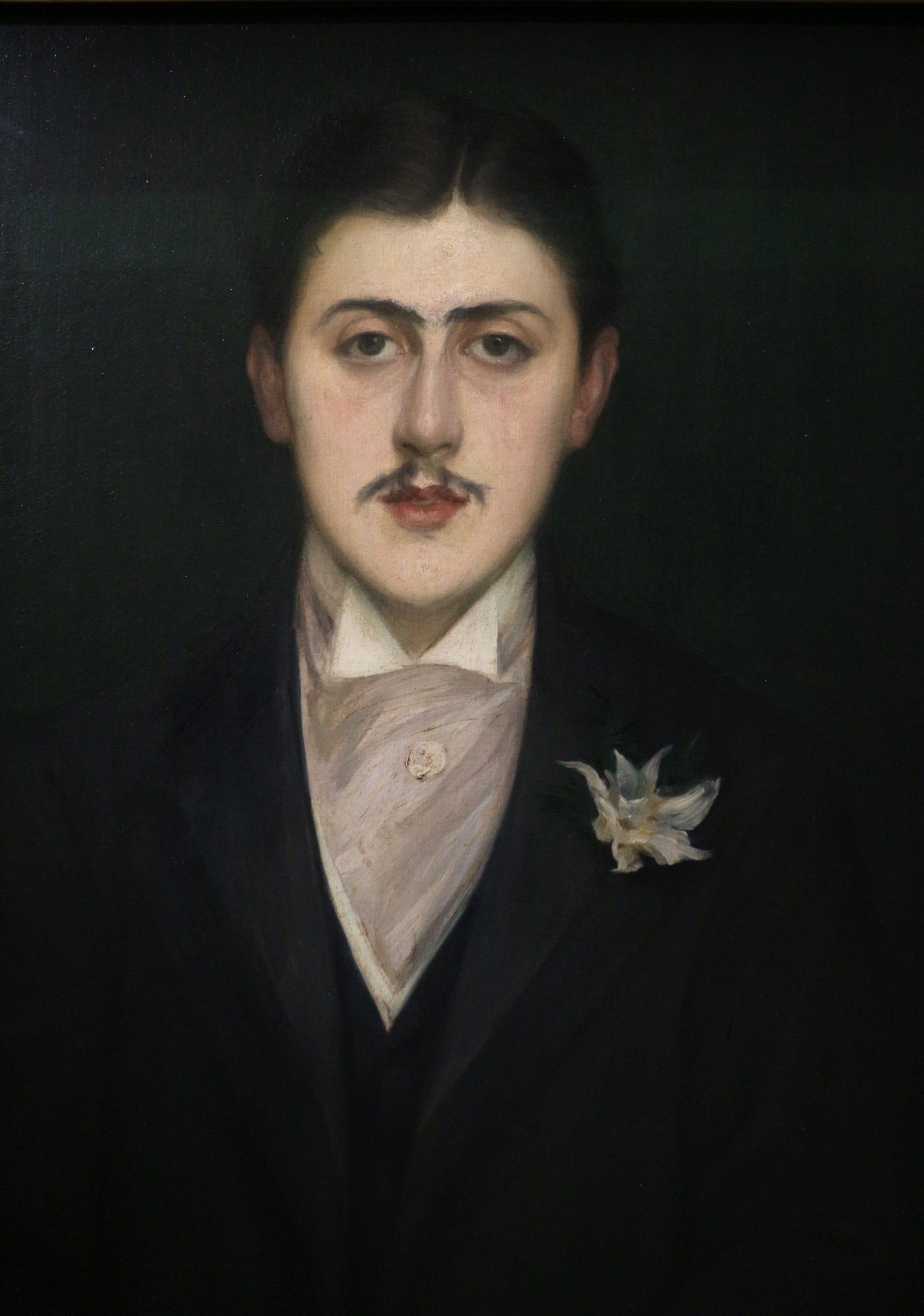
In my mid-twenties, I read Proust. I set aside a year to do it. In my early twenties, I had made a list of everything I thought I should read to become well read. For some reason I couldn't face War and Peace or The Brothers Karamazov, but Proust felt alluring.
Looking back, I remember moments, impressions and feelings, not so many details. Luminous, fleeting flows. I remember being bored by sections of it, but in a way that felt strangely productive, as though the book was stretching some neglected faculty of attention. By the end, I felt my reading imagination had become more elastic. Proust had probably altered something in how I read.
Most of all, I remember the ending hitting me like a revelation and feeling very emotionally moved by it. It felt less like the conclusion of a novel than the disclosure of a way of seeing life.
Afterwards I read a short biography of him. What stayed with me was the image of his final years. Shut away in his room, racing to finish the work before he died. A novel about memory and time and therefore, in some sense, about everything.
I'll try to reread it one day. Perhaps just the first volume and the last. I'm not sure I have enough of the thing he was writing about to read all of it again - time.
the real beauty of Proust for me is when it all coalesces, somehow, somehow, in the final volume. one of the few long books that deserves its total length. indeed i always wish it was longer...