

Washington is beautiful in the spring. We saw the cherry blossom in the tidal basin as the light was going down opposite Jefferson’s memorial, pink and bright and filling the sky. We drove to the Netherlands Carillon where the tulips bloom neatly in well-organized rows. Nearby is the Marine Corps Memorial, with all the conflicts the corps has served in carved around the base. I nearly snapped with indignity at the two children who were making a boisterous game below the second raising of the flag at Iwo-Jima. Over the road is the edge of Arlington cemetery, which is now being extended at the other end, where the air force memorial rises up.
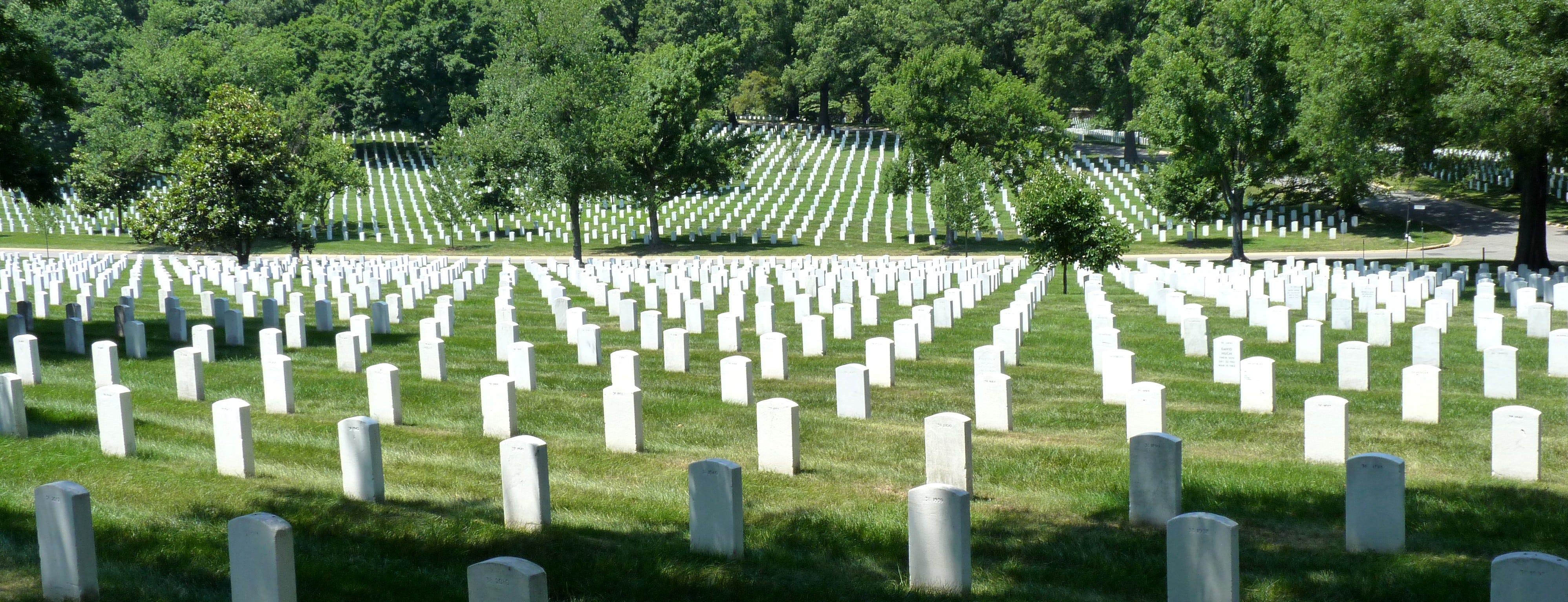
There are many wide roads through the graves, which line up in undulating rows, seen at some angles they fan out in triangular patterns, making new sets of neat lines. At many points, you cannot see beyond the waves of headstones.
We walked the hill up Arlington cemetery towards the Robert E. Lee memorial, known as Arlington House, past the eternal flame and the graves of JFK and Jackie and their two-day son and still-born daughter, past the standing pool and the graves of RFK and his wife, past the grave of Robert McNamara, and as we rounded the hill, Congress always coming into view behind the trees, and the Washington monument, and at some angles the Pentagon submerged in the leaves, the bells began to chime mechanically, and a yew tree appeared, standing steady in the strong sun and the chill wind, growing at the end of its youth.
The Lee house looks directly down to Lincoln’s memorial, huge and neoclassical, and there is a row of little gravestones—the first of the Union dead buried at Arlington—right beside. Inside there are the usual things: rich furniture, a carved mantlepiece, glassware, a piano. All the thousand acres here were a slave plantation. That is the land that now holds the graves. This house was slave built. The slave quarters are uncomfortably close. The women of the family broke the law and taught their slaves to read. In the 1850s, a will freed many of them. In this house lived the descendants of George Washington’s step-son. Washington’s step-grandson, George Washington Park Custis, inherited Mount Vernon, and built Arlington House. Robert E. Lee married Custis’s daughter there in 1831. And so the American idea of dynasty began.
We took the winding path down and back up to the tomb of the unknown soldier and saw the changing of the guard. The ceremony is remarkably intricate, almost like something devised by bees, which you watch in awe without knowing what it means. One soldier is marching in front of the tomb. A superior officer appears, followed by another soldier. The officer announces the ceremony will begin. We must be silent. We must stand. Next to me, a man rises from his mobility scooter.
The officer marches to the first soldier. The second soldier leaves, now unseen. The officer marches back. The second soldier reappears. All of this marching is done slowly, with almost dance-like movements—the heel is placed firmly and then a slow step is made, before the next heel is placed. Every pause occasions a turn-flick-snap motion, one heel clicking against the other. The turn-flick-snap is slowly done, with a sense of state, elaborate but restrained. Every turn requires two of these clicks: one at the pause, one at the turn. Various meetings, bows, presenting of arms, clicking of heels are made. In the five minutes of ceremony, some hundreds of individual motions and gestures must have been made. Everything has a very precise manner. When the officer inspects the soldier, he moves his head in the small, distinct gestures one associates with imitations of a robot. Everyone watches in silence. Half the people watch through their phone screens as they film it all.
The cemetery’s classical architecture is completely out of place. Nothing in American landscape justifies Grecian and Roman columns. The most American places are the plain headstones, the eternal flame burning in a metal cylinder, the fact that there is always a tour tram going past, or one of those slow-motion, open-sided tourist buses. All this is utterly American, not the classical imitation.
But read the words of Robert Kennedy carved above the pool, from a speech he delivered the night Martin Luther King was assassinated.
My favorite poet was Aeschylus. He wrote: “In our sleep, pain which cannot forget falls drop by drop upon the heart until, in our own despair, against our will, comes wisdom through the awful grace of God.”
What we need in the United States is not division; what we need in the United States is not hatred; what we need in the United States is not violence or lawlessness; but love and wisdom, and compassion toward one another, and a feeling of justice toward those who still suffer within our country, whether they be white or they be black.
Down in the tidal basin below the cemetery is the memorial for Martin Luther King, where these words are carved: “darkness cannot drive out darkness, only light can do that.” Kennedy’s words are close to the eternal flame at JFK’s grave. Americans often deny the depth and extent of their history. But standing in Arlington cemetery, one cannot find this history anything but remarkable. So much is held in so little ground. The out-of-place classical architecture makes sense in the heart of a modern empire, where Aeschylus’s words live with King’s, where classical ideals still live in new forms, and where the ghosts of injustice are as present as the eternal flame.
In the tidal basin the blossom is over now, the trees are in full leaf, and there are always airplanes taking off and coming in to land.
Henry, please, please, please, keep traveling in America and keep writing these posts. I can't get enough of them. Your deceptively straightforward observations are those of a man who not only looks, but sees. You show me my country in new and thought-provoking ways.
Thank you for this. Deeply touching and travels deep to the heart of what is important.