

The newspaper where Andy accepts a job at the end of The Devil Wears Prada is called ‘The New York Mirror’. The importance of this name is not hard to deduce. They report the world as it “really” is: they mirror the reality of unions and labour, real work. After she leaves the interview, she walks past the offices of Runway, the Vogue-like magazine which she walked out of a few weeks earlier. They report on a shadow world, a fake world, a world of shoes and bags and scarves: they are creating their own little world, far away from what matters.
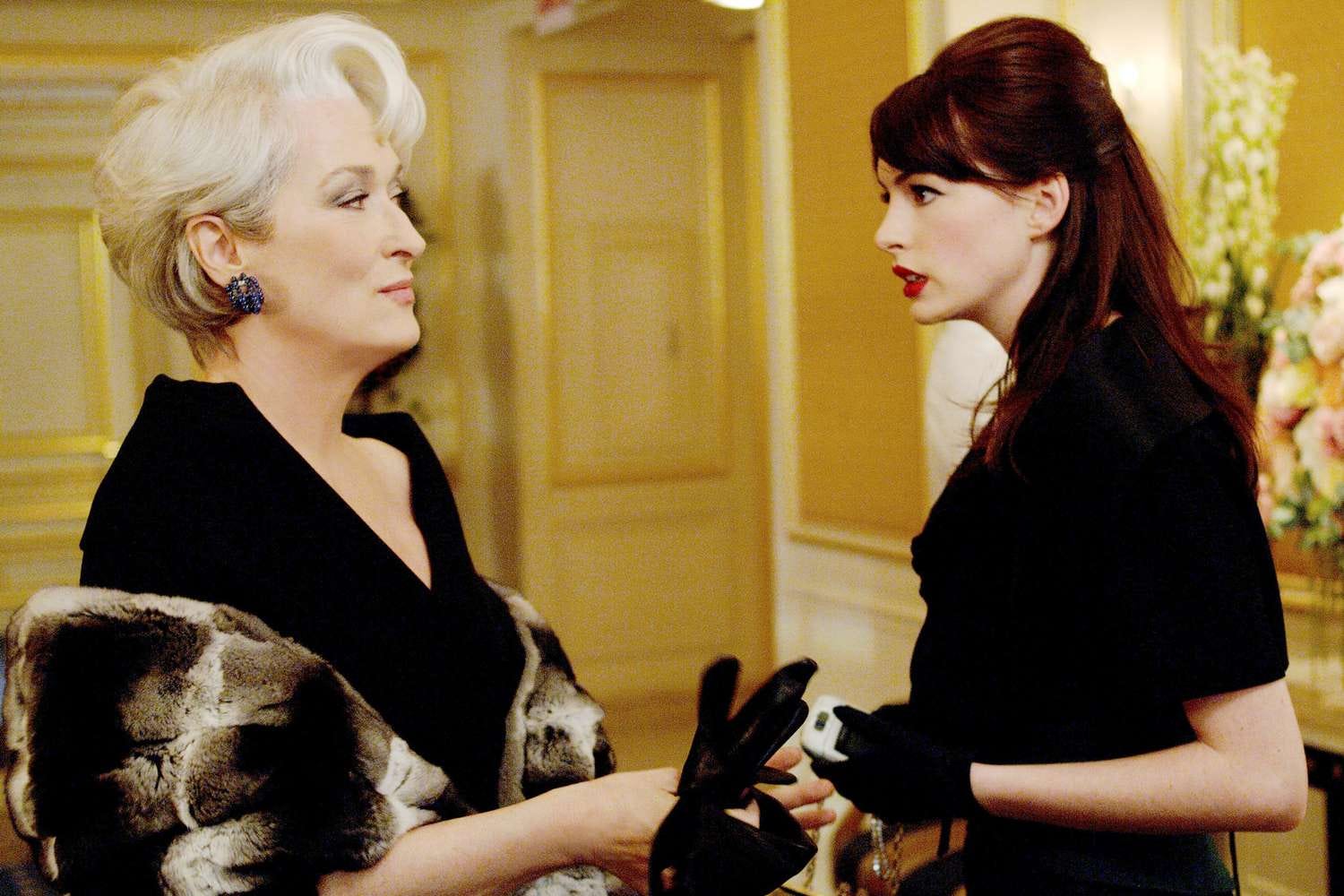
There is another mirror. Standing across from Runway, Andy sees her old boss, Miranda, the Anna Wintour character. The last thing Miranda told Andy, before she left, was “I see a lot of myself in you.” Andy denied it. Still denies it. But here she is, looking in the mirror. Neither woman will be told what to do. Neither of them is happy to compromise. There is some attempt to make the film into a Cinderella story in which Cinderella becomes not a princess but a worthy girl, a heroine of the little guy, but this does not work. We see Andy at her ease, well dressed now, not back in her old, unfashionable clothes, and able to look Miranda in the eye as an equal. She is not back at the beginning. Her quest has changed her.
In the opening scenes, Andy is in front of a mirror—brushing her teeth. She wears dowdy, worthy, lumpy sweaters. She sees herself “as she really is”. Within a few weeks of working as Miranda’s new assistant, under the tutelage of Emily, the senior assistant who mocks her clothes and weight, she is ambitious, ruthless even. She sold her soul the day Stanley Tucci arrived at her desk and gave her a pair of Jimmy Choo shoes, as Emily tells her. Soon enough, she goes to Paris, having taken Emily’s place. She has discovered her inner resources.
Naturally, the usual concessions are made to the supposed strictures of common morality, to forestall any objections from the inevitably sentimental audience that the worthy young woman has been warped by corporate ambition, heartless power, or material greed. To actually come out and admit that Miranda Priestly is not the devil but a respectable person of high integrity and that Andy’s earlier ambitions were weak and misguided would be like breaching the old Hollywood code about the direct portrayal of sexual behaviour. It would offend the sensibilities of the audience. The women of the 1930s were not supposed to be able to tolerate indiscreet portrayals of romance. And the movie-goers of the Millennial generation were not supposed to be able to accept that Miranda Priestly is an unproblematic heroine, a great mentor, and a true artist. Her name is not ironic: it is indicative of her dedication. She is a priest of her art.
But by the end of the film, Andy sees herself in a different mirror. She goes back to her boyfriend, but the resolution is ambiguous. He will live in Boston and she takes the job in New York anyway. She sits across the table from him and they reconcile. But it is when she and Miranda meet on the street that the film’s resolution arrives. Andy is more confident, has great equanimity now, and it is no thanks to her sulky, selfish, childish boyfriend. There is a crucial moment when he becomes acutely sulky because she missed his birthday due to a last-minute work necessity. He is a supercilious man child and she is well-rid of him. The film knows this and makes only a weak and code-obeying effort to throw them back together in the end. It is Miranda who Andy loves; it is Miranda who she seeks to emulate.
Some people are scared of ambition, whether it is other people’s or their own. Some people wish only for a calm and uncompromised life. Andy’s friends are such people. They have no role in the plot. They are there to make certain members of the audience feel comfortable about the fact that Andy wants to be at Runway. She could have left a lot earlier. She could have refused to go to Paris (ruining Emily’s dreams). She could have refused to sleep with Christian. She walked out at the end in defiance of Miranda because she had learned everything Miranda could teach her. The Devil Wears Prada is The Godfather for the millennial generation: Andy is an innocent who learns her inner steel, but in this film Andy and Miranda represent the virtues. They are self-controlled, judicious about other people’s talents, persevere to maintain standards of excellence, and make prudent decisions based on circumstances.
What they do not do is to make kindness the virtue above all others. It is a peculiar obsession of modern culture that “kindness costs nothing” or that we ought to be nice at all times. All behaviour is a choice, ruling out other behaviours. Sometimes kindness is, indeed, a cost in itself. Sometimes kindness means not being excellent, not being judicious, not being prudential. What Andy’s friends and boyfriend do not realise is that they live in a world they take for granted because of people like Miranda. Everyone loves the scene where Miranda explains how Andy’s cerulean sweater only exists because of designers. But the real moral heart of the film is in the scene when Andy goes to Stanley Tucci in tears because Miranda was mean to her.
You want me to say poor you, Miranda is picking on you? She’s just doing her job. Wake up, Six. You’re working at the place that first published some of the major artists of the century — Halston, De La Renta, Lagerfeld. And what they made is cooler than art, because you live your life in it — I mean, not you, but some people. This is not just a magazine. It’s a shining beacon of hope for, oh, I don’t know, say a young boy growing up in Rhode Island with six brothers, pretending to go to soccer practice when he was actually at sewing class and reading Runway at night under the covers with a flashlight. You have no idea how many legends have walked these halls and what’s worse, you don’t care. Because this is a “stepping stone” for you. This place, that people would die to work, you deign to work. And you want to know why she doesn’t give you a kiss on the forehead and put a gold star on your homework?
Each of her friends has principles like this. It is just that they think their art is more important—the art of cooking, in the boyfriend’s case, and literal art in Lily’s case. Fashion is too lowly for them. It exists in the shadow world—but all art is a little world, into which the initiates must be trained, be it cooking, art, or Runway. It is the corporate friend who keeps surprising them all with his knowledge of, and appreciation of, high fashion. And high is the important word. Vogue, Chanel, and all the rest of it represent a chapter in the history of art. Perhaps it takes an unpretentious corporate type to be comfortable admitting that, yes, fashion is an art. The “real” art friend is happy to take a free handbag, of course, just not to accept what it takes to get the bag. She has no idea how many legends have walked these halls and what’s worse, she doesn’t care. Lily is a concession to the code. Andy closes the door on her just as surely as Michael does to Kay. Michael tells Kay he did not kill his sister’s husband; Andy tells her boyfriend she is going back to “real” journalism. Both dissimulate; both control. Michael has become the Godfather; Andy has become herself.
By the end of the film, though, Andy does know, and she does care, and she understands what it takes to be the best. And she steps out into the streets of New York and decides to be the Miranda Priestly of her own world. All quests require the heroine to leave their world and step into some new relation to society after a period of trial. Andy begins in the little world of lumpy sweaters and cosy ideals and has to leave it for the little world of shoes and scarves. When she returns and has to arrive where she started and know the place for the first time, as T.S. Eliot said. At the end of The Devil Wears Prada, Andy realises that in her end is her new beginning. She keeps the haircut, and the sense of style, and the new slimmer figure, and she goes out to show the world that “beauty’s where you find it”, as the lyrics to Vogue go, the song which is playing when Andy wears her fashionable clothes for the first time with her boyfriend. She is among the initiated now. The audience must choose whether they prefer the security of the code or the allure of ambition, art, the halls where legends walk.
I think the .... let's call it resentment which some people (me, I am some people) feel towards high fashion is because it seems to demand a place in our attention which other art generally doesn't. Why do I see endless footage of the Met Gala from media outlets which DGAF about opera, for example? Is Vogue really more important than seeing Klimt paintings in Vienna's Belvedere Musum?
I’m not here for this recent reframing of Miranda Priestly. I think ambition for ambition’s sake is bad (which I would distinguish from wanting to do well because you believe the thing you are doing is worth it, whether or not you are the one to do it). To the degree that our social norms used to recognize this and no longer do, I think that’s a real loss.
Does Miranda Priestly care about fashion for fashion’s sake, rather than for the sake of the social status it confers her? Almost certainly, partially, and it’s fair to find that appealing. But she very clearly also cares about the social status component of it, in way that crowd out her genuine love of fashion.
How often do we see her take joy in fashion? Famously, never. As Nigel comments, she’s only smiled once. At risk of sounding like an LLM, that’s the performance of taste, not the exercise of it. .
Her famous speech about the cerulean sweater is also performative. She gives Andy a history of the color of her sweater and its ties to high fashion, but if it’s not clear why that history matters. If Andy had instead been wearing a denim jacket in a color popularized by workwear, would she have been safe from criticism? Isn’t dressing unfashionably its own form of fashion? How were the two identical belts different? (We never get an explanation of this, so to my mind, Andy’s comment remains valid.)
And of course, she could have educated Andy in a kinder way. That would, in fact, have cost nothing. I share the worry that we sometimes neglect opportunities to correct or improve something for the sake of kindness, but there are also plenty of ways to do so while also being kind - generally, more effective ways as well - and Miranda Proestly not choosing those ways demonstrates a greater concern for lording her status over others than actually fixing the thing that needs fixed (Andy’s lack of fashion knowledge).