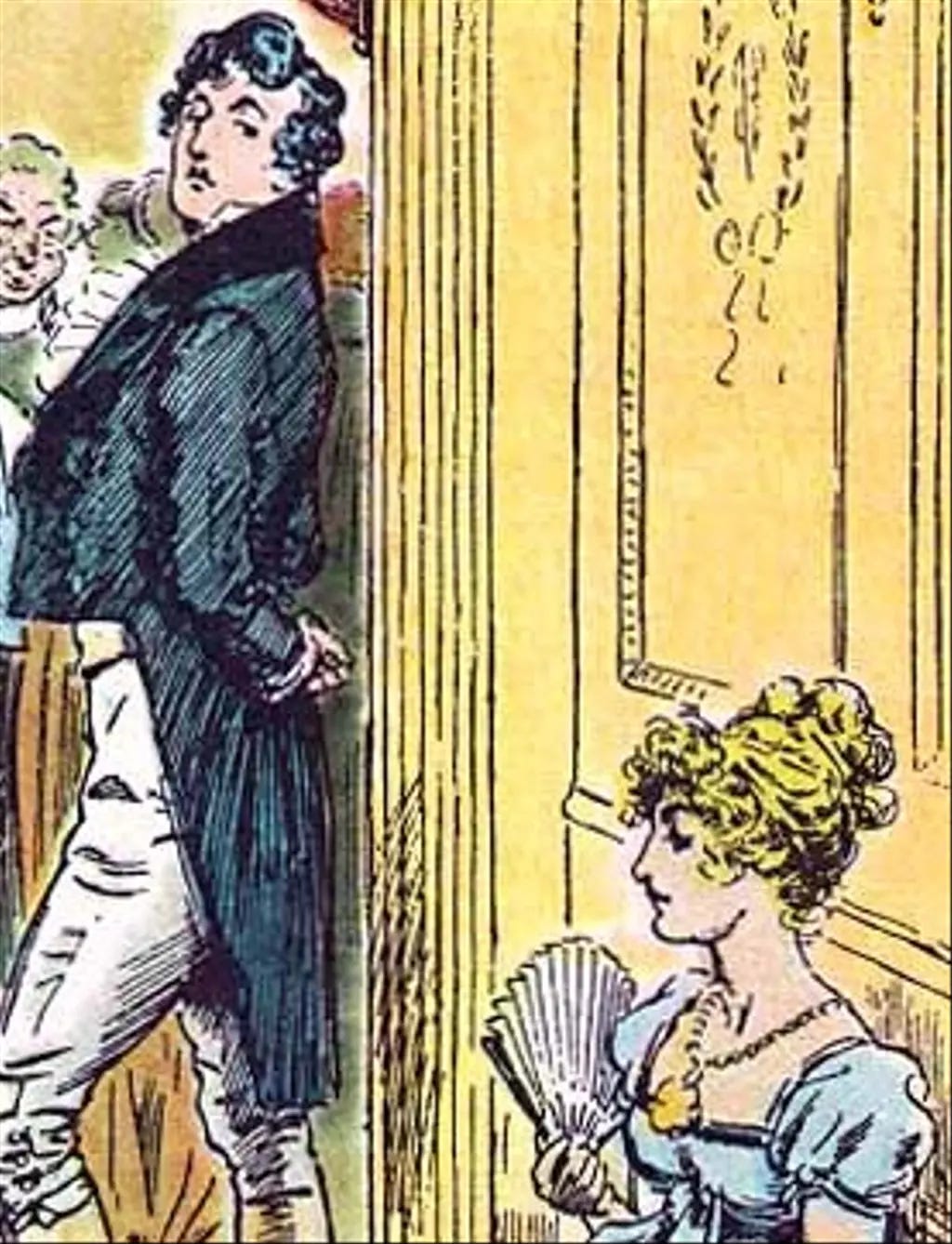
The question of whether or not AI is conscious seems to me to be related to the question of what we believe about fictional characters. In his recent interview with Dwarkesh Patel, Tyler Cowen proposed that Dwarkesh has some “AI psychosis” because he thinks there is a chance AI is sentient. Dwarkesh said, “It’s not obvious to me that they’re not sentient.” Now, it is obvious to Tyler Cowen that they are not sentient, as it is obvious to Rebecca Lowe. But what I wonder is whether Dwarkesh’s statement is the sort of thing we might believe about a fictional character. We know that Lizzy Bennet isn’t real, but we also sometimes believe things and talk about her as if she was real. You might say that, in the state of suspended reality we occupy while we read, it’s not obvious to us that she’s not sentient.
Novelists developed their ideas and methods of representing character in conjunction with the philosophers, most especially John Locke and Adam Smith. Locke proposed that we have a “quasi perception” of each other (that is E.J. Lowe’s phrase) and Smith developed the idea of an “impartial spectator”, an imagined inner conscience, learned through our interactions with other people. This philosophy developed from the idea that we are obscure to each other. We know each other imperfectly. Even though you and I are both conscious and both have language it is sometimes almost impossible to say what we mean, to make ourselves understood, to know each other. So we have to imagine each other. There are natural barriers to true sympathy and the imagination is the best we can do to overcome those barriers.
That problem is the heart of the novelist’s enterprise. Individuals have to be imagined to be known. But imagination is difficult and takes a lot of work and input. It takes a whole novel for us to really get to grips with a character. When we interact with an AI—or, perhaps I ought to say, when we use an AI—we are caught in the same dilemma. We imagine them. And our imaginings make them seem as if they are real. Because they respond differently to each user, we experience something that seems to be in a state between that of a character and a person. Usually the reader responds to the book. When the book can change, the whole imaginative enterprise gets confusing. Consciousness begins to be imagined.
These issues are familiar to literary criticism. Although there is a sense in which fictional characters are real, we know they are not real in the same way as us. They are real in the sense that books and words are real and in the way that the contents of our minds and imaginations are real. But they are not people. They are not conscious. Jane Austen told her family what happened to the characters after the novel ended, just as Bernard Shaw did for Pygmalion, and J.K. Rowling did for Harry Potter. But that doesn’t make the characters any more real.
However, we think of them as if they were real. Honest readers will gladly tell you that reading a novel is like spending time with the characters as if they were real. Some academics and snobs don’t like this sort of talk, but it has a long history and some eminent critics have said it. We really do feel as if we know Lizzy Bennet. And there is some value in this belief. It helps us to understand her as a character. After all, the point of making people up is that they relate in some way to actual real conscious people.
It has long been considered beyond the pale for literary critics to admire A.C. Bradley, who wrote a whole book, a hundred years ago, taking Shakespeare’s characters seriously as characters. He said that in Hamlet “the whole story turns upon the peculiar character of the hero.” The same is true of Pride and Prejudice and a great many other important literary works. Bradley wrote that Hamlet, in his violent moods, “would have been formidable to Othello or Macbeth.” That little phrase contains so much insight, even though it is obviously impossible that Hamlet could ever have “been” anything to Othello or Macbeth because Shakespeare made them all up and never put them in a play together.
The long-standing objection to Bradley and people like him is: these characters are not real! We might imagine his critics saying, Bradley has fictional psychosis! But to me it just seems perfectly obvious that Bradley is writing as if Hamlet were real. Shakespeare wishes us to feel like that in the theatre after all. The people who wrote letters to Sherlock Holmes—addressed to 221b Baker Street, an address that never existed—really did have fictional psychosis. (Just like the people who believe characters in soap operas are real, unable to distinguish them from the actors.) But Bradley was simply using his imagination as a critical faculty. Being able to talk about characters as if they were real is essential to reading and understanding literature. You have to read with some awareness of your “false” beliefs about the “reality” of the characters. It is part of how we have come to understand the ways we imagine ourselves and others in real life. It is all a question of knowing when we are imagining a real conscious person or imagining a character we treat as if they were real.
Another way of saying this is that Dwarkesh, and others with his beliefs, might be confusing the way they imagine AI to be with evidence for what AI really is. That is, they take their impression of the AI as evidence for its underlying consciousness, but they are really just acting as if the AI was conscious without treating it as fictional. When you read a book, it is obvious that you are imagining the characters. But when Claude talks back to you, it becomes harder to remember what’s going on, just as when you are in the middle of Pride and Prejudice you really might believe for a moment that you are in love with Lizzy Bennet. There are good philosophical reasons to believe that AI is not conscious, which I am not adding to here. All I am trying to show is that if you take seriously the possibility that AI is conscious, you might be treating it more like a fictional character than you intend.
These are preliminary thoughts that I hope to expand on soon. I find this topic very interesting and look forward to all of your thoughts.
A few relevant links