

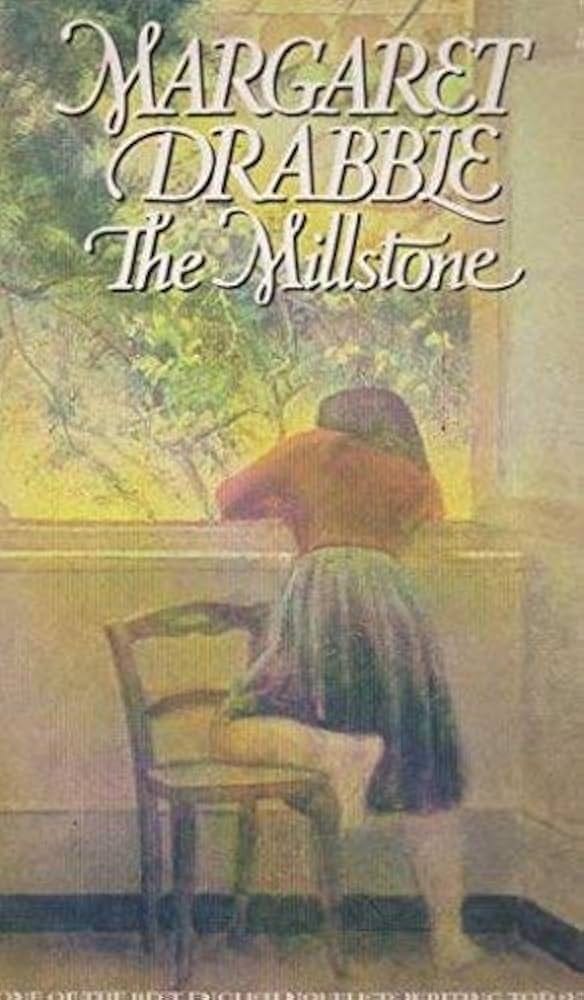
Margaret Drabble’s 1965 novel The Millstone, perhaps more well-known in England than the USA, is about a young woman, Rosamund, who is finishing her PhD thesis. Rosamund gets pregnant after a one-night stand and decides to raise the child alone. Rosamund is a demure and quiet woman, who spends her time doing patient work in the library; shortly after she gives birth, she is told she cannot see her baby. Her reaction is immense. To my mind, it’s one of the most compelling scenes in the twentieth century English novel.
“Now then, now then,” said Sister, “this is neither the time nor the place for hysterical talk like that. We must all be grateful that your child is . . .”
“Grateful,” I said. “I am grateful. I admire your hospital, I admire your work, I am devoted to the National Health Service. Now I want to see my baby.”
She came over to me and took my arm and started to push me gently towards the door; I have spent so much of my life in intelligent, superior effort to understand ignorance that I recognized her look at once. She pitied me and she was amazed. I let her get me as far as the door, being unable at first to resist the physical sense of propulsion, but when we got to the door I stopped and said, “No, I’m not going to leave. I’m going to stay here until you change your mind.”
“I have no intention of changing my mind,” she said, and once more took hold of my elbow and started to push. I resisted. We stood there for a moment; I could not believe that physical violence could possibly take place, but on the other hand I did not see what else I could do. So when she started to push, I started to scream. I screamed very loudly, shutting my eyes to do it, and listening in amazement to the deafening shindy that filled my head. Once I had started, I could not stop; I stood there, motionless, screaming, whilst they shook me and yelled at me and told me that I was upsetting everybody in earshot. “I don’t care,” I yelled, finding words for my inarticulate passion, “I don’t care, I don’t care, I don’t care about anyone, I don’t care, I don’t care, I don’t care.”
Eventually they got me to sit down, but I went on screaming and moaning and keeping my eyes shut; through the noise I could hear things happening, people coming and going, someone slapped my face, someone tried to put a wet flannel on my head, and all the time I was thinking I must go on doing this until they let me see her. Inside my head it was red and black and very hot, I remember, and I remember also the clearness of my consciousness and the ferocity of my emotion, and myself enduring them, myself neither one nor the other, but enduring them, and not breaking in two. After a while I heard someone shouting above the din, “For God’s sake tell her she can see the baby, someone try and tell her,” and I heard these words and instantly stopped and opened my eyes and beheld the stricken, confused silence around me.
Rosamund keeps baby Olivia secret from the father—even showing her to him and lying about her age. She is devoted to Olivia and the novel ends with them in their happy world together. The Millstone stands out because it is all about a young mother–so few great and popular novels are really about what it is like to give birth or the anxiety of a baby being diagnosed with a terrible illness (Olivia has a heart condition).
I thought of The Millstone this week when Sam Kahn asked on Notes:
Can anyone think of any novels/films/stories about motherhood? — like about pregnancy, childbirth, early childhood development? (I mean work that really goes in depth.) It’s obviously the most important thing in human life and it’s like nobody ever tries to write about it or otherwise ‘cover’ it. Is it just that it’s such an intimate, physical thing that art can’t really touch it except symbolically?
Sam got a whole load of dismissive and outraged replies. “Are you serious?”, “This is a you problem, not a cultural problem”, “Have you read any books written by women?”, “You should read feminist literary criticism before continuing to double down on such a facile take”, and so on…
Maybe Sam doesn’t know what these people know—but Margaret Drabble happens to agree with him. Although Drabble has said that she was not trying to write a novel about the “issues” of motherhood or childbirth, but was instead dramatizing things in her own life (“I wasn’t thinking about literary history”), she wrote in 2023,
It is easier to cite women who have written openly about sex, sexual orientation, menstruation and abortion than those who have written positively about childbirth… I continue to be surprised by the fact that “the Nursing Madonna” was considered a wholly suitable subject for art, while breastfeeding is still hardly ever mentioned in literature. We continue to inhabit a world of paradoxical values, one in which books and babies are not yet entirely compatible.
Hollis Robbins tweeted last year:
You can tell your literary eras this way: 19th-century fiction has lots of children and no sex while 20th- and 21st century fiction has lots of sex and no children.
And indeed—where are the children in Sally Rooney? (Her characters are starting to get pregnant though…) Now Hollis has written about mothers and children in literature for The Republic of Letters (edited by Sam):
But when I think about the question about motherhood and literature, I note that in so much literature — by which I mean canonical literature by men — the various elements of motherhood, including childbirth, lactation, separation, and child death, are primarily useful pieces of narrative machinery that encourage the reader to think about “larger” issues like law, property, power, the economy, nation, community. When the scope of fiction is so broad, why does anyone need “real” babies?
My mind turns to L.C. Knights’ famous essay “How Many Children Had Lady Macbeth?” (1933), and how to reconcile Lady Macbeth’s line “I have given Sucke, and know / How tender ‘tis to love the Babe that milkes me” with Macduff’s later assertion that Macbeth “has no children.” Don’t focus on such irrelevant things, Knight argues. On the one hand I agree: it is important to remember that there is no actual Lady Macbeth and there are no actual children who are killed, like poor Macduff’s “all my pretty chickens and their dam, in one fell swoop?”
But the fictional “babes” do a lot of heavy lifting in creating the horror of Lady Macbeth’s:
I would, while it was smiling in my face, / Have pluck’d my nipple from his boneless gums, / And dash’d the brains out.
Without mothers and babes “in real life,” none of this works.
In other words, motherhood outside the pages of the book allow male writers to pick and choose bits inside their books.
I recently read The Children of Men, which made me think again about how we live at a time when it is quite acceptable to dislike children. We don’t think of ourselves as very Victorian, but children are too often neither seen nor heard. Silenced with screens if nothing else! While so much good work has been done to ameliorate the public disdain of one group in society for another, it remains socially acceptable to say that you don’t like children. I have heard feminists who spend good parts of their career arguing against the wholesale stereotyping and dismissal of women say this! When the Alice Munro revelations came out, B.D. McClay wrote a great piece called “people hate children.”
As the fertility rate drops, so does the number of children in stories. I grew up reading The Famous Five and The Secret Seven. In Susan Cooper, five cousins come together for holiday adventures. In Narnia there are the four children. E. Nesbit often wrote about groups of children, related to each other, off on adventures. The children’s books I know today deal in smaller groups. Harry Potter has the Weasley family, but Harry and Hermione are only children. Katherine Rundell often writes books with one or two children, also un-siblinged. (The group of children in The Explorer are not related, for example.) The children in Philip Pullman are lone. Of course, orphans and lonely children are a common trope of stories, but it is hard to imagine a book like The Railway Children being popular today, or Peter Pan. The Railway Children is not just charming because of the children’s old-world freedom to explore the tracks, but because there are three of them. How remote that must feel to all the only children I know!
Children are well depicted in some late twentieth century writers like Diana Wynne Jones (all her novels, but notably Fire and Hemlock, 1985), Penelope Fitzgerald (Offshore, 1979), and Jane Gardam (short fiction). Still, they often focus on one or two children. This century we tend to have protagonists who are only children, such as in The Last Samurai, and The Curious Incident of the Dog in the Night Time, as well as writers like Neil Gaiman, Kazuo Ishiguro, Donna Tart.
Anyway, personally, I find Sam’s question fascinating.

I thought you were going to talk about how having children means that reading time is hard to manage (it is for me anyway and I find the topic interesting, although I don’t see many people speaking about it), but what I found instead is extraordinarily powerful. Thank you!
This is something I have also noticed and thought a lot about. I am a mother of a large family, and my children were born over a span of 22 years, between 2002 to 2024. I have never ever seen a woman like me represented in literature or film, except as a sort of harried side character. The experience OF being a mother to many, never. And in the nearly 24 years since I first became a mother, I have observed the open disdain for children has become more pronounced and socially acceptable. Particularly since the pandemic it seems that the default expectation of many people is that they will never have to see a child and they are righteously offended if they do. Some of these same people also seem to idolize their own childhoods, which is especially strange.