

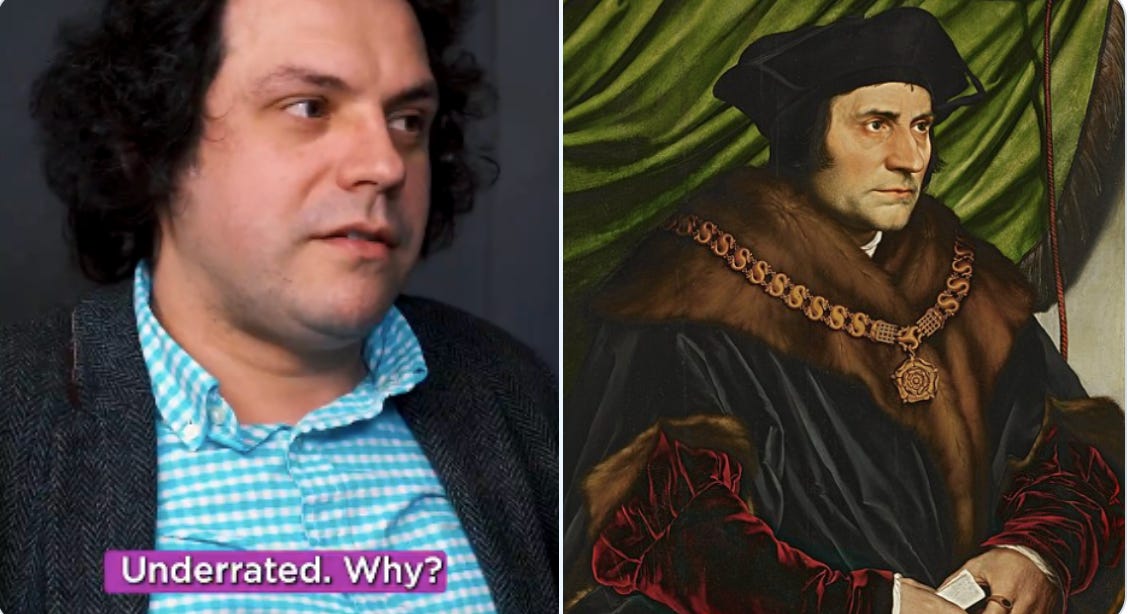
A few of the topics covered on ‘Conversations with Tyler’ got comments from people who want to know more. Why don’t I like Dostoevsky? So, with the ability to give more considered answers, and the chance to add a few old hobby horses that didn’t come to mind in the moment, (and noting that I have only seen a few comments in passing, so this is quite random), here are some additional Thoughts on Various Topics. One of the best aspects of the interview was that I left it thinking about all the issues a lot more. And I really want to re-read Milton and Spenser now! One comment compared the way I looked on the video to Holbein’s Thomas More. I feel the urge for red-velvet sleeves.
When is the next serious religious novel?
I said a young person in twenty years. That timeline seems much too long in retrospect and I wouldn’t be surprised if it was in the next few years. Yes, I know about Jon Fosse, but the question was about English language novels or, at least, I took it to be so, but Tyler did mention Dostoevsky. I just didn’t enjoy Fosse and it didn’t come to mind.
Why don’t I like Dostoevsky?
One effect of the interview was that I am resolved to read more Dostoevsky and to come to a fuller conclusion about his works. In essence, I think many of the short works are excellent, especially The Double, but I don’t always feel the power of the long books, and have usually failed to finish them. He is often a hectoring, bizarre, nationalistic, illiberal monster—and so melodramatic! so suitable to our time in that sense—who is read quite selectively in the West.
He is a major presence on Twitter. So quotable. So easy to fit to what people want to hear. All those appeals to your soul and your anxiety! So profound in a screenshot. All this Dostoevsky tweeting — Bah! read some Turgenev! Or Tolstoy! Give me Pierre running into the house on fire! Give me the death of Bazarov! O give me Levin proposing to Kitty in chalk on the table!
Despite his social media popularity, I suspect he might be bad for people, like too much Nietzsche. (Don’t let your children read Rousseau either.) Can it be a coincidence that he is popular now? Mostly, when you read all those inspiring quotes in context, you ought to feel grateful not to live in C19th Russia, not “seen”, not like you are reading wisdom. Anna Karenina is wisdom.
Still, I am a grump on this score. When I read Bakhtin’s praise of Dostoevsky I wondered—had he not read Shakespeare? Anyway, the main thing I took from this is that I need to read Dostoevsky again. Tyler and I agreed that temperament is an essential part of how we respond to literature and that is probably the bigger part of my reactions to these authors.
Pluribus
Since we recorded, I have written about Pluribus.

What’s the best portrait of mental illness in English fiction?
Not my area, as it were, but I believe others would add Sylvia Plath? (I know, I know, she’s American.)
Reading Shakespeare
The top comment on MR seems to think that Tyler and I said that “Shakespeare wrote to be read rather than performed.” No. Shakespeare clearly wrote to be performed. But, that is often said as if it means he did not write to be read, and that is not true. He knew he would be read, by a significant audience. He was a strong seller at the bookstalls. Literate elites were an important part of the playhouse audience. Shakespeare’s plays were some of the most frequently printed books in his lifetime. Half of his plays were printed. Plus there were anthologies, and he knew he would be pirated for them. Those speeches that sound like anthology speeches… really are anthology speeches. (Read Ted Tregear’s Anthologising Shakespeare.)
Some of the plays were very popular in print indeed. There were five quartos of Richard II before the Folio in 1623. Between the first performance in 1597 and the publication of the First Folio in 1623, there were seven quarto editions of Henry IV Part I.
The First Folio was only printed seven years after his death, aged 52. The printer’s costs were £250—at the time, a shoemaker could make £4 a year, a goldsmith £5. Inevitably, at fifteen shillings, this was the most expensive playbook ever published, and the previous thirty years had seen many literary folios, including those of Jonson and Montaigne. So the audience for his writing had become fairly strong on the basis of the quartos! Obviously it is nothing like the playhouse audience, but Shakespeare knew the elites were reading him, and would presumably have been less surprised than is often alleged to find his works in folio.
In any case, whatever your views on this subject, it is not determinative. It can be the case that he wrote to be performed but that it is, today, better to read him. “We do not love to see our author performed,” said William Hazlitt.
Overrated English authors
I forgot to add Martin Amis!
Milton and Johnson
Some people found a contradiction in what I said here.
COWEN: Here’s some easy ones. John Milton’s Paradise Lost—overrated or underrated?
OLIVER: Underrated.
COWEN: Why?
OLIVER: Oh, it’s easily one of the best poems in English, and it’s not read enough.
COWEN: Samuel Johnson said, “No man ever wished it was longer.” Do you agree?
OLIVER: I do happen to agree with that particular statement. Johnson’s allowed to be wrong a couple of times, and that’s one of his clunkers.
This was a conversation in the true sense. I know Tyler, so we chatted. He knows the source of Johnson’s quotation, and the wider context of the remark, and so I was able to elide my point. “No-one” ever wished it longer, and nor do I, but that doesn’t make Johnson’s general attitude right.
Paradise Lost is one of the books which the reader admires and lays down, and forgets to take up again. None ever wished it longer than it is. Its perusal is a duty rather than a pleasure. We read Milton for instruction, retire harassed and overburdened, and look elsewhere for recreation; we desert our master, and seek for companions.
Johnson is quite hard on Milton in general and he was surely overstating his case here. Do we really retire harassed and overburdened? Perhaps I shall change my mind if I find time to re-read it soon…
Harold Bloom and Harry Potter
I don’t know why the clip of the overrated-underrated section was so popular on Instagram, but some people especially enjoyed it that I “seemed like a young Harold Bloom and then dismissed him at the end.” At the same time, lots of people were writing Notes and Tweets to the effect that Bloom was an academic fraud. And I was the one defending Bloom.
As she rightly pointed out Bloom’s sexism (and the allegations of sexual harassment), Joyce Carol Oates made several outright false statements about Bloom’s work. If we confine ourselves to the words on the page, Bloom is better than his critics understand and worse than his fans believe.
The idea that Shakespeare’s characters “overhear” themselves is a significant observation. His claim that they are the first in Western literature to embark on recursive self-creation as a result of this may or may not be original, but it is not an idea to be dismissed. Bloom took the concept straight out of Mill’s ‘Thoughts on Poetry and its Varieties’, which is not an essay anyone ever feels the need to dismiss, though Bloom praised it in high terms. Shakespeare’s characters constantly re-narrate their lives. That means they are inventing (in the sense of “discovering”) themselves. That is what Bloom meant. Here is how Richard III does it:
What do I fear? myself? there’s none else by:
Richard loves Richard; that is, I am I.
Is there a murderer here? No. Yes, I am:
Then fly. What, from myself? Great reason why:
Lest I revenge. What, myself upon myself?
This is a simple insight, though an important one, and it is always surprising to find people denying it. Bloom may have been a strong figure in the culture wars—and as a figure who spoke directly to the reading public—than he was a critic. I don’t know. He seems to have been a monster in other ways. Abhorrent: but not relevant to the question of interpretation.
Anyway, Bloom was wrong about Harry Potter. Of course they are full of cliches. So what? Not everything a child reads ought to be The Wind in the Willows. What I should have added is that, for better or for worse, I suspect the most influential books of the last thirty years have been Harry Potter. (This is because the books are the Goldilocks of snobbery: not too high, not too low. Harry is Everyman at Eton.)
That really is overrating them.
Glad that we're finally moving past the Shakespeare as writing only for performance / Shakespeare as literary poet pendulum, which never worked. Lucas Erne's Shakespeare as Literary Dramatist was probably the transitional book. I'm currently writing something on conceptions of authorship in the 1590s which relies on thinking across the poetry / drama boundary, fortunately now common.
On Dostoevsky, I agree he's probably a bad influence on many but the thing he has over Tolstoy is that he's very funny! Great as Tolstoy is (and I wouldn't want to choose between them) he's basically humorless, at least to this non-Russian reader. Whereas Dostoevsky's black comedy is second to none.
While I appreciate Tolstoy’s style, I prefer Dostoevsky’s ideas. But which is more essential to a novel—its style or its ideas?
Then again, Tolstoy and Dostoevsky are not as monolithic as this debate might require them to be. Many who praise Tolstoy for his perfect novels, such as *War and Peace* or *Anna Karenina*, will distance themselves from his later “moralistic” works, which they consider imperfect (or too “idea-driven”).
Meanwhile, people who praise Dostoevsky (such as myself) tend to praise pretty much all of his works—while still acknowledging his imperfections as a novelist or a person. In fact, this lack of expectation makes his moments of eloquence even more stunning.
In criticism the idea of *perfection* doesn’t seem important to Dostoevskyans, but it does seem to bother Tolstoyans. Perhaps they’re most bothered because they know they praised him for something they also know he lacks. Meanwhile, Dostoevsky continues to get posted by more and more imperfect people.
In any case, this was a great conversation. Thanks for bringing up the Dostoevsky-Tolstoy conversation and being willing to accept your own grumpiness. (A very Dostoevskyan move, by the way. 😉)