

The magic of King’s Cross
Twice this Christmas, we passed through King’s Cross station. To my mind it has lost some of its charm since it was redesigned. The dendritic vaulted canopy is splendid, but there was something wonderful about the old station that I still enjoy in the old undisturbed parts of the platforms. There is something magical about plain architecture. E.M. Forster wrote in Howards End,
To Margaret — I hope that it will not set the reader against her — the station of King’s Cross had always suggested infinity. Its very situation — withdrawn a little behind the facile splendours of St Pancras — implied a comment on the materialism of life. Those great arches, colourless, indifferent, shouldering between them an unlovely clock, were fit portals for some eternal adventure, whose issue might be prosperous, but would certainly not be expressed in the ordinary language of prosperity.
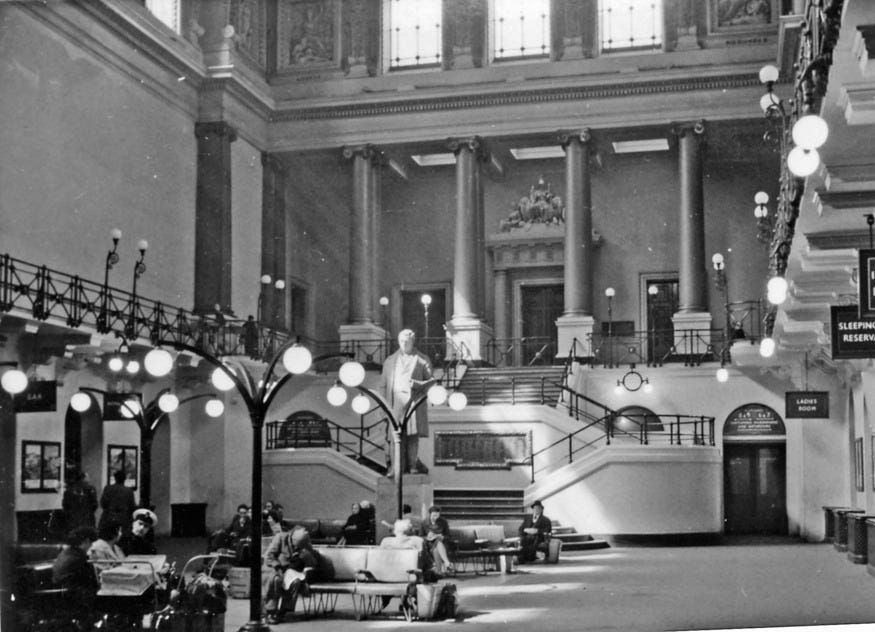
This is surely why it is so captivating that the Hogwarts Express departs from King’s Cross. None of the other terminus stations in London is fit portal for some eternal adventure. St. Pancras’ neo-gothic is too much of this world; Waterloo is an ugly memorial; Victoria is a monstrosity; Paddington has plenty of charm, but it is the charm of the here and now, of taxi cabs and London rain; Marylebone is too quaint; Euston is a miserable dump, no hint of its former glory, and though the old great hall would have been a very fine setting for magical adventures, it was rather too period.
The most influential book of our times?
Both times we passed through King’s Cross, we stopped at Platform 9¾. Of course, it is in the wrong place. Rowling once said she had confused the platforms with Euston, although it wouldn’t work there either.1 None of this matters—it’s a fantasy novel! But it is especially odd to see the platform in a place that, were it to lead through to the other side, would come out on platform eight, and nowhere near platform nine or ten.
We stopped not for my interest, but for the children, who have started reading the novels. We did not join the line to stand in front of the trolley and have a picture taken. We watched from the side for a few minutes. And I saw what I always see. Everyone in the queue was a grown-up, or at least an older teenager. There were no children queueing up to wear the Hogwarts scarf and pretend to run at the wall.
The children were all standing to one side, watching. I saw several other families doing what we were doing. The assistant told me it was always like this. 85% of the people who queue for platform 9¾ are grown-ups.
If you are ever in King’s Cross on September 1st, you will see large crowds of people dressed in Harry Potter costumes. Not just Harry and Hermione, but Dobby and Dumbledore and everyone else. They fill the place. The Hogwarts Express is announced at 11am. It even has its own departure screen. Cheers go up. You can hardly move for the crowd. And once again, the majority of them are adults, unaccompanied by children. There are children there, but it is by no means a children’s event.
Harry Potter is perhaps the most influential book of our times. It is as popular as The Hobbit, Alice in Wonderland, A Tale of Two Cities, And Then There Were None, The Lion the Witch and the Wardrobe…
The question is — why?
Magic, goodness, serious children
I have several ideas about why Harry Potter has sold quite so many hundreds of millions of copies. In no particular order:
—A magical battle of good and evil. This is the basic requirement of post-Tolkien fantasy. Moralising is said to have been removed from children’s literature after Alice in Wonderland, but that’s not simply not true! The promulgation of virtue remains a central literary concern.
—It makes goodness exciting. “I do not find goodies dull.” J.K. Rowling. So, for example, the “girly swot” character became sympathetic and heroic, not the usual cliche. Neville Longbottom is both admirable and interesting, not a stock figure of fun.
—It appeals to boys and to girls. This made it much more likely to be successfully recommended as very few books get real overlap between boys and girls.
—JKR treats children seriously. She has said, “There’s nothing that shouldn’t be dealt with in children’s literature.” She killed so many great characters!
—The fantasy is comprehensive but not smothering. So many children long for a letter from Hogwarts, a Hedwig to bring their post, and a system of magic that largely relies of correctly pronouncing a single word or phrase. Is there an element of fantasy that she didn’t manage to include? Even the people who don’t enjoy fantasy—the ones who won’t be reading Cart and Cwidder or Phantastes—can enjoy Harry Potter, because it is such an encyclopaedic collation. Yet, there are very few overtly off-putting fantasy elements. She never has too much silly magic: no-one calls out “not another bloody elf” in what is essentially a public school story with inverted snobbery.
Everyman at Eton
More important than all of this, I think, is that it has the right sort of snobbishness. The Dursleys are the suburban people no-one wants to be accused of being; the Malfoys are the posh people everyone wants to guiltlessly resent. Before there was billionaire shaming there was Malfoy hating.
Feeling this moral superiority to the rich “pure blood” Malfoys gives us the moral space to also look down on the cruel and uppity Dursleys. All expressions of social climbing and hierarchy in these novels are expressed by baddies. The sweet-spot is, as always in English culture, in the middle. Indeed, it’s remarkably just how openly snobbish and fat-shaming about the Dursleys the films are: it’s still acceptable to disdain the aspiring lower-middle in England! “I barely exaggerated” JKR said of them.
But the appeal is more than mere snobbishness—how many children feel trapped in suburban status-games and want to escape? How many have the fairy-tale dream of being changelings, dropped a few rungs lower than they really deserve? Rowling gave them an escape into a slightly higher (acceptably higher) class that combines: magic, the idea of the chosen one, and Goldilocks “just right” middle-class moral standards.
Harry is not too lower, not too upper; he’s not too smart, not too gullible; he’s not too much of an arrogant Quidditch star, nor too meek a winner. He’s rich, but he keeps quiet about it; he’s born with elite-level talent, but he cares more about his friends and letting good prevail. He has all the advantages one can hope for in England (gold, public school, a famous name, talent, diffidence combined with athletic skill) but he lives with the heart-breaking trade-off that his parents died. Thus what we might be wary of in others, we love in Harry Potter. He is the Everyman of the public school novel. Rich boys at posh schools can only be heroes today if they come from the right social strata.
Rowling’s inclusive elitism can be generalised, which is perhaps the biggest prevailing cultural force today. The anointed on every side of the culture-wars are blessed with inherently good ideas and feelings, but strive to be seen as non-elites. The new status is to have Goldilocks status: not too much.
A very relatable bildungsroman
Hence King’s Cross. Rowling really knows what charms the imagination. King’s Cross was no mistake! It was the only real choice for a London station that could be that sort of portal. It is the station where ordinary middle-class people can imagine themselves the enemy of Malfoys and Dursleys anywhere. And it is right next to the high-falutin gaudy of St. Pancras. The perfect contrast.
Who else wrote a book that allows the reader to imagine themselves at Eton but where they are Harry, rather than Malfoy? Throw in magic wands, admirable “girly swots” who save the day (and who aren’t that girly; Hermione has a dark side!), a dark lord, and put it all in a relatable bildungsroman about a very nice boy with immense natural talents he never boasts about, and you get, well, you get the most influential book of our times.
“King's Cross is a very very romantic place. Probably the most romantic station, purely because my parents met here, so that's always been part of my childhood folklore. My dad had just joined the navy, my mom had just joined the W.R.N.S, they were both traveling up to Arbroath in Scotland -- from London -- and they met on the train pulling out of King's Cross. So I wanted Harry to go to Hogwarts by train; I just love trains, I'm a bit nerdy like that. And obviously therefore it had to be King's Cross.
JKR: Like a lot in the Harry Potter books it was reality with a twist I wanted to find another entrance to the magical world, but I didn't want a kind of time-warp thing, I like the entrances to be places that you can only find if you have the knowledge. So anyone who ran at the barrier with enough confidence would be able to break through onto this platform between platform 9 -- platform 10.
JKR: I wrote Platform 9¾ when I was living in Manchester, and I wrongly visualized the platforms, and I was actually thinking of Euston, so anyone who's actually been to the real platforms 9 and 10 in King's Cross will realize they don't bear a great resemblance to the platforms 9 and 10 as described in the book. So that's just me coming clean, there. I was in Manchester, I couldn't check.”
http://www.accio-quote.org/articles/2001/1201-bbc-hpandme.htm
I don't disagree with your analysis but I feel like it falls victim to a problem I have with your overall take on literature (I wouldn't subscribe if i weren't largely with you on most things)
But it seems pretty clear to me that — which Harry Potter is good — no dispute — you must also factor in that to some degree it just kind of won societal lottery.
Right place.
Right time.
The right people saw it at the right moment. It had the right story.
There becomes a point for certain works that when they get big enough it becomes self-reinforcing. Other people consume the thing just because they want to be part of the conversation.
My take on Harry Potter has always been: It's good but it's not THAT good. Basically NOTHING is that good. It took on a life of its own that had nothing to do with its merits. Its become this social network that a certain kind of kid will probably want to join for a long long time.
Part of its story is just epic amounts of luck.
And this I think is my big critique of the Common Reader. I always feel like your take on things is that the entire story is merit-based.
And it's not the entire story. It might not even be most of the story.
And this is PARTICULARLY important with Harry Potter.
I'll never be convinced that there aren't other epic tales of young talented people that are every bit as inherently good as HARRY POTTER but they just didn't catch lightning in a bottle for reasons that were wholly out of the authors control.
Undoubtedly there will folks who read this as saying I'm saying the books aren't good. I'm not saying that. I just think the success of these books became at a certain point a perpetual motion machine long divorced from the books themselves.
My 9-year-old, very American son, who loves the Mets and the Knicks above all -- cannot get enough of these books. I think the escape into a larger, fantastical world - where the rules/spells/history are to be discovered, but the morality is clear drives the appeal.