A subscribers’ only thread for thoughts, questions, and discussion about Gerard Manley Hopkins, to keep the conversation from the book club going! Add anything you didn’t get to say or further thoughts you’ve had or research you’ve done. And tell us what you’ve been reading as a result of the discussion!
Wow! Thank you. An interesting choice of word too. Savagery.
I think of Whitman as Emersonian in whatever piety he might possess.
(“I am the owner of the sphere,
Of the seven stars and the solar year,
of Caesar's hand, and Plato's brain,
Of Lord Christ's heart, and Shakespeare's strain.”)
Is it (for Hopkins) enough to say that we inherit the spheres of thought and matter around us? That our souls connect those spheres with the filament of spiritual thought and feeling?
Forgive me this flight of fancy, but I'm going to put on my Hopkins/Our Dear Lord-galoshes and say 'no'. The Windhover is striving to go way beyond a Whitmanian/Emersonian spiritual worldview as I've described it.
One question I had as we were going over the three poems yesterday: when we read a religious poem like The Windhover in tandem with a poem that may not have religious ideas behind it (The Fish, for instance) are we forcing new meaning on the non-religious piece? For instance, fish have significant symbolism in Christianity.
Defo agree we should be cautious about how far we apply religious ideas to Bishop. What she shared with Hopkins was a technique and perspective as a poet.
Any one familiar with Whitman's A Noiseless Patient Spider? I thought a lot about that one as I was trying to figure out Windhover. In the poem, Whitman describes a spider and then turns to a description of the soul. He uses his observations about the spider's web-slinging to explore the nature of our own soul as 'instress'. The poem is worth looking at. But I am amazed by Hopkins in Windhover because he buries the turn or the volta. Suddenly we are Thee-ing the bird and turning over the soil and the embers are revealing new warmth. By contrast, Whitman spells it all out for us and perhaps loses some high-voltage in the process. I mark it a good Whitman poem, but medium-voltage.
Thanks that's great---will have a look at the chapter next time I'm in the library. They do share a concentrated style. "Wild-flapping pennants of joy"---what a great line!

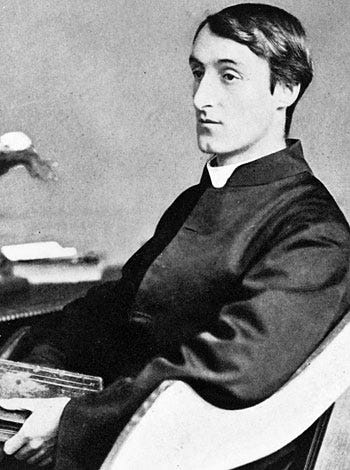
Wow! Thank you. An interesting choice of word too. Savagery.
I think of Whitman as Emersonian in whatever piety he might possess.
(“I am the owner of the sphere,
Of the seven stars and the solar year,
of Caesar's hand, and Plato's brain,
Of Lord Christ's heart, and Shakespeare's strain.”)
Is it (for Hopkins) enough to say that we inherit the spheres of thought and matter around us? That our souls connect those spheres with the filament of spiritual thought and feeling?
Forgive me this flight of fancy, but I'm going to put on my Hopkins/Our Dear Lord-galoshes and say 'no'. The Windhover is striving to go way beyond a Whitmanian/Emersonian spiritual worldview as I've described it.
One question I had as we were going over the three poems yesterday: when we read a religious poem like The Windhover in tandem with a poem that may not have religious ideas behind it (The Fish, for instance) are we forcing new meaning on the non-religious piece? For instance, fish have significant symbolism in Christianity.
Defo agree we should be cautious about how far we apply religious ideas to Bishop. What she shared with Hopkins was a technique and perspective as a poet.
Any one familiar with Whitman's A Noiseless Patient Spider? I thought a lot about that one as I was trying to figure out Windhover. In the poem, Whitman describes a spider and then turns to a description of the soul. He uses his observations about the spider's web-slinging to explore the nature of our own soul as 'instress'. The poem is worth looking at. But I am amazed by Hopkins in Windhover because he buries the turn or the volta. Suddenly we are Thee-ing the bird and turning over the soil and the embers are revealing new warmth. By contrast, Whitman spells it all out for us and perhaps loses some high-voltage in the process. I mark it a good Whitman poem, but medium-voltage.
Nice comparison. Here's the poem if anyone doesn't know it:
A noiseless patient spider,
I mark’d where on a little promontory it stood isolated,
Mark’d how to explore the vacant vast surrounding,
It launch’d forth filament, filament, filament, out of itself,
Ever unreeling them, ever tirelessly speeding them.
And you O my soul where you stand,
Surrounded, detached, in measureless oceans of space,
Ceaselessly musing, venturing, throwing, seeking the spheres to connect them,
Till the bridge you will need be form’d, till the ductile anchor hold,
Till the gossamer thread you fling catch somewhere, O my soul.
https://www.poetryfoundation.org/poems/45473/a-noiseless-patient-spider
I was thinking of 'Design' by Frost, also a spider poem...
Interesting, what did he mean by savagery?
Thanks that's great---will have a look at the chapter next time I'm in the library. They do share a concentrated style. "Wild-flapping pennants of joy"---what a great line!
He seems an asexual writer to me.