

Lázár, Nelio Biedermann
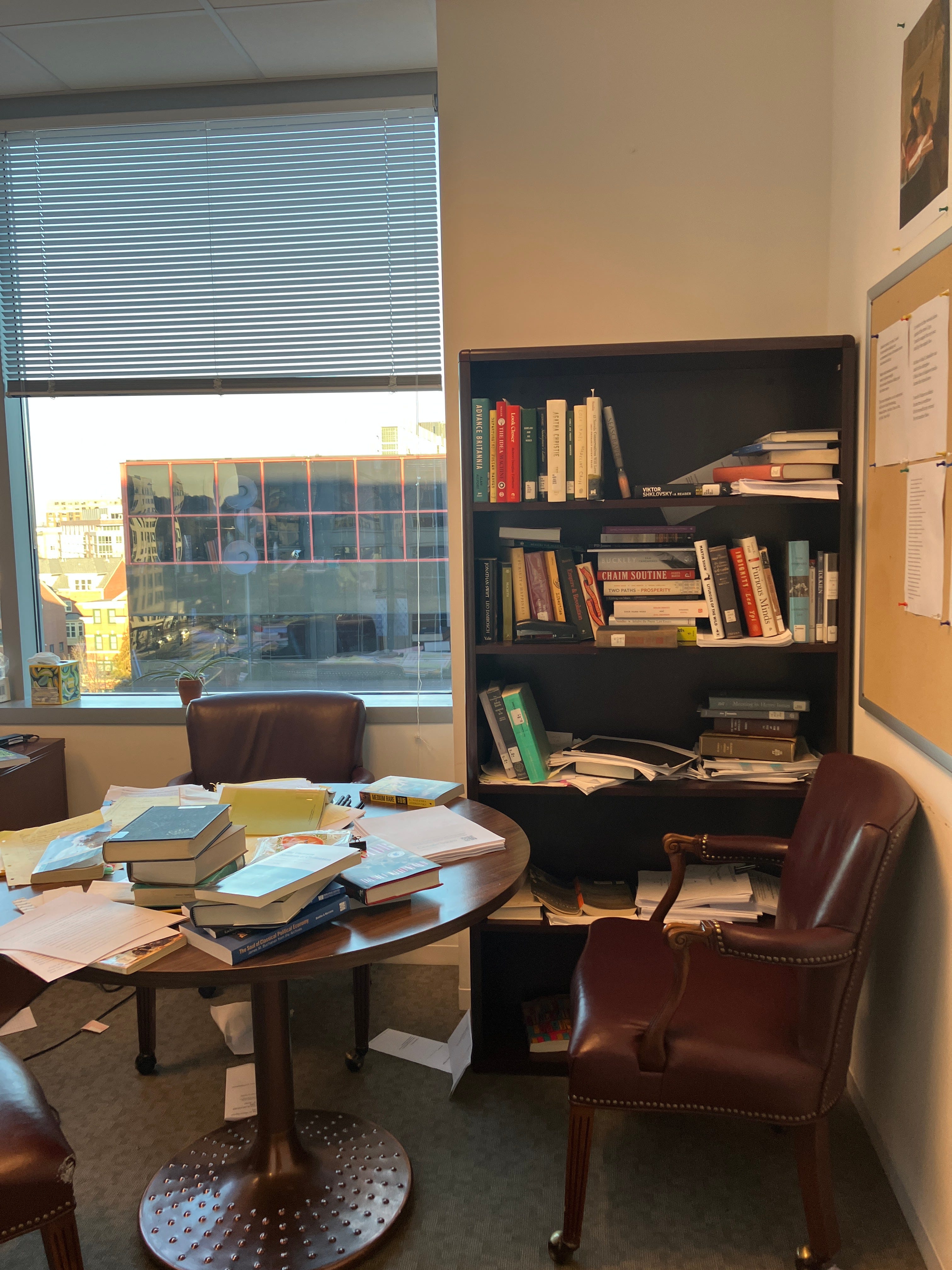
After I finished my morning pages of Henry James (a hundred pages of The Ambassadors is certainly a fine start to any day—I read lying prone on a sofa in Mercatus; later on, I move to the reading table in my office, where I make notes and hide behind the door), I picked this up in the mail, unexpectedly, and looked at the first few pages while my coffee was pouring. I have now read half of it and need to get back to work. So far, it is like The Radetsky March with more (explicit) sex, gothic elements, a touch of García Márquez, influence from the movies. Recommended. I am going to be reading more tonight.
The Pound Era, Hugh Kenner
I have only looked at some of this for research purposes, but it really is as good as people tell you. The Henry James pastiche at the beginning is masterly.
Weldon Kees
I read Kees’s poetry because of this very well-made documentary by Dana Gioia.
Gioia is a lifelong advocate for Kees and has done a good deal of research into his life and work. These are the four Kees poems I admired most. Overall I found him too nihilistic. Perhaps I read too much Larkin when I was young, but there is delight and hope and resistance in Larkin, and he is damn funny, whereas Kees was too often too bleak. I just cannot stand ‘For My Daughter’. This is a poor critical opinion, but it is my strong feeling. I was glad to read Kees, a new poet to me, and to experience his distinctive American idiom. But I did not take him to heart. Here is a shorter interview with Dana including a comparison of Kees to Eastern European poets.
Rivalry and Central Planning, Don Lavoie
Not the sort of book that is usually covered here at The Common Reader, but in my twenties I became interested in economics, and after sifting through the various schools of thought discovered the Austrians. They are, indeed, cranks in many respects, but their central insights are too-often overlooked because of their crankiness. Some of the essential work of (such as by Mises, and Hayek) simply cannot be ignored. (Did you know that opportunity cost is an Austrian concept?) The most popular book written by an “Austrian” is probably Economics in One Lesson by Henry Hazlitt. The most important single piece of writing by any Austrian is (in my opinion, as an interested amateur) Hayek’s paper The Uses of Knowledge in Society. (His papers on methodological individualism are also very worthwhile.) Obviously the normative/descriptive distinction is frequently disregarded when it comes to discussing such matters. Don Lavoie is a later member of the school, and this book recapitulates and reinterprets earlier debates about the theoretical possibility of central planning. I enjoyed it very much. Lavoie is a compelling writer. Some of you will see Austrian and think “free-market crazy”, or see Hayek and think “Pinochet supporter”. Good luck to you!
The Wealth of Nations
Who can ever tire of reading Adam Smith? A master of the good old plain English style, a heartfelt writer, a man of both parts and clarity. I have been revising Book V to prepare for an event, and also as part of some general background reading. I enjoy his writing so much I read some paragraphs out loud. (The joy of having an office with a reading table!) Is this one of the least read of the great English classics? Perhaps Smith suffers, like Bacon, from being too outside mainstream interests, too involved? Not everyone wants a thousand page treatise on economics. Still, I know people who find older books difficult to read but who find Smith as clear as crystal. (Smith knew his prose: the Lectures on Rhetoric is a great book.) And Smith is not abstract: he is obsessed with history, antiquity, examples from the laws. He always thinks about how things really work, the trades-offs and incentives, the likely evolution of social dynamics and equilibria. When he writes about education, both in the sense of teaching subjects and teaching morals, he is, here and in Theory of Moral Sentiments, highly exercised. It is quite entertaining how vexed he can become without losing control of his rational powers. He is appalled at the state of modern universities. He wishes for lectures to be paid by collecting fees from students, to avoid the idling effect of being paid from an endowment. He thinks “rivalship and emulation” are more important—what an important phrase. And he wishes for the government to provide some minimum of education to avoid the stultifying effects of division of labour:
The man whose whole life is spent in performing a few simple operations, of which the effects, too, are perhaps always the same, or very nearly the same, has no occasion to exert his understanding, or to exercise his invention, in finding out expedients for removing difficulties which never occur. He naturally loses, therefore, the habit of such exertion, and generally becomes as stupid and ignorant as it is possible for a human creature to become. The torpor of his mind renders him not only incapable of relishing or bearing a part in any rational conversation, but of conceiving any generous, noble, or tender sentiment, and consequently of forming any just judgment concerning many even of the ordinary duties of private life. Of the great and extensive interests of his country he is altogether incapable of judging; and unless very particular pains have been taken to render him otherwise, he is equally incapable of defending his country in war. The uniformity of his stationary life naturally corrupts the courage of his mind, and makes him regard, with abhorrence, the irregular, uncertain, and adventurous life of a soldier. It corrupts even the activity of his body, and renders him incapable of exerting his strength with vigour and perseverance in any other employment, than that to which he has been bred. His dexterity at his own particular trade seems, in this manner, to be acquired at the expense of his intellectual, social, and martial virtues. But in every improved and civilized society, this is the state into which the labouring poor, that is, the great body of the people, must necessarily fall, unless government takes some pains to prevent it.
In his book about the great economists, Tyler Cowen said this about Smith’s views on education (and other aspects of Book V): “The real social problem is about the fundamental shaping of individual character.” This, of course, is something Smith shares in common with the novelists. There is a moment in Clarissa when someone (Clarissa herself?) says:
We are all apt, you know, my dear, to praise our benefactors, because they are our benefactors; as if everybody did right or wrong as they obliged or disobliged us. But this good creature deserved to be kindly treated; so I could have no merit in favoring one whom it would have been ungrateful not to distinguish.
Smith was a great admirer of Richardson and says more or less exactly this at some point in Theory of Moral Sentiments. Mill says, “Human beings owe to each other help to distinguish the better from the worse, and encouragement to choose the former and avoid the latter. They should be forever stimulating each other to increased exercise of their higher faculties, and increased direction of their feelings and aims towards wise instead of foolish, elevating instead of degrading, objects and contemplations.” This, too, is Smithian, though Smith would emphasize incentives. The invisible hand was first formulated in a thought experiment about exactly these issues. Mill, of course, annotated The Wealth of Nations very young. And people say that liberals have no moral worldview… Pish!
More than once, Smith swipes at the philosophers. “There is nothing so absurd, says Cicero, which has not sometimes been asserted by some philosophers.” He is thinking along new lines and brining new methods to bear on philosophical problems. What he wants is a general understanding, on as broad a practical basis as possible, of human life, mind, and society. After a summary discussion of the introduction to universities of logic, pneumatology (the human soul and the Deity), “a debased system of moral philosophy”, and “a short and superficial system of physics”, he laments how narrow, crabbed, and tick-box it all was.
The alterations which the universities of Europe thus introduced into the ancient course of philosophy were all meant for the education of ecclesiastics, and to render it a more proper introduction to the study of theology. But the additional quantity of subtlety and sophistry, the casuistry and ascetic morality which those alterations introduced into it, certainly did not render it more for the education of gentlemen or men of the world, or more likely either to improve the understanding or to mend the heart.
An education “to improve the understanding or to mend the heart”! O Smith, you should be living at this hour!
Viktor Shklovsky: A Reader, trans. Alexandra Berlina
Most of my time recently has been spent preparing a lecture I am giving in Austin in early April. Shklovsky is a big part of my preparation. I had not known of this single volume with all his work in before. It is splendidly done. I don’t share Berlina’s interpretation of Shklovsky, but her introduction is very stimulating. There is a feeling now that Shklovsky didn’t really mean it when he said that defamiliarization was merely a literary technique, nothing to do with the world itself. This is not my reading of Shklovsky, but I find this to be a very stimulating debate. And almost all of Shklovsky is interesting. A critic you can learn from! His own anxieties later in life about the unoriginality of his idea is instructive, too, about the function of criticism, which is, as Johnson taught us, to improve opinion into knowledge. Men more often require to be reminded than informed!
Fantastic Literature A Critical Reader ed. by David Sandner
Some of the writers included here, like Todorov or Le Guin, are still very worth reading in the original books, but this is a very useful compilation that does exactly what you want it to do. I found several new essays here.
The English Novelists, ed. by Verschoyle, Derek
I read Graham Greene’s essay about Henry James in here and now I want to read the whole thing. This is where I found Elizabeth Bowen’s essay on Jane Austen. Next I will read Louis MacNiece on Thomas Malory.
The Witches of Eastwick, John Updike
I found this in a secondhand store on the way to Shenandoah. It’s boring. It’s also sexist, but Updike’s biggest problem is just that he is boring. It’s a gossip novel. I shall not be reading the new collection of letters.
The through-line of many of these pieces—Smith, the Austrians, many of the novelists in question — is the role of “rivalry and emulation” in the formation of character and the deciding of morals. Perhaps there is a book to be written with that title: Rivalry and Emulation: a history of moral, social, and economic ideas in the English novel. Perhaps it has already been written too many other ways… Rivalry is a means of discovering new information. In Henry James it leads to either great corruption or great innocence, in Dickens it becomes the basis of institutional torpor (the Smithian critique of the Circumlocution Office). In the liberal society, comparison is the basis of progress, commercial and moral, but it also the means by which we come to realize our faults, and this was something the economists and novelists developed together. We do not seek Platonic moral ideals in a Smithian world: morality is real, but it is known—discovered through rivalry and emulation—socially: our principles are only known in the constant state of disequilibria in which our rivalrous behaviors lead us to new understandings of what moral judgements are and are not acceptable. This is beautifully comic in Emma and gives a vision of evil in James. Such is the world of rivalry and emulation in which we all live, theorized as much by the novelists as by the economists.
Updike is a fascinating case study in reputational change.
Radetzky March with García Márquez is a sentence designed to make me stop whatever I’m doing. Right to the list.