

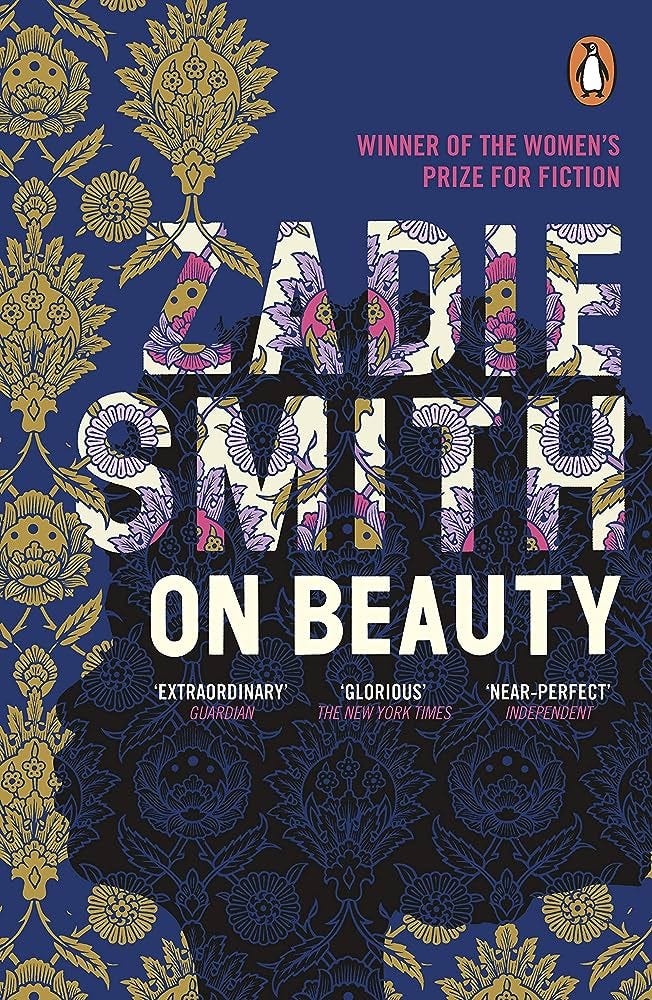
In anticipation of her new novel, it’s Zadie Smith season here at The Common Reader. Today is an essay about On Beauty (2005). Some of this essay is paywalled. But, good news, there’s a Summer Sale —20% off.
If you liked my essay How to read the canon, a paid subscription is one to way to start doing the things I recommended. Join us—and read the best that has been thought or said.
On Beauty and E.M. Forster
In 2006, I walked out of the bookshop reading On Beauty, and barely looked up until the end. I had become unaware that there was a world around me. My mother eventually gave up trying to talk to me and planted me in a cafe. As Jerome writes in the opening, I was “reading and feeling like you’re in a novel.”
In the last twenty-four hours, I re-read On Beauty and it holds up. Its model is Howards End, which Smith parallels throughout, even in the small ways she narrates time. Forster’s ingenious opening to chapter ten, “Several weeks passed”, is mirrored in Smith’s, “We must now jump nine months forward.”
Smith’s narrative interventions are often more subtle. She makes it clear that she is concerned with the poor, contra Forster’s notorious assertion, but she doesn’t declare it. Forster uses “We” obtrusively. Smith often makes this usage into more of an aside. (See the swear jars in chapter nine.) His characters are named after a writer of German Romanticisim whose ideas are being praised,—hers after a literary Theorist whose ideas are being critiqued. (Rightly so. Catherine Belsey believed Shakespeare’s plays are not works of art but “a location of cultural history.” Ugh.)
Forster sides with the Schlegels, against the forms of modern life that spoil his bucolic upper-class vision. He wrote in 1908, hearing a man had flown in an air machine, “Science, instead of freeing man … is enslaving him to machines.” This was the impetus for Howards End two years later. Forster wanted his readers to “connect the prose in us with the passion.” This is his shared aim with Smith, who takes post-structuralism to task, and comes down on the side of beauty.
Calming down Smith’s style
Smith was also reacting to criticism from James Wood, who called her first two novels “hysterical realism”,—“all shiny externality.” Wood disliked postmodern fiction’s obsession with explaining society without, in the tradition of George Eliot, being realistic. These writers—David Foster Wallace, Don Delillo, and so on—were systemic, pseudo-Dickensian, information heavy. They were not the “nearest thing to life.” They lacked real people.
Wood was concerned that novels were not fulfilling their aesthetic function because they were too bothered with what people might now call “life under late capitalism”. I would go further. Novelists are often not capable of analysing the whole culture because they are too restricted in their beliefs. Smith once claimed that the postmodern authors Wood decried knew about everything from economics to science, but really, how many of them have absorbed Hayek and Mill?1
So, one point (the point?) of On Beauty was to write a novel that was not hysterical realism. Wood complained of her first two novels that “the existence of vitality is mistaken for the drama of vitality”. Smith took that to heart. She restored the common sense idea that fiction, or beauty, is important for its own sake, not for any larger role it plays in “society”. She has elsewhere said her first commitment is to beauty.
At a similar time, Jonathan Franzen wrote The Corrections, a big explanatory novel, that strains too hard at its target. The Corrections fails as a social analysis—but succeeds as a realistic novel.
Smith’s narrative technique
This calmer realism allowed Smith to hone her technique. She went from hyper-real to subtle and nuanced. Look, for instance, (in part one, chapter eight) how the narrative uses the free indirect style and slips between idioms with subtlety. Free indirect style is when the words a character might say or think appear directly in the narration, no quote or speech marks.
When the narrator describes what teenage Levi thinks of his boss the phrase “tragic loser” is used, just how a sixteen-year-old would have talked in 2005; on the next page, the old lady who watches Levi walk past is “sitting on her porch eyeing him like there was no other news in town.” Another precise idiom.
Explaining free indirect style, Brad Skow makes a distinction between things that are fictional and things one of the characters takes to be true.
In this example, the phrase “tragic loser” means we are seeing the story as Levi sees it. It’s not quite true that Levi’s boss is a tragic loser. That’s just what Levi believes. This gap—between telling us something “true” in the fiction, like “this is Levi’s boss” vs telling us something someone in the fiction believes—is what Skow means. Similarly, when the old lady is “eyeing him like there was no other news in town” we get the same effect. These characters are all in the same narrative but they are not connected—Levi cannot empathise.
Where Forster had to keep saying “only connect” or some variation of it, Smith captures the language of her characters, and moves between the generations, through time. (As we will see in the next essay, the slippage of time, and our changing perceptions of the world as we age, is Smith’s central theme. )
Smith uses free indirect style to show the gap, to say “look, these people are not connected”. If she had done that in normal narration it would have been clumsy and judgemental. With free indirect style she recreates the feeling of the characters in us. Smith is getting us to wonder about how different characters are seeing the same moment differently.
Forster might have written the better novel overall, but he wasn’t as good at those sorts of subtleties as Smith.
These novels are not modernity’s answer to Bleak House. Literature has a long tradition of being ambivalent about capitalism and its ideologies. But opposition is not analysis. Sally Rooney shows that the way for fiction to deal with these issues is to represent them through realistic characters.
Have you read this piece by Christian Lorentzen, Henry? I found it v useful on what the ‘systems novel’ is/isn’t, versus a realist novel. And what you can do in a good novel.
https://www.bookforum.com/print/3001/don-delillo-s-novels-of-the-cold-war-and-its-aftermath-25202