

Paid subscribers can join this chat thread about Pride and Prejudice. The book club meets on 16th February. The next Shakespeare book club is 23rd February. We are discussing The Comedy of Errors. I strongly recommend watching this version from the Globe.
Regulated Hatred
In March 1939, at the Manchester Literary Society, W.D. Harding changed the way we talk about Jane Austen. Harding was not a literary critic. But his talk became the origin of a new way of seeing Jane Austen.1
Harding disagreed with the prevailing view that Austen was a “delicate satirist” who expressed “the gentler virtues of a civilised social order” and the “amiable weakness” of her characters. Instead, Harding said, her books were now being read “by precisely the sort of people whom she disliked.” She didn’t love her society: she wanted to undermine it. He called his essay “Regulated Hatred.”
The first example Harding gives is a passage from Northanger Abbey, when Henry Tilney says that in “a country like this” every man “is surrounded by a neighbourhood of voluntary spies”. And he quotes one of Austen’s letters, about her mother reading a letter from her aunt—they have seen one of Cassandra’s letters (Austen’s sister) and are “in a quandary about Charles and his prospects”. The various pieces of gossip (what the aunt thought, what Cassandra said) are debated. “Never mind,” Austen writes, “let them puzzle on together.” She held this sort of spying, he said, in contempt.
Harding thinks the remark about “a neighbourhood of voluntary spies” is missed or glided over by most readers, nestled, unexpectedly, as it is, in Henry’s speech. Henry’s other remarks are more complimentary: Austen smuggles it past us. He gives further examples. When Miss Elliot is chagrined at not having been able to marry her cousin, the satire allows us to feel superior to her, until Austen writes that Mr Elliot had “as by the accustomary intervention of kind friends they had been informed, spoken most disrespectfully of them all.”
In Emma, Austen writes that Miss Bates “enjoyed a most uncommon degree of popularity for a woman neither young, handsome, rich, nor married.” She continues,
Miss Bates stood in the very worst predicament in the world for having much of the public’s favour, and she had no intellectual superiority to make atonement to herself, or frighten those who might hate her into outward respect.
Although this “eruption of fear and hatred” into everyday life is distasteful for most people, Harding says it is undoubtedly part of Austen’s art. Harding contrasts Pride and Prejudice to Emma. In this extract from P&P, he says all readers can feel superior to Mr. Collins and Lady Catherine.
Their table was superlatively stupid. Scarcely a syllable was uttered that did not relate to the game, except when Mrs. Jenkinson expressed her fears of Miss De Bourgh’s being too hot or too cold, or having too much or too little light. A great deal more passed at the other table. Lady Catherine was generally speaking—stating the mistakes of the three others, or relating some anecdote of herself. Mr. Collins was employed in agreeing to everything her Ladyship said, thanking her for every fish he won, and apologizing if he thought he won too many. Sir William did not say much. He was storing his memory with anecdotes and noble names.
But in this, from Emma, we are all condemned,
…the usual rate of conversation; a few clever things said, a few downright silly, but by much the larger proportion neither the one nor the other—nothing worse than everyday remarks, dull repetitions, old news, and heavy jokes.
Harding says that the phrase “nothing worse” shows that Austen knows how lucky she is that this is the worst she has to put up with, but that the comment is not that of someone who “would have helped to make her society what it was, or ours what it is.” We all want Mrs. Bennet to be a harmless figure of fun, Harding says, but just look at what Austen wrote about her.
She was a woman of mean understanding, little information, and uncertain temper. When she was discontented, she fancied herself nervous. The business of her life was to get her daughters married: its solace was visiting and news.
So many of her readers must be like this, Harding contends, but still—they laugh along. To explain why Jane Austen has happy endings, Harding resorts to a discussion of the Cinderella theme. It is far less convincing that his initial contentions.
Harding had clearly hit on something important about Austen’s work. In the criticism that followed, however, his notion of regulated hatred was diminished to something more like mere hatred.
Harding’s inheritors: towards a culture war
In the 1960s, Marvin Mudrick wrote a book called Jane Austen: Irony as Defence and Discovery, inspired by Harding. He sees Lizzie Bennet as an “ironic spectator” who divides people into the simple and the intricate. (She tells Bingley she is only interested in intricate people). The simple give themselves away (Mr. Collins, Mrs. Bennet); the intricate are more amusing to the ironic spectator. This is a psychological, not a moral, way of understanding people. Not “are they good?”, but “are they interesting?” Simple characters can be good or bad, but they hold no surprises.
Mrs. Bennett’s simplicity is despicable. Here is what Mudrick calls Mrs. Bennet’s “irrepressible vulgarity”, which is what initially makes Darcy wary of forming an alliance with the Bennet family.
Mrs. Bennet seemed incapable of fatigue while enumerating the advantages of the match. His being such a charming young man, and so rich, and living but three miles from them, were the first points of self-gratulation…It was, moreover, such a promising thing for her younger daughters, as Jane’s marrying so greatly must throw them in the way of other rich men… In vain did Elizabeth endeavour to check the rapidity of her mother’s words, or persuade her to describe her felicity in a less audible whisper; for to her inexpressible vexation she could perceive that the chief of it was overheard by Mr. Darcy, who sat opposite to them. Her mother only scolded her for being nonsensical.
Later on, she sends Jane to Netherfield, hoping the rain would make her ill, forcing her to stay there, and thus be thrown into Bingley’s attention. When she is forced to accept that Bingley will not return to her, she says,
Well, my comfort is, I am sure Jane will die of a broken heart, and then he will be sorry for what he has done.
What she most fears, Mudrick says, is her own discomfort. The death of Mr. Bennet, without a good marriage for her daughters, will lead to that end. She is, in this sense, comparable to Mrs. Norris from Mansfield Park. The only daughter she is really sympathetic to is Lydia because they are made in the same image, Mudrick says. (Austen tells us, Lizzie was the least loved of her mother’s children.)
One of Jane Austen’s triumphs in Pride and Prejudice is her refusal to sentimentalize Lydia (as well as Mrs Bennet) once she has fashioned her to a hard and simple consistency… Lydia never repents; neither mother nor daughter even recognises there is anything to repent.
Elizabeth is not interested in these simple people. She loves her sister Jane, but does not rely on her judgement. She prefers the intricate. Likewise, Lizzie would never be interested in marrying Bingley. Mudrick tells us that love is simple only for the simple characters. For the intricate, like Lizzie, love is complicated and mature, not a story book affair.
Intricate though Mudrick’s theory is, it has many flaws. In 1985, reviewing an Austen biography in the TLS, Hermione Lee defended the “English tradition of affection and sympathy for Jane Austen.” John Halperin (the author under review) accused Austen of “spinsterly resentment”. Gone is the likeable and admirable Austen of Mary Lascelles and Elizabeth Jenkins. Lee hated Halperin’s book, calling it bigoted and narrow, accusing him of ignoring the feminist critical tradition (not something Jenkins had much time for, of course). Mudrick contributed to this sharp and spindly view of Austen. By the time of Lee’s review, attention was too much on Austen herself, not the novels. What Lee’s review shows us is that arguing about an imagined Austen has become the focus: she was an avatar in the culture wars.
And it was all quite far from Harding. Austen had been reduced to a witty hater.
A sensible view of Harding
In 2010, Wendy Ann Lee gave a sensible and measured consideration of Harding. Harding had said he was underlining “one or two features of her work”, but by the time of Lee’s review it had become more of a temperamental culture-war about whether she was Dear Aunt Jane or a nasty-minded spinster novelist.
As Wendy Ann Lee says, “Harding opened the door to a misanthropic Austen—not least Mudrick’s own portrait of a sadistic, commitment-phobic man-hater.”
But was that Harding’s fault?
Ann Lee looked at the full manuscript of Harding’s essay as originally published (and in draft), re-contextualised him as a war-time psychologist, and came to much more measured and useful conclusions. Where Harding used the Cinderella argument to explain why characters he didn’t like got married (like Fanny Price—outrageous opinion, she’s the best Austen heroine), Mudrick simply argued that Austen “hated love and marriage just as much as she hated people.” The Harding tradition was distorted.
Ann Lee syas:
Austenian irony, for Harding, is a highly flexible and ultimately charitable mode of expression, exercising a “capacity for keeping on good terms with people without too great treachery to [one]self”. Irony, according to Mudrick, is Austen’s equivalent to armor, a device used to protect herself from people, experiences, and feelings.
For Harding, Austen was a tactical inside member of a society she disliked; for Mudrick and his followers, she was a sexless outcast. Ann Lee says, “Harding’s Austen was not an injured, embittered woman but a confident social strategist motivated by practical insight.” For Harding, Austen was “intensely critical of people to whom she also has strong emotional attachments.”
Harding drew our attention both to Tilney’s comment about neighbourhood spies and to the fact that “It gets said, but with the minimum risk of setting people’s backs up.” His followers forgot that qualification.
Looking at the draft of Harding’s lecture, Ann Lee notes,
In the draft of “Regulated Hatred,” Harding observes that while Austen has long been accused of being politically and historically unaware at best, complacent at worst, he sees someone “explicitly attempting to change the social order,” not by subverting it “but in seeing it clearly for what it was.”
Seeing clearly is far more subtle than the “spinsterly resentment” tradition, and is, to my mind, much more capable of being integrated with everything else that is important about the novels: they show Austen’s ability to think strategically, the influence of Adam Smith’s moral philosophy, and her true affection for the love that exists between good people. As Ann Lee says, “Harding’s Austen engages in a form of opposition that preserves the dignity of her subjects without sacrificing her right of protest.”
That is, Austen is a thinker, an intellectual, a worldly philosopher. This is Ann Lee’s most useful paragraph.
Unlike romances—or novels like Jane Eyre and David Copperfield— where enemies just die, Austen’s fiction accepts the social necessity of living with one’s adversaries. Irksome as it may be, the fact is that Mrs. Elton belongs to the community. The realm of family demands even greater exertion. Musing on Mr. Darcy’s reasons for brokering marriage between Wickham and her wayward sister, Elizabeth Bennet considers and then doubts the possibility that he loves her: “to overcome a sentiment so natural as abhorrence against relationship with Wickham. Brother-in-law of Wickham! Every kind of pride must revolt from such a connection.” Yet the connection is made and carries into perpetuity as Elizabeth, too, becomes sister-in-law of Wickham. Where family especially is concerned, Austen’s novels recognize that while it may not be preferable to integrate offensive people (read: nations) into one’s circle, the costs of cutting them off can be too high and sometimes inconceivable.
Unpleasant relations cannot be avoided. In Pride and Prejudice, Elizabeth must accept Mr. Collins as the husband of her best friend (“Charlotte the wife of Mr. Collins, was a most humiliating picture!”) and must herself marry into the family of the insulting Lady Catherine.
Austen the thinker
What Ann Lee has shown is the deeper model of Jane Austen’s thinking: yes, she has a regulated hatred of many aspects of society, but she integrates that into her overall understanding of the dynamics that lead to marriages. She is not merely spiteful or resentful: she is open about both what she hates and admires. We shouldn’t be co-opting Austen into feminism or anti-feminism, hater or non-hater, but seeing her as a deep thinker.
From here, we will be better able to see the Jane Austen who has been analysed as a capable game theorist and the one whose work reflects the virtues of The Theory of Moral Sentiments.
To judge her merely as a social moralist is to miss all but the surface. She hates you, but only sometimes, and not exclusive of the complex matrix of relationships that make up our moral and social lives.
Her hatred is regulated by her intellect and her clear sight of the people she lived among.
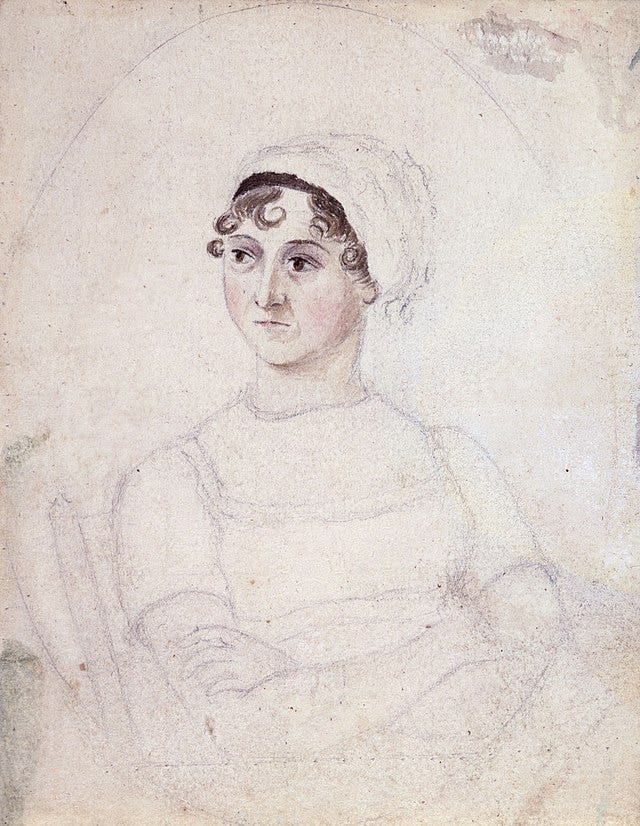
His points were not entirely original, but his whole perspective was the start of a new stream of thinking.
[Perhaps irrelevant but] I read P&P as much more condemnatory of Mr. Bennet than Mrs. Bennet—she is exasperating and limited, but has the material security of her children in mind, but by limiting his interest to only his "intelligent" children Mr. Bennet is actively destructive. I don't think Mrs. Bennet is likeable, and she does insane things (like sending Jane out in weather where she is likely to get sick), but she has some virtues. Mr. Bennet seems to have actively abdicated his own.
how does this (Austen as a thinker, intellectual, and worldly philosopher) fit with your thinking about gossip as the beginning to moral inquiry?