

War & Peace.
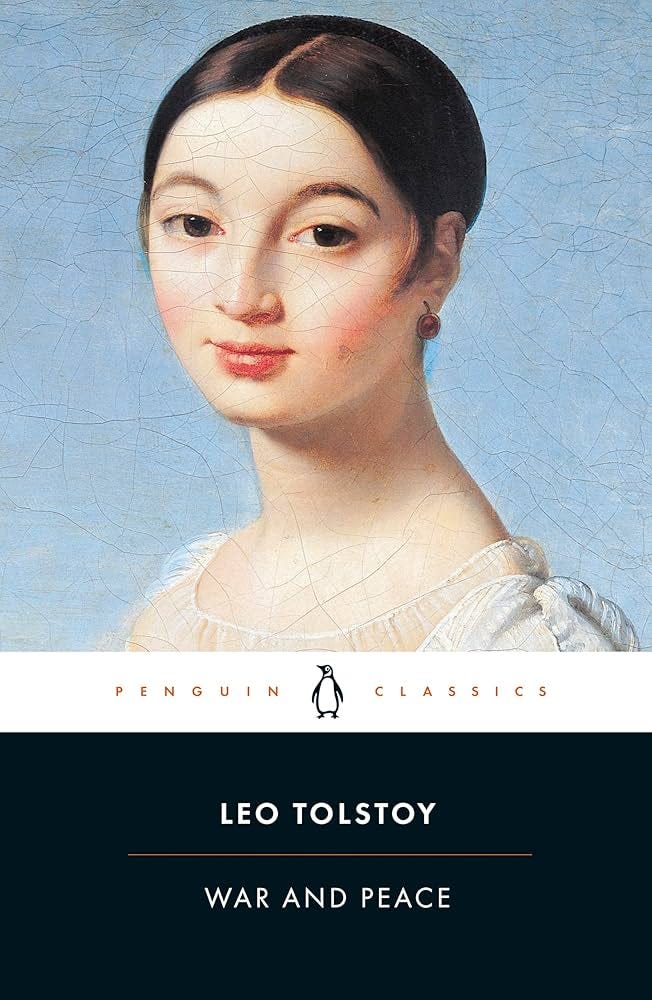
War & Peace, Tolstoy. Damn this was superb. Like The Golden Bowl last year, it gets a category of its own. I was lost to the world for a few days as I read this, other than the messages I sent to a friend who was reading it at the same time. Tolstoy’s greatness is made out of his clarity: he gives you everything you need. There is nothing hidden, implied, or “unreliable”. He shows you everything that history is made of. This is the greatest, grandest way of telling a story—the vivid, cinematic, expansive realism of which so few writers are really capable. Tolstoy is so clear, so precise, so plain that he can tell you any story he wants—even one of the largest stories of all. Some people tell me they don’t have time to read War & Peace, which is complete nonsense. It’s just the same as reading four or five “regular size” novels, something they are sure to achieve. If you really cannot face the monument, Tolstoy’s short fiction is excellent, especially Polikúshka. (I also read Master & Man, Confession, and various of the stories.) But really, there is very little to match the immersive experience of War & Peace. It has been said many times that one does not read this book, one lives it. When I was seventeen, I lived with Anna Karenina (book of books) and this year I had a similar experience with War & Peace. O! Pierre! O! Natasha! When Peggy Noonan read this novel, she wrote about what William F. Buckley Jr. said when he finally read Moby Dick in middle age—to think I might have died without reading it! Quite right. If you might die without reading Tolstoy, then stop making excuses and do what you know you ought to do, even if it is the short fiction only... So many scenes live with me now—the bear, the old count dying, the ball, Pierre at the train station, Natasha packing the cart in the fire, poor little Nikolai confused and innocent at war. They are all so real to me. O, this is history—this is life!
Non-Fiction 2025
Open Socrates, Agnes Callard, a genuinely exciting book of philosophy that made me take much more seriously the role of conversation in my life—not something I neglected, exactly, but something which I was already starting to practice a little more seriously. I was enthralled by the argument and I think Callard is more right than wrong. My review here. My interview with Agnes here.
Don’t Forget We’re Here Forever, Lamorna Ash. What sort of people are becoming religious in England? Lamorna Ash bought a car and spent two years driving round the country to find out. I wrote about this book and interviewed Lamorna.
Gertrude Stein: An Afterlife, Francesca Wade. You may not think you want to read about Gertrude Stein, and indeed you may dislike Stein, but you will still find this to be a well-researched, well-written, interesting book, full of cultural history, funny anecdotes, and sound judgement. Stein studied with William James and did original scientific research, collected works by Picasso and others before they were famous, and went to the second night of the Rite of Spring. She is a real late bloomer, too. You will learn a lot and enjoy it irrespective of your views on Modernism or anything else.
Sir Orfeo, I don’t know if Emily Spinach’s translation counts as one of the “best books of the year”, but I do know that I love this Romance and was pleased with her translation, available for free here on Substack.
Shakespeare’s Tragic Art, what a superb book! My interview with Lewis.
The Eagle and the Hart. A double biography of Richard II and Henry IV which I found compulsive. I interviewed Helen Castor as well.
Fiction 2025
The Odyssey, Mendelsohn translation. This book is the cornerstone of the Western tradition. I am an Odyssey person, not an Iliad person, and while I didn’t love all of this translation, the use of long lines does give a very different sense of the text than the usual pentameter. Much of it was really splendid. My review here, about the Odyssey as a quest narrative of sons in search of their fathers.
Sonny and Sonia, Kiran Desai. I have waited for some twenty years for Desai’s next book and was not at all disappointed. Just magnificent. My review.
On the Calculation of Volume. It feels to me that these books are not getting as much excitement and attention as they deserve. If you know, you know. My review here and here. My interview about these books with Rebecca Lowe here. I will have more to say soon…
Heaney Collected Poems. I don’t usually include poetry on these lists because I read poems in fits and starts, online, by leafing through old books, in anthologies, so it is hard to say what books of poetry I have enjoyed. Anyway, this book merits obvious inclusion, though most readers (including me) will be happier with their earlier selected editions and individual volumes. Podcast about Heaney. Review of Heaney.
Non-fiction pre-2025
Debra Gettelman’s 2024 book Imagining Otherwise changed the way I think about nineteenth-century fiction.
Woolf’s essays. The best thing I wrote this year was my essay for Liberties about Virginia Woolf’s essays. That involved re-reading The Common Reader which is one of my favorite books, obviously. Woolf must be the best critic of the twentieth century.
The Wealth of Nations and The Theory of Moral Sentiments. Adam Smith is essential reading in the English tradition. Obviously he is a remarkably important thinker, but he is also a very good prose writer. The Lectures on Rhetoric was the book of his that I most thrilled to.
Reflections, Burke. Maybe it is fifteen years since I read Burke. This, along with a selection of speeches and his note to Pitt about wages, was excellent. I went back with relish each evening. Richard Bourke’s intellectual biography of Burke is not for everyone, but if you are the right person then it’s exactly the book you want it to be.
The Establishment of Modern English Prose by Ian Robinson. Not for everyone, to say the least, but again wonderful if you are the right audience. I read this to research my Works in Progress essay about Prose.
Mikhail Bakhtin. I read both the Rabelais book and the dialogic imagination book, along with some of the later commentators. A hugely important critic. The Rabelais book in particular was revolutionary to me. I have been changing my mind—or expanding my thoughts—on related areas and Bakhtin has been essential to that.
Fiction pre-2025
As with last year, Shakespeare is assumed to be the greatest thing I read this year, also Jane Austen… I read some twelve of the plays or more, of which I most loved All’s Well and Macbeth. Mansfield Park and Sense and Sensibility are the Austen novels I most enjoyed.
Middlemarch. Need I say more?
Gulliver’s Travels is one of the very best books in English, and Swift is the most intelligent of the great authors. I read various of Swift’s pamphlets and poems too. The Ephraim biography was also splendid, but I only used the third volume.
Le Morte d’Arthur, I have dipped in and out of this book several times over the year, in translated, non-translated, and audio versions. I never regret opening it.
The Oxford Book of English Verse, ed. by Helen Gardner. I left all of my anthologies in England, including the three versions of the Oxford Book. I found this in a second hand store in Maryland. I have been very happy reading this book, especially Herrick and Henry Vaughan and Donne. I have also enjoyed reading Frost, Stevens, Dickinson, as always.
Summer in Baden-Baden. How had I not read this before?
Leopoldstadt. Heartbreaking. How I regret not seeing it on stage.
Dante, Singleton translation. I cannot stand poetry translations of Dante but I loved this. The sort of book you want to read a little bit of every day.
The Sea, The Sea. I read this for a discussion with Catherine Lacey. I will read it again before long.
The Girls of Slender Means, Muriel Spark. I read quite a few Spark novels before I reviewed Frances Wilson’s excellent new biography, and this is the one I admired the most. I read it twice, turning to the start as soon as I finished.
Brideshead. Perhaps the novel I have read most? Also a Liberties piece, I read this over the course of a week, ill in bed. Jewels never lose their lustre and this was every bit as good on the seventh (?) read, and continues to improve with age.
Atlas Shrugged, some of you won’t be able to stand the fact that I enjoyed this book—either because it is “bad” aesthetically or morally or intellectually or all three! It’s a mistake to judge a book like that. There used to be such a thing as a “good bad book”, and while that’s not quite the right term for Rand, it’s not far off. This might be the best genre novel ever written. At the least, it was a page turner. You may find it unreadable because the characters are cardboard or whatever, but I am able to read a certain amount of that stuff each year without turning up my nose, much to my benefit. I assume the haters don’t read much detective fiction or Sci Fi or anything else that falls foul of the cardboard character critique. Here is my Rand podcast with Hollis Robbins.
Told by an Idiot, Rose Macaulay. I didn’t expect to find this so interesting, but once I started I couldn’t stop… Good fun.
The Enigma of Arrival, V.S. Naipaul. A masterpiece. Naipaul is one of the great English novelists and this is one of his best books. Read it slowly.
Lolly Willowes, I loved loved loved this book. One for the people who enjoy Virago and Persephone authors, or if you have a taste for mid-century women writers like Bowen. No-one, of course, writes like Warner…
Fire and Hemlock, Diana Wynne Jones. Stunningly good, one of those children’s books that is also written for adults, fully relevant to the culture wars of its day about divorce. The closest book to this that I know of is The Ballad of Peckham Rye, noting that they are quite different books in many ways. You will get more out of this if you know some T.S. Eliot, but you can do that afterwards if needed. I also read Deep Secret, The Merlin Conspiracy, and Black Maria—Deep Secret is easily the best of these and perhaps one of Wynne Jones’s best as well.
Story of your Life, Ted Chiang. I had been meaning to read this for some time and I was tipped over by Naomi Kanakia’s recommendation. I will remember ‘The Tower of Babel’ forever.
The Magician’s Nephew. The best children’s book ever written.
Peter Pan. Obviously.
The Railway Children, E. Nesbit. Delightful. I know you have seen the film, but the book is much much better…
There are various books that I know I read in the library this year—like Kenneth Clark’s Gothic Revival, various books about the history of London Bridge, etc.—which are not included here because I am still working through all the notes I brought to the USA. I also left behind almost all my books and perhaps there is a masterwork sitting on the shelves in England that I will only remember once I have published this list…
I am part way through both Sir Charles Grandison and Clarissa (yes, I am a terribly disorganized reader). I will finish both of these excellent novels, but they are not on my list for this year for that reason. I only dipped in and out of Hegel’s Lectures on Fine Art and John Bayley’s Tolstoy and the Novel. I love them both, but I really did dip, so it’s probably not right to include them here.
A couple of thoughts/questions about this list.
War and Peace: Okay - amazing book - EXCEPT: I can't take the chapters where Tolstoy pauses the story and starts expounding his philosophy of history, with the repeated damning of Napoleon and the praise of Kutuzov. Those chapters I find frankly dull: whatever you think of Napoleon et al., this doesn't seem to me a very profound reading of him, and also distracts from the narrative. There is a place for that sort of material in a book: I love the whaling digressions in Moby Dick, because they seem to me to contribute to the grand symbolism of the general narrative. But I can't find much in the War and Peace digressions which add that sort of depth to the story of Pierre and Natasha and Andrei and the rest - and I notice that lovers of War and Peace (of whom I count myself one - with this severe reservation) rarely mention them. Or do you think I'm missing something there?
Atlas Shrugged: I've always been put off reading this, not by the politics per se, but by the knowledge that the climax of the book consists of a 100-page speech by the hero expounding his (or the author's) political philosophy. This sounds like the worst aspects of War and Peace on steroids, and I would really like to know how an aesthetic admirer of the book (as opposed to an admirer of the philosophy in question) deals with it.
Brideshead: my least favorite Waugh novel, I'm afraid - the sentimental Catholicism does nothing for me (it reminds me too much of The End of the Affair, which is my least favorite Graham Greene novel ...). I've read it twice, and disliked it more the second time than the first. (I should say I don't mind Catholicism in a book - quite the contrary, which is why I love some of Greene's other books. But Catholicism + sentimentalism is something else.)
So glad to see another shout-out to All's Well, which is definitely my top Shakespeare play that most people don't know about!
Definitely going to look at more Burke: I know the Reflections, but I've never read anything else by him - thanks for the reminder!!
Gary Saul Morson’s “Anna Karenina in our Time” is indispensable for not misreading Anna Karenina. This year I finished W&P for something like the sixth time. Tolstoy’s great gift is following ordinary human thought more closely: in finer increments than any other novelist.
Advice to new readers: Don’t sweat the French: It is Tolstoy’s belief that nothing important is said in French. Don’t sweat the historical theory, unless you’re the type that has to read every word. The novel is about so much more. Just accept the fact that you’re going to read it again.