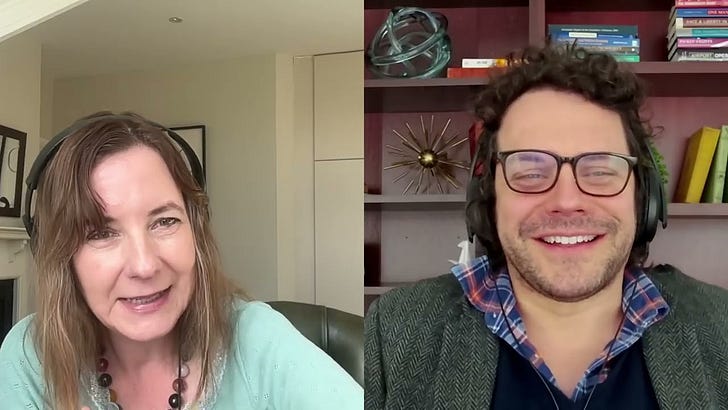

Ahead of her new book What’s So Great About the Great Books? coming out in April, Naomi Kanakia and I talked about literature from Herodotus to Tony Tulathimutte. We touched on Chaucer, Anglo-Saxon poetry, Scott Alexander, Shakespeare, William James, Helen deWitt, Marx and Engels, Walter Scott, Les Miserables, Jhootha Sach, the Mahabharata, and more. Naomi also talked about some of her working habits and the history and future of the Great Books movement. Naomi, of course, writes Woman of Letters here on Substack.
Transcript
Henry Oliver: Today, I am talking with Naomi Kanakia. Naomi is a novelist, a literary critic, and most importantly she writes a Substack called Woman of Letters, and she has a new book coming out, What’s So Great About the Great Books? Naomi, welcome.
Naomi Kanakia: Thanks for having me on.
Oliver: How is the internet changing the way that literature gets discussed and criticized, and what is that going to mean for the future of the Great Books?
Kanakia: How is the internet changing it? I can really speak to only how it has changed it for me. I started off as a writer of young adult novels and science fiction, and there’s these very active online fan cultures for those two things.
I was reading the Great Books all through that time. I started in 2010 through today. In the 2010s, it really felt like there was not a lot of online discussion of classic literature. Maybe that was just me and I wasn’t finding it, but it didn’t necessarily feel like there was that community.
I think because there are so many strong, public-facing institutions that discuss classic literature, like the NYRB, London Review of Books, a lot of journals, and universities, too. But now on Substack, there are a number of blogs—yours, mine, a number of other ones—that are devoted to classic literature. All of those have these commenters, a community of commenters. I also follow bloggers who have relatively small followings who are reading Tolstoy, reading Middlemarch, reading even much more esoteric things.
I know that for me, becoming involved in this online culture has given me much more of an awareness that there are many people who are reading the classics on their own. I think that was always true, but now it does feel like it’s more of a community.
Oliver: We are recording this the day after the Washington Post book section has been removed. You don’t see some sort of relationship between the way these literary institutions are changing online and the way the Great Books are going to be conceived of in the future? Because the Great Books came out of a an old-fashioned, saving-the-institutions kind of radical approach to university education. We’re now moving into a world where all those old things seem to be going.
Kanakia: Yes. I agree. The Great Books began in the University of Chicago and Columbia University. If you look into the history of the movement, it really was about university education and the idea that you would have a common core and all undergraduates would read these books. The idea that the Great Books were for the ordinary person was really an afterthought, at least for Mortimer Adler and those original Great Books guys. Now, the Great Books in the university have had a resurgence that we can discuss, but I do think there’s a lot more life and vitality in the kind of public-facing humanities than there has been.
I talked to Irina Dumitrescu, who writes for TLS (The Times Literary Supplement), LRB (The London Review of Books), a lot of these places, and she also said the same thing—that a lot of these journals are going into podcasts, and they’re noticing a huge interest in the humanities and in the classics even at the same time as big institutions are really scaling back on those things. Humanities majors are dropping, classics majors are getting cut, book coverage at major periodicals is going down. It does seem like there are signals that are conflicting. I don’t really know totally what to make of it. I do think there is some relation between those two things.
Ted Gioia on Substack is always talking about how culture is stagnant, basically, and one of the symptoms of that is that “back list” really outsells “front list” for books. Even in 2010, 50 percent of the books that were sold were front-list titles, books that had been released in the last 18 months. Now it’s something like only 35 percent of books or something like that are front-list titles. These could be completely wrong, but there’s been a trend.
I think the decrease in interest in front-list books is really what drives the loss of these book-review pages because they mostly review front-list books. So, I think that does imply that there’s a lot of interest in old books. That’s what our stagnant culture means.
Oliver: Why do you think your own blog is popular with the rationalists?
Kanakia: I don’t know for certain. There was a story I wrote that was a joke. There are all these pop nonfiction books that aim to prove something that seems counterintuitive, so I wrote a parody of one of those where I aim to prove that reading is bad for you. This book has many scientific studies that show the more you read, the worse it is because it makes you very rigid.
Scott Alexander, who is the archrationalist, really liked that, and he added me to his blog roll. Because of that, I got a thousand rationalist subscribers. I have found that rationalists at least somewhat interested in the classics. I think they are definitely interested in enduring sources of value. I’ve observed a fair amount of interest.
Oliver: How much of a lay reader are you really? Because you read scholarship and critics and you can just quote John Gilroy in the middle of a piece or something.
Kanakia: Yeah. That is a good question. I have definitely gotten more interested in secondary literature. In my book, I really talk about being a lay reader and personally having a nonacademic approach to literature. I do think that, over 15 years of being a lay reader, I have developed a lot of knowledge.
I’ve also learned the kind of secondary literature that is really important. I think having historical context adds a lot and is invaluable. Right now I’m rereading Les Miserables by Victor Hugo. When I first read it in 2010, I hardly knew anything about French history. I was even talking online with someone about how most people who read Les Miserables think it’s set in the French Revolution. That’s basically because Americans don’t really know anything about French history.
Everything makes just a lot more sense the more you know about the time because it was written for people in it. For people in 1860s France, who knew everything about their own recent history, that really adds a lot to it. I still don’t tend to go that much into interpretive literature, literature that tries to do readings of the stories or tell me the meaning of the stories. I feel like I haven’t really gotten that much out of that.
Oliver: How long have you been learning Anglo-Saxon?
Kanakia: I went through a big Anglo-Saxon phase. That was in 2010. It started because I started reading The Canterbury Tales in Middle English. There is a great app online called General Prologue created by one of your countrymen, Terry Richardson [NB it is Terry Jones], who loved Middle English. In this app, he recites the Middle English of the General Prologue. I started listening to this app, and I thought, I just really love the rhythms and the sounds of Middle English. And it’s quite easy to learn. So then, I got really into that.
And then I thought, but what about Anglo-Saxon? I’m very bad at languages. I studied Latin for seven years in middle school and high school. I never really got very far, but I thought, Anglo-Saxon has to be the easiest foreign language you can learn, right? So, I got into it.
I cannot sight read Anglo-Saxon, but I really got into Anglo-Saxon poetry. I really liked the Anglo-Saxon Chronicle. Most people probably would not like the Anglo-Saxon Chronicle because it’s very repetitive, but that makes it great if you’re a language learner because every entry is in this very repetitive structure. I just felt such a connection. I get in trouble when I say this kind of stuff, because I’m never quiet sure if it’s 100 percent true. But it’s certainly one of the oldest vernacular literatures in Europe. It’s just so much older than most of the other medieval literature I’ve read. And it just was such a window into a different part of history I never knew about.
Oliver: And you particularly like “The Dream of the Rood”?
Kanakia: Yeah, “The Dream of the Rood” is my favorite Anglo-Saxon poem. “The Dream of the Rood” is a poem that is told from the point of view of Christ’s cross. A man is having a dream. In this dream he encounters Christ’s cross, and Christ’s cross starts reciting to him basically the story of the crucifixion. At the end, the cross is buried. I don’t know, it was just so haunting and powerful. Yeah, it was one of my favorites.
Oliver: Why do you think Byron is a better poet than Alexander Pope?
Kanakia: This is an argument I cannot get into. I think this is coming up because T. S. Eliot felt that Alexander Pope was a great poet because he really exemplified the spirit of the age. I don’t know. I’ve tried to read Pope. It just doesn’t do it for me. Whereas with Byron, I read Don Juan and found it entertaining. I enjoyed it. Then, his lyric poetry is just more entertaining to read. With Alexander Pope, I’m learning a lot about what kind of poetry people wrote in the 18th century, but the joy is not there.
Oliver: Okay. Can we do a quick fire round where I say the name of a book and you just say what you think of it, whatever you think of it?
Kanakia: Sure.
Oliver: Okay. The Odyssey.
Kanakia: The Odyssey. Oh, I love The Odyssey. It has a very strange structure, where it starts with Telemachus and then there’s this flashback in the middle of it. It is much more readable than The Iliad; I’ll say that.
Oliver: Herodotus.
Kanakia: Herodotus is wild. Going into Herodotus, I really thought it was about the Persian war, which it is, but it’s mostly a general overview of everything that Herodotus knew, about anything. It’s been a long time since I read it. I really appreciate the voice of Herodotus, how human it is, and the accumulation of facts. It was great.
Oliver: I love the first half actually. The bit about the Persian war I’m less interested in, but the first half I think is fantastic. I particularly love the Egypt book.
Kanakia: Oh yeah, the Egypt book is really good.
Oliver: All those like giant beetles that are made of fire or whatever; I can’t remember the details, but it’s completely…
Kanakia: The Greeks are also so fascinated by Egypt. They go down there like what is going on out there? Then, most of what we know about Egypt comes from this Hellenistic period, when the Greeks went to Egypt. Our Egyptian kings list comes from the Hellenistic period where some scholar decided to sort out what everybody was up to and put it all into order. That’s why we have such an orderly story about Egypt. That’s the story that the Greeks tried to tell themselves.
Oliver: Marcus Aurelius.
Kanakia: Marcus Aurelius. When I first read The Meditations, which I loved, obviously, I thought, “being the Roman emperor cannot be this hard.” It really was a black pill moment because I thought, “if the emperor of Rome is so unhappy, maybe human power really doesn’t do it.”
Knowing more about Marcus Aurelius, he did have quite a difficult life. He was at war for most of his—just stuck in the region in Germany for ages. He had various troubles, but yeah, it really was very stoic. It was, oh, I just have to do my duty. Very “heavy is the head that wears the crown” kind of stuff. I thought, “okay, I guess being Roman emperor is not so great.”
Oliver: Omar Khayyam.
Kanakia: Omar Khayyam. Okay, I’ve only read The Rubaiyat of Omar Khayyam by Edward Fitzgerald, which I loved, but I cannot formulate a strong opinion right now.
Oliver: As You Like It.
Kanakia: No opinions.
Oliver: Boswell’s Life of Samuel Johnson.
Kanakia: Boswell’s Life of Samuel Johnson. I do have an opinion about this, which is that they should make a redacted version of Boswell’s Life of Samuel Johnson. I normally am not a big believer in abridgements because I feel like whatever is there is there. But, Boswell’s Life of Samuel Johnson, first of all, has a long portion before Boswell even meets Johnson. That portion drags; it’s not that great. Then it has all these like letters that Johnson wrote, which also are not that great. What’s really good is when Boswell just reports everything Johnson ever said, which is about half the book. You get a sense of Johnson’s conversation and his personality, and that is very gripping. I’ve definitely thought that with a different presentation, this could still be popular. People would still read this.
Oliver: The Communist Manifesto.
Kanakia: The Communist Manifesto. It’s very stirring. I love The Communist Manifesto. It has very haunting, powerful lines. I won’t try to quote from it because I’ll misquote them.
Oliver: But it is remarkably well written.
Kanakia: Oh yeah, it is a great work of literature.
Oliver: Yeah.
Kanakia: I read Capital [Das Kapital], which is not a great work of literature, and I would venture to say that it is not necessarily worth reading. It really feels like Marx’s reputation is built on other political writings like The Eighteenth Brumaire of Louis Bonaparte and works like that, which really seem to have a lot more meat on the bone than Capital.
Oliver: Pragmatism by William James.
Kanakia: Pragmatism. I mean, I’ve mentioned that in my book. I love William James in general. I think William James was writing in this 19th-century environment where it seemed like some form of skepticism was the only rational solution. You couldn’t have any source of value, and he really tried to cut through that with Pragmatism and was like, let’s just believe the things that are good to believe. It is definitely at least useful to think, although someone else can always argue with you about what is useful to believe. But, as a personal guide for belief, I think it is still useful.
Oliver: Major Barbara by George Bernard Shaw.
Kanakia: No strong opinions. It was a long time ago that I read Major Barbara.
Oliver: Tell me what you like about James Fenimore Cooper.
Kanakia: James Fenimore Cooper. Oh, this is great. I have basically a list of Great Books that I want to read, but four or five years ago, I thought, “what’s in all the other books that I know the names of but that are not reputed, are not the kind of books you still read?”
That was when I read Walter Scott, who I really love. And I just started reading all kinds of books that were kind of well known but have kind of fallen into literary disfavor. In almost every case, I felt like I got a lot out of these books. So, nowadays when I approach any realm of literature, I always look for those books.
In 19th-century American literature, the biggest no-longer-read book is The Last of the Mohicans by James Fenimore Cooper, which was America’s first bestseller. He was the first American novelist that had a high reputation in Europe. The Last of the Mohicans is kind of a historical romance, à la Walter Scott, but much more tightly written and much more tightly plotted.
Cooper has written five novels, the Leatherstocking Tales, that are all centered around this very virtuous, rough-hewn frontiersman, Natty Bumppo. He has his best friend, Chingachgook, who is the last of the Mohicans. He’s the last of his tribe. And the two of these guys are basically very sad and stoic. Chingachgook is distanced from his tribe. Chingachgook has a tribe of Native Americans that he hates—I want to say it’s the Huron. He’s always like, “they’re the bad ones,” and he’s always fighting them. Then, Natty Bumppo doesn’t really love settled civilization. He’s not precisely at war with it, but he does not like the settlers. They’re kind of stuck in the middle. They have various adventures, and I just thought it was so haunting and powerful.
I’ve been reading a lot of other 19th-century American literature, and virtually none of it treats Native Americans with this kind of respect. There’s a lot of diversity in the Native American characters; there’s really an attempt to show how their society works and the various ways that leadership and chiefship works among them. There’s this very haunting moment in The Last of the Mohicans, where this aged chief, Tamenund, comes out and starts speaking. This is a chief who, in American mythology, was famous for being a friend to the white people. But, James Fenimore Cooper writing in the 1820s has Tamenund come out at 80 years old and say, “we have to fight; we have to fight the white people. That’s our only option.” It was just such a powerful moment and such a powerful book.
I was really, really enthused. I read all of these Leatherstocking Tales. It was also a very strange experience to read these books that are generally supposed to be very turgid and boring, and then I read them and was like, “I understand. I’m so transported.” I understand exactly why readers in the 1820s loved this.
Oliver: Which Walter Scott books do you like?
Kanakia: I love all the Walter Scott books I’ve read, but the one I liked best was Kenilworth. Have you ever read Kenilworth?
Oliver: I don’t know that one.
Kanakia: Yeah, it’s about Elizabeth I, who had a romantic relationship with one of her courtiers.
Oliver: The Earl of Essex?
Kanakia: Yeah. She really thought they were going to get married, but then it turned out he was secretly married. Basically, I guess the implication is that he killed his wife in order to marry Queen Elizabeth I. It’s a novel all about him and that situation, and it just felt very tightly plotted. I really enjoyed it.
Oliver: What did you think of Rejection?
Kanakia: Rejection by Tony Tulathimutte? Initially when I read this book, I enjoyed it, but I was like, “life cannot possibly be this sad.” It’s five or six stories about these people who just have nothing going on. Their lives are so miserable, they can’t find anyone to sleep with, and they’re just doomed to be alone forever. I was like, “life can’t be this bad.” But now thinking back over it, it is one of the most memorable books I’ve read in the last year. It really sticks with you. I feel like my opinion of this book has gone up a lot in retrospect.
Oliver: How antisemitic is the House of Mirth?
Kanakia: That is a hotly debated question, which I mentioned in my book. I think there has been a good case made that Edith Wharton, the author of House of Mirth, who was from an old New York family, was herself fairly antisemitic and did not personally like Jewish people. What she portrays in this book is that this old New York society also was highly suspicious of Jewish people and was organized to keep Jewish people out.
In this book there is a rich Jewish man, Simon Rosedale, and there’s a poor woman, Lily Bart. Lily Bart’s main thing is whether she’s going to marry the poor guy, Lawrence Selden, or the rich guy, Percy Gryce. She can’t choose. She doesn’t want to be poor, but she also is always bored by the rich guys. Meanwhile, through the whole book, there’s Simon Rosedale, who’s always like, “you should marry me.” He’s the rich Jewish guy. He’s like, “you should marry me. I will give you lots of money. You can do whatever you want.”
Everybody else kind of just sees her as a woman and as a wife; he really sees her as an ally in his social climbing. That’s his main motivation. The book is relatively clear that he has a kind of respect for her that nobody else does. Then, over the course of the book, she also gains a lot more respect for him. Basically, late in the book, she decides to marry him, but she has fallen a lot in the world. He’s like, “that particular deal is not available anymore,” but he does offer her another deal that—although she finds it not to her taste—is still pretty good.
He basically is like, “I’ll give you some money, you’ll figure out how to rehabilitate your reputation, and later down the line, we can figure something out.” So, I think with a great author like Edith Wharton, there’s power in these portrayals. I felt it hard to come away from it feeling like the book is like a really antisemitic book.
Oliver: Now, you note that the Great Books movement started out as something quite socially aspirational. Do you think it’s still like that?
Kanakia: I do think so. Yeah. For me, that’s 100 percent what it was because I majored in econ. I always felt kind of inadequate as a writer against people who had majored in English. Then I started off as a science fiction writer, young adult writer, and I was like, “I’m going to read all these Great Books and then I’ll have read the books that everybody else has read.” In my mind, that’s also what it was—that there was some upper crust or literary society that was reading all these Great Books.
That’s really what did it. I do think there’s still an element of aspiration to it because it’s a club that you can join, that anyone can join. It’s very straightforward to be a Great Books reader, and so I think there’s still something there. I think because the Great Books movement has such a democratic quality to it, it actually doesn’t get you to the top socially, which has always been the true, always been the case. But, that’s okay. As long as you end up higher than where you started, that’s fine.
Oliver: What makes a book great?
Kanakia: I talk about it this in the book, and I go through many different authors’ conceptions of what makes a book great or what constitutes a classic. I don’t know that anyone has come up with a really satisfying answer. The Horatian formulation from Horace—that a book is great or an author is great if it has lasted for a hundred years—is the one that seems to be the most accurate. Like, any book that’s still being read a hundred years after it was written has a greatness.
I do think that T. S. Eliott’s formulation—that a civilization at its height produces certain literature and that literature partakes of the greatness of the civilization and summarizes the greatness of the civilization—does seem to have some kind of truth to it.
But it’s hard, right? Because the greatest French novel is In Search of Lost Time, but I don’t know that anyone would say that the France in the 1920s was at its height. It’s not a prescriptive thing, but it does seem like the way we read many of these Great Books, like Moby Dick, it feels like you’re like communing with the entire society that produced it. So, maybe there’s something there.
Oliver: Now, you’ve used a list from Clifton Fadiman.
Kanakia: Yes.
Oliver: Rather than from Mortimer Adler or Harold Bloom or several others. Why this list?
Kanakia: Well, the best reason is that it’s actually the list I’ve just been using for the last 15 years. I went to a science fiction convention in 2009, Readercon, and at this science fiction convention was Michael Dirda, who was a Washington Post book critic. He had recently come out with his book, Classics for Pleasure, which I also bought and liked. But he said that the list he had always used was this Clifton Fadiman book. And so when I decided to start reading the Great Books, I went and got that book. I have perused many other lists over time, but that was always the list that seemed best to me.
It seemed to have like the best mix. There’s considerable variation amongst these lists, but there’s also a lot of overlap. So any of these lists is going to have Dickens on it, and Tolstoy, and stuff like that. So really, you’re just thinking about, “aside from Dickens and Tolstoy and George Eliot and Walt Whitman and all these people, who are the other 50 authors that you’re going be reading?”
The Mortimer Adler list is very heavy on philosophy. It has Plotinus on it. It has all these scientific works. I don’t know, it didn’t speak to me as much. Whereas, this Clifton Fadiman and John Major list has all these Eastern works on it. It has The Tale of Genji, Romance of the Three Kingdoms, Story of the Stone, and that just spoke to me a little bit more.
Oliver: What modern books will be on a future Great Books list, whether it’s from someone alive or someone since the war.
Kanakia: Have you ever heard of Robert Caro?
Oliver: Sure.
Kanakia: Yeah. I think his Lyndon Johnson books are great books. They have changed the field of biography. They’re so complete, they seem to summarize an entire era, epoch. They’re highly rated, but I feel like they’re underrated as literature.
What else? I was actually a little bit surprised in this Clifton Fadiman-John Major book, which came out in 1999, that there are not more African Americans in their list. Like, Invisible Man definitely seemed like a huge missed work. You know, it’s hard. You would definitely want a book that has undergone enough critical evaluation that people are pretty certain that it is great. A lot of things that are more recent have not undergone that evaluation yet, but Invisible Man has, as have some works by Martin Luther King.
Oliver: What about The Autobiography of Malcolm X?
Kanakia: I would have to reread. I feel like it hasn’t been evaluated much as a literary document.
Oliver: Helen DeWitt?
Kanakia: It’s hard to say. It’s so idiosyncratic, The Last Samurai, but it is certainly one of the best novels of the last 25 years.
Oliver: Yeah.
Kanakia: It is hard to say, because there’s nothing else quite like it. But I would love if The Last Samurai was on a list like this; that would be amazing.
Oliver: If someone wants to try the Great Books, but they think that those sort of classic 19th-century novels are too difficult—because they’re long and the sentences are weird or whatever—what else should they do? Where else should they start?
Kanakia: Well, it depends on what they’re into, or it depends on their personality type. I think like there are people who like very, very difficult literature. There are people who are very into James Joyce and Proust. I think for some people the cost-benefit is better. If they’re going to be pouring over some book for a long time, they would prefer if it was overtly difficult.
If they’re not like that, then I would say, there are many Great Books that are more accessible. Hemingway is a good one and Grapes of Wrath is wonderful. The 19th-century American books tend to be written in a very different register than the English books. If you read Moby Dick, it feels like it’s written in a completely different language than Charles Dickens, even though they’re writing essentially at the same time.
Oliver: Is there too much Freud on the list that you’ve used?
Kanakia: Maybe. I know that Interpretation of Dreams is on that list, which I’ve tried to read and have decided life is too short. I didn’t really buy it, but I have read a fair amount of Freud. My impression of Freud was always that I would read Freud and somehow it would just seem completely fanciful or far out, like wouldn’t ring true. But then when I started reading Freud, it was more the opposite. I was like, oh yeah, this seems very, very true.
Like this battle between like the id and the ego and the super ego, and this feeling that like the psyche is at war with itself. Human beings really desire to be singular and exceptional, but then you’re constantly under assault by the reality principle, which is that you’re insignificant. That all seemed completely true. But then he tries to cure this somehow, which does not seem a curable problem. And he also situates the problem in some early sexual development, which also did not necessarily ring true. But no, I wouldn’t say there’s too much. Freud is a lot of fun. People should read Freud.
Oliver: Which of the Great Books have you really not liked?
Kanakia: I do get asked this quite a bit. I would say the Great Book that I really felt like—at least in translation—was not that rewarding in an unabridged version was Don Quixote. Because at least half the length of Don Quixote is these like interpolated novellas that are really long and tedious. I felt Don Quixote was a big slog. But maybe someday I’ll go back and reread it and love it. Who knows?
Oliver: Now you wrote that the question of biography is totally divorced from the question of what art is and how it operates. What do you think of George Orwell’s supposition that if Shakespeare came back tomorrow, and we found out he used to rape children that we should—we would not say, you know, it’s fine to carry on to doing that because he might write another King Lear.
Kanakia: Well, if we discovered that Shakespeare was raping children, he should go to prison for that. No. It’s totally divorced in both senses. You don’t get any credit in the court of law because you are the writer of King Lear. If I murdered someone and then I was hauled in front of a judge and they were like, oh, Naomi’s a genius, I wouldn’t get off for murder. Nor should I get off for murder.
So in terms of like whether we would punish Shakespeare for his crime of raping children, I don’t think King Lear should count at all, but it’s never used that way. It’s never should someone go to prison or not for their crimes, because they’re a genius. It’s always used the other way, which is should we read King Lear knowing that the author raped children, but I also feel like that is immaterial. If you read King Lear, you’re not enabling someone to rape children.
Oliver: There’s an almost endless amount of discussion these days about the Great Books and education and the value of the humanities, and what’s the future of it all. What is your short opinion on that?
Kanakia: My short opinion is that the Great Books at least are going to be fine. The Great Books will continue to be read, and they would even survive the university. All these books predate the university and they will survive the university. I feel like the university has stewarded literature in its own way for a while now and has made certain choices in that stewardship. I think if that stewardship was given up to more voluntary associations that had less financial support, then I think the choices would probably be very different. But I still think the greatest works would survive.
Oliver: Now this is a quote from the book: “I am glad that reactionaries love the Great Books. They’ve invited a Trojan horse into their own camp.” Tell us what you mean by that.
Kanakia: Let’s say you believed in Christian theocracy, that you thought America should be organized on explicitly Christian principles. And because you believe in Christian theocracy, you organize a school that teaches the Great Books. Many of these schools that are Christian schools that have Great Books programs will also teach Nietzsche. They definitely put some kind of spin on Nietzsche. But they will teach anti-Christ, and that is a counterpoint to Christian morality and Christian theology. There are many things that you’ll read in the Great Books that are corrosive to various kinds of certainties.
If someone who I think is bad starts educating themselves in the Great Books, I don’t think that the Great Books are going to make them worse from my perspective. So it’s good.
Oliver: How did reading the Mahabharata change you?
Kanakia: Oh yeah, so the Mahabharata is a Hindu epic from, let’s say, the first century AD. I’m Indian and most Indians are familiar with the basic outline of the Mahabharata story because it’s told in various retellings, and there’s a TV serial that my parents would rent from the Indian store growing up and we would watch it tape by tape. So I’m very familiar with it. Like there’s never been a time I have not known this story.
But I was also familiar with the idea that there is a written version in Sanskrit that’s extremely long. It is 10 times as long as the Iliad and the Odyssey combined. This Mahabharata story is not that long. I’ve read a version of it that’s about 800 pages long. So how could something that’s 10 times this long be the same? A new unabridged translation came out 10 years ago. So I started reading it, and it basically contains the entire Sanskrit Vedic worldview in it.
I had never been exposed to this very coherently laid-out version of what I would call Hindu cosmology and ethics. Hindus don’t really get taught those things in a very organized way. The book is basically about dharma, the principle of rightness and how this principle of rightness orders the universe and how it basically results in everybody getting their just deserts in various ways. As I was reading the book, I was like, this seems very true that there is some cosmic rebalancing here, and that everything does turn out more or less the way it should, which is not something that I can defend on a rational level.
But just reading the book, it just made me feel like, yes, that is true. There is justice, the universe is organized by justice. It took me about a year to read the whole thing. I started waking up at 5:00 a.m. and reading for an hour each morning, and it just was a really magical, profound experience that brought me a lot closer to my grandmother’s religious beliefs.
Oliver: Is it ever possible to persuade someone with arguments that they should read literature, or is it just something that they have to have an inclination toward and then follow someone’s example? Because I feel like we have so many columns and op-eds and “books are good because of X reason, and it’s very important because of Y reason.” And like, who cares? No one cares. If you are persuaded, you take all that very seriously and you argue about what exactly are the precise reasons we should say. And if you’re not persuaded, you don’t even know this is happening.
And what really persuades you is like, oh, Naomi sounds pretty compelling about the Mahabharata. That sounds cool. I’ll try that. It’s much more of a temperamental, feelingsy kind of thing. Is it possible to argue people into thinking about this differently? Or should we just be doing what we do and setting an example and hoping that people will follow.
Kanakia: As to whether it’s possible or not, I do not know. But I do think these columns are too ambitious. A thousand-word column and the imagined audience for this column is somebody who doesn’t read books at all, who doesn’t care about literature at all. And then in a thousand-word column, you’re going to persuade them to care about literature. This is no good. It’s so unnecessary.
Whereas there’s a much broader range of people who love to read books, but have never picked up Moby Dick or have never picked up Middlemarch, or who like maybe loved Middlemarch, but never thought maybe I should then go on and read Jane Austen and George Eliot.
I think trying to shift people from “I don’t read books at all; reading books is not something I do,” to being a Great Books card-carrying lover of literature is a lot. I really aim for a much lower result than that, which is to whatever extent people are interested in literature, they should pursue that interest. And as the rationalists would say, there’s a lot of alpha in that; there’s a lot to be gained from converting people who are somewhat interested into people who are very interested.
Oliver: If there was a more widespread practice of humanism in education and the general culture, would that make America into a more liberal country in any way?
Kanakia: What do you mean by humanism?
Oliver: You know, the old-fashioned liberal arts approach, the revival of the literary journal culture, the sort of depolitical approach to literature, the way things used to be, as it were.
Kanakia: It couldn’t hurt. It couldn’t hurt is my answer to that question.
Oliver: Okay.
Kanakia: What you’re describing is basically the way I was educated. I went to Catholic school in DC at St. Anselm’s Abbey School, in Northeast, DC, grade school. Highly recommend sending your little boys there. No complaints about the school. They talked about humanism all the time and all these civic virtues. I thought it was great. I don’t know what people in other schools learn, but I really feel like it was a superior way of teaching.
Now, you know, it was Catholic school, so a lot of people who graduated from my school are conservatives and don’t really have the beliefs that I have, but that’s okay.
Oliver: Tell us about your reading habits.
Kanakia: I read mostly ebooks. I really love ebooks because you can make the type bigger. I just read all the time. They vary. I don’t wake up at 5:00 a.m. to read anymore. Sometimes if I feel like I’m not reading enough—because I write this blog, and the blog doesn’t get written unless I’m reading. That’s the engine, and so sometimes I set aside a day each week to read. But generally, the reading mostly takes care of itself.
What I tend to get is very into a particular thing, and then I’ll start reading more and more in that area. Recently, I was reading a lot of New Yorker stories. So I started reading more and more of these storywriters that have been published in the New Yorker and old anthologies of New Yorker stories. And then eventually I am done. I’m tired. It’s time to move on.
Oliver: But do you read several books at once? Do you make notes? Do you abandon books? How many hours a day do you read?
Kanakia: Hours a day: Because my e-reader keeps these stats, I’d say 15 or 20 hours a week of reading. Nowadays because I write for the blog, I often think as I’m reading how I would frame a post about this. So I look for quotes, like what quote I would look at. I take different kinds of notes. I’ll make more notes if I’m more confused by what is going on. Especially with nonfiction books, I’ll try sometimes to make notes just to iron out what exactly I think is happening or what I think the argument is. But no, not much of a note taker.
Oliver: What will you read next?
Kanakia: What will I read next? Well, I’ve been thinking about getting back into Indian literature. Right now I’m reading Les Miserables by Victor Hugo. But there’s an Indian novel called Jhootha Sach, which is a partition novel that is originally in Hindi. And it’s also a thousand pages long, and is frequently compared to Les Miserables and War and Peace. So I’m thinking about tackling that finally.
Oliver: Naomi Kanakia, thank you very much.
Kanakia: Thanks for having me.