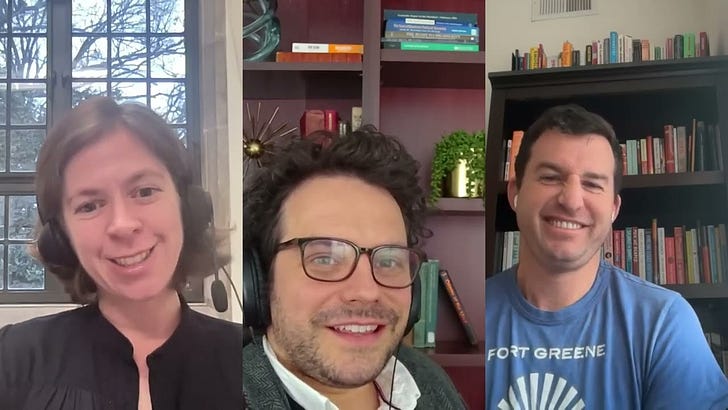

My colleague Oliver Traldi recently published an essay called ‘Jane Austen’s Virtuous Liberalism’. It’s a very nice discussion of the ways in which Austen understand the challenges of character formation.
Virtue, as Austen sees it, faces two tough challenges. First, people whose characters are not yet formed must see how to be virtuous rather than vicious. Then, the virtuous must somehow find a way to succeed in their struggles against the vicious without adopting vicious means.
In this episode, Oliver and I discussed Austen’s ideas of virtue, what that has to do with liberalism, the relationship between philosophy and literature more broadly, as well as poetry and ideas about the Great Books. We also talked about the Keira Knightly Pride and Prejudice. Yes, we both liked it. Here is why Oliver thinks Jane Austen is so popular among philosophers.
TRALDI: And so I do think that even though she’s not making arguments, she’s not laying out philosophical theories, there is a level of precision in her thinking about virtue, which I do think is something that it took me a little aback.
And I think it’s part of why—one person who quote-tweeted my article was Daniel Kodsi, who’s a friend of our colleague John Maier and his coauthor often. And he runs this magazine called The Philosophers’ Magazine, which I had written before. And Daniel quote-tweeted my article with something like, “Add Oliver to the list of all the philosophers who love Austen.”
OLIVER: And it’s a long list.
TRALDI: And I think it’s a long list. And I do think this precision is part of it that she does, that it is—again, it’s not like a philosophy journal article, but it is an intellectual sophistication that is often not present in novelists that we really appreciate.
And here is an extract about Austen, Smith, and the wonderfully fertile period at the end of the eighteen century.
TRALDI: But yes, I think it’s obvious—without knowing the background, I’m sure there are scholarly questions about, how much Smith did Austen read? And they’re both 250th—a lot was happening in 1775 and 1776.
OLIVER: Those were great years. Those were the good old days.
TRALDI: They were great years. In the great books syllabus, you get to the end of the 1700s and suddenly there’s this—you have Smith, you have Kant, you have the American Revolution, you have the French Revolution, you have Burke. Rousseau is right before, Montesquieu is right before. I mean, it was a real—
OLIVER: It’s a great time.
TRALDI: It was a great time. A lot was being done. And obviously, you know, I love the 1800s. I love the Romantics. But you could teach a whole great books course from 1750 to 1800, probably.
OLIVER: You’ve also got all the dictionaries and all that kind of work going on as well. It’s a very, very fertile—explorations.
TRALDI: Yes, yes. There’s all sorts of—yes, it was an amazing time.
OLIVER: So did you, having read these two, Austen and Smith, close together—
TRALDI: Yes, and I should say that my reading of Austen was much more careful than my reading of Smith.
OLIVER: Sure, but you wrote this before you read Smith.
TRALDI: Yes, absolutely.
OLIVER: Or at least you fully conceived it. Do you see a lot of Smith in Austen?
TRALDI: “A lot” might be—
This was my favourite bit.
TRALDI: Yes. But this is one of the great—I know we talked about this, but it’s one of the great—you see this in Smith, you see this in Austen—commerce has its own virtues, and they are very traditional virtues. You have to be trustworthy. You have to be pleasant. You can’t really be wholly self-interested in every moment because people have to be willing to deal with you given your—I mean, think about Yelp reviews or even just word of mouth. “Oh, that person screwed me over.”
OLIVER: There’s a discussion in one of Hayek’s papers, which is—it’s a very Smithian point he makes about, the nature of the knowledge problem means that it’s not so much that I’m trying to get information about the thing you’re trying to sell me, but I’m really trying to get information about you and whether you are someone I should be buying from. Which is exactly the project that the novelists and Smith—there’s a sort of period between Smith and the early novelists, running through Austen to George Eliot, when they’re all working on that problem together.
TRALDI: Yes. I do think in Austen, it’s often—the real puzzle is, how do you make out somebody else’s character?
OLIVER: Exactly.
TRALDI: This is a phrase that Lizzy Bennet does use with regard to Darcy. And how do we actually figure out who the trustworthy and untrustworthy people are?
OLIVER: And if you’re too philosophical about that, in the sort of analytic sense, I think you can end up not paying enough attention to the particulars of that question.
TRALDI: Yes.
OLIVER: Because when you actually try and do it, it’s really, really hard.
TRALDI: Yes. And I think this is the sort of—reading Austen, you get a sense of—and there are very few philosophy papers on things like this. Reading Austen, you get a sense of, what sorts of details in a normal life are the ones that I can extract information from to make out somebody else’s character?
Oliver is an analytical, political philosopher. You can find out more about his work here. Here he is on Twitter. His Substack is orting. You can watch the episode on YouTube here.
Transcript
HENRY OLIVER: Today I am talking to Oliver Traldi. Oliver is an assistant professor of philosophy at the University of Toledo in Ohio. He is my colleague on the Emerging Scholars Program at the Mercatus Center, and he’s written a book about political beliefs as well as many other articles for magazines, online.
He’s got a Substack. He’s maybe the most prominent political and epistemological young philosopher of his generation. [laughter] But most importantly for us, he is interested in Jane Austen and the idea of virtue. Oliver, welcome.
OLIVER TRALDI: Thank you so much for having me.
Reading Austen as a Philosopher
OLIVER: Let’s just start—before we get to this article you’ve written, tell me about being a philosopher but reading Jane Austen, because she’s often read and commented on by people who are not philosophers or who are only philosophers by acquaintance or whatever.
TRALDI: Right.
OLIVER: Is it different reading as a philosopher, do you think?
TRALDI: I think yes and no. One thing as a philosopher, there are—contemporary philosophy, we have very exacting standards of rigor and clarity. And when we look for a theory, we want something that’s been improved by hundreds of people and thousands of journal articles.
And so, if you were to simply extract a theory of virtue from a novel and say, “Does this—is this the end-all, be-all of moral thinking?” obviously you’re going to be disappointed. So I think as a philosopher, you have to look for other types of things, other types of sensitivities rather than logical sensitivity.
You have to say, how sensitive is the author to the different types of situations where people’s virtue can be exhibited or challenged? Or how sensitive is the author to the different types of pressures that a character’s convictions can be put under, or the different sorts of compromises that they might have to make, or the different sorts of people who might not be virtuous who they might have to interact with and sort of, you know, contract with or avoid? And what are going to be the impacts of different kinds of choices in those situations?
So the novelists, I think, tend—if they do it well, a novelist who’s interested in morality will understand living morally probably better than a philosopher, while maybe not understanding, say, arguments about whether morality supervenes on reality or vice versa, or what grounds morality, or different theories of meta-ethics or whatever.
OLIVER: I mean, there are obviously some novelists who do have a better appreciation of those things than others, we should say.
TRALDI: Yes, I think that’s absolutely true. And as I wrote in my article, I do think Austen in particular had an appreciation for this issue that you might call moral disarming or unilateral disarming. You know, does the moral person put themselves at a disadvantage relative to the immoral person? And then how do we actually help—how does morality survive?
So that’s a kind of philosophical question, but I tend to think—I taught last year—I think we’ve talked about this a bit. I taught in a great books program at Tulsa.
OLIVER: This is the Jennifer Frey program.
TRALDI: This is the ill-fated Jennifer Frey program. Jennifer—I don’t know if you’ve met her, but she’s an incredibly charismatic person. But somehow the program, despite being enormously successful, did not survive. You know, I was there for a year, and they decided that was long enough.
OLIVER: [laughs] You don’t think your arrival was the—
TRALDI: No, no. I hope not. I most certainly hope not.
OLIVER: No. General problems of higher education prevailed. Yes.
TRALDI: Yes, many, many problems of higher education these days. But yes, so I think—what was I saying?
OLIVER: Well, I think we’re getting to this question of, you are not just a philosopher; you teach the great books.
TRALDI: Right, exactly. The great books. That’s where I was. Yes.
Philosophy and the Great Books
OLIVER: So, one thing I’m interested in is that, you know, reading as a philosopher, you get a slightly different perspective on Austen. When you read other fiction, poetry, whatever, is there a benefit to you as a philosopher? Does it broaden you in some way?
TRALDI: Yes. I think absolutely, it’s broadening, but it’s also focusing in a different way. You know, contemporary philosophy is often described or captured with the word epicycles. So what we mean when we say epicycles is, you have some major theory, which is supposed to answer some big question. And then your career as a philosopher—you’re like three layers deep in the theory, in some sub-debate, and you’re making some really fine-grained distinctions.
And if you can make those distinctions successfully, you’ve had a really great career. But I think it’s easy to forget, why are we doing—you know, what attracted us to philosophy? Why are we doing this to begin with?
And the great novels, great books in general—one example I always use is the Book of Job. It doesn’t really—it’s not doing clear philosophy on the question of why do bad things happen to good people. But when you read it, you feel the question, why do bad things happen to good people? You get it, you know? You get why this is a question that people have worried about for thousands of years. You get why it calls out for an answer.
You know, there’s a lot of truth out there. I’m looking at a set of coat hangers, and I could count the coat hangers. But if you were given the decision, would I rather have an answer to how many coat hangers are across the room from me, or why do bad things happen to good people? You’d probably go with the latter one. There’s somehow some kind of depth or importance to that question, right?
And I think there’s—a great novelist can often generate some vividity to these questions. They can show how these questions are part of a good life, asking these questions, trying to have these questions answered—or a not-so-good life.
Certainly in Austen there are a lot of characters who learn to be more virtuous. Probably Emma is the clearest example. But you might also think of Marianne Dashwood. Really—
OLIVER: Lizzy Bennet.
TRALDI: Lizzy Bennet really learns to be a better person. I actually think her character is rather close to Emma in a lot of ways.
OLIVER: Yes, I think Emma’s sort of a clear rewrite of Lizzy in some—yes, yes.
TRALDI: Yes, and in some ways more evocative, actually. Yes. I mean, we can talk about all these books. But yes, I think there’s these things, even—obviously qua literature, they have other virtues, right? Which much philosophy doesn’t have; very little philosophy has the literary virtues.
But the philosophical virtue that a lot of literature does have is you see, okay, these are the—this is what a life is like. This is what making choices is like. These are the big questions when you decide how to live your life and what kinds of choices to make.
And I think Austen—these questions are all through Austen, even though nobody has to murder anybody in Austen. Nobody has to make decisions about war and peace or about, you know, civilizational decline or civilizational progress or anything like that. These people making these small choices in a lot of ways. But those are the lives that most of us lead. And when you read Austen, you think, “Oh, okay, there’s a virtuous and a vicious way to lead this kind of rather normal life.”
The Good Life
OLIVER: The question of what is a good life, or what is a good life in a commercial society, maybe, is the sort of bedrock of what she’s doing.
TRALDI: Yes, I think so. And that’s why I think Austen—you know, Austen wasn’t on our syllabus at Tulsa, but she was certainly discussed. And the “what is a good life” question—to me, it’s the big question that a great books program for college students should always come back to.
If I didn’t know what else to talk about, I would just say, “Well, we just read this book.” You know, we read these old biographies of Charlemagne from, like, Einhard—Notker the Stammerer and Einhard, his adopted son or whatever. I don’t remember. But this is like 800s. I’m sure you know more about this stuff than I do.
And I wasn’t quite sure what to do with them because what do I know about Charlemagne? So I just said, “Does it seem like Charlemagne lived a good life?” And you know, you’re off to the races. And I think that’s important at that age, because that’s the age at which—
OLIVER: For the undergraduates?
TRALDI: Yes. I think that’s the age at which you’re starting to make your own big decisions about what sort of life to lead. And I think for me, looking back to myself at that age, I think one thing I did wrong—at Tulsa I was in some ways as much a student as a teacher. I was rereading a lot of this stuff for the first time in decades. And some of it I was reading for the first time. As I told you, I was reading a lot of Austen for the first time for this essay.
OLIVER: Right, right.
TRALDI: And yes, it was stuff that I had thought about at a theoretical level, you know, like what are the ins and outs of this theory or this philosophical move or something like that. But you feel the question a bit differently when you’re like, “Okay, I’m an adult. I have to decide whether to live in this way or that way.”
The world is open to you. You could convert to Thomism [laughter] like so many have tried to have me do, or you could become a merchant after reading The Wealth of Nations. Or you could become a revolutionary after reading Marx, or you could become a Nietzschean. You know, there are all these choices open to you.
OLIVER: Please don’t become a Nietzchean.
TRALDI: No, no. That is, I’m a—
OLIVER: Keep your children out of school if that’s going to be the result. [laughs]
TRALDI: Yes. I’m a committed moralist, so I cannot, but he is—he made a comeback, that’s for sure.
Philosophy and Poetry
OLIVER: Now, there’s this obviously sort of long-running question in philosophy about, what is the relationship between philosophy and poetry? Are they antagonists, or are they in some way, you know, twins, and each provides one half of what is needed for a complete way of understanding the world? Do you have a position on this?
TRALDI: Yes, I mean, I think they’re what the kids call twinning.
OLIVER: Twinning? [laughs]
TRALDI: I think they’re twinning. No, no, I think that means something different. I think that means when you’re wearing the same outfit or something like that.
OLIVER: So we’re almost twinning with our stripes—yes, I see.
TRALDI: We’re almost. We actually—we are stripes and blue. Yes, we’re closer than I would’ve expected.
I would say closer to twins. There are a lot of claims that philosophy is at odds somehow with this or that. There’s also this—certain people will say, “Well, ever since Socrates, philosophy has been at odds with politics.” And a big part of philosophy is, how do you survive? Well, I don’t know. Nobody’s trying to kill me. I think of myself as a decently committed philosopher.
OLIVER: It seems to me this changed fundamentally in the Enlightenment and with the Romantics, and they see it all much more joined up. It’s a sort of ancient-and-modern dynamic.
TRALDI: Yes, there may be an ancient-and-modern distinction there. But yes, for me I don’t see any kind of contradiction. Now, there are—and I think this comes out of what I said before—philosophical attempts to understand poetry. And certain kinds of literary and aesthetic devices do sometimes fall a little flat.
The philosophical literature on metaphor, for instance—I think some theories of metaphor really don’t get why people use metaphors. [laughter] So one of the most important theories of metaphor is that they’re all just false, that it’s like everybody who uses a metaphor is lying. This isn’t the full theory. There are bells and whistles added.
OLIVER: Sure, sure.
TRALDI: But yes, so I think there’s no contradiction. But at the same time, they are different modes in some ways, and people who do the one are often trying to do something different than the other.
I do think that the desire for rigor and precision and clarity that philosophers have can be a little maddening to nonphilosophers, who see the pull of philosophical questions like, “What sort of life I should lead?” and then see, what do philosophers actually do?
And we’re doing all this modal logic and all these truth tables and all this very technical stuff that looks like math. And they say, “That can’t possibly be the right way to think about how to live.” And it’s true that there are these studies of—that suggest ethicists aren’t actually very good people and things like that, although you have to wonder what is the background ethical theory that went into evaluating them.
So yes, I don’t think there’s really a contradiction between philosophy and anything else. But certainly, there was a point in my life where I always come back to trying to write poetry and do poorly and then stop. But it was always something where I would say, “Okay, if I’m doing philosophy in the afternoon, I better wait till the evening to write poetry.” You have to sort of reboot and get into a different mode.
OLIVER: Iris Murdoch used to write philosophy in the morning and novels in the afternoon. That kind of thing.
TRALDI: Yes, I think that’s very sensible.
OLIVER: And she was upstairs for the one and downstairs for the other.
TRALDI: Yes. That’s even better, you know?
Favorite Poets
OLIVER: Which poets do you like?
TRALDI: Geez, I guess for an American, I like Wallace Stevens. I wasn’t expecting this question. For a Brit, you know, I actually like Philip Larkin a lot.
OLIVER: Oh, yes?
TRALDI: I know—what is the opinion of Larkin? Is he considered—
OLIVER: Very high.
TRALDI: Very high? Okay.
OLIVER: Some—there are some dissenters, but basically he’s the guy.
TRALDI: He’s the guy, okay. Yes.
OLIVER: Twentieth-century English poetry is like Auden, Larkin, Betjeman.
TRALDI: Yes, Auden is—actually, my friend Jane Cooper just wrote something about Auden.
OLIVER: Yes, Jane is excellent.
TRALDI: Yes, Jane is really great.
OLIVER: That was in the New Statesman if you want to look it up.
TRALDI: That was in the New Statesman. Yes, yes, yes. But Auden, I don’t know quite as well.
I mean, poetry is—I think it’s interesting the way that we receive poetry now. I think you were talking about this a few days ago, about things like poems appearing as inspirational quotes on social media or something like that, and whoever is the most quotable. And you felt like maybe Dostoevsky is very quotable.
OLIVER: Dostoevsky has a sort of screenshot quality.
TRALDI: Yes, yes.
OLIVER: As does Martin Amis.
TRALDI: Yes. So I—
OLIVER: Whereas Philip Larkin in a funny way—you know, he has very short poems. You can get the whole poem on Twitter. Like, Robert Frost has that. But something like “The Whitsun Weddings,” it’s quite hard to just take three lines out. The whole thing works as a—and that, so that poem gets less—
TRALDI: Yes. Which is what you would expect from a good poem, really, that it would form a kind of whole.
OLIVER: Exactly. If it’s a three-page ode, it should have a continuous quality.
TRALDI: Yes, it should have a kind of internal structure. Yes.
OLIVER: There are some one-line things and—but I think it’s notable that a poet like Wordsworth doesn’t seem to get a lot of social media play. And I think probably that’s one reason.
TRALDI: So yes, I think Larkin is somebody who, I did see some shorter references to him, and I thought I’d better just go and look up a ton of poems by this guy. And Stevens was the same way.
Death and Philip Larkin
OLIVER: So, which Larkin do you like?
TRALDI: You’re really putting me on the spot here. [laughter] It has been a little while.
OLIVER: I lied to you and said it would be about Jane Austen.
TRALDI: Yes, now I’m completely screwed. Well, he has a bunch about death. He has one where death is a ship following you. And he has one where death is, like, a fruit that gets picked or something.
OLIVER: Apple?
TRALDI: Might be an apple.
OLIVER: He decides not to throw the apple.
TRALDI: There’s one with sweetbreads in it. And now I’m really—
OLIVER: The ship one, “Next, Please”—that’s excellent.
TRALDI: Yes.
OLIVER: He sees the—it’s like hearing the music coming, and then the ship.
TRALDI: I forgot that that was the title. I forgot that that was the title.
OLIVER: And then as the ship goes past, it leaves nothing in its wake. It’s very sort of—very gloomy.
TRALDI: It’s very gloomy, yes. I think I read Larkin in a gloomy phase; it was like Larkin and Radiohead or something.
OLIVER: But he’s a good example of what you were saying before, that he won’t think propositionally. He’s logical in the sense that he’s sort of orderly, and he goes from one thing to the next. But he’s not being a philosopher.
TRALDI: No, of course. Yes.
OLIVER: But he’s very preoccupied with the sorts of questions that philosophers are probing, but has a sort of very meaningful treatment of them.
TRALDI: Yes.
OLIVER: And I think in a way, the sharp response that you want from the reader in those questions, Larkin is better at provoking than someone like Bertrand Russell or some other contemporary of his.
TRALDI: Yes, yes.
OLIVER: Bertrand Russell’s a bit earlier, but you know what I mean.
TRALDI: No, I think that’s exactly right. And I think that is why I’m a fan of the great books pedagogically and not—I don’t know if Larkin will be called a great, you know, like, who knows? I don’t really understand that designation, but tings like poetry and novels.
OLIVER: The biggest dissenter was Harold Bloom, who said Philip Larkin’s just a period piece. And he doesn’t understand why everyone likes him.
TRALDI: Oh, yes, well, I’m not on board with everything. Oh, I’ve also been—
OLIVER: No, you’re not very Bloomian.
TRALDI: I’m not very Bloomian, I don’t think.
OLIVER: Either Allan or Harold.
TRALDI: Yes. Well, I actually—this is very embarrassing, but I’ve actually never read The Closing of the American Mind, which I know is—
OLIVER: But why should you? I’m not sure it’s retained its—
TRALDI: Well, it’s certainly been received into my circle. But it is like a classic of anti-ideological—
OLIVER: Sure. Have you read Adler, How to Read a Book, that kind of great books stuff?
TRALDI: No. There’s so many things that I haven’t read. I mean, I’m just learning how to read. I learned how to read in Tulsa last year, [laughter] in Oklahoma, which is not where most people would go to learn how to read.
Jane Austen and the Problem of Morality
OLIVER: So let’s move to Jane Austen. Your thesis basically is, many moral theories face this problem that if I believe XYZ theory and you don’t believe it, you can get the advantage of me. Because I’ll always stick to my principles and you can just be a bad guy.
TRALDI: Yes.
OLIVER: So is morality screwed? This is what people say about liberalism. This is what you’re arguing. And you think Jane Austen’s got an answer to that?
TRALDI: Yes, I think she has a kind of answer. And again, one decision I had to make while writing the essay was, am I going to go super—this is a completely philosophically rigorous and respectable answer? Or am I just going to kind of sketch it?
OLIVER: Slum it in literary criticism? [laughter]
TRALDI: Yes, I wouldn’t put it quite that way, but—and I think I went for the latter, where I just wanted to kind of evoke the answer. And I think the answer has something to do with living in a large enough society where—and Austen I think is not the only person to give this answer. But you live in a large enough society where, when people see you acting well and somebody else acting poorly, the disadvantage that you have in that one interaction is outweighed by the advantages you have from the society that you gain from being seen to act well by many others.
So one thing I didn’t mention here, but a connection I made when I was first coming up with this idea, is that it’s actually a lot like what Martin Luther King Jr. says about civil disobedience. So he says, you might think, if you’re out there and the police are coming at you with bats, or the white supremacists are coming at you with bats or whatever, weapons or whatever, you might think, “I’m on the losing end of this interaction.”
But actually what will happen is that this interaction will be seen by many others. And you, by keeping your calm, will be seen to be the virtuous one, and they, by being violent, will be seen to be the vicious ones. And this can only help your political cause. I’m probably abstracting some of the details of King’s presentation.
OLIVER: In a vulgar sense, this is the sort of “be the change you want to see” approach.
TRALDI: Yes, but also, be the change you want other people to see. You know? Because that’s how it gets saved from—and again, one of the ways in which this is not quite philosophically rigorous is because the philosopher can say, “Well, what about an example where nobody’s going to see it? Or what about an example where the situation is set up that in doing the right thing, you’re perceived to have done the wrong thing?” And you get back into tough problems. And that’s why we have philosophy. You know, there’s always going to be these puzzles.
OLIVER: But we don’t get the—I think this is what the novelists are helpful for. We don’t get to set the conditions in our lives. You know, when you’re doing a philosophical problem, you can just say, “Well, these are the conditions. What happens then?” And what Jane Austen is so good at is saying, “I’m going to take her and drop her in this house, and that’s life. And she’s just going to—she won’t even know what the conditions are for a long time.” That’s the novelist’s preoccupation.
TRALDI: Yes. Yes. It’s interesting what you said about not even knowing what the conditions are. It’s one thing I love, which is there in, I think, a lot of Austen—and it’s done by a lot of my favorite novelists. I think Kazuo Ishiguro is really good at this. It’s just novels where you see the characters’ growing awareness of their circumstances and—
OLIVER: Like in Klara and the Sun or something.
TRALDI: Yes, or I think certainly in Never Let Me Go and in Remains of the Day, a lot of the action is in a situation where you understand what’s going on better than the characters do.
Clues and Games
TRALDI: And I think we talked about this the other day. In Austen, Emma, for example, is this sort of, like, halfway detective where she sees a lot of clues that could help her understand the nature of the life she’s leading and the circumstances she’s in, but she always misinterprets the clues. But on the other hand, it’s not like she misses them entirely. She’s kind of on the right track, and at least she’s trying.
OLIVER: And what I think Austen does so well in that book—I think it’s her most important book—is that by putting us, without quite realizing it, with Emma’s blinkers on, as it were, and only allowing our perspective to be her perspective, she makes us the detective.
But whereas in a detective novel, you know, there’s a funny little man and he is a detective, and he says, “Oh, there’s a clue in this novel,” the read of—on the first read very often goes straight past what they must later realize to be a clue. And that is such a normal condition of life, that, “Oh, actually, that was one of the conditions, but you couldn’t have known it. Sorry.” And you can only work it out in retrospect.
TRALDI: Yes. In modern love, these are sometimes called red flags. [laughter] I think it’s not quite a precise analogy, but yes, I think it’s right. And I certainly—I had read Emma years ago and didn’t really notice. As you say, on my first read, I didn’t really notice, even having watched—I think it was the, what is it, the Kate Beckinsale version maybe, from ITV in like 1996 or something.
It was really in reading it for this essay that I noticed that this feature that, starting on page 30 or 40 or so, there’s a—and they’re often in games. The clues are often in games. So very early on, Elton is playing some sort of poem game with Emma.
OLIVER: The riddles, yes.
TRALDI: The riddle game. And you know, Emma already misinterprets his riddles as being about Harriet rather than about her. But then there’s also—the riddles also have some relation to things that happen much later.
OLIVER: Then there’s the anagram game at the end.
TRALDI: There’s the anagram game at the end. Yes, it’s the—and I don’t think there are many games like that in any of the other Austen.
OLIVER: People play games, but we’re not taken into them and have them narrated in that way.
TRALDI: And they’re not word games in general. There’s card games and things like that. And you know, in Pride and Prejudice, Wickham has all these gambling debts and things like that.
OLIVER: Yes.
TRALDI: You know, in—I don’t know if you know Whit Stillman, but for the same magazine a couple years ago I wrote about Whit Stillman, who’s a sort of conservative filmmaker who’s a huge Austen fan and brings in Austenian themes to a lot of his movies, but writes them about characters in the 1960s and ’70s. And one of them was called The Last Days of Disco, for example, about—and some of the broader social themes he talks about are also there in Austen.
So one thing that was just on the edges of my consciousness as I read through the novels for this essay was the question of the noble man versus the working man, which I think is very present in Austen and has something to do with her conception of virtue: that the virtuous person will be engaging in commerce in some way.
OLIVER: Those moments of the noble and the virtuous man or whatever often take place in a shop, like the drapier in Emma or the jewelry shop in Sense and Sensibility.
TRALDI: That’s interesting. That’s interesting.
OLIVER: She’s very careful to take us into a commercial situation and contrast.
TRALDI: See, that is the sort of detail that I think a philosopher—I think we—the mere—the vibe of, “You’re in a shop, and this means something.” I think this is something philosophers are—we can watch for the action; we can judge the characters’ actions. But then there are these questions of atmosphere and milieu. And certain things happen in a shop; certain things happen at the seaside. In Persuasion there’s an injury by the seaside.
OLIVER: Yes. That’s one of the most exciting scenes in Austen. Very dramatic.
TRALDI: Yes, yes. I think actually Persuasion in some ways is quite different than her other books. It has a sort of—you know, in some ways it feels a little more like Frankenstein or Wuthering Heights at points. There’s a little bit of a windblown, dark quality to it at times. It’s a little bit bleaker. It’s a little hard to explain why, but that’s just a feeling that I had reading it that maybe had changed with some of the other literary tastes of the time.
Artlessness in Austen’s Heroines
OLIVER: Now, the quality that you focus on in the heroines, in this question of virtue defending itself against bad actors who break the rules, is artlessness.
TRALDI: Yes. So this is a term Austen uses quite a bit, and almost always, she very much picks and chooses the characters who are going to receive this term. And I thought that this is like—it’s not only her artless characters who face this question about how can morality survive, or how can virtue prevail, but I think they’re the limit point.
Like, if you really are unwilling to use—and I mentioned in the essay, when Darcy describes—I forget what; maybe it’s him describing how he found Lydia and Wickham, or it’s something to do with Wickham—he said, “I had to resort to arts.” So it must be, the “arts” back then means—one of the meanings of the term is dishonesty or subterfuge or something.
OLIVER: Yes, if someone was artful, it could have—
TRALDI: Yes, like the Artful Dodger.
OLIVER: Exactly. Could have negative connotations for sure.
TRALDI: Yes. And so the artless one, you know, they’re missing something.
So it’s the question of, if you view—morality in a way means you’re missing something, right? You’ve taken arts out of your arsenal. You’ve taken tools that could deal with certain situations, and you’ve just decided not to use them. So the question is, how can it be an advantage to have less tools?
You know, we’re here at Mercatus; the economists would tell you it’s never advantageous to have fewer choices, right? There’s no paradox of choice. It’s never advantageous to have fewer choices. And so I think this is the—if morality is a kind of unilateral disarmament, artlessness is the clearest case of that.
OLIVER: And you’re seeing that in Fanny Price, Elinor—
TRALDI: You see that in Fanny Price. You see that in Elinor. Harriet Smith is described as artless over and over again. And then there are these other characters who are described as artful, or other things that are mentioned as arts.
I think Harriet, in a lot of ways, is the one who’s most often described this way. And it’s interesting because you think of Emma changing a lot in Emma, but Knightley actually shifts in his evaluation of Harriet, who he thought of as sort of an unserious person. And Knightley himself comes to recognize her artlessness as a kind of seriousness which makes her a good match, not ultimately for him, but for his dude, Robert.
OLIVER: The farmer.
TRALDI: The farmer, yes.
OLIVER: He doesn’t change his view of her social position, though.
TRALDI: No, certainly not. But he does change his view of her character, basically. You know, her artlessness is not silliness. It has a sort of depth to it.
And yes, certainly Fanny. In the Whit Stillman movie Metropolitan that’s part of what set me on this, there’s this whole discussion of the book Mansfield Park and this old Lionel Trilling essay about it where he says, how is it—there’s this question about how modern people can even like Mansfield Park because we’ve sort of lost the notion of virtue being exciting or something.
One of the most provocative lines to me in Austen was in Sense and Sensibility where it says that Elinor glories in Edward’s integrity, which is an odd thing to glory in. You don’t glory—nobody is on Instagram showing off their integrity, you know?
OLIVER: It’s like that René Gerard quote people like to pass around: “Everyone is on diet pills and nobody wants to be a saint.”
TRALDI: I like that. That is very Instagrammable.
OLIVER: Exactly. Exactly.
TRALDI: That’s very good, actually. I like that. Yes, so there’s something provocative about the notion that virtue can be exciting, and in particular can be romantically exciting.
The Importance of Integrity
OLIVER: Or even less than that. One thing I think is difficult for people interpreting Austen today is that virtue, whether it’s exciting or romantically exciting, or the notion of integrity is of interest for its own sake.
There’s a lot of—you know, we have integrity as an organization. It’s very important for me to have integrity as a professional. But there’s not as much a sense of, just having integrity is the good life. We don’t need to be complicated about this. That’s just—you should just do that. And Austen’s very firm on that all the way through.
And criticism wants to pull her towards sometimes feminism, sometimes discussions of slavery, sometimes various other things. And she’s just constantly sort of resisting that by saying, “I like integrity. I like good people. I don’t think it’s that hard.” It’s a good line you’ve picked up on, I think.
TRALDI: There’s a character in The Wire who says, “A man’s gotta have a code.” I think he’s Omar, who murders the drug dealers and steals from them.
OLIVER: I haven’t seen it.
TRALDI: So he says, “A man’s gotta have a code.” And I think there is a—even in a character who in some ways is bad, we admire the integrity of having a code and sticking to it.
There is this debate, I guess in moral philosophy, or at least on the outskirts of moral philosophy, about, “Well, if your code is wrong, maybe it’s better not to stick to it.” I don’t share that perspective. I think part of the good life is holding yourself to certain standards. And if those standards turn out to be wrong, the holding yourself is still of moral value, right? Not allowing yourself—
OLIVER: It doesn’t mean they’re not adjustable.
TRALDI: Yes, no, of course. If you decide the standards are wrong, and in Austen—
OLIVER: It’s sort of implicit in the idea of having standards that you will be honest and therefore accept when your standards need to be improved or whatever. Right?
TRALDI: Yes, I think that’s absolutely right. And in Austen we certainly see people shifting their standards. And I think one thing that I—of course, modern readers and watchers of Austen do not quite understand some of these things. But I think in Pride and Prejudice in particular, we’re supposed to feel that Lizzy Bennet is quite hard on people and has to learn to improve herself in that way.
OLIVER: We’re delighted with her when she does that because we think it’s sassy.
TRALDI: Yes, exactly. If you go on YouTube, you can see all these, like, “Lizzy Bennet owning people’s lives for 50 minutes,” these compilations of clips from the various movies or whatever. And she’s obviously very, very clever.
But she realizes—after coming to understand who Wickham is and feeling that she might not have another chance with Darcy, she comes to realize that she has had certain prejudices, which have made her blind to the realities of the world and blind to what might be her best options.
So yes, I was saying I believe in integrity; that’s all I was saying. And integrity obviously is adjustable, but I tend to think that it’s better—even if the rule is wrong, it’s better for the person who has it to hold themselves to it, rather than to adjust to try to get an advantage.
And in philosophy, we have all sorts of terminology for these sorts of questions: “Are you an internalist or an externalist about reasons or about rules or whatever?” I think the more literary way to say it would just be that integrity is a virtue. And people should stick to their codes unless they see a good reason to change them.
Austen and Adam Smith
OLIVER: Now, you have recently been reading Adam Smith.
TRALDI: Yes, I did read a lot of Adam Smith for this debate we had last week. Although I did a poor job because I had forgotten that the debate was about whether Smith was a philosopher or an economist. [laughter] I thought it was simply, is he a philosopher or not? So I put myself in the odd position of arguing that Adam Smith is not an economist.
But yes, I think it’s obvious—without knowing the background, I’m sure there are scholarly questions about, how much Smith did Austen read? And they’re both 250th—a lot was happening in 1775 and 1776.
OLIVER: Those were great years. Those were the good old days.
TRALDI: They were great years. In the great books syllabus, you get to the end of the 1700s and suddenly there’s this—you have Smith, you have Kant, you have the American Revolution, you have the French Revolution, you have Burke. Rousseau is right before, Montesquieu is right before. I mean, it was a real—
OLIVER: It’s a great time.
TRALDI: It was a great time. A lot was being done. And obviously, you know, I love the 1800s. I love the Romantics. But you could teach a whole great books course from 1750 to 1800, probably.
OLIVER: You’ve also got all the dictionaries and all that kind of work going on as well. It’s a very, very fertile—explorations.
TRALDI: Yes, yes. There’s all sorts of—yes, it was an amazing time.
OLIVER: So did you, having read these two, Austen and Smith, close together—
TRALDI: Yes, and I should say that my reading of Austen was much more careful than my reading of Smith.
OLIVER: Sure, but you wrote this before you read Smith.
TRALDI: Yes, absolutely.
OLIVER: Or at least you fully conceived it. Do you see a lot of Smith in Austen?
TRALDI: “A lot” might be—
OLIVER: Primarily from Theory of Moral Sentiments.
TRALDI: So I would say that the notion of sympathy as being fundamentally part of how you recognize a good person seems to me to be there in Austen. The characters are—
OLIVER: And this is the thing about awareness of other people and learning from that awareness.
TRALDI: Awareness of other people and learning from other people and feeling other people’s emotions. One thing that is related to sympathy in an odd way—and I think actually Austen and Smith conceive of it a bit differently, but that is there for both of them, in particular in Sense and Sensibility—is this notion of self-control or self-command.
OLIVER: Self command. Yes. Yes.
The Importance of Self-Command
TRALDI: Now, Smith gives a really odd argument about self command, which is that if you don’t have control over your emotions, you will end up feeling or expressing something that other people can’t sympathize with. And this is bad because sympathy is good, or something like that. I actually think it’s a rather confused argument.
OLIVER: I think what he’s saying is that if you display a lack of self-command, then no matter what you are feeling, people find it difficult to deal with that sort of uncontrolled behavior. It’s not the particular expression of feeling; it’s the fact that you are a little unstable or—
TRALDI: Yes, I think that’s right.
OLIVER: —a bit extra.
TRALDI: I think what Smith doesn’t do is explain quite how that’s bad. But what I think is that actually, in Sense and Sensibility, it’s a little bit the reverse, where actually Elinor and their mother, they do sympathize with Marianne. They do feel what she’s feeling after—who’s the other, the w guy in Sense and Sensibility? They’re all w’s.
OLIVER: Oh, Willoughby.
TRALDI: Willoughby, right, right. Not Wickham, Willoughby. When Willoughby—
OLIVER: You can just say “the cad.”
TRALDI: The cad. There’s always a cad. So when the cad leaves, Marianne has all these emotions, and you really feel them. And Marianne also has a lack of self-command when Willoughby is there. There’s this whole episode, which I didn’t quite make the most of but felt very important, where they go to the house of this woman. They just sort of barge into this house, Willoughby and Marianne.
And this is really supposed to show something about the relationship. If you and your partner barge into somebody’s house, it can’t be a good relationship somehow because it’s leading you into bad actions. That’s my sense of what that episode is supposed to show from the highest possible remove.
OLIVER: I think, yes, and I think there are several other instances of that: when they ride in the carriage together, unaccompanied.
TRALDI: Right, right.
OLIVER: And there’s a sort of general consternation about this. And Marianne sort of says, “Oh, well, how can it be a problem?” And they—part of the consternation is, you’re breaking the rules in a very flagrant way, but also that you are assuming that it’s okay because you’ll get married. And this assumption is a very big one.
TRALDI: Yes. And obviously there is this assumption that—she doesn’t recognize quite how—she thinks her position is much more secure than it actually is, which is how it turns out in the book. But I think we’re supposed to think that even if she were right about Willoughby’s affection, which in a sense, she—Willoughby—
OLIVER: No. Even if they do get married, she’s broken the rules in a way that—
TRALDI: She’s broken certain rules in a way that is—but I think what’s different from Smith is, there is sympathy from her family even though she lacks self-command. But that is precisely—so it’s sort of a different theory of why self-command is good. It’s precisely because her emotional state is actually draining for her family.
And then Elinor says—when she learns that Elinor has actually been going through something—
OLIVER: The same.
TRALDI: —very similar, and maybe even rougher, in this whole thing with Lucy Steele telling her about this, you know, blah, blah, blah.
OLIVER: Which is a beautiful name—to steal. I mean, it’s great.
TRALDI: It’s an amazing—honestly, in some ways Sense and Sensibility may have been my favorite. I think it’s just lovely.
OLIVER: If I just wanted to just read one for fun, that’s what I go to. I do, yes.
TRALDI: Yes. And there’s a lot—none of these things are quite perfectly in there. But I think honestly, everything that’s in the other novels has a little part to play in Sense and Sensibility. You know, I think if I were to recommend just one, if somebody was like, “I have time for just one,” I might recommend Sense and Sensibility.
But in the end, Marianne says—again, it’s one of these amazingly evocative lines. Elinor says, “You didn’t act that badly. Do you compare your conduct with Willoughby’s?” And she says, “No, I compare it with—Elinor, I compare it with your conduct. You have this self-command.”
And it’s precisely the fact—it’s not—and I think this is why philosophers do like Austen, because it’s not—it’s still literary, but there is a precision to her moral evaluations. It’s precisely the fact that Elinor knew that her family loved her and didn’t want to burden—it’s all quite conscious. She didn’t want to burden her family with her emotions. But you actually see that Elinor has this family trait of having very strong sentiment, which Marianne does, and simply also has this virtue of self-command.
And that is—there are film adaptations and TV adaptations that demonstrate self-command, but it’s a very hard thing to film. It’s something you feel inside. It’s a very hard—the actors have to be very good for you to see—you see pieces of it in some of the adaptations of Persuasion and some of the adaptations of Sense and Sensibility, but self-command is very hard to find.
Austen Adaptations
OLIVER: Which adaptations do you like the best?
TRALDI: I’m forgetting—I often like the long ones that I think were for the British ITV. So I like the—I think Kate Beckinsale was in the Emma one. Although I think there was one of Persuasion, which was also quite good. I like the one of Northanger Abbey. I don’t think it’s that good, but it’s kind of cute, which I think it’s probably the cutest of her long novels.
Whit Stillman did a very loose adaptation of Lady Susan, which is hilariously funny at times, and also has Kate Beckinsale and some other great actors in it.
OLIVER: Did you see the new Persuasion on Netflix a couple of years ago?
TRALDI: No. No.
OLIVER: It has that—is it Dakota Johnson, the actress, who’s famous for other non-Austenian—Fifty Shades of Grey or whatever.
TRALDI: Yes, and isn’t she one of the Avengers or something like that?
OLIVER: Something like that. But everyone was very upset that it was this terrible adaptation.
TRALDI: Oh, yes.
OLIVER: Didn’t—it sort of killed all of Austen’s words. She looks at the camera; she drinks from the bottle. I actually thought it was quite fun. On the basis that all adaptations are bad—
TRALDI: I think if you allow some looseness, it can be quite fun. So for example, the 2005 Pride and Prejudice, I think if you’re just sort of like, “Well, this is just somebody who was inspired by Pride and Prejudice,” you can have a lot of fun with the movie.
OLIVER: I think as an interpretation of the book, that film is quite bad.
TRALDI: Oh, yes. I think it’s absolutely missing the mark.
OLIVER: But in terms of like, the countryside and the house and the geese and the food, it’s fantastic.
TRALDI: Oh, yes. It’s lovely to look at.
OLIVER: The dresses, right? The clothes are amazing.
TRALDI: And a lot of the—and the cast is honestly like—
OLIVER: Yes, it’s great.
TRALDI: The cast is really, really great. And the parts as they are—
OLIVER: Rosamund Pike is maybe the best Jane on TV.
TRALDI: She’s terrific. And who’s the one who plays Kitty?
OLIVER: Yes.
TRALDI: Who is in—and the father is the guy from The Hunger Games. I forget his name, but I think the father is excellent in that. But of course, it’s not exactly the father from Austen.
OLIVER: No, no, no.
TRALDI: But as a movie itself—but yes, I like a lot of these longer TV versions.
One odd thing—they make these choices. So there is some scholarly apparatus brought to bear on some of them. So I think maybe it’s Persuasion that there were multiple versions of, and some of the adaptations use pieces from the unpublished version, which are interesting. And as I was reading it, I had to Google around a bit and figure out these things.
Austen’s Moral Precision
TRALDI: I was going to say about Austen’s moral precision, the other place where I think this comes in—and I wrote a bit about this in the essay—is near the end of Mansfield Park, when—the names are what I’m worst at—when Edmund, right, is finally disillusioned with—
OLIVER: Mary.
TRALDI: With Mary Crawford?
OLIVER: Mm-hmm.
TRALDI: It’s because there was this affair. There’s always a sibling or a cousin who makes some horrible mistake, you know? So there was this affair, and Mary Crawford can only criticize it by saying that they weren’t very prudent, you know, in prudential terms. They took a big risk. They made a bad decision. You know, they really screwed themselves over.
OLIVER: They could have made it work. Yes.
TRALDI: Yes. And Edmund realizes that she lacks moral fervor because he thinks the appropriate criticism should be a moral one. And as a psychological matter, it shouldn’t even enter your head, I think is the idea. I’m extrapolating a bit, but if you see somebody acting this badly, to then say, “Well, geez, you’re doing something that isn’t in your interest”—for that to be your first thought indicates that your priorities are highly misplaced in a way that, to him, is quite unattractive.
And this also struck me as a moment of—this is something we philosophers talk about. What is the distinction between prudence and morality? They both tell you what you should do, in some sense, but there’s different—the shoulds have different forces, right? So Edmund has a certain moral precision and sensitivity which, actually, Fanny is basically the only person he knows—not that everybody in the house is a bad person; his father is a decent guy, and one of the aunts is okay, I think.
But yes, there’s a real sophistication to this evaluation. And it’s funny to me that she actually used this as the—I mean, I suspect that even at the time there were readers who were just like, “Wait, I really don’t get what the nature of Edmund’s problem is here,” because it’s not like Mary—Mary’s not like, “Oh, yes, I support infidelity.” You know? She’s not like— it’s if you blinked, you might miss it, the mistake that Mary has made.
And so I do think that even though she’s not making arguments, she’s not laying out philosophical theories, there is a level of precision in her thinking about virtue, which I do think is something that it took me a little aback.
And I think it’s part of why—one person who quote-tweeted my article was Daniel Kodsi, who’s a friend of our colleague John Maier and his coauthor often. And he runs this magazine called The Philosophers’ Magazine, which I had written before. And Daniel quote-tweeted my article with something like, “Add Oliver to the list of all the philosophers who love Austen.”
OLIVER: And it’s a long list.
TRALDI: And I think it’s a long list. And I do think this precision is part of it that she does, that it is—again, it’s not like a philosophy journal article, but it is an intellectual sophistication that is often not present in novelists that we really appreciate.
Every Word Matters
OLIVER: I mean, one way people talk about the great books is to say that every word matters. And a lot of novelists will say that about their own. Well, you know, Elizabeth Bowen used to say, “What you’re doing is to make everything count.” Austen is one of the examples where it’s actually true. Every word is being used carefully.
TRALDI: Yes. It’s funny, this bears on another Twitter argument I had recently about this phrase logographic necessity. Basically, every word in a great book is there for a reason. I think that’s right. Although you have to be careful about—if you were to say, “Well, every word in Plato is there for a reason, so you can’t really say he’s wrong about every—” you would be kind of abandoning the philosophical mission.
OLIVER: I mean it in the sense of what you might call the artistic or structural integrity of the book. Not everything has to tell in the meaning sense. But it all holds as a unit for some—
TRALDI: Yes. I think everything is there—there is what we could call an internal reason for everything to be there. Everything is there to hold together—
OLIVER: Like the making of a piece of furniture or something.
TRALDI: And I think you hear—I think this is one thing that—and not all classical music, but I think it’s one thing that distinguishes classical music even from very good contemporary pop music or jazz or rock music, is that you have this sense of, “Yes, every note I hear basically is holding up a larger structure of some sort.”
OLIVER: Yes. And Jane Austen is very Mozart in that way.
TRALDI: Yes, I think that’s right. Yes.
Austen’s Place in Great Books Programs
OLIVER: So should Jane Austen have a bigger place on great books programs, based on all these things you’ve said about her?
TRALDI: Yes, this is—so, there was actually a debate—I did not write the piece in response to this debate, but this is—
OLIVER: Tanner Greer.
TRALDI: Yes, there was—Tanner Greer weighed in on this, and my friend Circe. I think—
OLIVER: I think they’re just desperately wrong.
TRALDI: You think they don’t—that she—
OLIVER: I think Emma is obviously a book that should be on one of these syllabuses. Maybe Sense and Sensibility.
TRALDI: Yes. I think the ones I would consider are Emma, Sense and Sensibility, Mansfield Park. I do think they’re actually longer than I realized, which is always—I mean, there are these very practical concerns with putting together a syllabus.
OLIVER: Sure, sure. Although I want to ask you about that, because my response to a lot of these debates, which is maybe just because of where I studied, but just make them read more. And if they don’t do the reading, that’s their, you know—
TRALDI: That’s true. Well, I don’t want to get into this too much. We already make them read a lot compared to—so for example, a year ago, I had my students read two novels in a week, which is more than most courses make college students read.
OLIVER: But that’s by no means unreasonable.
TRALDI: No, no, of course, of course.
OLIVER: You know.
TRALDI: Well, exigencies of the teenage mind aside—
OLIVER: Because I often think this, when people debate how things should be taught and why it’s so important to keep these programs, and they’ll talk about the importance of writing essays. And then it turns out the students maybe write one essay a semester. And I sort of think, well, who cares? All this rhetoric for one essay.
TRALDI: Yes. I don’t know if I’m really ever going to assign essays again. It just is—the age of AI is upon us.
OLIVER: Sure. But you see what I mean.
TRALDI: No, yes, I know exactly what you mean. And I do think reading a lot is the main part of—and certainly, you know, when I read all seven of these in two weeks, that’s much more reading than I normally do, as well, to write this essay.
OLIVER: But you didn’t have to lie on the sofa afterwards with a cold compress. You were fine.
TRALDI: In a way it was a really good two weeks. If you get to read—I mean, this is why we have good lives, right? If you get to read Jane Austen and you call that work, it’s a nice life.
OLIVER: So yes, will you be putting Emma on your program?
TRALDI: I would definitely consider Emma. I would definitely consider Sense and Sensibility. I would consider Mansfield Park. I think these are the ones that have—the moral element is very prominent. But it’s obviously there in all of her books.
OLIVER: You can have a really good moral discussion about Mansfield Park, which is a bigger, broader thing than Pride and Prejudice, for example.
TRALDI: Yes, I think so. I would definitely consider—in the 1800s there were—obviously the British novel of the 1800s was a big deal, and there’s—
OLIVER: [laughs] We did quite well, yes.
TRALDI: You all did quite well. So the ones we did at Tulsa—we had Frankenstein and Wuthering Heights and The Picture of Dorian Gray. And then we had one Irish, The Portrait of the Artist as a Young Man. And I don’t think anybody—if you replaced one of those with Emma or Mansfield Park, I don’t think anybody would say, “Oh, you made a horrible call.”
OLIVER: I think Tanner’s point was that you simply don’t have that many slots for an English novel that deals with these sorts of ideas, and that it should obviously be Middlemarch because that is the bigger novel. It’s about bigger questions of society. It’s about the whole—it’s got more greatness in it, whereas Austen is sort of more about the individual.
TRALDI: So I do think that this question of greatness—I think there are some people who read Austen and they think, “Well, this is—obviously it has all these sorts of themes, but it’s not great. It has this littleness to it. It has this smallness to it.”
OLIVER: It’s domestic.
TRALDI: That is not my reading of it. I think if that’s the question, I don’t feel that way. I think it pulls out these great themes about the nature of virtue and the nature of moral learning, becoming a better person, the nature of love. We read Sappho. We read the Symposium.
To me, you read Wuthering Heights and you say, “Oh, this is a really big book because it’s about society and how trauma gets passed down, and it has these horror elements, and it’s very dark.” But actually, it’s quite hard to figure out, how do we turn Wuthering Heights in a discussion about how to live? With Austen, it’s just completely straightforward.
OLIVER: [laughs] How not to live, maybe.
TRALDI: Yes. In Austen, it’s just completely straightforward. This is the discussion. This is what she had in mind as well, this question of how to live. So to me, Austen is completely—in terms of her successes as an artist, she belongs. In terms of her themes, she belongs. So I would not rule her out. I think she is absolutely a great, and who knows what that means, but I think she would be completely appropriate on any of these syllabi.
Reading Plans
OLIVER: Very good. And what will you read next?
TRALDI: What will I read next? I mean, our—from the beginning, I’m thinking I should read some more poetry. It’s been a while. Actually, speaking of—this is funny. Well, I want to get into William Empson. He had an odd life, which I think somebody should do like a movie about him or something.
OLIVER: Yes, he’d make a great movie.
TRALDI: I think Empson would be a good movie. So that might be—
OLIVER: Are you going to read the poems or the criticism?
TRALDI: Probably a little of both, but that’s for a while from now. I think, you know, at the moment I’m back to reading philosophy. So what novel will I read next? That’s a good question. What should I read next?
OLIVER: If you like Jane Austen?
TRALDI: Yes.
OLIVER: Maybe read one of the people that she admired, like Samuel Richardson or Fanny Burney, someone like that.
TRALDI: You know, I do think—you saying Samuel Richardson reminded me, I’ve read very little Samuel Johnson. I think reading some of the great critics, I think, writing this piece—
OLIVER: Oh, Johnson, yes. You would like Johnson.
TRALDI: I think I would like Johnson. I think I would like Empson. The history of literary criticism is something I have very, very little idea of.
OLIVER: Oh, well, then, Johnson. I mean, he’s the best.
TRALDI: Yes, I think I should, I should definitely read Johnson.
OLIVER: English literary criticism begins and ends with Samuel Johnson.
TRALDI: You know what, this is a little different, but—I might have talked about this with you a little bit—I want to read The Fable of the Bees, Mandeville, because reading about Smith—a lot of the ideas that we think of as Smithian are actually Mandevillian, and he kind of moderated them.
OLIVER: Well, he hated Mandeville.
TRALDI: Yes.
OLIVER: Very hard on him.
TRALDI: Yes. So a lot—like the invisible hand, it’s only a small part of Smith’s thinking, but it was like the entirety of Mandeville’s thinking, this sort of dynamic.
OLIVER: Well, I think it means different things for them. I think Mandeville, in a funny way, is more philosophical in the sense you were saying, and trying to make these propositions. And Smith was saying, “Well, what about feelings? What about all these funny things that we can’t account for? Like, look around. It’s too messy.”
TRALDI: No, that makes sense to me. Yes, I think between Mandeville and Smith, Mandeville is somebody who thought virtue was sort of like a con.
OLIVER: A fool’s game.
TRALDI: Exactly. You’re sort of a sucker if you try to be virtuous.
OLIVER: I think he also just assumed that if you were commercial, you were obviously on the get.
TRALDI: Yes. But this is one of the great—I know we talked about this, but it’s one of the great—you see this in Smith, you see this in Austen—commerce has its own virtues, and they are very traditional virtues. You have to be trustworthy. You have to be pleasant. You can’t really be wholly self-interested in every moment because people have to be willing to deal with you given your—I mean, think about Yelp reviews or even just word of mouth. “Oh, that person screwed me over.”
OLIVER: There’s a discussion in one of Hayek’s papers, which is—it’s a very Smithian point he makes about, the nature of the knowledge problem means that it’s not so much that I’m trying to get information about the thing you’re trying to sell me, but I’m really trying to get information about you and whether you are someone I should be buying from. Which is exactly the project that the novelists and Smith—there’s a sort of period between Smith and the early novelists, running through Austen to George Eliot, when they’re all working on that problem together.
TRALDI: Yes. I do think in Austen, it’s often—the real puzzle is, how do you make out somebody else’s character?
OLIVER: Exactly.
TRALDI: This is a phrase that Lizzy Bennet does use with regard to Darcy. And how do we actually figure out who the trustworthy and untrustworthy people are?
OLIVER: And if you’re too philosophical about that, in the sort of analytic sense, I think you can end up not paying enough attention to the particulars of that question.
TRALDI: Yes.
OLIVER: Because when you actually try and do it, it’s really, really hard.
TRALDI: Yes. And I think this is the sort of—reading Austen, you get a sense of—and there are very few philosophy papers on things like this. Reading Austen, you get a sense of, what sorts of details in a normal life are the ones that I can extract information from to make out somebody else’s character?
In philosophy, we do ask, what is a good character and what is the good action in this sort of situation? What is the bad action in this sort of situation? But it’s not for the philosopher to say, “Okay, in the sorts of situations you’re likely to be in, what do you pay—where do you direct your attention to try to figure out these things about?”
And it’s not—I don’t think Austen—it’s not super subtle either. In Persuasion—I mentioned in the essay—in Persuasion, it starts out by saying Anne really cared about paying off the family’s debts, and the rest of her family didn’t give a shit, you know? And it’s sort of like, okay, so we just immediately are like, Anne’s the sort of person who you might want to have a business transaction with because if she has a debt to you, she might actually pay it. And I forget if that’s the exact detail, but it’s something like that, you know?
OLIVER: And there’s also the novelist—Jane Austen is very good at what you don’t see, which again, is not always something easy for philosophy to handle. But it’s very important, I think, that even though this novel is supposed to be about Anne, she doesn’t appear—she’s mentioned in passing in the first chapter, and she doesn’t actually appear until the next chapter.
And you’re, I think, supposed to become aware of the fact that she’s treated in that way, and she’s seen in that way, through her—and there are a lot of these absences. The carpenter in Mansfield Park who builds the theater stage, he never actually comes onto the page. They mention him, but he’s never in the room.
And there’s a sense of that in Pride and Prejudice with Mary. We’re very aware when she quotes a sermon and everyone laughs, but she’s actually always there, on the margin. And occasionally Austen reminds us, “Oh, poor Mary couldn’t deal with the party, couldn’t—” And I think you’re supposed to try and keep in mind, Poor Mary is here for this scene. And we are forgetting. And this is another interesting way she explores these ideas.
TRALDI: Yes, I definitely felt in the beginning of Persuasion, this is the longest that it takes for a main character to be introduced.
The Fates of the Bennet Sisters
TRALDI: What is your view of Mary? Because they’re making this show called The Other Bennet Sister about Mary.
OLIVER: Oh, yes. [laughs]
TRALDI: I feel like Mary—you are supposed to feel sorry for her, but you’re you’re also not—I don’t think she’s supposed to be thought of as a super virtuous character herself.
OLIVER: No. No, no, no. My view of Austen is that all of her novels are about moral education or the development of virtue, or whatever you want to call it. They’re basically structured as quests. And Austen is engaged with the culture wars of her times, and she’s offering an alternative way of thinking about it.
So rather than the sort of sermons, op-eds, and all this war of pen and ink that’s going on, she’s trying to do something sort of philosophical, but more literary, and to tend to say, “Look, you’ve got to turn away from these arguments and sides. You have to go out into the world and figure it out.”
So Lizzy Bennet never comes to the proper realizations of herself and Darcy and everyone until she gets in her carriage and drives around Derbyshire and talks to a servant and sort of goes on that journey into the unknown. And we’re told very clearly at the end, Lizzy and Jane get married, happy ever after. Lydia is in perpetual “quest,” quote unquote, for security and nice lodging. And she never finds it. They just have to live in perpetual quest. I think that’s very telling.
Kitty goes to live with her elder sisters, and Austen says it does her the world of good. She doesn’t turn out like Lydia after all. She gets brought up properly when she goes away from home. And Mary, because she’s now left on her own, has room to flourish, and she goes out with her mother and she socializes. And she finds it awkward, and her mother’s quite embarrassing, but actually it’s the best thing that ever happened to her.
And just like Smith says, and just like Austen says, you can only learn these things in real life, in practice. That’s what Mary’s missing. And she’s there always as a reminder that the Mr. Collins culture wars approach, that can also happen to you just as a bookish nerd staying at home. It’s what happens to Mr. Bennet. And in a way, there is a novel to be written about her, but it’s picking up from the very—almost on the last page when she tells us—
TRALDI: Yes, that’s interesting. That’s a very—
OLIVER: It’s a great detail.
TRALDI: No, that’s a very compelling interpretation of the fate of the sisters at the end. I think that’s completely convincing.
Commercial Virtues
TRALDI: There was one thing—and I know this is sort of repeating something, and I know you were trying to wrap up, so I’m happy to wrap up whenever. But you talked about Lizzy talking to the servants. I think it’s very important that you see the impression that Lizzy gets from the servants, who are people who Darcy deals with in a commercial way.
These are the people who he has commercial relationships with, but they’re also warm commercial relationships. And this is contrasted with—she learns Wickham has actually built up all these gambling debts, right? You learn these characters, but the characters have something to do with, how do these people deal with the people who they have to transact with?
And I think that sort of resolves the—there’s this question of, should we be transactional? Is Austen telling us to be transactional about love and marriage? In a sense, yes, but that’s not a cold transactionalism. It’s not the way we would—it’s not the negative sense of being transactional that we would normally—
OLIVER: Right, right, right.
TRALDI: These days, if you say, “Well, that woman is transactional about her relationships,” it means the opposite of what people like Smith and Austen think we should be in our commercial relationships, right?
OLIVER: Brings this out beautifully in Sense and Sensibility in the jewelry shop. Do you remember this? Elinor goes in because she has to sell some of her mother’s old jewels to try and eke out their income. And she’s there to bargain. She’s going to try and get a good price because she needs—another 10 pounds is really important to her.
TRALDI: Yes, yes.
OLIVER: Her brother John, because they’re in London, comes in coincidentally and says, “Oh, you’re here. What are you doing here? Woo woo woo,” and just goes up, pays the price, and takes the jewels off to his wife. And it’s almost like Jeeves and Wooster. He’s the idiot, aristocratic, sort of gullible, no commercial sense, no haggling at all.
And then there’s the fussy old man with his toothpick case. “Do I want a pearl inlaid here? Maybe I want the pearl down there.” And Elinor is made to wait for 20 minutes, and Austen says something like, “until the man decided that he could live until next Wednesday when the pearls would be properly embedded.” And I think she’s showing us these Smithian distinctions between ways of being commercial, ways of having transactions.
And Elinor comes out of that very honest, very straightforward, very virtuous in her commerciality, and the other two are sort of greedy, myopic—
TRALDI: I mean, I do think certainly Sense and Sensibility—obviously these families, there’s always something hanging over every family in Austen. And in Sense and Sensibility, it’s the unwillingness of the brother and his wife to support—I mean, I forget the details of the family relationships, but to support Elinor and Marianne.
OLIVER: That’s right. I can’t remember if they’re stepsiblings or half-siblings. So he’s inherited all the money. They’re stepsiblings, I think. And his father said, “Look after the girls.” And the wife talks him down from giving them, I can’t remember, 200 a year to the occasional 10 pounds.
TRALDI: It’s talked down; it gets cut to like 20 percent or something of the original.
OLIVER: Oh, it’s cut to, “Do it at your own discretion.” So the poor women are left on their meager income.
TRALDI: Yes. Yes. And it’s shown that, like Anne, Elinor is really the only one who is sensible enough to deal with these new circumstances.
OLIVER: Has any household economy. Yes. Exactly. So these commercial virtues are in the home. They’re in the shop.
TRALDI: Yes.
OLIVER: Yes, exactly. So Oliver’s essay was published in Fusion. It is called “Jane Austen’s Virtuous Liberalism.” You can go and read it. And Oliver, thank you very much. This was great.
TRALDI: Thank you so much for having me. This was a lot of fun.