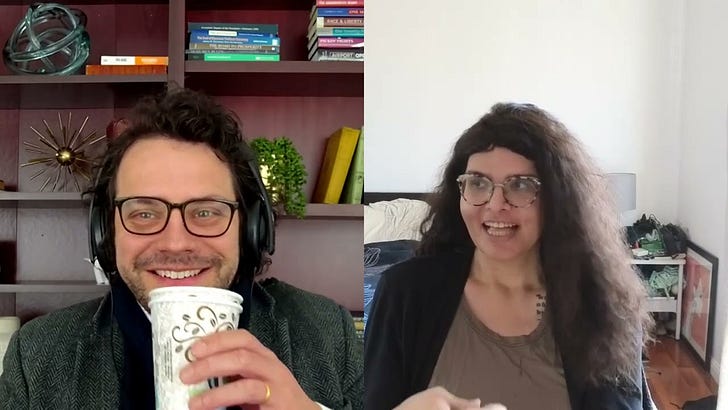

Philip Hensher and I discussed the history of the novel in Britain from Defoe to Hollinghurst. Philip is remarkably well-read and happy to share his real opinions. He can go from Swift to Fitzgerald on the turn of a pin, isn’t shy about holding his ground, and has some very firm views. People who read novels are protected against becoming violent. Ideas are not important in most novels. Walter Scott isn’t very good. Arnold Bennett is a top 20 novelist. Rachel Cusk has the best chance of being read in 100 years. That sort of thing. Here’s one exchange where we disagreed about what a novel is.
HENSHER: Oh, Henry, Henry, how can you kill a book like that? How can you—
OLIVER: Look, you can’t have Jane Austen without the Enlightenment, and you can’t have George Eliot without the secularization of Jesus, and you can’t have Tolstoy without all the slightly incredible things that he believed.
HENSHER: No, let’s not talk about Tolstoy.
OLIVER: No, but the list goes on, right? Henry James even, who is often called a man of no ideas, he’s an incredibly good liberal. He might be the best novelist about the liberal idea that one person should not be allowed to dominate over another, in private conditions rather than just government. These ideas are, in a way, they’re the thing that distinguish those writers. Jane Austen knows how to observe and how to present because she’s thinking about what it means underneath.
HENSHER: I don’t know. I don’t know about that.
OLIVER: I don’t even think you can have Middlemarch without John Stuart Mill’s political economy, in a way.
HENSHER: Yes, that’s probably true. But George Eliot’s an unusual sort of novelist.
Jane Austen, I mean, how do we know what did she—what did Jane Austen think about slavery in the boldest and most extreme form? I think we can deduce that she thought that people involved in the slave trade or who came near it, like Mrs. Elton, were not at all the sort of people that she would altogether like to hang out with. I think the same is true of Sir Thomas Bertram, and the weakness of his imagination is somehow tied in with the fact that he has a plantation where he doesn’t really think about the people that it affects.
But already we’re into speculation. I don’t know what we can really deduce about Jane Austen’s idea, because she’s such a polyphonic novelist that we don’t find an idea being put forward without being able to find a character who’s saying the exact opposite. And sometimes one side of the argument is eventually dismissed, but not always, I think.
I said this at the conference we had a discussion with. I think that when you boil a novel down to its absolute irreducible essentials, I think what you have is not a proposal or a view of society or anything like that. It’s Charles Pooter painting his bath red, or the moment in Ivy Compton-Burnett’s Mother and Son when the son irrevocably falls out with his mother by telling her that he doesn’t want to have sugar in his tea anymore.
From the very beginning, novelists have said, “What I’m writing about, I’m writing about nothing, and this is the virtue of what I’m doing. I’m writing about the utter triviality of everyday life.” And that, for me, is the enchantment.
OLIVER: Well, some novelists have said that.
HENSHER: A lot.
OLIVER: Samuel Richardson didn’t say that. Samuel Richardson’s quite an important exception.
HENSHER: No, but people said it about Richardson.
OLIVER: I don’t think we—yes, but we can’t believe it.
HENSHER: People definitely said—no, I think we can.
OLIVER: Pamela is a novel of ideas.
HENSHER: Well, it’s a novel that contains some ideas.
OLIVER: Yes.
Transcript
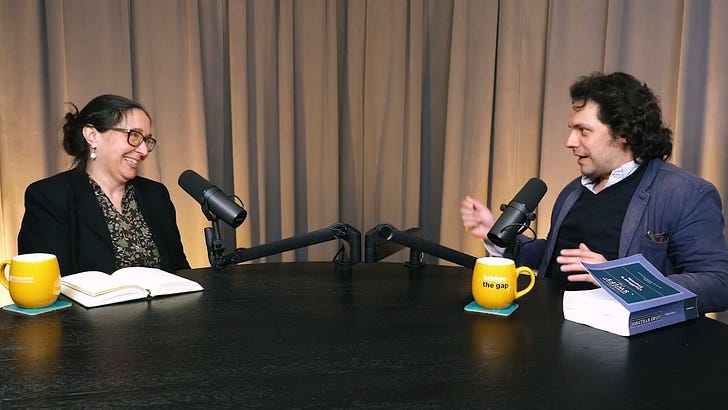
HENRY OLIVER: Today I am talking to Philip Hensher. Philip is a British novelist. He’s written books like The Northern Clemency, King of the Badgers, The Emperor Waltz, and now he’s got a new book, A History of the Novel in Britain, and you can see it there. It looks very pretty with Alice in Wonderland on the front.
Philip, hello.
PHILIP HENSHER: Hello, Henry.
Novels Are for Everyone
OLIVER: Now, to begin with, tell me about your grandmothers.
HENSHER: Oh, okay. Yes, well, I finished the book because—I kept my story out of it, largely. I thought that I should go back to a time when everybody read novels. It wasn’t a specialist interest as it seems to be turning into. And I thought I would talk about my two grandmothers, both of whom left school when they were 14. They worked in very ordinary and hard jobs in factories all their lives, and they were passionate readers of novels.
My paternal grandmother loved Dickens. She had a complete set of Dickens, which, I’ve discovered after some research, was issued as an offer by the Daily Express sometime in the 1930s. I’ve still got it, actually. I’m going to go and get a sample volume. It’s terribly cheaply produced.
OLIVER: Oh, I’ve got that set. That’s great, yes.
HENSHER: Yes. The publisher is otherwise only noted as a printer. The typeface is absolutely tiny.
OLIVER: It’s painful.
HENSHER: It’s painful to read. But she had it. She loved Dickens.
My maternal grandmother, I don’t have any of her books, I’m afraid. I would say that she loved stories of family lives, of people interacting with each other. She loved Catherine Cookson, a now slightly forgotten popular novelist of the 1950s, 1960s, 1970s. But she read an enormous amount. I mean, she must have read one or two novels a week, every week of her life.
I think that the thing that has disappeared since my grandmothers’ generation is the idea that everybody can read novels. They speak to everybody. They explore every part of life, potentially.
What seems to be happening now, and I greatly regret it, is that it’s passing into the property of expensively educated people, people who have gone to private schools, perhaps, have certainly gone to university. And the sort of reader like my grandmother, who read Bleak House with a lot of pleasure, seems to be disappearing.
So that was one of the reasons why I wanted to write the book, to make the case for how wonderfully enjoyable novels are. They’re not a duty, or they shouldn’t be a duty. They should just be founded in pleasure, however complex that pleasure might be. And I wanted to finish the book by citing my two grandmothers, who were such great readers.
OLIVER: And as well as inheriting that reading culture from them, you got a lot of that at your school, didn’t you?
HENSHER: Yes, I suppose I did. I think that it’s hard for me to say because I was in at the beginning of a sort of curriculum change, where there was an idea that we ought to give the kids things that are relevant or are going to appeal to their social concerns. So, I mean, this is going back to the very early 1980s. My set novel for A-level was The Grapes of Wrath, a classic tale of victimhood, really. Classic approved message.
And the thing was, I think what started me off as a passionate reader of novels was a sort of rebellious turn away from that sort of thing. I read Jane Austen off my own bat. I read a lot of Dickens before I left school—things that we weren’t taught at all. And that’s always been the sort of reader that I am, saying, “Oh, we’re not supposed to be reading this,” you know? “It’s not on the curriculum.”
Parliament and Thatcher
OLIVER: What was it like working in the House of Commons?
HENSHER: It was fine. [laughter] It was a very unusual experience. I don’t think it was a job that most people would’ve known existed. When people said to me, “Well, what do you actually do?” I used to say, “Well, you know the guys with wigs who sit in front of the Speaker? They’re my bosses.” And it was a strange, ritualistic experience, and you were physically in the middle of all these political dramas.
When I started work, I started work in the House of Commons the beginning of September—this is September 1990. And six weeks later, there was all the drama of Mrs. Thatcher being thrown out, which I saw physically very close up. I didn’t have anything to do with it. You weren’t aware of what really was going on, but you were there. And Mrs. Thatcher swept past you at crisis moments.
And that’s a very seductive place to be as a baby novelist, because novels are very often told by people occupying minor positions about the lives of the great. There’s a mid-20th-century novelist called Alfred Duggan who made a career out of writing historical novels of the lives of Roman emperors as told by their servants.
And I think that, actually, the novel that I eventually wrote about the fall of Mrs. Thatcher, Kitchen Venom, which has just been rereleased 30 years later by an American publisher, McNally Editions, as a neglected classic—I think that was very much one of those books. Somebody who saw these vast and world-changing events physically close up without really being an insider at all.
OLIVER: Do you think you’re more conservative than most other novelists today? Small c conservative. Or big c.
HENSHER: No, I don’t—I think that I’ve never been someone who fits in with the on dit, as it were. I don’t think that I’m particularly bothered about what people think of what I might think. One of the least effective arguments to change somebody’s mind, it always seems to me, is to say, “But most people think . . .” Most people are wrong about things.
So yes, I do think that actually having a close connection with political figures—after Mrs Thatcher, I did get to know some cabinet ministers, mostly, for one historical reason or another, Conservative cabinet ministers. And then coming out from spending the day with them and going to some book launch in the ’90s and having to listen to some member of the lumpen intelligentsia say, “Oh, these people are so evil.” I’m just going, you know, “Save the word for someone else.”
So yes, I think that I have a kind of interest in some things that most literary people just aren’t interested in at all. And I think I’ve come to conclusions of my own about some burning contemporary issues. I don’t think of myself as conservative. I think of myself as a 19th-century liberal. But then again, I also think of Mrs. Thatcher as a 19th-century liberal.
OLIVER: I was going to say.
HENSHER: [laughs] I don’t know where that leaves you.
OLIVER: I was very struck in, I think it’s something you wrote or an interview you gave, where you said that you were at a comprehensive school in Sheffield. And contrary to what we think was going on at the time, actually you had teachers who were quite pleased about Mrs. Thatcher getting elected. And in the age of bell-bottoms, people were going to Mahler concerts all the time. On that front, you have a different view of the way England was, as it were.
HENSHER: Yes. It’s partly true that those people have been flattened out of history. Eight years before the miners’ strike, for instance, when Mrs. Thatcher did come to lead the Conservative Party, it wasn’t actually apparent to most people that she was the embodiment of all evil. And I think that people realized that something must be done.
There’s a lot of retrospective reimagining of these things. I think the absolutely classic example is Mrs. Thatcher taking free milk away from, I think, seven to elevens. And this is always presented as a gesture of sheer evil. But I can tell you, as one of the children who drank the official milk, it was absolutely disgusting. It was delivered at 7:00 a.m., and then it sat there in the sun for four hours in the summer, and it was absolutely undrinkable. Nobody drank it. Absolutely nobody drank it. It was a complete waste of money.
There might have been some point in giving people free milk in the 1940s when there was rationing, but by the 1970s, what was the point in the government buying you milk? It was frankly the job of your parents to buy milk. But we’re returning to that position. And people seem to be assuming it’s the job of the government to buy your children breakfast these days, but what do I know?
Things changed later on, I would say. The mood in the North certainly altered when people saw that the economic basis of subsidy was going to be taken away and that the coal mines would close down, the steel industry would close down, and it would take a long time for these things to turn round. And I understand why people feel that, but it’s completely wrong to project that backwards into the 1970s.
The 18th-Century Battleground
OLIVER: Now, you did your PhD about the 18th century. Why do you think that century is so much less popular than the 19th century, which seems to get all the attention? But in fact, the 18th century is in a way a much richer, more diverse period, aesthetically.
HENSHER: Well, I don’t really know, actually, because I got to the end of my PhD and I got my PhD, and after that, I have to say it took me a while to get back to it. It is interesting because it is the battleground between what people used to think literature ought to be, which was firmly rooted in the classics, and a sort of vernacular, raucous, popular form that’s based in shocking things like the lives of criminals, pornography even. Rather extraordinary books explaining how people ought to behave to get on in society, how they should write letters.
So it’s a battleground between Alexander Pope, who I must say I do love, but a very kind of classical, perfect, absolutely glass-like surface; and then, people like Defoe, whose sentences just run on in a kind of chaotic way. It can’t have been very obvious which of them was going to triumph, really. Whether it was going to be the epic poem in rhyming couplets, after Virgil, or whether it was going to be a 300-page scandalous narrative about a prostitute in London today. Or rather, the answer would’ve been obvious, but it would’ve been obvious and wrong. So, there you go.
So yes, it is interesting. It is interesting. I think for me, the 19th century is more interesting simply because of the sheer abundance of material. There are plenty of books in the 18th century, but not the kind of colossal tidal wave of thousands and thousands of novels coming out, sometimes nearly a thousand novels in a single year as the tide rolls on. And that, as anyone who reads my book will appreciate, is actually the thing that I really love: a lot of books turning up.
OLIVER: Did you study with John Mullan for that PhD?
HENSHER: No. I knew him a little bit. He was a fellow in the college where I did it, and I used to pass the time of day with him in the courtyard. But no, I had a succession of supervisors, but not him.
Judging the Booker
OLIVER: I see. Now, you also judged the Booker Prize. How did that change your understanding of the way the literary world really works, as it were?
HENSHER: Well, I quite enjoyed judging the Booker Prize. It’s a very unusual experience because it’s the only experience you’re ever going to have of reading a lot of novels that are published at the same time. Even as books are being published, all sorts of filtering mechanisms are usually taking place.
With that, I think I read 140, 150 novels, all of which were published in 2001. And when you do that, you see all sorts of tendencies that you hadn’t really suspected. I remember that year, the thing that was extraordinarily common, to the point of being maybe a third or even 40 percent of the books submitted, were novels with a dual time scheme, where in the present day a woman is working in a library and she finds a box, and it’s the love letters of Mary, Queen of Scots, and then back to Mary, Queen of Scots. I’m making it up. I can’t remember.
And I think the novels that kicked that off are certainly some very good novels. Ruth Prawer Jhabvala’s Heat and Dust in the 1970s, or later on, Alan Hollinghurst’s The Swimming-Pool Library and Antonia Byatt’s Possession. But the sheer number that were imitating that structure was really extraordinary.
The later insight that I had into a predominant obsession was when I judged the Giller Prize in Canada, and again, it was about 120, 130 novels. And this was about 10 years ago now. And it was predominantly tales by second-generation immigrants of historical stories of their parents’ country of origin. There were a lot of those, and I think that’s an admirable thing, so long as it doesn’t overrun the rights of Bangladeshis, say, still living in Bangladesh to write their own stories which will be heard.
It’s an interesting thing, judging a big literary prize. I was very skeptical about the value of them. But that year, judging the Booker, I think we did a much better job than a lot of juries have done. We not only shortlisted Ian McEwan for his best novel, Peter Carey for his best novel, but Andrew Miller, excellent novel, Ali Smith’s first novel, and who were the other two? Oh, David Mitchell’s second novel, and Rachel Seiffert, a very talented novelist with a brilliant novel.
Novels vs. Sport
OLIVER: How many novels do you read in an ordinary week?
HENSHER: Oh, no idea. Three, four, five, something like that.
OLIVER: So you’re spending an awful lot of your time reading novels.
HENSHER: Well, I don’t know about that. [laughter] I’d say I’m probably reading a novel three or four hours a day, something like that. I am a pathologically fast reader. I don’t want to go into it too much because it does sound insane.
Remember that I’ve often wondered why someone like me manages to read so many books by most people’s standards. And I’ve come to the conclusion it’s because I have absolutely no interest in sport whatsoever. And it’s surprising the number of people who—I mean, if you watch a football match, even if you watch it at home without the trouble of getting on a train and going there, a football match is 90 minutes, but there’s half an hour in the middle; two hours.
There’s an hour of disquisition before; that’s three hours. And there’s an hour afterwards; that’s four hours. Well, in four hours I can read a novel by Graham Greene. That’s not a challenge. And I think that if you completely remove that from your life then, yes, you can get through a lot of novels, particularly if, like me, you absolutely love novels. It’s never been anything but a sheer pleasure.
Well, actually, I won’t say never because there were one or two months, writing this book, when I knew I was going to have to get over a personal distaste and read a very prolific novelist in bulk who I knew I couldn’t stand. I’m not going to say who they were; it’s not fair. But I think you might be able to guess a couple of them.
OLIVER: Did you know V.S. Naipaul?
HENSHER: A little, yes.
OLIVER: What was he like?
HENSHER: If you said the right thing to him, he would respond intelligently and interestingly. If you weren’t scared of him, that was better. I would guess that when he first met you, if he knew who you are by repute, as he happened to do with me because I was a book reviewer, he would say something borderline insulting. And if you absolutely didn’t react to that, if you just kind of carried on talking to him in a respectful and interested way, then things were fine. Things were absolutely fine.
Also, I think he was just a deeply interesting human being who had the knack, when he was bored, of saying something that would kick up a bit of a fuss. And I associate with that. I would say that many of my best friends are very much like that, just saying things to kick up a fuss. I wasn’t any more than someone who just met him a handful of times. But I had the utmost respect for him, and I still do.
OLIVER: Yes, he’s one of the great writers in English, I think.
HENSHER: Yes, I agree.
Dominance of the Novel
OLIVER: Why is the novel so dominant as a literary form?
HENSHER: What, now? Is it?
OLIVER: Well, there is no longer the same kind of reach or popularity for—there’s no Addison, there’s no poet, there’s no . . . To me it seems like, for the common reader, as it were, it’s all novels with a few other things. Whereas in the 18th century, it was lots of everything.
HENSHER: Well, I don’t know. I don’t want to talk down my beloved form. It does seem to me that memoirs are very largely where it’s at. Novels, to a very marked degree, get noticed much more if people can spin them as in some way memoiristic. And that’s not a criticism at all.
I was just thinking about this reading Rachel Cusk’s new novel, Life of M. And I think Rachel is one of the authors with the best chance of being read in 50 or 100 years’ time. I do think she’s an absolutely marvelous novelist. But there’s no question that there’s more of a buzz around her when you can say, “Oh, well, this novel is based on her friendship with Emma Thompson,” or whoever the actress was—I’ve already forgotten—or “She’s written a book about this and this. It’s all based in her real life.”
Those things have a tendency of fading away, but I think that it only seems to get through to people when we’re talking about, “Is this real?” Like that guy that killed himself last week, is his memoir—I mean, if he’d written a novel to be published by Simon & Schuster, would we be talking about it to the same degree? It’s not in the situation as the sonnet cycle. People are still reading novels, but I don’t know that it’s as dominant as all that.
If it was, “Why was it dominant? Why was the novel form dominant?” I think actually it’s to do with the omniscient voice. I think, from the beginning, the novel could go anywhere. It could take the reader by the hand, could lead them into places that they would never in a million years go. And from the invention of the railways—people commented about this a lot at the time—people were no longer limited to seeing their own class. They would be waiting on a railway station, and every class of society, it seemed, would be waiting there.
But the challenges of a simple reader in finding out about the upper classes that they’d glimpse in these situations, or indeed a curious upper-class reader in finding out about the lives of the very poor carrying a chicken to market in a third-class carriage, in real life, that would be pretty limited. The novel could take you anywhere it wanted to go, and that, I think, is really never going to go away.
I can see, even now, publishers are sharpening their claws, and they want to leap on any really talented novelist of, say, transgender lives now. They probably weren’t very interested in that or hadn’t thought about it until 20 years ago. Now it seems like a very current thing, and they’re interested. They’ve been very interested for some time in Black British authors as well. They’re not people who are trying to find a voice for those communities, necessarily, but probably just as powerfully finding an audience who wants to find out about the community without having to say, “Well, this is going to be our documentary discovery.” You can just imagine what it’s like, and that’s good enough.
But who knows why things come into fashion, why they dominate, and why they disappear? The epic poem was the dominant form of the 17th century, and no one’s really written one for about 300 years now.
On Rachel Cusk
OLIVER: Who are the other best living British novelists?
HENSHER: Oh, no, don’t tempt me.
OLIVER: No, you’re not, no?
HENSHER: No, I’m not going to be tempted.
OLIVER: Can you give your argument for Rachel Cusk? Because I think she’s dreadful.
HENSHER: Do you?
OLIVER: Yes, I think it’s very boring. I find the Outline trilogy quite unreadable, actually.
HENSHER: Oh, okay.
OLIVER: On the first page, I thought, “Wow, this is so exciting. She’s doing something really new.” And by halfway through the first book, I thought, “Well, it’s over. She’s done everything it can do. I can’t take it anymore.”
HENSHER: I think that what will keep her going is the unfailing beauty of her sentences. I think she has cadences like no other writer. That keeps people going. And what I really love about some of her books is that they are literally about nothing. I think The Country Life is an absolutely superb book, but what’s it about, really? A girl goes to the country and falls out with her family. It’s absolutely great.
Yes, what is it? What are they about? I mean, but that’s the thing. I don’t think that you really find what’s wonderful about novels by saying, “What are they about?” I thought the trilogy was just a wonderful bit of thread-spinning. And maybe it’s just me, but those novels that consist of the gathering of one story after another, sometimes never coming to a conclusion, they work such a spell.
And that’s true about, not a novel, but One Thousand and One Nights; The Canterbury Tales; Calvino, If on a Winter’s Night a Traveler; or in the same category, Elmore Leonard’s Get Shorty, which I think is the great American novel of the last 50 years. And it’s exactly that. It’s a series of stories being told as one person tries to pitch a movie to another. It’s absolutely glorious. And I think that the Cusk trilogy is very much like that.
Long before Rachel’s trilogy, I did have this plan to write a novel of storytelling, and it was going to be called Tales from the Pit. And actually, I signed a contract for it, and it was going to be stories told from one orchestral musician to another during the interminable performances of some long-running opera or other. But the thing that stopped me from writing it was that I discovered that Berlioz, the great composer and great writer, had written a book very similar, called Les soirées de l’orchestre. And I thought, “No, I’m not going to outdo Berlioz.”
On Literary Critics
OLIVER: Who are the critics from whom you have learnt the most?
HENSHER: Peter Garside, the great Regency critic. J. M. S. Tompkins, who wrote a superb book about 100 years ago about the popular novel after 1770 to about 1820. That’s a superb book. John Sutherland I think is really good. I love his books solving problems in novels. George Saintsbury, end-of-the-19th-century critic who had the principle, “Read everything.” And I think that his books about the novel in particular are really—they can’t be improved on. He was just so well read.
OLIVER: Yes. What about more modern critics? That sort of ends a long time ago.
HENSHER: I don’t know. I don’t know. I don’t know that there are any critics writing—I mean, I don’t describe myself as a critic. I’m just a book reviewer.
OLIVER: Leavis, Carey, Hermione Lee?
HENSHER: Oh, yes. I think Hermione is really a great biographer, and her life of Virginia Woolf was very good. Her life of Penelope Fitzgerald was better, and her life of Anita Brookner is exemplary. It really is.
OLIVER: But the Fitzgerald book has no religion.
HENSHER: Yes. I probably didn’t notice that.
OLIVER: Penelope Fitzgerald, she never talks about it, but it’s all about God. And the book is quite secular and feminist in a way that I felt was perhaps more Hermione Lee than Penelope Fitzgerald, you know?
HENSHER: Yes, that’s a very good point. It’s not something that I really pay attention to. You could make the case that there are all sorts of private parts of people’s lives that are just closed to the investigator. Very few literary biographers talk seriously about sexual relations or about money, for instance. I don’t really see why religion shouldn’t be different. I don’t know. I haven’t really thought about that.
Critics—I can’t stand Leavis. I think he’s wrong about everything. I do think he’s wrong about everything, and I don’t know what he means when he says, “This is life-enhancing.” I was like, “What does that mean,” you know? What does it mean? And people in Cambridge were always saying, “What does that sentence mean?” Who knows? Boy. And I think they must have said it to Leavis about five times a day. Who else? Suggest some names to me.
OLIVER: I thought John Carey, The Intellectuals and the Masses.
HENSHER: Yes, John Carey. Yes, that is a proper—
OLIVER: It’s a great book.
HENSHER: That’s a proper game changer, actually. And I don’t see how you could disprove it. He’s wrong—
OLIVER: And the Dickens book, The Violent Effigy.
HENSHER: Yes, that’s brilliant. He’s occasionally just wrong, but he’s wrong in interesting ways. The Thackeray book writes off some great novels, in my view. The Intellectuals and the Masses, he’s just wrong about George Moore. But on the whole, yes, he’s a very good thing.
Of course, John Carey was the last generation of critics to have a proper training in textual bibliography. So his editions of Milton, and especially the brilliant edition of the James Hogg Private Memoirs and Confessions of a Justified Sinner, they are a very good preparation for going through a work of literature and talking about every word of that work of literature.
Two Thousand Novels
OLIVER: You read 2,000 novels in order to write your history of the novel.
HENSHER: Oh, a lot more than that.
OLIVER: Okay.
HENSHER: A lot more than that. There’s 2,000 novels that are talked about.
OLIVER: In the bibliography.
HENSHER: There are a lot more novels that I just didn’t put in.
OLIVER: Where did you get them all? You must have had trouble finding some of them.
HENSHER: It’s much easier now than it used to be. There’s Gutenberg, of course. There’s this wonderful publisher—I want to get to the bottom of it—an online publisher that will sell you the collected—what’s it called? I don’t know—will sell you the collected works of some very minor novelists for like 1.99. A couple weeks ago, I just bought all the novels of Rhoda Broughton for 1.99. So that was very useful.
And there are various other online sources. There’s the London Library, of course, for physical copies, which they still have a surprising number of things. They had a copy, for instance, of the very last three-volume novel to be published, which is a novel by George Gissing’s brother, Algernon. I can’t tell you how bad it is. Oh, god, it’s absolutely atrocious. Anyway, they had a copy. So, yes, you sort of gather them here and there.
I knew that a novel was seriously obscure when neither Gutenberg nor the HathiTrust websites or anybody else could come up with a copy. There’s a novel from the 1790s that crops up in a lot of bibliographies and general surveys of 1790s novels by Charlotte Palmer. She’s a woman called Charlotte Palmer. I don’t know anything about her at all. And it’s called It Is and It Is Not a Novel. It sounds fascinating, but I did notice that it’s suddenly referred to for the first time in a study of 2013, and every single reference since then more or less repeats what that first commentator has said.
I couldn’t find a copy of it myself in any of the sources, and I did wonder. Jane Austen was a very keen reader of women writers of that period, and I did think, “Jane Austen couldn’t possibly have heard of this writer and her book, because there’s a character in Jane Austen called Charlotte Palmer.” She wouldn’t have done that if she’d made that connection. It would be like giving a character the name Fanny Burney. So I’m sure that it does exist somewhere, but I couldn’t track it down.
OLIVER: And you excluded Ulysses.
HENSHER: Yes. That was a really difficult one. I tormented myself over Ulysses, and I could justify including Joyce. Firstly, he always had a British passport. He never had an Irish passport or anything else, so you could base it on that.
On the other hand, it was published in Paris. I do talk a little bit about Portrait of the Artist, which was published in London. It was published in Paris, and he never lived in Britain after leaving Ireland when it was still part of Britain. So, I mean, I couldn’t not mention it at all.
But I thought in the end, just from a literary politics sort of standpoint, I thought if I put Ulysses in, describing it as an example of the novel in Britain, that would kick off a fuss that I didn’t feel passionate about defending. Oddly enough, I would’ve been more tempted to include Finnegans Wake, which I’m passionately fond of and which was, of course, published by Faber and Faber in 1939. But it made no sense to leave Ulysses out and include Finnegans Wake.
Where the borders were drawn, who to include and who to leave out, it wasn’t an easy decision. And on the whole, I did include people rather than exclude them. But Joyce is such a national figure in Ireland that I did think there would be a bit of a row if I started claiming him as a British novelist.
On Penelope Fitzgerald
OLIVER: You have a very nice suggestion in the back of the book for a Library of Britain, which would be a bit like the Library of America, but obviously we have a lot more to publish here.
HENSHER: Yes, it would obviously be a lot better. [laughter]
OLIVER: But I think you left Penelope Fitzgerald off your list of the people who should be first in line.
HENSHER: Oh, did I? Oh, that wasn’t deliberate. What a disaster.
OLIVER: I wondered. I thought this must be—
HENSHER: Oh, no, that was a cock-up.
OLIVER: So you do want her in.
HENSHER: Oh, yes. Yes, definitely. And the biographies as well.
OLIVER: Because I think she’s a great genius. Oh, the biographies are amazing, yes.
HENSHER: Yes. Penelope was the last person in my life who I’ve been scared of. I’m not scared of many people, and probably in my adult life on the fingers of one hand, really. But Penelope, I was scared of, and I do not know why. I do not know why, because she was always unfailingly polite and civil. She just had a sort of level stare as though she was kind of assessing you, and she might at any point say something that you would carry with yourself for the rest of your life shuddering.
And she never did. She never did. She was extremely nice, but I don’t know. There was something very odd about Penelope. It was as if—do you know that description of the Greek Alexandrian poet Cavafy, that he was a gentleman that stood at right angles to the universe? She was like that. You met her at a party, and she’d stand there. She looked very much like the White Queen in Alice. She always had a kind of Sainsbury’s plastic bag by the side of her, and she just seemed kind of detached from the party and from everyone.
I think she liked solitude. I don’t think the impression that she didn’t quite want to be there was at all false. She was a one-off, Penelope, I think. And I know that people who worked with her—we shared an editor at one point, and she was one of those authors that inspired huge amounts of loyalty. I think the biographies are, in a way, even stranger than—The Knox Brothers, and the Charlotte Mew biography is incredible.
OLIVER: It’s crazy.
HENSHER: It’s incredible. It’s absolutely incredible. I wish she’d—there were a couple of biographies that she wanted to write and didn’t. She was going to write a biography of L. P. Hartley and gave it up because she discovered too much about L. P. Hartley’s sex life, and Leslie Hartley’s sister was still alive. She dropped that.
And I think there was talk of a biography of M. R. James. The very last thing that Penelope published, almost, I have a responsibility for because Penguin Classics—Penguin Modern Classics, probably—were going to bring out a selection of M. R. James’s short stories. And they asked me to write the introduction to them, and I said, “I will write the introduction to them, but only if Penelope refuses to.” So they went to Penelope, and she said yes. And I’m very proud of that.
OLIVER: Yes, that’s a great piece of writing as well. Right, I’m going to read out a quote from your book.
HENSHER: Oh, Lord.
Novel-Reading and Morality
OLIVER: Here we go. Quote: “If you had read more than one novel with attention, it would be impossible to bring a machete down upon the face of another human being without guessing what it would be like to be behind that face as the blade fell upon it. You would not do it.” End quote. Now, we just know that that’s not true, isn’t it? A lot of awful people have read novels and continued to do their thing.
HENSHER: Well, I think those people are celebrities in the world of psychology. Isn’t it interesting that concentration camp guards read Hölderlin’s poems? They’re extreme cases. Overwhelmingly, there is not much overlap between habitual readers of novels and the sort of people who carry machetes in the streets of London. That’s definitely the case. I think that’s beyond arguing.
It might be the case that it’s not 100 percent cure. You can’t guarantee that if somebody has read Great Expectations with attention and love, that they won’t go out afterwards and say, “All right, I’ve done that. He gets off with Estelle”—or alternatively, “He doesn’t get off with Estelle,” according to which ending you read—“Now I’m going to go and chop some bugger’s head off with my machete.” Well, it’s conceivable, I suppose, but it’s very, very unlikely.
And I don’t know what better protection we have against the idea that the next generation is going to be more prone to violence. If we could persuade everybody to read and engage with novels, then that would be a very, very good protection against the spread of violence. I’m sure that’s right.
OLIVER: So you do think that the novel is causing the moral improvement somehow? It’s not just that civilized people, as it were, enjoy novels. There is some mechanism of change there?
HENSHER: Yes, and by moral improvement, I mean the simple act of imagining what it’s like to be somebody else. Not necessarily to pass judgment on those people, but to imagine what it’s like to live another life. And that’s the beginning of the human imagination, I think.
Effects of Patronage on the Novel
OLIVER: One of the main arguments of the book is that patrons, as you call them, had too much control over the novel, how it was priced, what form it took, whether it could talk about naughty things, et cetera. But the thing I actually enjoyed most about your book was, you were very good at showing how diverse and innovative the form has been, and how quickly and how cleverly novelists have responded to every new set of conditions, set of constraints.
Isn’t the truth somewhere between these two, that the patrons are also responding to real-world conditions, what the public will and won’t stick? The mothers have never wanted the daughters to read books, so the books have to get around that somehow. Isn’t everyone reacting to the real world, as it were? And the cold, dead hand of the patron isn’t gripping quite as tightly as that, maybe.
HENSHER: Well, I think that the argument is not that patrons exert too much power, but where they do exert too much power, it has, on the whole, a bad influence on the contents of the book. And patrons always assume that the readership is a uniform thing, that because they and their—Mudie in the 19th century, his 30,000 subscribers—because they wanted to read heartwarming tales in which nobody ever committed adultery, that nobody did.
Now, clearly that was completely wrong because when George Moore in the 1880s wrote a marvelous novel called A Mummer’s Wife, about a woman who runs off with her lover and becomes an alcoholic among a lot of actors—glorious, and they priced it at sixpence—Mudie’s turned it down flat, of course, because “No one’s going to read this book. Oh, our people don’t want to read it.”
Well, he was completely wrong. It went into six editions in two years priced at sixpence. And that actually has gone on. In the 1950s, Kingsley Amis was persuaded by his editor to take a word—I don’t know what it was, maybe it was the word bugger—out of a novel because they said, “The Boots Lending Library won’t buy it.”
Now, I suspect that 10 years later, Kingsley Amis would have said, “Well, stuff Boots Lending Library; I’m going to sell to people who do want to read it.” Because only five years after he was told that, Penguin published Lady Chatterley’s Lover after a very useful—useful from the point of view of publicity—obscenity trial. I have no idea whether Boots Library took Lady Chatterley’s Lover. I rather suspect not. But it sold hundreds of thousands within days, and quite right too.
The thing is that there may be a readership that likes one sort of novel, but there’s also a sort of readership that likes another sort of novel, and patrons never want to admit that.
Your second point, about the way that novels reach out to new areas, it’s absolutely true. And it’s quite striking, the sort of novels that very effectively reach out to explore unfamiliar bits of society. For instance, the working-class novels of the 1890s, which are often horrifically violent—Arthur Morrison’s A Child of the Jago, I think one of the great 19th-century novels, but there’s no doubt there’s bits in it that have to be read with great revulsion. That was against everything that people thought the novel ought to be doing.
Even if something was a bit less specific, if it was about a new or unfamiliar minority, then it could go against the patron’s power. There’s a very good example of a novel by the Jewish novelist Julia Frankau called Dr. Phillips. And it was one of the most enjoyable discoveries of my reading. It’s a story of murder and adultery in the upper-class Maida Vale Jewish Victorian life. I absolutely adored it. And the patrons wouldn’t have touched it. They thought, “Oh, no one’s going to read this.”
But the novel is always going to give opportunities to people from communities that haven’t had their voices heard. Women, from the start, could write and publish novels when they couldn’t become doctors or lawyers or politicians. And people from ethnic minorities are heard surprisingly early in the history, and it’s because readers wanted to hear about something new.
And I think that’s an absolutely thrilling development. And it’s nothing to do with patrons either. It’s invariably publishers who just think, “Well, let’s try this thing out. Let’s see whether we can find readership for what it’s like to live on a remote farm in Africa.” Or going back to the 1880s, “Let’s see if our readers want to find out what it’s like to be a new immigrant off this boat called the Windrush.” One of the great novels of the 20th century emerged, Sam Selvon’s The Lonely Londoners.
It’s always out of some sort of commercial desire just to try something out and see if there are readers there. It’s a very effective mechanism for broadening participation in society, I think.
The Role of Ideas
OLIVER: What about the role of ideas? Isn’t there an essential place for philosophy, theology, economics, all these other disciplines? The development of the novel is inseparable from these things. Not just people like George Eliot and Jane Austen, but there are ideas in every book, aren’t there?
HENSHER: Well, I think there are assumptions in every book. It depends what you mean by an idea, really. If you mean a philosophical proposition, then I would say no. There’s also the problem that an idea, the justifiable quality of an idea, whether it’s a good idea or whether it’s a truthful idea, whether that has an impact on the quality of a novel. And it’s quite hard to see that a novel that we agree with is necessarily going to be a better novel than a novel that’s talking total nonsense from the ideas point of view.
I think that there is a place for the proper Cambridge idea of a novel, a Cambridge idea of an idea in a novel. But I don’t think it’s essential. I’ve been thinking about this since we had this discussion at that conference. And I think that my main feeling about it is that we ought to admire novels for doing well what only the novel can do well. Those things are to sketch out lives, individual lives, however eccentric or idiosyncratic, to create the illusion of human beings, to listen to and convey the speech of individuals, and not necessarily to do what other forms of writing can do much better, which is to set out a case for one idea or another.
Now, of course, that’s oversimplifying the whole thing. But I must say that I can think of novels that I absolutely love, that no doubt have some kind of idea or assumption running through them. But I don’t know that’s really what I or anybody else reads a novel for. I mean, what are the ideas—I’m just looking at the shelf in front of me. What are the ideas in The Diary of a Nobody? Without a doubt, one of the greatest novels in British literature. What is the idea of The Diary of a Nobody?
OLIVER: I think that novel is premised on a very clear and simple set of ideas about the British class system, and about what is acceptable to mock and what is acceptable to be the butt of satire. That novel now, in a way, isn’t funny anymore because it’s too mean. It’s too cruel.
HENSHER: Are you kidding me? Seriously?
OLIVER: I find the first half funny, and by the end of it, I just think, “There’s nothing actually wrong with this guy. Gosh.”
HENSHER: No, there’s nothing wrong with him at all.
OLIVER: It’s unbearable how mean they’re being to him.
HENSHER: It’s absolutely adorable. Come on, Charles Pooter painting his bath red. [laughter] His son deciding that he’s going to call himself Lupin.
OLIVER: Yes, but it’s not purely observational. It is what gives it its coherence and its organization. I mean, that is a very condensed novel. It’s a remarkable achievement technically, to do so much in so little space. And that is because it is organized around a certain set of ideas about the British class system, which are largely no longer real.
HENSHER: Oh, Henry, Henry, how can you kill a book like that? How can you—
OLIVER: Look, you can’t have Jane Austen without the Enlightenment, and you can’t have George Eliot without the secularization of Jesus, and you can’t have Tolstoy without all the slightly incredible things that he believed.
HENSHER: No, let’s not talk about Tolstoy.
OLIVER: No, but the list goes on, right? Henry James even, who is often called a man of no ideas, he’s an incredibly good liberal. He might be the best novelist about the liberal idea that one person should not be allowed to dominate over another, in private conditions rather than just government. These ideas are, in a way, they’re the thing that distinguish those writers. Jane Austen knows how to observe and how to present because she’s thinking about what it means underneath.
HENSHER: I don’t know. I don’t know about that.
OLIVER: I don’t even think you can have Middlemarch without John Stuart Mill’s political economy, in a way.
HENSHER: Yes, that’s probably true. But George Eliot’s an unusual sort of novelist.
Jane Austen, I mean, how do we know what did she—what did Jane Austen think about slavery in the boldest and most extreme form? I think we can deduce that she thought that people involved in the slave trade or who came near it, like Mrs. Elton, were not at all the sort of people that she would altogether like to hang out with. I think the same is true of Sir Thomas Bertram, and the weakness of his imagination is somehow tied in with the fact that he has a plantation where he doesn’t really think about the people that it affects.
But already we’re into speculation. I don’t know what we can really deduce about Jane Austen’s idea, because she’s such a polyphonic novelist that we don’t find an idea being put forward without being able to find a character who’s saying the exact opposite. And sometimes one side of the argument is eventually dismissed, but not always, I think.
I said this at the conference we had a discussion with. I think that when you boil a novel down to its absolute irreducible essentials, I think what you have is not a proposal or a view of society or anything like that. It’s Charles Pooter painting his bath red, or the moment in Ivy Compton-Burnett’s Mother and Son when the son irrevocably falls out with his mother by telling her that he doesn’t want to have sugar in his tea anymore.
From the very beginning, novelists have said, “What I’m writing about, I’m writing about nothing, and this is the virtue of what I’m doing. I’m writing about the utter triviality of everyday life.” And that, for me, is the enchantment.
OLIVER: Well, some novelists have said that.
HENSHER: A lot.
OLIVER: Samuel Richardson didn’t say that. Samuel Richardson’s quite an important exception.
HENSHER: No, but people said it about Richardson.
OLIVER: I don’t think we—yes, but we can’t believe it.
HENSHER: People definitely said—no, I think we can.
OLIVER: Pamela is a novel of ideas.
HENSHER: Well, it’s a novel that contains some ideas.
OLIVER: Yes.
HENSHER: Henry, I don’t think we’re going to agree on this. [laughter] I don’t think we’re going to agree on this. But if I want to read a book that sets out ideas, I do—I’m not a complete empty-headed flibbertigibbet. The other day I was reading one of my favorite books of ideas, which is The Presentation of Self in Everyday Life.
And I do think that books of ideas have their place. And it’s tempting to think, “Oh, I could transfer the insights of Erving Goffman into a fictional drama.” But you couldn’t. You absolutely couldn’t. It would rely much more on peculiar objects and observations that aren’t laden with propositions.
The Best English Novels for Beginners
OLIVER: One of the questions I get asked most often is from people who have not been bookish people. They’re more on the science or practical side. They haven’t read great novels since they were at school, and they want a list of five great English novels to get started. What’s your list?
HENSHER: Vanity Fair never failed. The Old Wives’ Tale never failed. An Evelyn Waugh. Which Evelyn Waugh? I think Put Out More Flags, actually, because it’s such a brilliantly funny novel. It’s a very strange novel. But it’s about a particular historical situation, which is often a kind of temptation.
What else? I’m only recommending novels by men because I think it’s men who have this problem, and I think that asking them straight off to read a particular feminine take on the world, sometimes you do hit just a blank wall. But I do think that they will get round to Mansfield Park or Daniel Deronda, my favorite Eliot.
I think I would also suggest The Lonely Londoners, the Sam Selvon. I do think it’s the most enchanting exercise in voice. And, how many is that? Is that four or five?
OLIVER: I think that’s four.
HENSHER: Oh, what am I going to do, then? Oh, you’ve got to have a Dickens. Bleak House. I think actually there’s a fallacy in people recommending novels to reluctant readers, which is, they always suggest something kind of easily digestible. But I think the way forward is to give something at its most intense and concentrated and just see if that counts. “This is what the novel really is like.”
Oh, I know the other one. I mentioned it earlier, the James Hogg, Private Memoirs and Confessions of a Justified Sinner. Oh my god, that’s a fantastic novel. I really do think that’s good. Yes.
OLIVER: And can you do the same for children’s books?
HENSHER: No.
OLIVER: Fair enough.
HENSHER: No, I’m 61 years old. “Would you like to read this book, little—?” No, no, no, thank you.
Quick-Fire Questions
OLIVER: Let’s do a quick-fire round. I say the name of a novelist, and you give us your opinion. Short form.
HENSHER: Oh, gosh. Oh, terrifying.
OLIVER: That’s all right. You’ll do very well. Arnold Bennett.
HENSHER: Underrated. Marvelous.
OLIVER: Where should we start? And how good—
HENSHER: The Old Wives’ Tale. No, or The Card. The Card is a glorious novel. It’s absolutely ludicrous; it’s fantastic. The Old Wives’ Tale is, I think, the greatest French novel in English. It’s magnificent.
OLIVER: When you say underrated, how good is he?
HENSHER: Oh, top 20. Top 20 writers in English.
OLIVER: Iris Murdoch.
HENSHER: She’s out of fashion at the moment, very much out of fashion at the moment, I think for reasons that were out of her control. It’s impossible to tell at this point what is going to happen to a novelist like that. Is she going to carry on declining and drift out of our interest in the way that the novels of William De Morgan did? Or is she going to reach a bottom and then slide upwards?
I must say that I loved Iris’s novels to an incredible degree when I was 17. I could read them all day long. I think I must have read every single one of Iris Murdoch’s novels between the ages of 17 and 20. And the moment when I came to London and saw Iris at a literary party was one of the most overwhelming of my life.
What happened—weirdly, it was at a party in a secondhand bookshop in Clapham Old Town. Doesn’t exist anymore. And she was just standing there looking around with great empty eyes. And then Woodrow Wyatt tottered in in a very noisy way and said, “Iris, Iris, what are we doing here? What is this place? What are we doing?” It was very strange.
OLIVER: Walter Scott.
HENSHER: The creation is immense. The achievement is overwhelming. And towards the end of the 19th century, a reaction set in, which was so powerful that it defined many of Scott’s most characteristic stylistic features as the embodiment of bad writing. It’s not his fault. I myself, I admit to sharing in that reaction. And he comes to me in flashes of sublimity. I think the first chapter of The Heart of Midlothian is one of the most impressive pieces of writing of the century.
He did so much good for literature that it’s hard to be dismissive about him altogether, and I wouldn’t want to be. On the other hand, stylistically, he’s so out of tune with what we regard as good writing that I thought in the end it would just ring a completely false note if I pretended that I didn’t have problems with the style. So, you know, he’s in a particular historical position. We’re in a particular historical position. Who knows what that tells you about either of us, really?
OLIVER: Alan Hollinghurst.
HENSHER: Oh, who is my best friend, so yes, of course he’s marvelous.
OLIVER: Which one do you recommend?
HENSHER: I absolutely love The Stranger’s Child. I think that’s such an innovative novel, and it’s so clever and funny. But they’re all simply marvelous. He’s a marvelous novelist.
OLIVER: That’s the one I’m always pushing on people. It’s heartbreaking. It’s beautiful.
HENSHER: Yes.
OLIVER: It’s clever. It’s really wonderful.
HENSHER: So clever. You’re not going to trap me into saying rude things about darling Alan.
Various Elizabeths
OLIVER: No, no traps. No traps. Elizabeth Taylor.
HENSHER: Great novelist. Great novelist. And central to her time in a way that I don’t think anyone really appreciated until some time after she died. After she died, some organization or other gave her a posthumous award for a lifetime’s achievement, and her husband, John, went to collect it. And he said in his acceptance speech, “What a shame you couldn’t have said this while she was alive.” And it was absolutely right.
As a handler of technical material, I don’t think there’s a novelist in the 20th century to surpass her. Just the way in which characters are introduced and interact, how the plot proceeds, the evocation of place, it is just the most extravagantly perfect technical handling.
She’s the novelist who, more than anything, I show to my students in Bath Spa. And it is astonishing how if you give them a page of Elizabeth Taylor, almost chosen at random, you can go through it inch by inch, word by word, and just emerge at the end absolutely astonished by the expertise of the handling. I think she’s an absolutely marvelous novelist.
OLIVER: Elizabeth Bowen.
HENSHER: I think she went off. But those novels from To the North certainly to The Death of the Heart, and maybe even The Heat of the Day, are absolutely thrilling. Psychologically, she’s an absolute whiz at seeing people, seeing into people’s minds. She’s better at children than almost anybody, and there are a lot of people writing about childhood in the 1930s.
The Death of the Heart, I think, is her best novel, though The House in Paris runs it pretty close. The middle section, where the young heroine goes to the seaside to stay with a family that she doesn’t really know and is followed by her cad of a boyfriend, is an absolutely stunning survey of uncertain behavior. And it’s rarer than you think, actually, novelists writing about people behaving uncertainly for reasons that they don’t quite understand.
The Heat of the Day, it has superb things in it, but I would say that it falls slight victim to the tendency of the time to think that novelists ought to write about serious subjects of contemporary concern. Novels of ideas, Henry, I’m sorry to say. And she just wasn’t that sort of novelist. When she’s doing two people lying on the grass just talking about nothing much, it’s marvelous. But when you creak it up into this plot about someone’s a spy and—oh, Elizabeth, don’t do it to me. Anyway, but that’s just me. A lot of people absolutely love The Heat of the Day.
OLIVER: Elizabeth Jenkins, Bowen’s great friend.
HENSHER: My knowledge of Elizabeth Jenkins that I can produce at short notice is The Tortoise and the Hare. And I think a lot of the same things that I said about Elizabeth Taylor are the same. It’s a lovely classical style.
I’ve often given people to look at the first page of The Tortoise and the Hare. I think it slightly suffers from the title, which makes the narrative seem a bit predetermined, but that’s a minor sin. I would love to read some more Elizabeth Jenkins, actually. I know I read another one or two some time ago, but I’ve completely forgotten what they were called, so don’t test me.
OLIVER: The best ones are Dr. Gully, Honey, and Brightness, after The Tortoise and the Hare.
HENSHER: Okay. Oh, that’s interesting. Okay. I’ve got a bit of an allergy—you’re going to disprove this immediately. I’ve got a bit of an allergy to novels, like Twitter profiles, which include the word doctor. [laughter]
OLIVER: It’s only called that because it’s a historical novel.
HENSHER: Yes, they are putting me off.
OLIVER: Fair enough. Fair enough. Fair enough.
HENSHER: I love Trollope, but I must say that when I reach out for Doctor Thorne, my hand—
OLIVER: It’s not the best.
HENSHER: I don’t know why. Why is it?
OLIVER: Because relative to what actually happens, it’s too long, and so you have to get through a lot of stuff that doesn’t really do anything for the novel.
HENSHER: No, I mean why is it the title that includes the word doctor is so off-putting?
OLIVER: Oh, that I can’t help you with.
HENSHER: No, I can’t help. Yes, I’m going to investigate to see if I can think of a novel with doctor in it.
OLIVER: Jenkins is another one who’s a superb biographer.
HENSHER: Oh, yes.
OLIVER: Her Jane Austen biography is amazing, really beautiful. Really incredible.
HENSHER: Okay. All right. Okay.
More Novelists
OLIVER: Martin Amis.
HENSHER: Yes, I think he is great. I do think he was wonderful. There are some later novels where he slightly fell down because he wanted to say something solemn about a major political situation. But he went on being a very good novelist a lot longer than people assume. I remember when The Pregnant Widow came out, and I think The Pregnant Widow is an absolutely enchanting novel. It’s just full of regret and grown-up thoughts, and, oh, I absolutely loved it.
Oh, my Lord, you should have seen the reviews that it got. I think word just got round among young people that Martin was no good anymore. He’s got the thing that his father had, of a brilliant ear for dialogue, and much more than his father, but sharing some of the same qualities. He had the air of being able to write a sentence that readers would remember. I’m sure that most people who like Martin Amis, if you said to them, “Give us a sentence from Martin Amis,” they’d be able to come up with one.
OLIVER: And lastly, Jilly Cooper.
HENSHER: Oh, yes. Do you know, people always roll their eyes when I say I don’t see why Jilly Cooper shouldn’t be the novelist from our time that survives in posterity. She’s got a lot of the qualities that actually make for a good prospect of survival. Her characters sound distinct. You always know who’s speaking. It’s got a good social range. It’s not about two retired actors sitting in a bedsit in Kentish Town. They’re funny, which is always good. People love them.
The first of the series of her long books—not the 1970s romances, though those are very enjoyable too—the earliest of them, Riders, published in 1986, never gone out of print. Now, there’s not many novels from 1986 that are still going strong with large readership. They had large readerships even before the television drama. That’s not the only reason. So I think, yes, I’d put my money on Jilly Cooper still to be read in 100 years’ time, ahead of Julian Barnes.
Final Thoughts
OLIVER: Last two questions. How do you think AI will change the novel?
HENSHER: No idea. Absolutely no idea. I think that novel has found ways to take advantage of technology and change in society before. It will do so again. I’m a novelist myself, but my practice has been long formed. I don’t think that I’m the person to ask this about.
What you want to do is ask somebody like the brilliant student that I was just talking to, who’s 22 years old, a student of mine who has been thinking about AI since he started his undergraduate degree. Those people, they will have it in their bones, and they will master it, I’m convinced. But my answer is worth less than nothing.
OLIVER: What will you do next?
HENSHER: Oh, I’ve retired. That’s it. That’s it. Glorious. I’m very happy.
OLIVER: You’re not going to set up the Library of Britain?
HENSHER: No, no, I couldn’t run that. Someone else can do that. No. I mean, it’d be nice if anyone took it seriously.
OLIVER: I think it’s a great idea.
HENSHER: Yes, I think it’s a great idea. I wouldn’t have put it—but no, I’m going to retire now. I’ve spent 30 years publishing novels, and there’s 12 novels, 2 volumes of short stories, and finishing with a history of my art form. I think that sounds like a nice, shapely career.
I don’t want to be writing novels about my idea of what the kids are like when I’m 75. I think that’s absolutely a fatal idea. [laughter] Of course, I’m just saying that, and you never know when something’s going to tempt. But at the moment, I think I’m going to retire.
OLIVER: Very good. Philip Hensher, thank you very much.
HENSHER: Pleasure. Thank you, Henry.