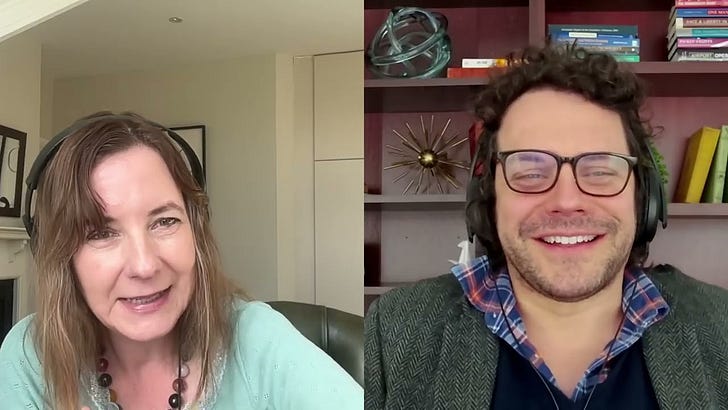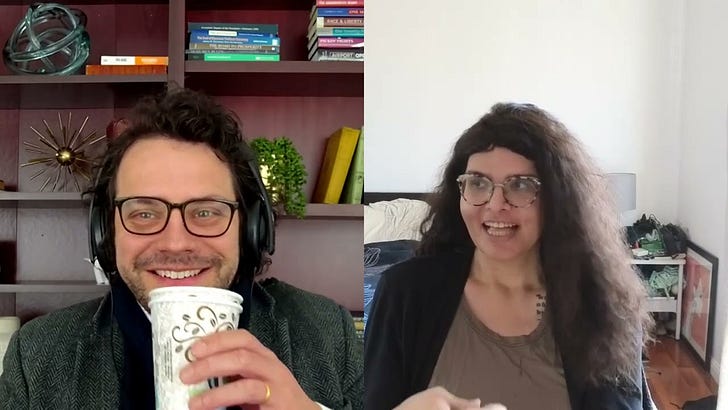

Obviously, this is mostly about the literacy crisis, whether we understand it properly, whether it is happening in Spain, whether the PISA data supports James’ thesis, and so on. I began by asking James Marriott how things might work out for the best…
OLIVER: So the book is about the reading crisis and the risk it poses to liberal democracy. I want you to tell me, what is the most likely optimistic outcome? You might think that the odds of everything going well are very low, but if we do scrape through, what will it look like?
MARRIOTT: That’s such a good question, and nobody has ever asked me that question before. Seeking optimism from me is a unique idea. I think the most likely optimistic outcome, as I think so often in history, is stagnation and more of the same, and things don’t change.
We also talked about AI as a transmission of liberal democracy, a means of distributing James’ own work, and things like that. At the end, we had some fun about literary critics and Shakespeare which is much more civilized that arguing about the literacy crisis.
MARRIOTT: Yes, I’m keen to read The Winter’s Tale, and I’ve got it, actually. It came in my little set.
OLIVER: I think you’ll be pleasantly surprised, and then you can read Northrop Frye’s book about it.
MARRIOTT: Yes.
OLIVER: Which would be James Marriott–coded.
MARRIOTT: Yes, good. I am very biased towards things that are James Marriott–coded.
The Frye book I had in mind was A Natural Perspective. James is also going to read A.C. Bradley and we might record another podcast about that. Bradley being one of the greats.
Transcript
HENRY OLIVER: Today I am talking to James Marriott. James is a Times columnist, a Substacker—he writes Cultural Capital—and he has a new book called The New Dark Ages. James, welcome.
JAMES MARRIOTT: Thanks very much for having me.
The Reading Crisis
OLIVER: So the book is about the reading crisis and the risk it poses to liberal democracy. I want you to tell me, what is the most likely optimistic outcome? You might think that the odds of everything going well are very low, but if we do scrape through, what will it look like?
MARRIOTT: That’s such a good question, and nobody has ever asked me that question before. Seeking optimism from me is a unique idea. I think the most likely optimistic outcome, as I think so often in history, is stagnation and more of the same, and things don’t change. And I guess I think there are a lot of reasons to be pessimistic.
I think societies have a remarkable capacity to go on stagnating or declining slowly and imperceptibly for a very long time, and often much longer than we think. I know that’s pretty tepid optimism. Probably in the general scheme of the sort of takes that I offer, that is quite optimistic. But yes, I always think that stagnation and drifting and can-kicking are underrated forces in history.
OLIVER: Are we not going to stagnate at quite a high level?
MARRIOTT: Yes.
OLIVER: So is the pessimism sort of misplaced, in the sense that even a relatively bad outcome for us would be really quite good by the standards of human history?
MARRIOTT: Yes, of course. Although, I mean, the standards of human history are an appallingly low bar. And I think any of us asked to try to eke out an existence in pre-industrial modernity would view that with more horror than a prison sentence or being sent to almost any country in the modern world. To live in a sort of pre-industrial, pre-democratic state would be pretty terrible, so that’s a low bar.
That said, I think the main lesson from history is that—and I guess this is one of the points that is in the background of the book—is that we are living extraordinarily anomalous lives. To live in a literate and democratic culture is overwhelmingly not the norm through the entirety of human history. And I think sometimes humans have an extraordinary capacity for complacency, and the thing that comes back to me more and more, the more history I read, is how unusual and how fragile the modern world is.
We are not the norm. This is weird. And that’s a cause in some ways for great optimism, and if things do stagnate, they’ll stagnate with living standards that most of our ancestors would have viewed as almost miraculous. But I think an awareness of how anomalous it is to live in a literate and democratic society can be quite, I don’t know, maybe chastening isn’t the word, but salutary perhaps.
The Impact of AI
OLIVER: Now, AI is bringing a huge amount of writing into the world. Some of it’s slop, but some of it’s going to be quite good, and it’s going to get better. Is there a future in which the overall balance is quite different but is either sufficient to sustain democracy or produce something, you know, better?
MARRIOTT: Yes, I thought there’s an interesting point that you made in your piece. I’ve seen Dan Williams make the same argument, that the biases of—I guess is what you’re referring to, that we know the biases of artificial intelligence machines are basically Enlightenment liberal. AI is basically a centrist dad when you quiz it about politics.
Yes, I think that’s definitely a cause for optimism. I think that talking to AI through text about politics is probably a minority experience of artificial intelligence. I think most people’s political exposure to AI is much more likely to be image-based and is much more likely to be seeing slop memes on TikTok or Twitter or something like that.
And I think if you are using AI to write questions to ask it about policy, you’re probably in a very small minority. If you are seeing, I don’t know, racist AI-generated memes on Twitter or TikTok, you’re probably much closer to what the majority experience of the political implications of AI are. So that would be my take.
I don’t discount the fact that AI is often more reliable in its political takes than a lot of newspapers. I think that’s just a minority experience of AI for politics.
OLIVER: But the AI is going to be integrated into all sorts of things: in corporate life, in politics directly, in newspapers, and it’s going to be the major transmission mechanism to get the old liberal Enlightenment view from the old world into the new world. So could it be, in a way, a replacement for print culture?
MARRIOTT: Good question.
OLIVER: Obviously, a very imperfect substitute and very different thing, and the overall balance of good and bad will change significantly. But it might just be the thing that gets print into the future.
MARRIOTT: Maybe, but I guess my feeling would be that this move from a literate culture to a visual one has been in train for a long time now. And I think we worry a lot about AI writing, and we worry about university students getting AI to write their essays, and we view this deluge of artificially generated text as a major story of AI.
And I guess I would just come back to the previous point, which is that I think a lot of people’s major interactions with AI are probably more likely to be visual than they are to be text-based. And also, anybody trying to monetize AI for commercial purposes will find themselves susceptible to exactly the same commercial impulses that social media is susceptible to, that newspapers are susceptible to.
So although AI, if you talk to it as an individual user, may give you a sort of wet centrist dad on the one hand, on the other, “maybe we should be fiscally responsible” sort of answer. I think AI, as utilized by companies seeking to make a profit from it, will probably be drawn into the general direction of discourse that I think is now more than half a century old, which is more tribal, more emotional, more extreme. That would be my view.
OLIVER: Okay, so imagine, though, that we create a sort of James Marriott AI, and it takes all of you, all of your writing, all of your ideas, and it makes a little James Marriott avatar. And it puts you on TikTok or wherever it is that people are going to be, and you are part of this visual, video-based world. Is there not a sort of sense in which the playing field can be leveled quite a lot because the distribution through AI is going to give what you want, stronger competitiveness against social-media slop and other things?
MARRIOTT: It’s a good idea. I mean, I think creating an AI James Marriott would be one of the less commercial uses of artificial intelligence. But I don’t know, maybe in the middle of this hype bubble we can make it happen. Someone will fund us.
I would say, again, I guess coming back to one of the fundamental theses of the book, which we owe to Marshall McLuhan, is that the way we communicate in the spoken word and the way we communicate in a video is fundamentally different to the way that we communicate through writing.
One doesn’t want to be self-aggrandizing, but if one hopes one is making a net-positive contribution to public discourse—maybe I am, maybe I’m not—but if I am, I think that’s probably because I’m writing, and a lot of what I do is writing. And I think, as Marshall McLuhan argued and as I also believe, the written word tends to structure our ideas more coherently. It’s a more propitious environment for logical analysis. It invites us to make evidence for our ideas. It promotes analytic habits of thought and expression.
That stuff to me disappears with video, or largely disappears with video. And I would say, you could AI-generate me onto TikTok, and indeed I have made TikToks. I’ve been made to do it at The Times. But I don’t think you could get the same quality of thought and analysis and argument in a TikTok video, however sophisticated the AI, as you would in a written argument.
Did We Survive Television?
OLIVER: No, but you’re never going to get that kind of sophistication on the television. And we survived television pretty well, even though I think television is much worse than AI and social media.
MARRIOTT: True, although did we survive television? I mean, I guess—
OLIVER: Well, James, I mean, liberal democracy is still here.
MARRIOTT: Well, it’s here for us, in our countries. Not everyone around the world can say that. I mean, we did survive television, but I think it’s very striking how much some of the most concerning antidemocratic trends that are coming to fruition in lots of ways around the world at the moment begin with television. And I think, if you’re looking at the rise of populism and partisanship in America, you can look at characters like Newt Gingrich, you can look at the rise of conservative radio, and I would say, “Okay, we survived television.”
I’d be interested to know, actually, what the counterhistory would be: no smartphones, but just television. Television was already ratcheting into a much more partisan and emotional style of discourse before the iPhone. I mean, cable news in the early 2000s was really already, in many cases, quite extreme. I’d be very interested to know what would have happened without the iPhone. Would cable news alone have taken us into the realm of political populism and Donald Trump? Did we even need social media to do that?
I think it’s a good question. I don’t know the answer, but I think the direction of travel in hindsight already seems pretty clear, and I think it’s been accelerated by the ubiquity of smartphones and the ubiquity of mobile video. But I think we could have—yes, I think there’s a strong case we could have got there just with television.
Oral Culture
OLIVER: Now, people are always talking about an oral culture and how we’re going into an oral culture and stuff like this. It’s not really—the future that we’re beginning is not really oral, is it? What is it?
MARRIOTT: No, it’s not. I think that idea of an oral culture has acquired this sort of meme-able cultural cachet that I think in some ways is justified. I guess if you’re to ask someone like Walter Ong, the great media theorist, very much in the air, who wrote this great book, Orality and Literacy, he would say that the future we’re headed towards is one of secondary orality.
So the argument is not that we’re all going to literally become illiterate and start singing bardic oral poems to each other over TikTok. Maybe that would be a preferable future compared to where we’re headed. The argument would be that as we communicate more and more face-to-face and more and more in person and more and more verbally and orally rather than through writing, we’re not turning into Homeric Greece.
But I do think it is unavoidable, and I just think it’s so true that so many aspects of our world do resemble the cultural environment that Marshall McLuhan and Walter Ong argued was typical of oral cultures. One that I always think is so striking is, Ong talks about how one of the features of oral discourse is rambling repetition.
When you’re making an idea orally as opposed to in print, you find it hard to structure your thought as a speaker. You tend to repeat yourself to clarify ideas that you haven’t quite managed to get over properly on the hoof. You’re also trying to bring your audience along. It’s not easy to follow a print-style linear argument aurally, and I think that’s why I, and a lot of people I know, struggle with audiobooks because so much of reading and so much of the value of reading is your eyes flitting backwards and forwards, up and down the page, rereading bits, thinking about it, going at your own pace.
The imperative of speech, which is continuous and flows forwards and forwards and forwards, means that we have to talk in this more roundabout—I notice myself doing it now. I’m repeating myself. We talk in a more roundabout, more repetitive manner. This is something that Walter Ong identified as completely characteristic of oral discourse, and I think it’s totally characteristic of podcasts.
One of my jobs at The Times is reviewing podcasts, and every single podcast is rambling and repetitive, even the good ones, and that’s part of the point. You wouldn’t follow it otherwise. So I think that’s a very striking observation.
I guess the things that we would worry about most politically would be the fact that I think print has tended historically to cool and rationalize discourse. The phrase that Walter Ong uses is that print separates the knower from the known. Marshall McLuhan liked to point out how almost eerie print culture seems from the perspective of an oral-traditional society.
In a traditional society that communicates orally, it’s very emotional. You’re up in each other’s faces all the time. You’re talking, you’re grabbing each other’s shoulders, you’re charming people, you’re crying, you’re laughing. The world of print is completely desaturated of all that human emotion. All we can rely upon really in print to get a case across is to try and, insofar as we can, make a persuasive, logical argument. You can’t shout at people, you can’t cry, you can’t charm people through the printed page.
And I think one of the really important things—and I think this is probably the thing that I find most fundamental about this alleged return to orality—is the rushing back in of that old, emotional, highly charged, angry, sad, charming human world that was suppressed by print.
And I think from the point of view of politics, its suppression was a benefit. A politics that excludes emotional styles of argument and is forced to rely much more on logical, linear argument I think is much better for democracy. To me, that’s the most important similarity between a sort of oral culture and a sort of secondary oral culture.
Education Through YouTube
OLIVER: Tell us how someone can use YouTube to get an education.
MARRIOTT: I think the way to use YouTube to get an education is to stick to videos largely that were probably made when television production was still highly influenced by a literate society. Television has changed a lot in the last 50 or 60 years. And I think you realize that a lot of especially educational programming that was made in the ’60s and ’70s was made by people who had very literate assumptions about how you communicated and how you argued.
I guess you’re referring to the Substack post that I wrote about what to watch on YouTube, and I mean, my absolute favorite thing on there—I’ve never spoken to you about this. I sort of would assume you’re a fan, but I don’t know. It’s Kenneth Clark’s Civilization, this amazing—Kenneth Clark, former director of the National Gallery, great art historian, just takes you all the way from what we mustn’t call the Dark Ages up to the 20th century and explains it all to you.
I mean, it’s very Whiggish, probably partly why I like it, but it’s really a series of lectures. It’s really a series of spoken lectures with moving images, which I think patently owes a lot to the kind of literate assumptions about communication that were shared by Kenneth Clark and his producers.
It hadn’t yet occurred to them that television might be Kenneth Clark being like, “Yo, I’m in Venice,” and then like five seconds later, you cut to him doing a kind of stunt or doing a kind of pratfall. TV was basically a lecture hall with images, and I think that was probably one of the most productive uses of television. That’s an incredibly educational show, for all that it has, I think, what many people would find a slightly outdated view of cultural and artistic progress.
OLIVER: Do you think it’s outdated?
MARRIOTT: Well, I mean, yes, there were a couple of fairly obvious things. The bit where he dismisses Islam and says it has no civilization or something almost like that is clearly wrong. The fact he decides to exclude Spain from the entire series because he disapproved of the Spanish and thought they weren’t sufficiently intellectual and civilized to belong to a program called Civilization. A lot of people would obviously criticize that kind of Whig tendency that is very unfashionable.
I think it’s been unduly criticized, this idea that history is a march of progress and is getting better, and you move from the Dark Ages where everyone’s making hideous, crude carvings of people on church walls, to the Renaissance, when suddenly we appreciate the splendor of man and his creativity, to the Enlightenment, where the smile of reason shines upon us and we all are won over to scientific values.
I mean, that’s very unfashionable nowadays. It’s a sort of history that I actually do subscribe to and I think has been unfairly maligned, and I think there are people making sophisticated and persuasive arguments for a more Whiggish attitude to history now. But yes, a lot of people would scoff at that.
OLIVER: One of my favorite things about that program is the extraordinarily odd way in which he pronounces certain words.
MARRIOTT: Capitalism.
OLIVER: Capitalism.
MARRIOTT: I love it.
OLIVER: And also the Ro-co-co. [laughter]
MARRIOTT: He himself is just an amazing artifact of a completely vanished sort of bourgeois culture. As a teenager, I remember thinking, “Can I get away with calling it capitalism?” And even at my teenage worst, I managed to decide against it, which I think everyone can agree was a rare good shout from me as a 17-year-old
Liberal Ideas and Print Culture
OLIVER: Now, in the Cherwell, you’re quoted saying that liberal ideas are imposed from above by institutions like the BBC and The Times. Is this not inconsistent, though, with the idea of print culture as the engine of civilization? Because print culture doesn’t have an “above,” and it necessitates a kind of polycentricity and a diversity that the old BBC model was almost built to oppose.
MARRIOTT: There’s truth in that, in my view—and there may be some contradiction there. I would say that print culture inherently does have an “above,” actually. And I guess one of the slightly less popular, elitist things that you might say about the advantages of a society that conducts its political debates in print is that there is kind of an automatic elitism to print expression.
Not everybody can do it—I think something easily forgotten by you and me, living in a world in which we are writers and we are surrounded by writers. In fact, the requirement that if you have a political opinion, you have to express it in coherent writing takes a lot of people out of the discourse automatically.
The bad side of that is that it takes a load of people who don’t have the privilege of a university education out of public discourse. The good side is that I do think being able to express yourself coherently in written argument is probably a decent test of intelligence. And I do think that one of the advantages that print discourse imposes on a civilization is, it probably does select for a certain coherence of thought among participants in public discourse.
Not universally, and of course that can be hugely overdone, but I’d say at the margins that’s probably true.
OLIVER: But there’s an extent to which what print allows for is opposition to the established church, and a kind of scientific dissent, and the ability—you discuss the Republic of Letters in your book, the ability of someone from somewhere else to just join in. And there’s a lot of talk now about there are too many gatekeepers in the old culture, but of course, the old culture was about the proliferation of new gatekeepers and the making of new keys and so on. Isn’t print just too much of a many-headed monster for your theory?
MARRIOTT: Yes, of course it is. And obviously any short polemical book called The New Dark Ages is probably going to tend to somewhat oversimplify history. And the argument is absolutely not that every printed book is virtuous and every TikTok video is an evil force for irrationality. It’s that I think the two media have certain biases, and the bias of print is, I think, towards greater rationality. So there’s a very sound overall case you can make for it.
The second part of your question was about Republic of Letters dissent. I guess my case there would be that—I think partly because it’s not easy to make a written argument—is that a print culture tends to be a meritocracy in a virtuous way.
The great test of succeeding in a literate society is, can you express yourself coherently and persuasively in print? It’s not, are you well connected, are you charming, can you talk persuasive bullshit? It’s can you express your ideas in print, which has all those demands of logical and coherent expression.
I think that’s one of the virtues of the Republic of Letters. It’s a good compromise between elitism—in that not everybody can join, because not everybody can make their case logically in writing—and meritocracy. You can join if you can, and that really diversifies the kinds of people who can contribute to scientific debate and philosophical debate.
And when you look at the various participants in the 18th-century Republic of Letters, people coming from quite different backgrounds—Robert Hooke and Robert Boyle, very different social backgrounds—treated the same in the Republic of Letters because all you can see is their argument, and these things are treated meritocratically. And I think that was a huge virtue of print culture in the 18th century.
OLIVER: How do you explain the PISA [Programme for International Student Assessment] results in Asia, where they have a lot of smartphones and much less of a crisis of reading and education, and other countries as well?
MARRIOTT: It’s true that some Asian countries haven’t declined as precipitously as Western countries. I don’t think that can take us away from the overall story, which is one of stagnation and decline. I guess also, a lot of Third World countries—I mean, certainly in Latin America—there is still low-hanging fruit in literacy and education and improvements to education which can be witnessed.
I think the striking thing is the almost universal story among developed countries, which is one of decline or stagnation, and I think we should be alarmed about that.
Cultural Capital
OLIVER: You talk a lot about people being status driven—people reacting to other people’s status and their relative status. But does that not in some way undercut the idea of the inherent value of print culture and ideas and suggest that, if we have another mechanism for hooking up liberal democracy to status, print, or books or whatever, may be more discardable than you think?
MARRIOTT: So what, the idea would be that we find a way of making democratic values high status?
OLIVER: Something like that. You seem to argue in various places—even on the name of your Substack, right, Cultural Capital—that making print high status is one reason why people become interested in it and take its argument seriously.
MARRIOTT: Yes.
OLIVER: I sort of find this—I recoil from this. I kind of hate this idea because I think that there is some inherent quality of the books and the writings. But if status does matter that much, couldn’t we just try—couldn’t there be other ways in which status can be attached to the right ideas?
MARRIOTT: Yes. Definitely. I’m not saying that books and writing are valuable because they supply social status. But I think people sometimes feel queasy, understandably, about the fact that a lot of what attracts people who go on to become very literate to the idea of wanting to be a writer or wanting to be well read probably is the incredible cultural capital that has attached to books and writing and literary culture in general for the last 400, 500 years of our culture.
It’s not something that feels comfortable to say because we like to think that we like books because we are just curious people who are motivated entirely by our own dispassionate love of knowledge. I mean, hopefully that’s somewhat true, but I don’t think that’s 100 percent true of anybody, and I think you have to be realistic about the fact that that is part of the appeal of books for a lot of people.
And I think when you’re thinking about how to sell books to the next generation, and if we worry that the next generation is reading less, I think the statusful aspect of books is something that is worth thinking about. The fact that when you and I were teenagers, writers seemed really cool.
I don’t think we particularly looked at Martin Amis, but I know a lot of people who looked at Martin Amis and thought, “That guy’s so cool. Being a writer is really cool. Being smart and articulate and literate are really statusful, cool things to be.” And that thought can get a lot of people through the door of being interested in literacy.
I guess one of the things that I’d worry about that status argument now is that if you are 17 years old now, who are the cool writers who are inspiring you to be interested in literary culture and who are inspiring you to think that this is this glamorous, exciting endeavor that you want to be involved with and will benefit you and give you an interesting and cool life? I mean, Henry Oliver and James Marriott obviously, maybe. Maybe we’re not icons of cool.
OLIVER: Oh, talk for yourself, please.
MARRIOTT: As literary culture declines, its status declines. And I think one danger is that we fail to—figures who we might feel somewhat skeptical about but who contain the glamour of literature and can sell it to people who are on their way in.
I mean, there’s a certain kind of person who finds Harold Bloom an incredibly cool and exciting character, and I know a few people who watched Harold Bloom’s videos on YouTube. And they got sold on the idea that being a literate, intelligent person would be an impressive thing to be via Harold Bloom. Then they discovered everything else.
I mean, I’m a Harold Bloom skeptic, but—and we might resent a figure like that, but he has some cultural value in selling what we’re doing to people who are outside it. And I think we’ve got to hope that cool, sexy people will be attracted to literature because that has historically got people through the door.
And I think people are a little squeamish about saying that, but I think by being overly squeamish about saying it, you miss a way that we can think about how we’d want to get people into all this stuff.
OLIVER: Why are you a Harold Bloom skeptic?
MARRIOTT: Well, maybe “skeptic” is putting it too strongly. I think I find a lot of the harrumphing—maybe there’s a narcissism of small differences going on here, but a lot of the sort of harrumphing, sweeping statements about literature, I sometimes find it a little bit bogus, and I think his public persona I sometimes find a bit bogus.
I think he was playing up to the idea of what people wanted a literate intellectual to look like a bit much. And I sometimes think that you read a lot of his writing, and either the later stuff, which feels very thin and churned out to me, often, or even things like The Anxiety of Influence, there’s sort of lots of pyrotechnics and hyperventilating.
The older I get, the more I question how interesting the actual ideas and criticism in that book are. I mean, he’s obviously—it would be stupid to say he’s not a great critic. He is. But I think he was also very adept at constructing a public image, and there’s more than a little bit of a whiff of bullshit about that.
All these stories that he tells about how when he sits down at breakfast, he’s just such a great reader that he just can’t help himself but read the text on the cereal box, and that always makes me feel a little bit like, “Oh, come off it.” But I mean, I guess everyone in the public eye is constructing their image to some extent, so we can’t be too cross about it.
Spain’s Reading Crisis
OLIVER: Why do you think there’s much less of a reading crisis in Spain?
MARRIOTT: I think there is a reading crisis in Spain. If you look at the most recent set of PISA results, Spain is recording its lowest reading levels on record, according to the results that just came out earlier this year. There has been a little bit of a sort of miniature meme about this idea that reading levels in Spain are rising. I think there’s a Substack post about it. Maybe it’s true.
I would be surprised if Spain happened to be an anomaly in a trajectory of decline that seems to affect every other European country. One thing is that that data is all self-reported, and I think we always have to be wary of self-reported data about reading and, in my view, assume that people are always going to be over-optimistic about how much they’re reading, and that’s probably the case in Spain.
The other thing to say is that Spain has historically, no shade to the Spanish, been one of the least literate countries in Europe. And countries in which literacy is rising in the Third World, that’s because they’re playing educational catch-up to what we’d expect the sort of minimum standard for developed countries to be.
I wonder if that’s more of what’s going on in Spain. The fact that it’s recorded its lowest PISA results for reading in its history last week suggests that that idea that, according to this survey, Spain is experiencing an increase in reading may not be correct.
Economics of the Reading Crisis
OLIVER: If things are as bad as you say, how long until it shows up in the GDP numbers?
MARRIOTT: Good question. We’ve talked about this before. My argument isn’t particularly about the impact of literacy on economic performance. I think there must be a correlation. One of the major impetuses to the rise of literacy in the 18th century was that states were becoming more complex, commerce was becoming more complex. And if you wanted to be a merchant or you wanted to be a bureaucrat in a 17th-century state, you kind of had to be literate, otherwise you were just not going to maximize your economic potential. A lot of the impetus for literacy outside of Protestantism came from increased state complexity and commerce.
Why it’s not showing up in the GDP figures now? I don’t know. Maybe it never will. As we begin to shove off more of our office work and our brain work onto intelligent machines, it may be that we can keep that upward economic trajectory going even as the human capital deteriorates. I guess we’re still—
OLIVER: You don’t believe that we can have a major threat to liberal democracy and a degeneration of political culture and process without some kind of lowering of GDP, right? Or GDP growth.
MARRIOTT: I don’t know. I’m not necessarily sure those two things correlate. That sort of line that people like to repeat about America, “the world’s most successful failed state”—I mean, America has been demonstrating for a quarter of a century that you can have chaotic and partisan politics that appears to be obeying the most deranged and horrifying rules of irrationality with an incredibly dynamic, innovative economy.
So I’d be reluctant to say that I think there’s necessarily a correlation. I would say that if what we’re hearing from universities about declining literacy among students is true, this does have a knock-on effect. One of the major, maybe underappreciated factors in those PISA declines is that the declines are in reading, mathematics, and science. I think probably what is driving those declines in maths and science to a large degree is declining literacy, because you need to be able to read properly to answer maths problems and science problems.
I would say if we begin to see those generations who’ve been at school during this time of declining test scores, and really quite steeply declining PISA scores now, I would be surprised if that didn’t eventually show up economically somehow in declining productivity.
OLIVER: Five years, 10 years?
MARRIOTT: I would say, yes, 10—it would be interesting to see in 10 or 20 years whether that has made a difference. You’ve got to remember, how old is the average employee of a UK company? What, in their 30s or 40s? These are people who have not come of age or were not being educated during that time that PISA scores were sort of steeply declining. So it may just be that that cohort hasn’t entered the workforce yet.
OLIVER: Or it may be that they have started entering and that the problems have been overstated by the people who give quotes to The Atlantic for the monthly obligatory students-can’t-read-anymore viral article.
MARRIOTT: [laughs] That’s certainly possible. I mean, it’s always nice to have one’s biases confirmed. And one of the experiences of promoting this book and going to bookshops to talk about it is the fact that the audiences are full of Times readers, and then they’re full of English teachers, and they’re full of teachers of other subjects. And teachers are more black-pilled on this, in my experience, than almost anybody else.
Secondary school teachers, especially secondary school teachers at state schools in the UK, who are teaching children who aren’t from middle-class families, are in despair and are the only people who would ever say to me, “You’re not going far enough. This is bad.” I wouldn’t like to place too much emphasis on anecdotes of people who turn up to talks by a guy promoting a book called The New Dark Ages, but it is sort of significant. It feels at least maybe plausibly significant to me that the audience for the book so far has been Times readers, Substack readers, teachers.
Dueling Crises
OLIVER: Do you think that—assume your thesis is correct. Will the fertility crisis mean that we go extinct before liberal democracy dies?
MARRIOTT: Oh my god, I love this. Maximum pessimism. How do all the pessimistic scenarios affecting our culture coincide?
OLIVER: Which one’s going to get us first?
MARRIOTT: Yes, I know. This is kind of intersectional pessimism—the pessimism omnicalls. All pessimisms coincide. So the question is, will the literacy crisis get us first or will the fertility crisis get us first?
OLIVER: Another way of phrasing it would be, even if you’re totally correct, should you not have written a book about the fertility crisis because that’s the real problem that civilization faces, which is that we’re just going to sort of stop being here?
MARRIOTT: Yes, true. I mean, there could be hardly anybody less qualified to write a book about the fertility crisis than me. I sincerely believe that we are seeing the immediate term’s political effect of that move from a literate to a visual culture. I think it explains Donald Trump. I think it explains 70 or 80 percent of the authoritarian, personalist leaders around the world. I think it’s an important problem.
The fertility crisis—I’m just not the guy to tell you how imminent or how severe that is. It would be interesting to see how those things intersect. I can see a future in which a low-fertility future, the people who are reproducing themselves may be less prone to using technology if we believe that the iPhone is a factor in declining fertility and making people more isolated, less likely to socialize, less likely to form relationships, less likely to form families.
And at least some of the future of fertility seems to lie with the Amish. So maybe there’s a kind of Luddite fertility revival on our horizon from Amish people who don’t have iPhones, therefore they do have children, therefore can read, and maybe that’s the future. But I mean, that’s really whimsical.
OLIVER: Not very liberal or democratic, though.
MARRIOTT: True, but let’s see what wonders literacy works. [laughter]
Cultural Entropy
OLIVER: What about the idea that Donald Trump—and we’re sort of using him as a stand-in for a whole range of trends. But what about the idea that human culture is just fragile, it has lots of internal tendencies towards decay, and the decline of reading is another symptom of the sort of internal decombustion that human civilization is going through?
We just cannot tolerate too much peace, too much liberalism, too much—I don’t want to use that meme about “hard times produce strong men,” but there’s some kind of truth in that. And rather than decline of reading causes political problems, it’s like, decline of reading and political problems are symptoms of the same malaise underneath it all.
MARRIOTT: I think that’s a really interesting point. I certainly think there’s an argument that all political systems are subject to decay. There has never been a political system in history that has just lasted indefinitely and continued going. I don’t see any reason why democracy should be exempt from that historical lesson.
I don’t think there’s anything in democracy that would lead us to suspect it’s an eternal political system. If you read the sort of ancient Greek theorists who are categorizing political systems and saying what their dangers are, so the danger of aristocracy is tyranny, and the danger of democracy in the classical world would have been thought to be a kind of populism—rule by the mob.
And it may just be that democracy has a half-life, and as it decays, it decays into populism. And some of what we’re experiencing might just be the inevitable trajectory of any democracy, which gives power to a majority, and eventually that begins to produce certain feedback loops whereby an intolerant and irrational majority or segment of voters just starts making things worse and voting in an irrational manner.
My theory, for all the drama of the book’s title, is not, “This is the only factor in history.” Is reading naturally subject to decay? I actually don’t think so. I think the lesson, if you were standing in, what, 1930, 1940 trying to project—and no one had told you about television—you were trying to project the direction of reading, you would say, “Yes, it’s going to get more and more.”
I mean, the lesson of the last 50 years has been this huge explosion in literacy, mass participation in reading newspapers and books, a working-class autodidact movement, which is kind of quite remarkable and very strong and very high-minded. You would say all this is on an upward trajectory, and it does seem to be—I don’t think that is something that decays naturally.
I think people spend their leisure time doing the most, probably to a large degree, the most entertaining, immediately available option. If that’s books, people will be very literate. If it’s TV and smartphones, people become less literate because literacy becomes less appealing.
Favorite Literary Critics
OLIVER: Let’s move on to some fun things.
MARRIOTT: Yes, let’s—having doom-mongered, having speculated that democracy is inherently doomed. It’s not even any external factors, it’s just fucked automatically. Yes, that’s a new level of pessimism.
OLIVER: For the very small number of people who are still reading, let’s talk about some books.
MARRIOTT: Yes.
OLIVER: Now, you’ve been reading Barbara Everett.
MARRIOTT: Yes.
OLIVER: Tell me what you like about her work.
MARRIOTT: I have begun to realize the literary critics I enjoy belong to a certain tradition that has the words “John Bayley” somewhere near the beginning of it.
OLIVER: Yes.
MARRIOTT: John Bayley was the husband of Iris Murdoch and was an advocate for a probably now quite unfashionable but humane, warm, textually attentive kind of criticism that I think took a serious blow in the latter half of the 20th century from literary theory, which likes, in my view, incomprehensible jargon and sort of vast unsupported nonsense words and ideas.
And Barbara Everett belongs, to me, to that tradition of criticism. The book I was reading was called Poets in Their Time, a series of essays on poets from John Donne to Philip Larkin. Close, close reading, intelligent close reading, sort of commonsensical close reading. I mean, I’m assuming Barbara Everett is a real close read, is a real Henry Oliver icon.
OLIVER: Oh, sure. And John Bayley, actually. I like what you say. I think he’s a great critic, and it’s a shame that he’s slightly receded.
MARRIOTT: Yes, and I realized everybody I like—I think we both share an affection for this podcast, Close Readings, hosted by Seamus Perry and Mark Ford, two English literature professors both taught by John Bayley. Everything goes back to John Bayley. All the critics I like go back to him.
OLIVER: Alan Hollinghurst as well was taught by John Bayley.
MARRIOTT: Really?
OLIVER: Yes.
MARRIOTT: Someone should do an essay on the virtuous influence of John Bayley in postwar literary culture. More virtuous, I’d argue, than his wife, Iris Murdoch.
OLIVER: Well, no, no, let’s not go there because—
MARRIOTT: I’m an Iris Murdoch skeptic. That’s just me being controversial.
OLIVER: I’m always pushing Bayley’s book about Tolstoy at people. I think that’s a great book.
MARRIOTT: I’ve never read it, but I should read it.
OLIVER: And there’s a really good, scholarly article that’s from a similar period where he talks about the nature of literary character and uses some material from Tolstoy to illustrate that. I think that’s really great.
MARRIOTT: Yes.
OLIVER: And I would see them all as part of this bigger thing that George Steiner called the “old criticism,” which is not just close reading but is a sort of attempt to understand the metaphysics, the moral seriousness, the general temperament and set of ideas within the work and behind the work.
MARRIOTT: I completely agree.
OLIVER: It may or may not be compatible with close reading. Some of them are close readers, and some of them are quite broad readers in a way.
MARRIOTT: Yes. I would say the common denominator of that school of criticism is basically people who actually like books, and people who actually like reading, and people who actually get it. And literary theory is people who like the idea of liking books and like swinging pretentious buzzwords around but don’t, in my view, really get it. But not to be too much of a fogey about it.
OLIVER: We might not include William Empson in the old criticism. He’s a kind of radical of his own school.
MARRIOTT: Yes. William Empson is a sort of unclassifiable one-off, really, isn’t he? But I think everybody smart in the old school likes Empson.
OLIVER: I’m quite ambivalent about Empson. I find it unsatisfying.
MARRIOTT: I sort of love it. I’m a bit of a sucker for those totally dazzling, slightly tendentious, ultraclose readings of a George Herbert poem.
OLIVER: Hmm. I love it when Christopher Ricks and Helen Vendler do it, but there’s something about Empson that makes me feel a bit like he’s moving cards very quickly in front of me, and I can’t quite keep track of it, and at the end, he brings out the answer, and I sort of have to accept it.
MARRIOTT: Yes, I think that’s definitely true. And I think, I mean certainly in the ambiguity book, it gets a bit relentless. You feel like you’re slightly being—I mean, it’s a great book, but you’re being slightly close-read to death. And by the end you’re just like, “Okay, fine. This John Donne poem means whatever you want it to mean. I give up. I’m not going to try and argue with you anymore. I’ve had enough sort of tendentious 12 interpretations of one line.” I don’t know.
I am a sucker for it, and I sometimes like the spectacle of literary criticism. I think the spectacle of a mind as undeniably powerful as William Empson’s—I mean, to me probably one of the most powerful intellectual engines that the 20th century produced—going to town on a Shakespeare sonnet is just, whether you agree with the conclusions he draws, I just think if you like watching somebody do the smartest and most powerful version of what we love, it’s very hard for me to look away.
OLIVER: What about someone like A. C. Bradley?
MARRIOTT: I’ve never read A. C. Bradley. I have his book on my shelf, but I’ve not read it. That’s the sort of more character-based Shakespeare criticism, isn’t it?
OLIVER: Yes. Oh, I’m excited. I think this is James Marriott–coded, as they say.
MARRIOTT: I think you recommended it to me, and I think many things you recommend to me, I know, are James Marriott–coded, so it’s on the shelf.
OLIVER: Good. All right. Well, when you’ve read it, we’ll do another podcast devoted to A. C. Bradley.
MARRIOTT: I’d be keen to.
Rereading Anna Karenina
OLIVER: Anna Karenina you read recently.
MARRIOTT: Yes.
OLIVER: What was that like?
MARRIOTT: Yes, I loved it. Reread, actually. The experience of reading Anna Karenina was what a fatuous and shallow reader of Anna Karenina I was when I read it when I was about 21. It’s just so enjoyable. I’m not going to say anything new about Tolstoy on a podcast, but all the obvious things people say, just such a superlative—one of those people who’s clearly just a novelist to his absolute fingertips.
The ability to spot—the ability to draw attention to telling details, the emotional understanding. The ability to walk into someone’s perspective, convincingly occupy it for a chapter, and then just walk into someone else’s perspective and do the same thing. I mean, all the obvious novelist things, he just does superlatively. I’m going to assume that you agree. What do you like about Anna Karenina?
OLIVER: Oh, I love everything about it. I think it’s the great novel. I think Tolstoy is the Homer of the novel. He has this wonderful ability to give you everything you need. Nothing is concealed, nothing is ambiguous, nothing is waiting for you to draw it out. He makes it all available to you, and somehow this enhances the nature of the art.
It doesn’t make him artless. There’s a genius to his simplicity, and it’s because he’s able to see and connect so much, so many of the details of life, which perhaps before Tolstoy, we wouldn’t have thought it was possible to put so much together in that way.
MARRIOTT: Yes, I completely agree. And I mean, having written an incredibly short journalistic book, you just think, how the hell did you write Anna Karenina? I mean, it is beyond comprehension.
The other question that occurs to me is, why are so many great novels about adultery? Adultery is to the novel as the fall of Troy is to the epic poem. Why is it so central? Why does it crop up all the time? What is it about that theme that so powerfully activates what the novel can do?
OLIVER: My sort of basic theory of the novel is that it takes the old quest romance and domesticates it, first through things like Gulliver’s Travels, but then gradually it brings things into the drawing room with Jane Austen and Henry James. And the novelists are constantly using the language of adventure, pilgrimage, all these sort of journey metaphors.
They know that this is what they’re doing. And of course, once the traveler doesn’t have a strange land to go to, or a war to get involved with, or whatever, they have to make journeys of the mind, and they have to make quests that are—what is the most dramatic thing that can happen as you walk around the drawing room and have a conversation? Well, love and war are the two main preoccupations, and so the novel has to, in a way, move over to love.
Obviously, there are great novels of war, but those novels seem to completely challenge the question of what is a novel and how much it can contain. And some people have even said War and Peace isn’t a novel, and it starts to push the novel back into some other territory, I think.
MARRIOTT: That’s such an interesting idea. I mean, both the Odyssey and Madame Bovary are about a man trying to get through to his wife. I don’t know, maybe that’s bullshit, but . . .
Favorite Shakespeare Plays
OLIVER: No, I think this is exactly right. You’ve just got a new set of Shakespeare editions. What are you reading? Which one are you reading?
MARRIOTT: I started with The Tempest. I’m actually ill read as a post-university grown-up in Shakespeare. My go-to would be Milton, and if I was going to read great poetry for fun, I would get Paradise Lost. I’ve been experiencing doubts about Paradise Lost, relative to some of the criticisms made of it in the 20th century, and I thought, “Well, you’ve got to go one up. You’ve got to go Shakespeare.”
And one of my biases as a reader is, I just love lyric poetry. I love a good metaphor. I love a good image. So I want to read the most poetic Shakespeare plays. I think also the plays that are most satisfying to read rather than to watch—The Tempest is basically in some ways a long poem as much as it is a play.
I’ve got Richard II lined up and Antony and Cleopatra, so I’m doing it for the poetry and then hoping to maybe expand out from there. Where would you direct me? You’re better read in Shakespeare than I am.
OLIVER: I think you would enjoy Cymbeline, Henry IV . . .
MARRIOTT: I love Henry IV. Henry IV, Part 1 is probably, after Hamlet, my second-favorite Shakespeare play.
OLIVER: And maybe Measure for Measure.
MARRIOTT: I’ve literally zero knowledge of Measure for Measure.
OLIVER: Oh, my god. It’s a hidden gem for you. You’ve got to read that one.
MARRIOTT: I’m sort of intrigued by the late romances. I mean, I’m sure they turn out to be not as good as one imagines them to be. These sort of mysterious plays like Timon of Athens and Pericles and all this sort of stuff. But I mean, that might be not a justified curiosity.
OLIVER: Cymbeline and The Winter’s Tale and The Tempest I think are some of the best Shakespeare.
MARRIOTT: Yes, I’m keen to read The Winter’s Tale, and I’ve got it, actually. It came in my little set.
OLIVER: I think you’ll be pleasantly surprised, and then you can read Northrop Frye’s book about it.
MARRIOTT: Yes.
OLIVER: Which would be James Marriott–coded.
MARRIOTT: Yes, good. I am very biased towards things that are James Marriott–coded.
OLIVER: And tell us, lastly, what will you do next?
MARRIOTT: My god, I don’t know. It’s hard to think about, having discovered how difficult it is to write a book. I think one of the exercises of writing this book probably was to slightly exercise what a complex I had about actually writing a book. And being forced by my publisher to write a short, journalistic polemic, I’m hoping has kind of killed some of my demons.
I mean, I’m still feeling the utter terror of having a book out, but I felt very terrified about the prospect. I’m hoping that I’ll do something freer, more thoughtful, maybe less polemical. Having a point of view can get a little bit exhausting.
And if all the arguments that I make about literacy and literature are true, expressing one point of view forcefully is one of the less interesting things that a book can do—although I do think, in this instance, important. So yes, hopefully the next thing will not be a polemic, but it’s sort of quite daunting to think about having discovered how hard it is to write even a short book.
OLIVER: James Marriott, thank you very much.
MARRIOTT: Thank you.